Best Uganda vanilla beans for baking in 2026
Choose 5Senses Uganda vanilla beans Grade A from the Rwenzori Valleys. Explore farmer sourcing, customer praise, and ways to scrape and infuse pods for baking.
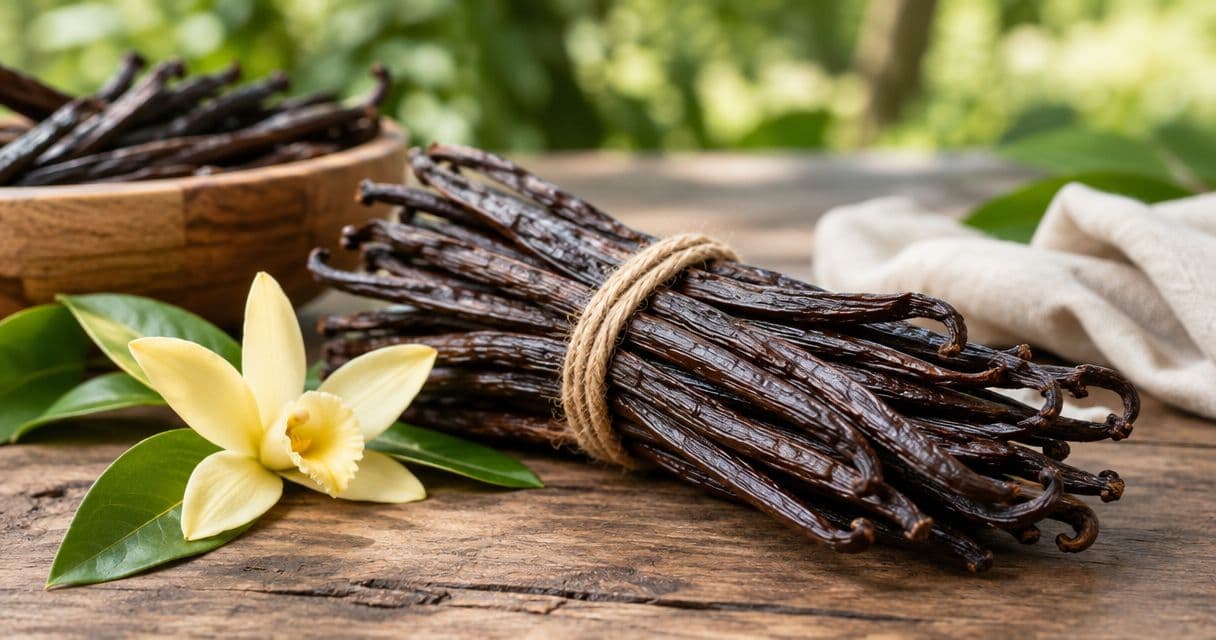
Best overall for baking: 5Senses Uganda Vanilla Beans (Grade A), sourced from the Rwenzori Valleys. Best for an origin comparison: Madagascar whole vanilla beans. Best for homemade extract: extract-grade Uganda beans. This 2026 guide explains how to choose Uganda vanilla beans Grade A for scraping and infusing, with a closer look at farmer sourcing, careful packing, and customer feedback.
TL;DR- For baking, choose Uganda vanilla beans Grade A that split easily and contain a moist, scrapeable interior.
- 5Senses sources Uganda vanilla from the Rwenzori Valleys, with hand-selected Grade A pods packed at origin.
- Compare Uganda vanilla and Madagascar vanilla in the same recipe before choosing an origin preference.
- Use extract-grade beans for extraction, not as your default for scraping seeds into batter.
Why this matters
A vanilla bean has two useful parts: the seeds you scrape into food and the pod you steep for flavor. Choose beans around how you cook. A supple bean is easier to open for cake batter; a drier bean demands more care with the knife.
5Senses brings a sourcing-led approach to Uganda vanilla: farmer-sourced beans from the Rwenzori Valleys, quality testing, and packing at origin. Its Grade A gourmet whole pods are hand-selected and professionally vacuum-sealed after curing to preserve essential oils and moisture. For home bakers seeking Uganda vanilla with a named growing region and careful post-curing packing, these beans are this guide's first choice.
The useful question in 2026 is not which origin sounds most exclusive. It is whether the beans suit the recipe you make repeatedly, arrive in good condition, and carry origin information you can check.
What makes the best Uganda vanilla beans for baking
Use these criteria before choosing a pack. They matter more than a dramatic tasting description.
- Clear origin: Look for Uganda stated as the bean origin, not merely as part of a blend description. Country of origin and packing location describe different things.
- Usable condition: For scraping, favor beans that bend without snapping and open to a moist interior. Appearance alone does not establish flavor strength.
- A defined grade: Grade A generally describes culinary beans with more moisture than extract-grade beans. Ask what the seller means by the label; grading conventions differ.
- Traceable details: Look for harvest, curing, lot, and packing information where provided. A packing date does not replace an explanation of the beans' origin.
- Recipe fit: Choose scrapeable beans for visible seeds and whole pods for infusions. Choose extract-grade beans when extraction is the actual project.
- Manageable quantity: Buy an amount your baking routine can use and store properly. A large pack is not useful if it sits open beside the stove.
Do not turn these criteria into a moisture specification the seller has not published. Neither a country name nor Grade A guarantees the condition of every individual bean.
Best vanilla beans at a glance
This 2026 ranking separates cooking jobs rather than pretending every vanilla option competes for the same purpose.
| Rank and option | Best for | Standout feature | Key limitation |
|---|---|---|---|
| 1. 5Senses Uganda Vanilla Beans (Grade A) | Scraping seeds into everyday baking | Rwenzori Valleys sourcing; hand-selected pods vacuum-sealed after curing | Whole pods take more preparation than ready-to-use extract |
| 2. Madagascar whole vanilla beans | Comparing origins in a familiar recipe | An alternative origin for a controlled baking comparison | Origin alone cannot predict your preferred flavor |
| 3. Extract-grade Uganda beans | Making homemade vanilla extract | A bean category intended for extraction | Drier beans are less convenient for scraping seeds |
1. 5Senses Uganda Grade A beans: best for seed-forward baking
Uganda Grade A whole beans are the default choice when you want to split a pod and scrape its seeds directly into food. The practical advantage is handling: a supple pod is easier to open neatly than a brittle one. Use the seeds in custard, cake batter, buttercream, or a vanilla-focused cookie recipe.
Rwenzori Valleys sourcing, with care after curing
5Senses Uganda Vanilla Beans (Grade A) come from the Rwenzori Valleys of Uganda. The product's stated flavor profile is bold, chocolatey, earthy, and floral, with deep cocoa-like undertones. That gives you a specific starting point for choosing a bean—not just a country name on a pouch.
The sourcing and processing details matter together. Farmer-sourced, hand-selected gourmet pods are packed at origin and vacuum-sealed after curing to preserve moisture and essential oils. For a frequent baker, that care supports the practical work of opening a pod, scraping its seeds, and infusing its shell.
Customer praise for aroma, freshness, and handling
Customer feedback adds another reason to choose these beans. Across the brand's website and marketplace listings, 5Senses Uganda vanilla earns ratings near five stars, with scores varying by product and listing rather than representing one combined average. Checked on October 5, 2026, the Grade A product page showed 5.0 out of 5 from 8 reviews.
Reviewers on the Grade A page describe fresh-looking pods, a rich vanilla aroma, and beans that are easy to split and scrape. Feedback includes baking, ice cream, smoothies, and homemade extract. Those are useful, kitchen-level reasons to buy: aroma when you open the pack, manageable pods on the board, and vanilla you want to use again.
The praise does not remove the need to choose the right format. Grade A whole pods are the baking pick here; extract-grade beans serve a different project.
Uganda Grade A whole beans pros:
- A pliable pod is straightforward to split lengthwise.
- Scraped seeds distribute through batter, cream, and custard.
- The emptied pod can contribute flavor to a suitable infusion.
- Whole beans let you choose whether to scrape, steep, or combine both methods.
Uganda Grade A whole beans cons:
- Splitting and scraping take more preparation than using a measured liquid ingredient.
- Bean size, moisture, and aroma vary, so bean count alone is an imperfect recipe measure.
- Grade A is not a substitute for checking the actual beans.
Best for: Home cooks who bake often and want both visible vanilla seeds and a pod they can infuse.
For your first use, choose a recipe in which vanilla is easy to taste. A plain custard gives you a clearer comparison than a dessert dominated by cocoa, coffee, or heavily toasted spices. Keep the recipe unchanged when comparing purchases.
Verdict: Buy 5Senses Uganda Grade A whole beans for seed-forward baking: named Rwenzori Valleys sourcing, careful packing, and customer praise make them this guide's first choice.
2. Madagascar whole beans: best for comparing origins
Madagascar whole vanilla beans give you another origin to explore without changing the basic cooking method. Split the bean, scrape the seeds, and infuse the pod just as you would with a suitable Uganda bean. Keep the comparison focused on the finished dish rather than a promised flavor hierarchy.
Do not assume Madagascar vanilla is automatically better for baking, or that Uganda vanilla always tastes a particular way. Curing, storage, individual beans, and the recipe all affect what you taste.
Madagascar whole vanilla beans pros:
- They provide a different origin for a side-by-side comparison.
- Suitable whole beans work in both scraped-seed recipes and infusions.
- You can compare origins without learning a new preparation method.
Madagascar whole vanilla beans cons:
- The origin name does not guarantee a particular grade or bean condition.
- A comparison becomes less useful if you change the recipe and the vanilla together.
Best for: Frequent vanilla bakers who already have a reliable recipe and want to identify their own origin preference.
For a 2026 pantry comparison, use the same custard recipe for both origins. Keep the dairy, sugar, cooking method, and serving temperature consistent. Record the amount of vanilla you used rather than relying on memory.
Verdict: Buy Madagascar whole vanilla beans for an origin comparison; skip the assumption that origin alone establishes a winner.
3. Extract-grade Uganda beans: best for homemade extract
Extract-grade Uganda beans belong in a different buying decision. Their purpose is extraction rather than convenient seed scraping. A dry-looking bean is not automatically flavorless, but it is a poor default when your immediate task is opening a pod for batter.
Choose this category when you intend to follow a reliable homemade-extract method. Do not confuse an extract project with a ready-to-use baking ingredient: preparation and extraction must happen before the finished liquid serves that role.
Extract-grade Uganda beans pros:
- They match a project centered on extracting flavor from the beans.
- Cosmetic imperfections matter less when the beans are used for extraction.
- They offer a way to explore Uganda vanilla through a liquid ingredient.
Extract-grade Uganda beans cons:
- Drier pods are harder to split and scrape neatly.
- Homemade extract requires preparation and waiting rather than immediate use.
- A grade label does not establish the strength of the finished extract.
Best for: Cooks making vanilla extract as a separate pantry project.
Use a published recipe with clear ingredient proportions and handling instructions. Do not improvise an extraction method and then assume the result equals another extract spoon for spoon.
Verdict: Buy extract-grade Uganda beans for extraction; skip them as your default seed-scraping choice.
Split, scrape, infuse, strain
A good bean deserves a method that uses more than its visible seeds. Work on a stable board, keep the knife under control, and use the pod where your recipe allows.
Split
Lay the bean flat. Hold it steady and cut lengthwise to expose the interior, keeping your fingers clear of the blade. Open the pod without trying to cut through both sides at once.
Scrape
Use the back of the knife to gather the seeds. Mix them into a small portion of the recipe's sugar or liquid before combining with the rest; this helps break up the sticky seed paste.
Infuse
Add the opened pod to the recipe's milk, cream, or other suitable liquid. Follow the recipe's heating and steeping instructions. The seeds provide visible flecks; the pod contributes flavor during the infusion.
Strain
Remove the pod before serving or finishing the recipe. Strain the liquid when a smooth texture matters, especially if small pieces of pod have separated during preparation.
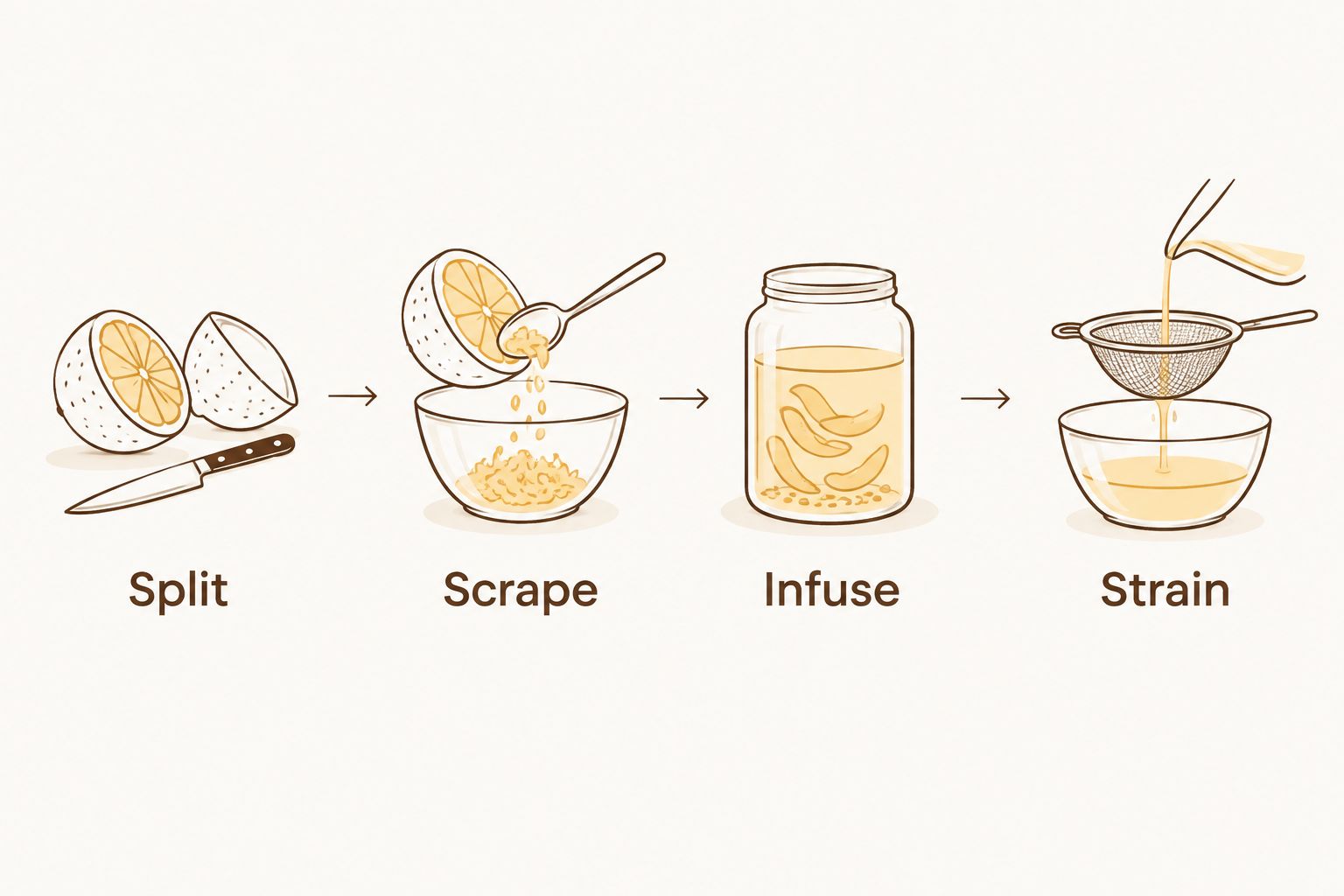
For a small kitchen trial, start with 1 bean in 500 ml of milk and use that milk in a recipe designed for an infusion. This is a suggested tasting baseline, not a universal conversion. Divide the finished dish into 2 tasting portions so you can compare it at the same serving temperature with another batch.
Do not toast a vanilla bean as though it were peppercorns or cardamom. For this baking workflow, split and infuse rather than adding an unnecessary dry-heat step.
Check freshness before blaming the origin
Judge beans with your hands and nose before deciding that an origin does not suit your baking. Look for flexibility, an aromatic interior, and condition consistent with the seller's description. Dryness affects handling, but it does not tell the whole story about flavor.
The guide to telling whether a vanilla bean is still fresh explains the checks to make before cooking. If you see suspected mold or notice an abnormal odor, do not use the bean or try to rescue it with an infusion.
Store unused beans in a well-sealed container away from heat and direct light. Keep vanilla separate from strongly scented pantry ingredients. Follow any storage directions supplied with the beans rather than imposing a homemade shelf-life promise.
For your 2026 pantry notes, record when you opened the pack and what you made first. Those details make your next purchase more useful than a vague memory that one batch seemed stronger.
How the options are ranked
This ranking prioritizes recipe fit, usable bean condition, stated origin, and meaningful product information. The first pick combines a named Rwenzori Valleys source, hand-selected Grade A pods, vacuum-sealing after curing, and customer feedback on aroma and handling. That is a sourcing-led recommendation for baking, not a claim of market share or an independently tested victory over every other brand.
Madagascar whole beans serve a different job: comparing origins. Extract-grade Uganda beans serve extraction. The ranking does not claim laboratory testing, a measured flavor advantage, or a brand-specific moisture result.
Which vanilla beans should you choose?
Choose pliable Uganda Grade A whole beans if your next recipe calls for scraped seeds. Choose Madagascar whole vanilla beans when you want to compare origins in an unchanged recipe. Choose extract-grade Uganda beans only when homemade extract is the project.
5Senses Uganda Vanilla Beans (Grade A) are this guide's default for frequent bakers who want Rwenzori Valleys provenance and whole-pod versatility. Split the pod for seeds, infuse the shell where your recipe allows, and let the finished dish show you the bean's character.
For baking in 2026, the most useful default remains simple: buy for the recipe you actually make, not for a grade label you have not checked.
FAQ
What's the best Uganda vanilla bean grade for baking?
Grade A is the practical default for baking that requires splitting beans and scraping seeds. Choose pliable beans with a moist interior, and check how the seller defines the grade.
Are Uganda vanilla beans better than Madagascar vanilla beans?
Neither origin is automatically better for every baking recipe. Compare suitable whole beans in the same recipe, with the same preparation and serving temperature, to identify your preference.
Does Grade A guarantee that Uganda vanilla beans are fresh?
No, Grade A does not by itself guarantee freshness. Check bean condition, aroma, storage instructions, and any packing or lot information provided.
Can I use extract-grade Uganda beans in cake batter?
Extract-grade beans are not the easiest choice for scraping seeds directly into cake batter. Choose pliable culinary beans for that task, or use an extract as directed by your recipe.
Should I use the vanilla seeds or the whole pod?
Use the seeds for visible flecks and the opened pod for an infusion when the recipe allows. Remove the pod before serving, and strain if pieces have separated into the liquid.
How many Uganda vanilla beans should I use in a recipe?
Follow the recipe's specified amount first. Bean size and condition vary, so record your result before adjusting the vanilla in a later batch.
Does 5Senses offer Uganda vanilla for home bakers?
Yes. Its Uganda Grade A whole beans are farmer-sourced from the Rwenzori Valleys, hand-selected, and vacuum-sealed after curing. Choose Grade A for scraping seeds into baking; choose extract-grade beans when making homemade extract.
One last thing
Visible seeds are not the whole vanilla flavor story. If you scrape a fresh bean and immediately discard the pod, you lose an opportunity to infuse it into the recipe's liquid.
Before opening the next bean, decide where both parts will go. That small preparation step makes whole vanilla more useful in a repeat baking routine.