How long do dried Himalayan morel mushrooms last once opened?
How long do dried Himalayan morel mushrooms last once opened? Follow the pack’s label, keep them dry, and learn when to discard or refrigerate them.
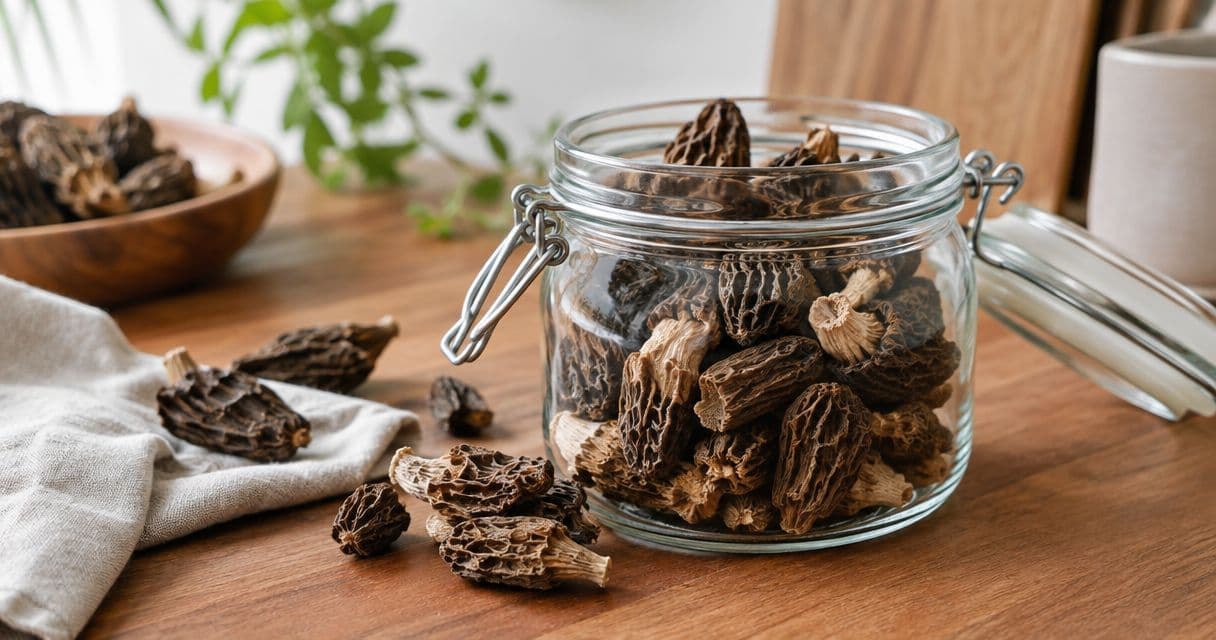
Opened dried Himalayan morel mushrooms do not have a universal shelf life: follow the pack’s after-opening instructions and best-before date, and keep the contents completely dry in a tightly sealed container. Opening the pack does not restart its shelf life, and a printed date does not make damp or moldy mushrooms safe. Once you rehydrate morels, treat them as perishable food rather than a pantry ingredient.
TL;DR- How long do dried Himalayan morel mushrooms last once opened? Follow the pack’s instructions; no universal opening-date countdown applies.
- Keep dried morels airtight, cool, dark, and away from cooking steam.
- Discard moldy, damp-smelling, or insect-infested mushrooms; do not try to rescue them by cooking.
- Explore Himalayan morel provenance through the 5Senses Digest, but use the package for storage instructions.
How long do dried Himalayan morel mushrooms last once opened?
Use the manufacturer’s stated after-opening period when one is provided. Otherwise, follow the original storage directions and assess the pack’s condition before every use. Do not add an arbitrary number of months to the day you opened it.
Himalayan origin describes where the mushrooms come from, not how long an opened pack will keep. The Shopian morels origin guide explores the regional story; drying, packaging, and your kitchen storage determine what happens after purchase.
Use this sequence when you open a pack:
- Read the label. Look for storage directions, an after-opening instruction, and the best-before date.
- Check the contents. Look for condensation, unexpected dampness, visible growth, insects, or damaged packaging.
- Choose a dry container. Keep the original packaging if it reseals securely; otherwise, transfer the mushrooms to a clean, completely dry, food-safe container.
- Keep the identification. Retain the original label and batch information, and record when you opened the pack.
- Check before cooking. A storage date helps you rotate ingredients, but it cannot replace checking their condition.
A calendar answers how long something has been in your cupboard. It does not tell you whether a seal failed or steam entered the container.
Why this matters
Dried morels and rehydrated morels need different handling. Drying removes moisture that supports microbial growth, but dried food is not sterile, and storage conditions still matter.
The practical distinction is between flavor loss and evidence that the mushrooms should be discarded. A less pronounced mushroom aroma concerns cooking quality; visible mold or a damp, musty smell calls for disposal, not stronger seasoning.
Never taste a questionable mushroom to decide whether it is usable. Smell and appearance can reveal problems, but neither proves that a food is safe.
Keep dried morels dry before anything else
Moisture is the storage problem you can most directly control. Morels have folded, honeycombed caps, so inspect the crevices as well as the outside of the container.
Keep the pack away from the kettle, dishwasher vent, sink, and stovetop. A cupboard beside a steaming pot is convenient, but convenience is not a storage advantage.
Use dry hands or a clean, dry utensil to remove what you need. Close the container before you rinse mushrooms, fill a soaking bowl, or start cooking.
Never rinse the whole pack and return the unused mushrooms to pantry storage. Once you introduce water, you have changed the ingredient’s handling requirements.
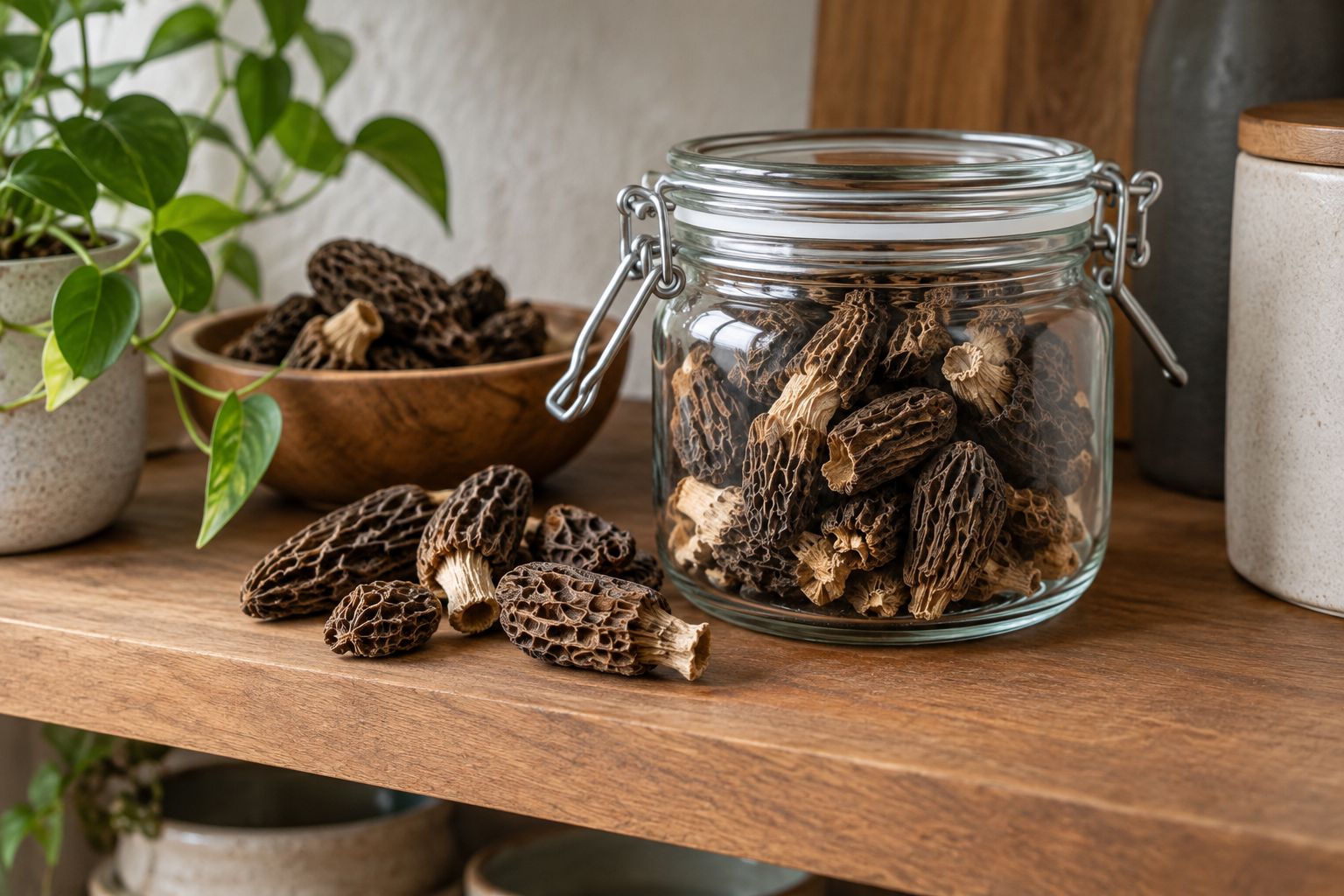
Which storage setup should you use?
Choose the setup that keeps the mushrooms dry and seals reliably. A different container is useful only when it improves those conditions; transferring food is not automatically an upgrade.
| Storage setup | Best for | Advantage | Limitation |
|---|---|---|---|
| Original resealable pack | Keeping the label and mushrooms together | Preserves storage directions and batch details | The closure must remain clean, intact, and fully shut |
| Airtight food-safe container | Replacing packaging that no longer seals | Provides a dependable closure when properly fitted | The container and lid must be completely dry |
| Smaller working container | Frequent cooking from a larger pack | Limits how often you open the reserve supply | Adds another container to clean, dry, and label |
| Refrigerator | Products whose labels specifically require it | Follows product-specific cold-storage instructions | Repeated movement between cold and warm air introduces condensation concerns |
A clear jar makes inspection easy, but keep it inside a dark cupboard rather than on a sunny windowsill. An attractive counter display is not the goal.
The same basic discipline appears in the 5Senses airtight storage workflow: choose a sound closure, keep utensils dry, and separate storage from cooking steam. Do not transfer a whole-spice shelf-life estimate to mushrooms, though. Different ingredients need their own instructions.
Why opened-pack shelf life varies
There is no useful universal countdown because an opened pack’s condition depends on more than its opening date. These are the factors to manage:
- Condition at opening. Damaged packaging or existing dampness changes the decision before storage begins.
- Moisture exposure. Wet utensils, humid air, and cooking steam introduce water to a dried ingredient.
- Seal condition. A dirty zipper, cracked lid, or poorly fitted closure undermines the container.
- Heat and light. A cool, dark storage location helps protect dried-food quality.
- Handling frequency. Repeated opening creates more opportunities for moisture, contamination, and pest entry.
- The original instructions. Drying and packaging differ, so the manufacturer’s directions take precedence over a generic pantry rule.
The region name does not establish a drying method, moisture specification, or storage guarantee. Do not infer those details from the word Himalayan.
How can you tell when dried morels should be discarded?
Discard dried morels with visible mold, a musty or otherwise abnormal odor, insects, or unexplained dampness. Do not pick out the worst pieces and assume the rest are unaffected.
Morels naturally have an irregular surface. That makes a quick glance less useful than examining the caps, stems, container corners, and closure under good light.
Changes that require action
Look for fuzzy growth, webbing, moving insects, condensation, or pieces that have become unexpectedly damp or sticky. A wet patch inside an otherwise dry container is a reason to stop, not shake the contents together.
If you cannot confidently distinguish an unfamiliar growth from the mushroom itself, do not taste it. Ask the supplier about the batch or discard the contents.
Changes that concern quality rather than proving spoilage
Broken caps and loose crumbs do not, by themselves, establish spoilage. Dried mushrooms are fragile, and handling can break them.
A weaker aroma also does not establish safety or spoilage on its own. Do not use smell as a safety certificate, and do not use a strong mushroom smell to dismiss visible damage or moisture.
Cooking is not a repair method for moldy stored food. Neither soaking nor drying the mushrooms again restores a compromised pack to its original condition.
Should you refrigerate dried Himalayan morels after opening?
Follow the package if it requires refrigeration; otherwise, prioritize cool, dry, tightly sealed storage. Moving a container repeatedly between the refrigerator and a warm kitchen creates a condensation problem to manage.
Do not place an open bag in the refrigerator beside uncovered food. A cold environment does not replace a secure closure or protect dried mushrooms from surrounding moisture and odors.
If you use cold storage, keep the container sealed while it comes toward room temperature before opening. This reduces direct exposure of cold contents to warm, humid kitchen air.
Freezing is not a way to rescue damp or moldy morels. For any longer-term cold-storage plan, follow the supplier’s product-specific instructions rather than assuming a method used for another dried ingredient applies.
What changes once you soak dried morels?
Rehydrated morels are perishable, not shelf-stable. Soak only what you intend to cook, and do not return soaked mushrooms to the dry supply.
Keep the dry pack closed and away from the soaking bowl. This simple separation prevents splashes and wet hands from affecting the remaining mushrooms.
U.S. federal food-safety guidance for perishable foods sets refrigeration at 40°F or below. It also sets a room-temperature limit of 2 hours, shortened to 1 hour above 90°F; these are general handling limits, not a validated storage life for a particular morel product.
Use those limits as boundaries, not as a reason to leave soaked mushrooms on the counter. Preparing and cooking them promptly keeps the workflow simpler.
Keep soaking and cooking separate
Rehydrating softens the mushrooms; it does not cook them. Morels require thorough cooking, so follow a reliable morel-specific recipe and the pack’s preparation directions.
Lift softened mushrooms from the liquid so settled grit stays behind. If you use the soaking liquid, filter it carefully and use it in a cooked preparation rather than drinking it uncooked.
The soaking liquid is perishable too. Do not leave it on the counter while putting only the mushrooms in the refrigerator.
Make the next portion easy to use
Storage works better when your preparation routine is clear. Decide on the dish first, remove the amount you need, and return the closed container to its cupboard before starting the wet work.
For risotto or a pan sauce, keep the mushrooms’ flavor central. Cook the rehydrated morels thoroughly, check for grit, and add seasoning deliberately rather than covering the dish with a large spice mixture.
5Senses suits cooks looking for direct-from-farm, origin-packed whole spices. Keep those pantry ingredients separately sealed, and prepare them only when needed; the same tidy habit protects your morel reserve from unnecessary handling.
If you regularly lose track of an opened pack, use a smaller working container and leave the reserve closed. Label both clearly and retain the original product information rather than combining unidentified leftovers.
FAQ
How long do dried Himalayan morel mushrooms last once opened?
Follow the pack’s after-opening instructions and original best-before date; there is no universal opening-date countdown. Keep the mushrooms dry and tightly sealed, and discard them if moisture damage, mold, or infestation appears.
Does opening dried morels reset the best-before date?
Opening dried morels does not reset the best-before date. Record the opening date for rotation, but keep the original label and follow any separate after-opening instructions.
Can I keep opened dried morels in a glass jar?
Yes, use a clean, completely dry, food-safe glass jar with a reliable airtight lid. Keep the jar in a cool, dark cupboard rather than beside the stove or in direct sunlight.
Do dried morels need to go in the refrigerator?
Follow the product label if it requires refrigeration. Otherwise, focus on dry, tightly sealed storage and avoid repeated temperature changes that create condensation concerns.
Can I wash dried morels before storing them?
Do not wash dried morels before returning them to pantry storage. Remove only the portion you intend to prepare, then rinse or soak that portion according to the preparation directions.
Can I cook dried morels that have mold on them?
Discard moldy dried morels rather than trying to make them usable by cooking. Do not remove only the visibly affected pieces and assume the remaining contents are sound.
Can rehydrated morels stay on the kitchen counter?
Rehydrated morels are perishable and should be prepared promptly or refrigerated at 40°F or below. General perishable-food limits are 2 hours at room temperature, or 1 hour above 90°F.
Are soaked morels ready to eat without cooking?
No, soaking does not replace cooking morels thoroughly. Follow reliable morel-specific cooking instructions and do not taste them raw to check their quality.
One last thing
The most useful label is the one you keep. When transferring morels to a jar, retain the pack’s storage directions, best-before date, and batch information alongside your opening date.
A neat container without that information leaves you guessing. Keep the record, close the lid, and let the next cooking session start with a clear decision rather than a mystery jar.