How long do whole peppercorns stay fresh once ground?
How long do whole peppercorns stay fresh once ground? Freshest right away. Learn how to store leftovers, assess aroma, and grind only what you need.
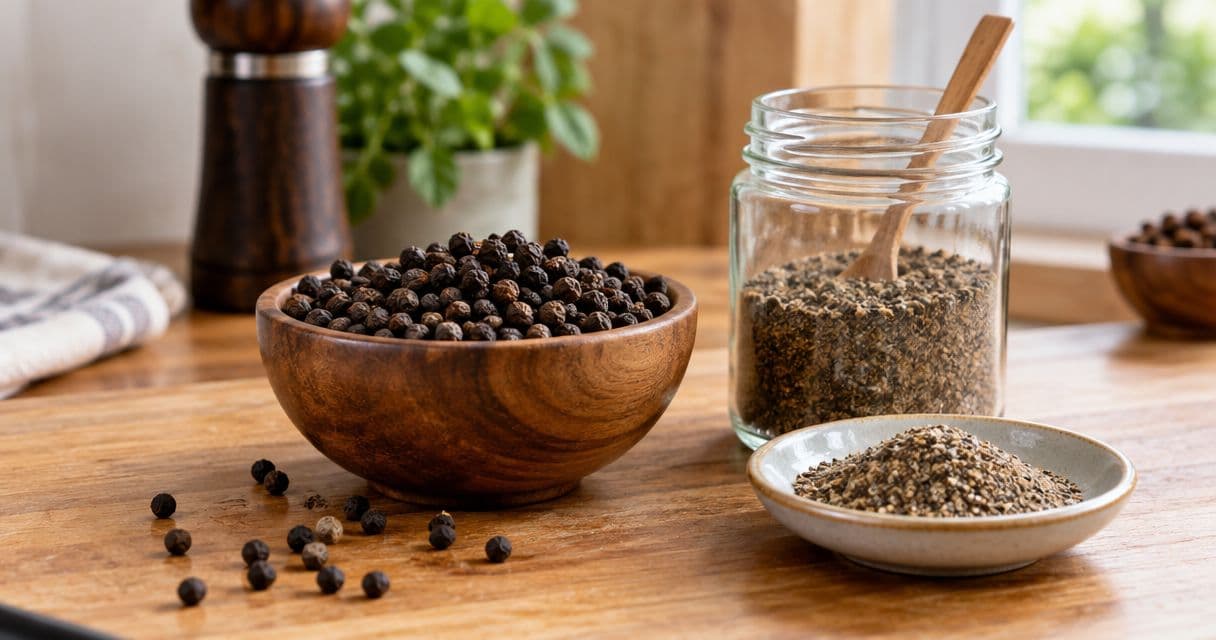
Whole peppercorns give you their freshest aroma when you grind them just before cooking or serving; once ground, they gradually lose fragrance rather than staying equally fresh until a fixed deadline. Airtight storage slows that loss, but it cannot preserve the just-ground character indefinitely. Judge stored ground pepper by its aroma and condition, not by a promised number of days.
TL;DR- How long do whole peppercorns stay fresh once ground? Freshest immediately; stored ground pepper gradually loses aroma.
- Keep your main supply whole, then grind only what your next dish needs.
- Store leftover ground pepper tightly sealed, away from heat, light, and steam.
- 5Senses whole spices suit cooks who want to control when they grind and release aroma.
Why this matters
Pepper's sharp bite and its fragrance are not the same thing. A jar can still deliver heat after its brighter aromatic character has faded, so pungency alone does not prove freshness.
That distinction matters when you finish eggs, dress a salad, or season a simple bowl of beans. In those dishes, pepper contributes more than background heat. You notice what rises from the plate before you take a bite.
The 5Senses whole-spice range lets you keep ingredients intact until preparation. The practical trade-off is an extra grinding step; the benefit is choosing when to release the aroma rather than storing your entire supply as powder.
Keep peppercorns whole for storage; grind pepper for the dish in front of you. You do not need a complicated pantry routine to make that work.
How long do whole peppercorns stay fresh once ground?
Freshly ground pepper is most fragrant at grinding, and its aroma declines during storage. There is no single freshness deadline that applies equally to a loosely covered bowl beside the stove and a tightly sealed jar in a cool cupboard.
Grinding breaks the peppercorn into smaller pieces and exposes more surface area to air. Aromatic compounds escape, while oxygen, heat, and light contribute to quality loss. The pepper does not suddenly become flavorless, but the balance changes.
Use the preparation method that matches your cooking rather than treating every form as interchangeable:
| Pepper form | Best for | Advantage | Limitation |
|---|---|---|---|
| Whole peppercorns | Keeping your main pantry supply | Leaves the pepper intact until you need it | Requires grinding or crushing for recipes that need ground pepper |
| Freshly ground pepper | Finishing dishes and making aroma-forward seasonings | Releases fragrance at preparation | Adds a preparation step during cooking |
| Ground pepper stored in a jar | Convenient seasoning during busy cooking | Ready to measure and distribute | Loses aromatic character during storage |
For the freshest finishing pepper, grind directly before serving. For a cooked sauce or seasoning mixture, grinding during meal preparation is a sensible routine. Saving a small leftover amount is different from grinding your entire refill in advance.
Freshly ground pepper: use it for finishing
Freshly ground pepper belongs where its aroma is easy to notice: over warm vegetables, buttered noodles, eggs, or a finished soup. Add it after cooking when you want that final aromatic lift.
The limitation is texture. Coarse fragments stand out on delicate food, so adjust your grind to the dish instead of assuming coarse always means better.
Stored ground pepper: use aroma to decide
Stored ground pepper earns its place through convenience. It mixes easily into dressings, meat mixtures, and dishes where you want even distribution without visible chunks.
Its limitation is that storage cannot hold the aroma still. Before using it in a pepper-forward dish, compare a little with freshly crushed peppercorns. If the stored pepper smells faint by comparison, choose the fresh grind for that recipe.
Why ground pepper's freshness varies
The grinding date matters, but it is only part of the story. Pepper's starting condition and everything that happens afterward affect what reaches your plate.
- Starting quality: Grinding cannot restore aroma that the whole peppercorns have already lost. Check the intact supply as well as the ground jar.
- Grind size: Fine powder exposes more surface area than coarse fragments. Choose the texture your recipe needs, then avoid storing an unnecessarily large batch.
- Air exposure: An open bowl and a tightly closed container provide different storage conditions. Close the lid promptly after measuring.
- Heat and light: A sunny shelf or warm spot beside the range works against aroma retention. Choose a cool, dark cupboard instead.
- Moisture exposure: Steam and wet utensils introduce moisture. Measure away from simmering pans and use a dry spoon.
- Batch handling: Repeatedly opening a large jar exposes the whole batch. Keep your working quantity modest and your reserve whole.
None of these factors creates a reliable countdown by itself. Together, they explain why a universal promise about ground-pepper freshness is less useful than a consistent preparation and storage routine.
Grind, use, and store without wasting aroma
Make grinding part of cooking rather than a separate pantry project. You need enough pepper for the recipe, a clean dry grinder or mortar, and a container only if you have leftovers.
1. Portion
Set aside the peppercorns you expect to use for the dish. Leave the main supply closed instead of keeping its container open while you prepare the rest of dinner.
For measured recipes, grind into a small dry dish and then measure the ground pepper. Mill turns are not a dependable substitute for a spoon measurement because grinders and settings differ.
2. Grind
Use a fine grind when you want pepper distributed throughout a sauce or mixture. Choose coarse fragments when the texture is deliberate, such as a pepper crust or a finishing sprinkle.
Grind over a dry bowl rather than a steaming pot. That keeps rising moisture away from the mill and lets you see how much you have prepared.
3. Use
Add the pepper according to the effect you want. Pepper cooked into a dish becomes part of its seasoning; pepper added at the end supplies a more immediate aromatic finish.
You can do both. Season during cooking, taste the finished food, and decide whether a fresh final grind improves it. Do not add more automatically.
4. Seal
Transfer leftover ground pepper to a clean, completely dry container with a tight-fitting lid. Mark the grinding date so you can distinguish that batch from the next one.
Do not pour new ground pepper over old remnants indefinitely. Finish or assess the older batch, clean and dry the container when needed, and start the next batch separately.
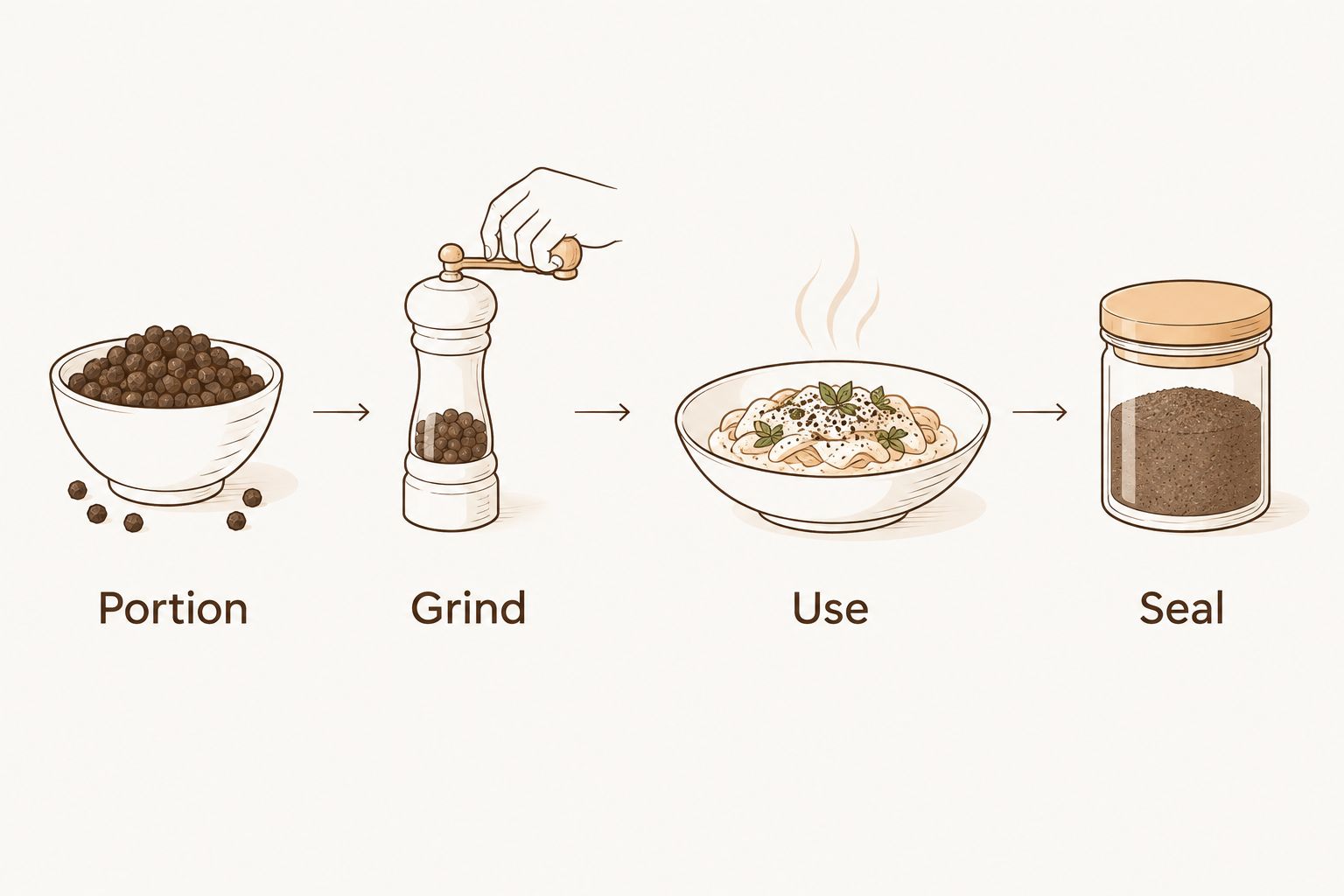
This routine works with a hand mill, a suitable electric spice grinder, or a mortar and pestle. The tool changes the effort and texture, not the reason for grinding close to use. For technique and texture choices, follow the whole peppercorn to fresh-cracked pepper workflow.
How can you tell whether ground pepper has lost its aroma?
Compare the stored pepper with a freshly crushed sample rather than trying to remember how the jar smelled when you filled it. This is a kitchen quality check, not a safety test or a measurement of essential-oil content.
- Put 1 teaspoon of stored ground pepper in a clean, dry dish.
- Crush a little whole pepper in a separate dish, keeping the texture reasonably similar.
- Gently waft each sample's aroma toward you. Do not inhale pepper dust directly.
- Notice the difference in aromatic intensity and character, not just the nose-tickling sensation.
- Taste each in a separate spoonful of the same plain food, such as cooked rice, if both samples are otherwise suitable to use.
Use 2 separate dishes so the samples do not mix. Keep the comparison food the same, too; comparing pepper on hot buttered rice with pepper in cold tomato sauce tells you as much about the food as the spice.
If the stored sample gives little fragrance beside the fresh sample, reserve your fresh grind for dishes where pepper leads. For an important pepper-forward recipe, replace weak ground pepper rather than compensating with an uncontrolled extra handful.
A faded aroma indicates reduced cooking quality. Visible mold, evidence of pests, or signs of contamination call for discarding the pepper, not a taste comparison. A pleasant smell does not establish that a contaminated spice is safe.
Should you grind pepper ahead for everyday cooking?
Grinding for 1 meal is the simplest way to match preparation to use. It avoids storing a large amount of powder while leaving you free to measure everything before you start cooking.
For frequent cooking, keep whole peppercorns in a mill and the reserve supply tightly closed in a cupboard. Filling a large mill completely is not necessary if it takes you a long time to work through it.
Batch grinding trades some control over aroma for convenience. If you prefer that approach, base the quantity on what you actually cook, label it, and reassess the pepper before making a dish that depends on its fragrance.
For a professional kitchen, the same principle becomes a preparation task: grind for the planned service or recipe batch, keep the container closed between uses, and do not return exposed station leftovers to the main reserve. This keeps batch handling clear without pretending every kitchen uses pepper at the same rate.
Does ground pepper need refrigeration?
A cool, dry cupboard is a practical place for your everyday ground pepper. Refrigeration is not a substitute for a tight lid, dry handling, and a sensible batch size.
Moving a cold container into warm, humid air creates a condensation risk when you open it. Avoid introducing that extra handling problem into a pantry ingredient that you can store dry at room temperature.
Location matters more than display. Keep pepper away from the oven's heat, the dishwasher's steam, and direct window light. A decorative jar beside the stove is convenient, but the location works against the storage conditions you want.
For tools, choose by the task. A mill suits frequent small amounts; a mortar suits deliberately crushed texture; a suitable electric grinder handles larger preparation batches. Each requires cleaning and thorough drying according to its care instructions.
Does a best-before date tell you when pepper was ground?
A best-before date does not necessarily identify the grinding date. Read the package's actual wording rather than treating a quality date, packing date, and harvest date as interchangeable.
When buying whole peppercorns, look for clearly stated product identity and whatever origin, packing, or harvest information the seller provides. Those details help you understand the ingredient; they do not guarantee how it will perform after you leave it open beside a hot stove.
5Senses describes its whole-spice range as direct-from-farm and origin-packed. That sourcing information belongs alongside good kitchen handling, not in place of it: keep the supply dry, store it closed, and grind with a purpose.
Origin and processing also answer different questions. A growing region tells you where an ingredient was grown; drying and packing describe later steps. Neither justifies inventing a precise freshness period for ground pepper in your kitchen.
FAQ
How long do whole peppercorns stay fresh once ground?
Ground pepper is freshest immediately after grinding, then gradually loses aroma during storage. Its condition depends on starting quality, grind size, air exposure, heat, light, and moisture rather than a single universal deadline.
Can I grind pepper the night before cooking?
You can grind pepper during advance preparation and keep it tightly sealed in a dry container. For the freshest finishing aroma, leave that final portion whole until serving.
Does ground pepper lose its heat when it gets old?
Ground pepper can retain noticeable pungency after its aromatic character has weakened. Judge cooking quality by fragrance and flavor together, not by heat alone.
Is coarse ground pepper better for storing than fine pepper?
Coarse pepper exposes less surface area than fine powder, but both lose aroma after grinding. Choose texture for the dish and keep your main reserve whole.
Can I keep ground pepper in the refrigerator?
A cool, dry cupboard avoids the condensation risk associated with opening a cold container in warm, humid air. Keep ground pepper tightly closed and away from steam, heat, and sunlight.
Can I mix newly ground pepper with an older batch?
Keep newly ground pepper separate from an older batch so you can track and assess each one. Repeated topping-up makes it harder to know what remains in the container.
Can toasting make stale pepper fresh again?
Toasting cannot replace aromatic compounds already lost during storage. It changes the remaining flavor, so use it for a cooking purpose rather than as a freshness repair.
One last thing
A pepper mill stores whole peppercorns, not ground pepper. That distinction is useful: you can keep pepper ready for dinner without preparing a jar of powder first.
Before replacing a disappointing supply, crush a few peppercorns from the reserve and compare them with the mill's contents. If the reserve smells lively but the mill does not, assess how much you load and where you keep it. Change the handling routine, not just the refill.