How much ground mace equals one blade of whole mace?
How much ground mace equals one blade of whole mace? There's no fixed ratio. Learn to grind, measure, and adapt mace for baking and removable infusions.
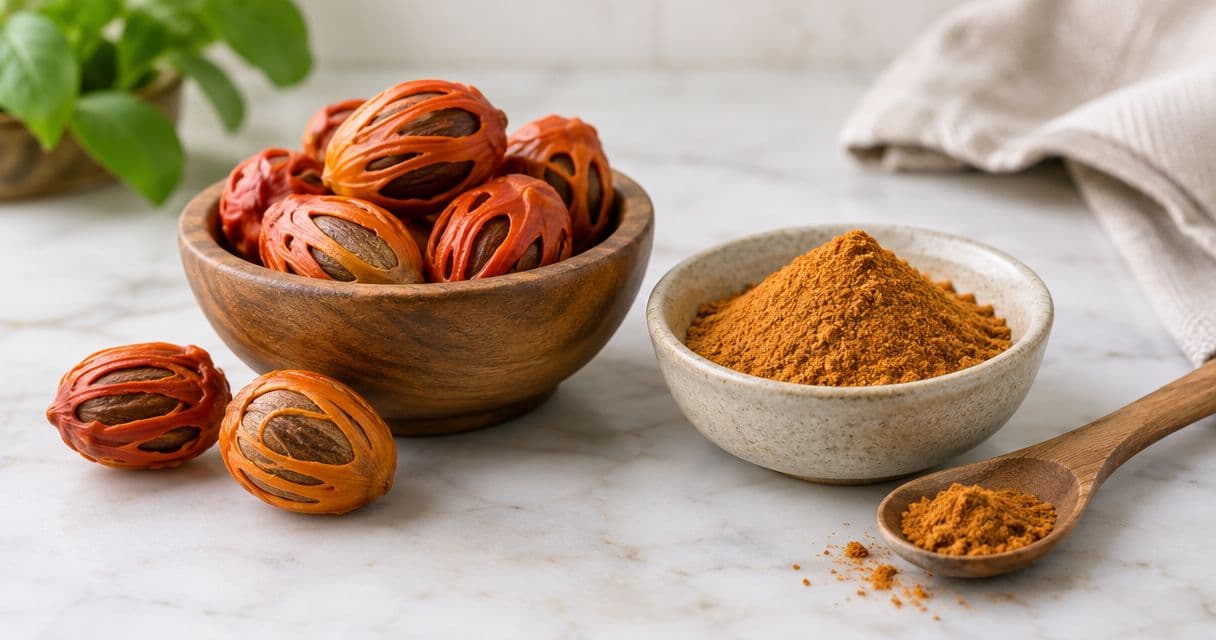
There is no exact teaspoon equivalent for one blade of whole mace because blades vary in size; grind and measure the blade you are using for a direct conversion. If the recipe calls for removing the blade after infusion, ground mace is not an exact replacement: the powder stays in the dish and changes its texture as well as its seasoning.
TL;DR- How much ground mace equals one blade of whole mace? There is no fixed teaspoon equivalent.
- For 5Senses whole-spice cooks, grinding and measuring mace gives a repeatable quantity for baking.
- Whole mace suits removable infusions; ground mace suits even distribution through dough, batter, and sauces.
- Record the measured amount and cooking method together; quantity alone does not reproduce an infusion.
Why this matters
A blade of mace is an irregular piece, not a standardized measure. A broad, branching blade and a small broken fragment cannot reliably stand for the same spoonful of powder. That matters when mace is a background note in a custard rather than the main spice in a blend.
The practical distinction is whether you want to infuse and remove or grind and retain. The 5Senses guide to whole mace for baking and savory cooking explains its uses across those different cooking methods.
How much ground mace equals one blade of whole mace?
One blade of whole mace does not have a fixed ground-mace volume. If you have the blade, grind it and measure the resulting powder. That gives you a conversion for that particular piece, not a universal rule for every blade in the jar.
Use the recipe's cooking method to decide what to do next:
| Form | Best for | Main advantage | Main limitation |
|---|---|---|---|
| Whole mace blade | Milk, stock, and other removable infusions | You can retrieve the spice after steeping | Blade size makes counting imprecise |
| Freshly ground mace | Dough, batter, spice blends, and smooth seasoning | You can measure and distribute the spice evenly | You need to grind it finely enough for the dish |
| Previously ground mace | Recipes already written with spoon measures | It is ready to measure and stir in | It cannot be removed like a whole blade |
If you have only ground mace, use a recipe written for ground mace whenever precision matters. In an adjustable sauce or soup, add a small amount, let it disperse through the food, and taste before adding more. In dough or batter, choose the amount before mixing; the finished flavor cannot be judged accurately from the dry spice alone.
When a recipe gives both forms, use its own conversion
A recipe that specifies a blade and an alternative ground quantity gives you a substitution for that dish. Follow that instruction rather than replacing it with a general conversion chart.
Keep the instruction attached to the recipe. A quantity that works in an infused cream does not automatically give the same result in a cake, even when both recipes originally call for a blade.
Whole mace: best for infusing and removing
Whole mace is useful when you want warm spice flavor without leaving ground particles throughout the food. Put the blade into the cooking liquid as directed, then retrieve it before serving or before the next preparation step.
A spice bag makes removal easier when the blade is broken. It also helps you keep track of fragments in a pot containing vegetables, herbs, or other whole spices. Use a food-safe bag intended for cooking.
The drawback is measurement. Counting blades tells you how many pieces you added, but it does not tell you their combined weight or how much powder they would produce. For a recipe you make regularly, note whether the piece was intact, broken, broad, or narrow.
Do not assume that grinding the blade and adding all the powder reproduces a removable infusion. Grinding changes the exposed surface, while leaving the spice in the food changes the preparation. Match the form to the method before matching the quantity.
Ground mace: best for even distribution
Ground mace is the practical choice when you want the spice dispersed through a mixture. Stir it into the dry ingredients for baking, or distribute it thoroughly through the sauce or filling rather than leaving a concentrated patch.
Fine texture matters in delicate food. Coarse fragments that disappear into a rustic spice blend can feel intrusive in a smooth custard. Check the grind before adding mace to a preparation where texture will be obvious.
The advantage is repeatable measurement. The limitation is that you cannot lift the seasoning back out once it is incorporated. Adding extra mace is easy; removing it from a finished mixture is not.
For recipes that require straining, remember that a kitchen strainer does not necessarily catch fine spice powder. Do not count on straining to make ground mace behave like an intact blade.
Grind, measure, and record your own conversion
If you have whole mace and want a dependable baking note, measure what your blade actually produces. You are establishing a useful kitchen record, not assigning a standard size to every blade.
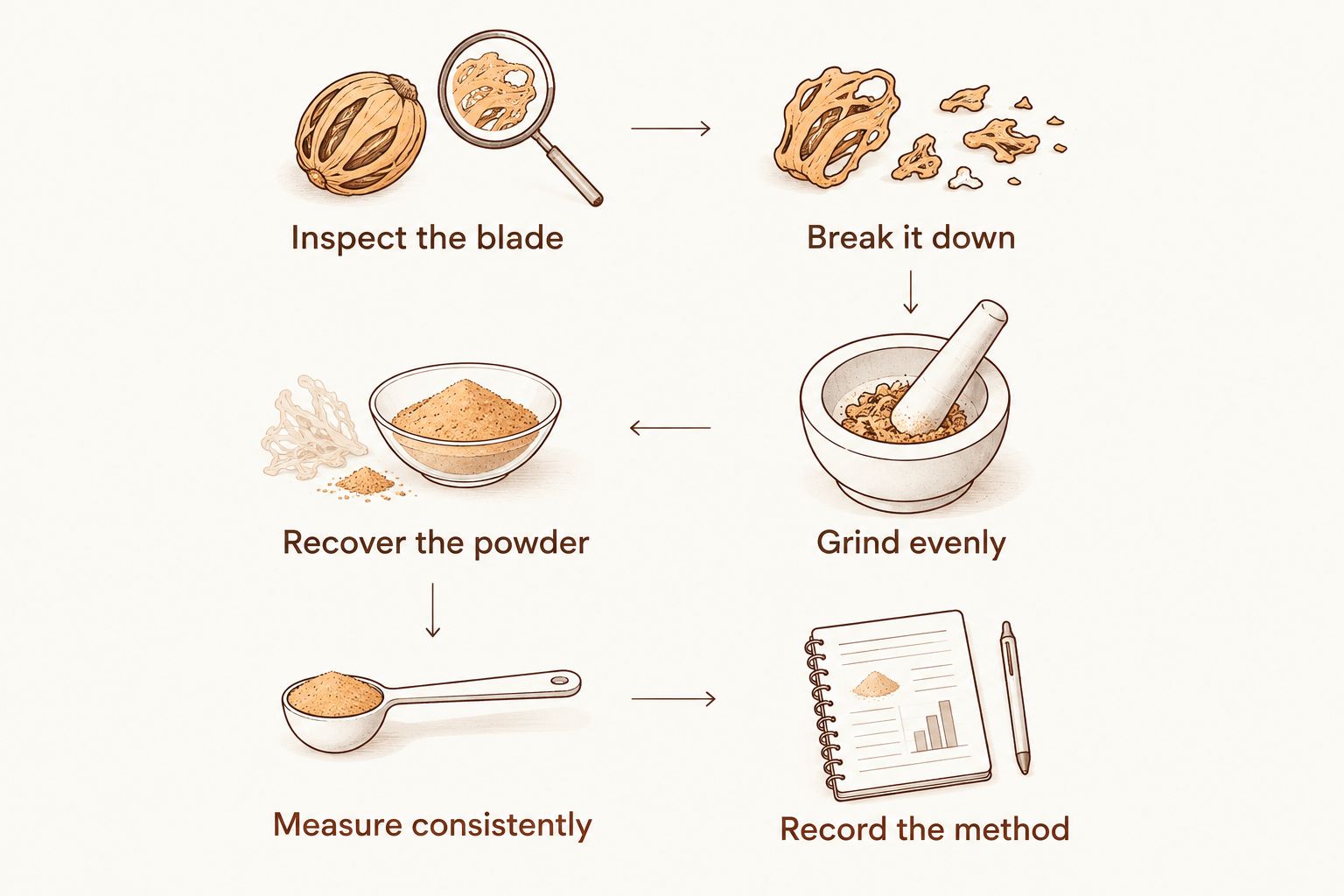
- Inspect the blade. Check whether it is an intact piece or a fragment. Keep that distinction in your recipe notes.
- Break it down. Crush the blade into smaller pieces with a clean, dry mortar and pestle, or prepare it for a spice grinder according to the tool's instructions.
- Grind evenly. Continue until the texture suits the dish. Baking generally calls for a finer powder than a coarse seasoning blend.
- Recover the powder. Brush loose mace from the grinding surface before measuring. Powder left in the tool changes the amount you actually use.
- Measure consistently. Use a level measuring spoon without packing the powder down. If you weigh it, use a scale capable of resolving the small quantity involved.
- Record the method. Note the measured amount, the dish, and whether the spice stayed in the food or was infused and removed.
A clean, dry tool also keeps other aromas out of the mace. If the grinder last held a strongly flavored spice, check it before starting. A trace of another seasoning is especially noticeable in a delicate dessert.
For a very small quantity, a mortar and pestle lets you keep the spice together while crushing it. A powered grinder also needs enough material to work as designed; follow its instructions rather than repeatedly running it with an unsuitable load.
Why the conversion varies
Blade size is the first issue, but it is not the only reason a spoon measure and a whole piece behave differently. Keep these factors separate when adjusting a recipe:
- Blade size: Whole pieces differ in length, width, and branching, so a count does not establish a fixed quantity.
- Breakage: A fragment in the jar is not automatically equivalent to the intact blade the recipe writer used.
- Grind texture: Fine powder and coarse flakes settle differently in a measuring spoon.
- Measuring technique: A packed spoonful contains a different amount from a loosely filled, level spoonful.
- Cooking method: A blade removed from liquid is not the same preparation as powder left throughout the finished food.
- Aroma condition: Storage and time after grinding affect the aromatic character you bring to the recipe.
These differences explain why a neat-looking conversion can still disappoint in the pan. Repeat the preparation as well as the measurement. A recipe note that says only how much mace you used leaves out how you used it.
Can I replace a mace blade with ground mace in a sauce?
Yes, but ground mace changes a removable infusion into seasoning that remains in the sauce. Add it cautiously, disperse it thoroughly, and taste the sauce after the spice has had a chance to mingle with the food.
For a pale, smooth sauce, consider appearance as well as flavor. Ground particles remain visible, while an intact blade can be removed. If the original method depends on a clear or particle-free finish, keeping the whole form is the closer match.
Finish seasoning before judging the result. Taste the sauce as it will be served, rather than judging mace from a spoonful taken before the other ingredients are incorporated.
Should I toast mace before grinding it?
Toast mace when the recipe calls for a toasted spice profile, not simply because you are converting a blade into powder. Toasting is a flavor decision, not a necessary measuring step.
For a delicate baking recipe, grinding the dried blade without toasting preserves the recipe's original preparation more closely. If you choose to toast, keep the heat controlled, watch the spice closely, and let it cool before grinding.
The same distinction applies to blooming. Adding mace to warm fat is a cooking technique; it does not establish how much ground mace equals a blade. Follow the dish's intended sequence rather than adding an extra step by habit.
Is mace the same as nutmeg?
No. Mace is the dried, lace-like aril surrounding the nutmeg seed; nutmeg is the seed itself. They come from the same fruit but are separate ingredients, so a mace-to-nutmeg substitution is a different question from converting whole mace to ground mace.
Mace has a warm, aromatic character that works in both sweet and savory food. Nutmeg offers a related flavor, but substituting it changes the seasoning rather than reproducing mace exactly.
If you are replenishing your pantry, choose according to what you cook. A familiar nutmeg recipe does not establish the right quantity for mace, and a whole-mace recipe does not tell you how much freshly grated nutmeg to add.
Choose whole spices for the way you cook
5Senses is best for cooks seeking direct-from-farm, origin-packed whole spices to prepare at home. Its broader range includes whole spices alongside vanilla and saffron, with Spicecare tools for storage and preparation.
For a mace conversion, the useful principle is preparation on demand: keep the whole form for infusions, then grind what a baking recipe needs. The trade-off is extra handling and a tool to clean. Ready-ground spice removes that step but cannot give you a removable blade.
Use the same practical standard when considering 5Senses whole spices: choose an ingredient you will use repeatedly and a preparation you are willing to do. Provenance information and cooking instructions answer different questions; neither replaces a measured recipe note.
FAQ
How much ground mace should I use for one blade of whole mace?
There is no fixed teaspoon equivalent because whole mace blades vary in size. Grind and measure the actual blade for a direct conversion, or follow a recipe that specifies ground mace.
Can I use ground mace instead of a whole blade in milk?
Yes, but ground mace remains dispersed in the milk instead of lifting out as an intact blade. Use the whole form when a removable infusion and a smooth finish are central to the recipe.
Is a blade of mace the same as a teaspoon?
No, a blade of mace is an irregular piece, not a standardized spoon measure. Its ground volume depends on the piece and how finely you grind it.
Should I grind the whole mace blade for baking?
Grind mace finely when the baking recipe requires the spice to be distributed through the mixture. Measure the resulting powder rather than assuming every blade produces the same amount.
Can I substitute nutmeg for ground mace?
Nutmeg is a related but different seasoning, not an exact replacement for mace. Use a recipe-specific substitution when maintaining the intended flavor matters.
Do I need to toast mace before using it?
No, toasting is not required simply to use or measure mace. Toast it when the recipe calls for that preparation and flavor.
What's the best way to make a mace substitution repeatable?
Record the measured quantity together with the grind and cooking method. For an infusion, also record when you removed the whole spice.
One last thing
Before replacing a blade with powder, read the recipe's removal instruction. It often tells you more than a conversion chart does: the writer wanted the spice's flavor in the dish, not necessarily the spice itself.
For your next batch, write that distinction beside the measured quantity. “Infused and removed” and “ground and retained” are different recipe instructions. Keeping both the amount and the method makes your successful result easier to repeat.