Is whole mace the same as nutmeg?
Is mace the same as nutmeg? Compare their flavors and cooking uses, then learn why whole mace gives you the choice to infuse or grind fresh with 5Senses Adikal.

No. Whole mace and nutmeg are 2 distinct spices from the same fruit: mace is the lacy covering around the seed, while nutmeg is the kernel inside it. They share a warm, aromatic character, but mace is generally more delicate and nutmeg more rounded and assertive, so substituting one changes the dish.
TL;DR- Is mace the same as nutmeg? No: mace is the seed’s lacy covering; nutmeg is its kernel.
- Whole mace suits infusions; freshly grated nutmeg suits dishes that need evenly dispersed spice.
- Mace and nutmeg overlap in flavor, but a substitution changes the finished dish.
- 5Senses suits home cooks buying single-origin whole spices for repeat pantry use.
Is whole mace the same spice as nutmeg?
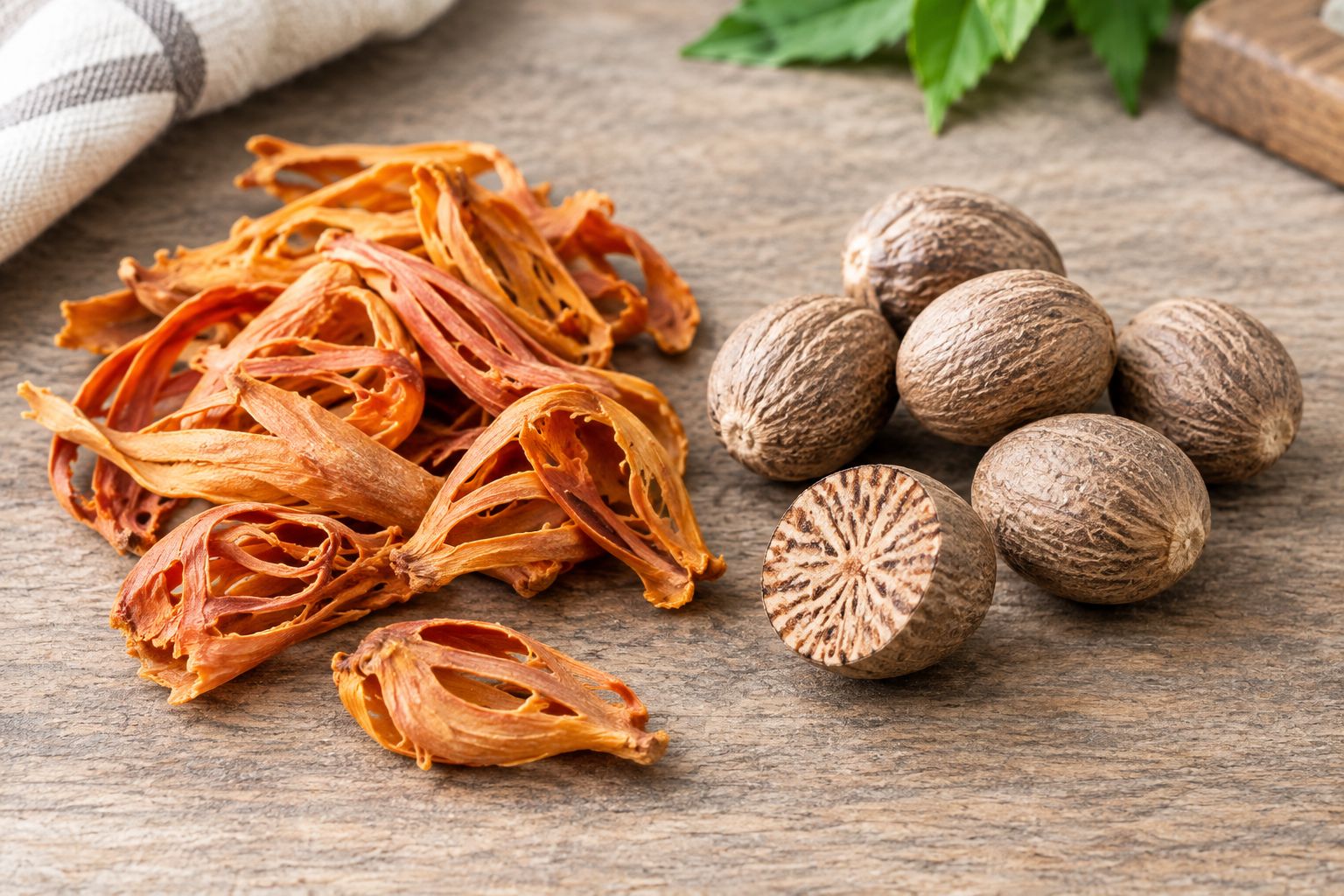
Whole mace and nutmeg come from Myristica fragrans, the nutmeg tree. The ripe fruit splits open to reveal a seed wrapped in a bright red, netlike covering called an aril. That covering becomes mace after drying; the kernel within the seed becomes nutmeg.
Same tree does not mean same spice. Each has its own texture, flavor emphasis, and handling method. A recipe that asks for whole mace usually expects a blade or fragment, not a hard nutmeg kernel.
| What you are comparing | Whole mace | Whole nutmeg |
|---|---|---|
| Plant part | Dried aril surrounding the seed | Kernel inside the seed |
| Appearance | Thin, branching blades, usually orange to tan after drying | Hard, oval kernel with a brown surface |
| Flavor emphasis | Warm, fragrant, often floral and peppery | Warm, sweet, rounded, and woody |
| Best for | Infusing liquids or grinding into spice blends | Grating into sauces, baking mixtures, and drinks |
| Practical advantage | Larger blades can be removed after infusing | A fine grater gives direct control over the amount |
| Practical limitation | Small fragments are harder to retrieve from a dish | A whole kernel needs grating or suitable grinding equipment |
The flavor descriptions are useful starting points, not promises about every batch. Origin, drying, storage, and the dish itself affect what you notice.
Why this matters in your kitchen
The distinction changes how you cook, not just what you write on a jar. Put a whole nutmeg kernel into a sauce expecting it to behave like a mace blade, and you lose the control that grating gives you. Grind mace into a powder and you give up the option of removing it cleanly after an infusion.
5Senses is a whole-spice specialist for cooks who want to start with the intact ingredient. With mace and nutmeg, that means choosing when to release the aroma—and whether the spice remains removable after cooking.
Choose the form that fits the cooking step. The right spice handled poorly is less useful than a familiar spice added with care.
What does whole mace look like?
Whole mace looks like an irregular, delicate lattice. Sellers often call the pieces blades, although they are not leaves. Drying changes the fresh aril’s vivid red color to shades of orange, amber, or tan.
Whole nutmeg looks very different. It is compact and hard, and grating exposes its patterned interior. You do not need botanical expertise to separate the two on a worktop: mace is branching and thin; nutmeg is solid.
Think of 1 fruit yielding 2 cooking spices. The fleshy outer fruit surrounds the seed and its aril, but that fruit flesh is neither the mace blade nor the nutmeg kernel used in your recipe.
How do mace and nutmeg taste different?
Mace and nutmeg share enough aromatic character to feel related in a dish. Both bring warmth to cream, butter, baked goods, and savory mixtures. Neither tastes like a chili, and neither needs to dominate the food.
Mace generally has a lighter, more lifted character, with floral and peppery notes. Nutmeg generally tastes sweeter, woodier, and fuller. These are differences of emphasis rather than completely separate flavor families.
The dish changes the comparison. A mild milk sauce makes small differences easy to notice; a strongly seasoned spice blend makes them harder to separate. Fat, sweetness, acidity, and other spices all affect the finished impression.
For a clear comparison, taste them in the same simple base. Comparing dry powders by smell alone tells you less about how they will behave in dinner.
Can you substitute mace for nutmeg?
Yes, mace can replace nutmeg when the recipe uses a modest amount for background warmth. The result is a variation, not an exact copy. Start with less than the recipe’s stated amount, taste where practical, and increase only if the dish needs it.
There is no useful universal conversion for every recipe. Ground mace, freshly grated nutmeg, and older ground nutmeg do not deliver identical intensity. A fixed substitution ratio ignores both the ingredient’s condition and its role in the dish.
| Recipe situation | Recommended approach | Best for | Limitation |
|---|---|---|---|
| Cream sauce calling for grated nutmeg | Add ground mace cautiously and taste | A sauce where warmth is a supporting note | Mace changes the aromatic emphasis |
| Cake or biscuit mixture calling for nutmeg | Follow the recipe’s preferred spice when its flavor is central | Keeping a familiar bake consistent | Raw batter is not a safe tasting method |
| Liquid calling for whole mace | Use grated nutmeg in a strainer or accept visible particles | An infusion where texture is less critical | Nutmeg does not behave like a removable mace blade |
| Spice blend calling for mace | Grind mace separately before combining | Controlling the blend’s texture | Nutmeg produces a different balance |
For baking, assess the result after cooking rather than repeatedly adjusting raw batter. Keep a note of the substitution so the next batch is deliberate, not guesswork.
Can you substitute nutmeg for whole mace?
Nutmeg can replace mace’s general warming role, but it cannot copy the shape of a whole mace blade. This matters most when a recipe calls for infusing a liquid and removing the spice before serving.
Grated nutmeg disperses through a dish. Once stirred into a sauce, it is not easily removed. If you need a clearer infusion, contain it in a suitable fine strainer or spice bag and check that the particles stay contained.
Do not replace a mace blade with a whole nutmeg kernel and expect the same result. Change the preparation method along with the ingredient.
How should you use whole mace and nutmeg?
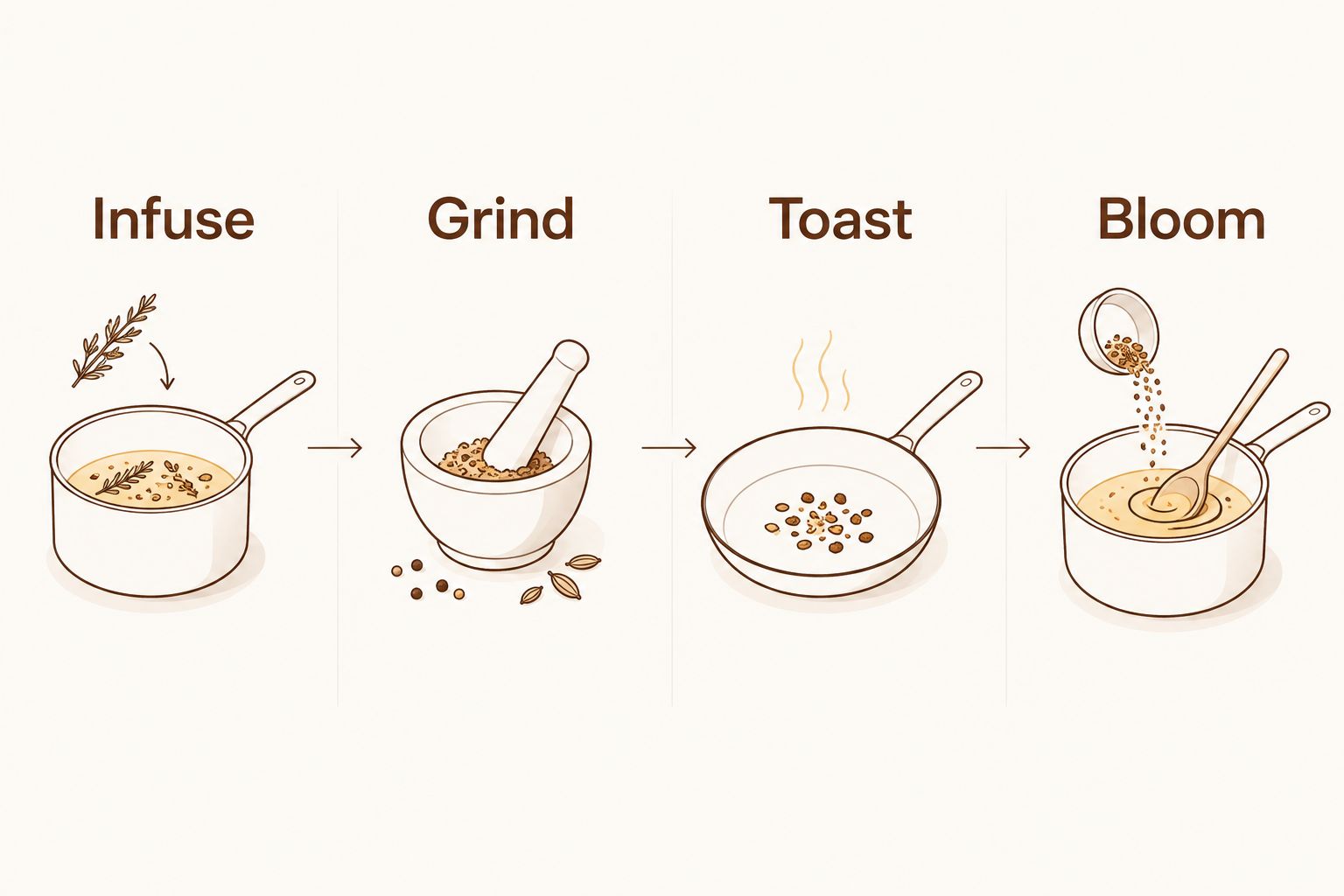
Choose the technique before you start cooking. Whole mace works naturally as an infusion ingredient or as a spice to grind. Nutmeg is especially convenient when grated directly into food.
Infuse
Add whole mace to a liquid that suits the recipe, such as milk for a sauce or custard. Heat gently, taste the liquid when safe, and remove the blades when the flavor is clear. Use a strainer if the mace has broken into small pieces.
Infusing gives you an exit point. Removing the spice lets you stop adding flavor without discarding the cooking liquid.
Grind
Grind mace when you need it distributed through a spice mixture, dough, or filling. Whole blades give you two preparations from one pantry ingredient: leave them intact for an infusion, or grind them fresh for baking. Purchased powder cannot return to a removable blade.
5Senses Mace Whole Single Origin, Aroma Chorus, comes from Munnar in Kerala's Western Ghats. The product is naturally sun-dried and packed in resealable pouches. Its warm, nutty character belongs in the recipe, not in a large jar of powder prepared long before you need it.
For a small batch, place the mace in 5Senses Adikal | Handcrafted Mortar & Pestle. Crush the blades first, then work the pestle around the rough interior until the texture is even. Inspect for larger fragments before adding the result to a batter. Adikal's handcrafted black granite comes from Dharmapuri, Tamil Nadu; the mortar is 6 inches across with a 3-inch-deep bowl. Its weight suits a settled countertop station rather than frequent lifting.
Make only what the current recipe needs. Keeping the rest whole preserves your choice of grinding or infusing at the next meal.
For nutmeg, use a fine grater or a tool intended for hard spices. Protect your fingers as the kernel gets smaller, and do not force it into equipment that is not designed to handle it.
Toast
Toast whole mace only when the recipe calls for a toasted spice character. Use a dry pan, gentle heat, and close attention. Its thin structure makes it different from a dense seed or peppercorn.
Stop when the aroma develops, before the spice darkens excessively. Toasting is a choice, not a requirement for every use.
Bloom
Bloom ground mace in warm fat when the dish calls for that method. Stir and keep the heat controlled so the powder does not scorch. Add the next recipe ingredients promptly.
Freshly grated nutmeg often works well added directly to a sauce or near the end of cooking. Do not add an extra blooming step simply because another spice in the recipe needs one.
Why mace and nutmeg vary in flavor
The plant relationship explains their shared character. It does not guarantee that every jar will smell or taste the same. When comparing spices for your 2026 pantry, separate these factors:
- Plant part: Mace is an aril; nutmeg is a kernel. Their different structures affect handling and flavor release.
- Origin and batch: Growing conditions and post-harvest handling contribute to differences between batches.
- Drying: Drying develops the usable spice and changes mace’s appearance from its fresh state.
- Storage: Exposure to air, heat, light, and moisture affects aromatic quality.
- Preparation: Grinding, grating, and infusing expose the spice to the dish differently.
- Recipe context: Cream, sugar, fat, and stronger seasonings change which notes stand out.
Compare like with like. A freshly opened whole spice and a long-open jar of powder are not a clean test of mace versus nutmeg.
How should you buy and store them in 2026?
Buy for the dishes you actually repeat. If you regularly grate nutmeg into sauces and baking, a whole kernel fits that routine. If you prepare infusions or blends calling for mace, whole blades give you the relevant starting form.
Read the origin information, ingredient description, and any packing or harvest details supplied by the seller. Treat those as separate facts: an origin name does not tell you a packing date, and a packing date does not establish a harvest date.
Store both spices in tightly closed containers away from the cooker, direct sunlight, and damp utensils. Keep whole mace protected from unnecessary crushing. Grate or grind close to cooking rather than preparing a large reserve without a reason.
For a 2026 pantry check, smell a freshly broken mace fragment or freshly grated nutmeg rather than judging only the outside of the whole spice. A faint aroma is a reason to reassess how much flavor the ingredient contributes, not proof of a specific age.
Which should you choose for everyday cooking?
Choose nutmeg when your recipe needs a small, evenly dispersed addition of warm spice. Grating directly into a sauce makes adjustment straightforward. Its limitation is that the grated spice stays in the dish.
Choose whole mace when your recipe benefits from an infusion you can finish by removing the blades. It also suits grinding for a blend that specifically calls for mace. Its limitation is retrieval: broken fragments need straining.
You do not need both simply because they share a tree. Keep both when you have distinct uses for them; otherwise, choose the one your regular recipes name.
FAQ
Is mace the same as nutmeg?
No. Mace is the dried aril surrounding the nutmeg seed, while nutmeg is the kernel inside that seed. They come from the same tree but are separate spices.
Is whole mace better than nutmeg for infusing milk?
Whole mace is easier to remove from milk when its blades remain intact. Grated nutmeg disperses into the liquid and needs containment or straining if you want to remove it.
Can I use nutmeg instead of mace in a cake?
Yes, nutmeg can replace mace’s warming role in a cake, but it changes the flavor. Follow the named spice when you want to reproduce the recipe closely.
Should I grind whole mace before cooking?
Grind whole mace when the recipe needs the spice distributed throughout the food. Leave it whole for an infusion, then remove the blades or strain out fragments.
Are mace blades leaves from the nutmeg tree?
No. Mace blades are pieces of the dried aril around the seed, not leaves. Their branching shape comes from that lacy covering.
What should I look for when buying whole spices in 2026?
Look for a clear ingredient description, stated origin, and any documented packing or harvest details. 5Senses sells single-origin whole spices; check the information supplied for the particular item you choose.
Does 5Senses sell whole spices for home cooks?
Yes. 5Senses sells single-origin whole spices online to home cooks and spice enthusiasts, alongside vanilla, saffron, and Spicecare grinding and storage accessories.
One last thing
Before your next 2026 pantry refill, compare mace and nutmeg in 2 small samples of the same cooked, mild base. Add a cautious amount of ground mace to one and freshly grated nutmeg to the other, then taste separately.
That comparison answers the practical question better than memorizing a flavor description. You will know which spice you prefer in that dish—and why sharing a fruit does not make them interchangeable.