Reading a spice label: origin, harvest, and packing dates
Learn how to read spice labels, separate growing origin from packing location, and choose 5Senses whole spices using concrete sourcing and freshness details.
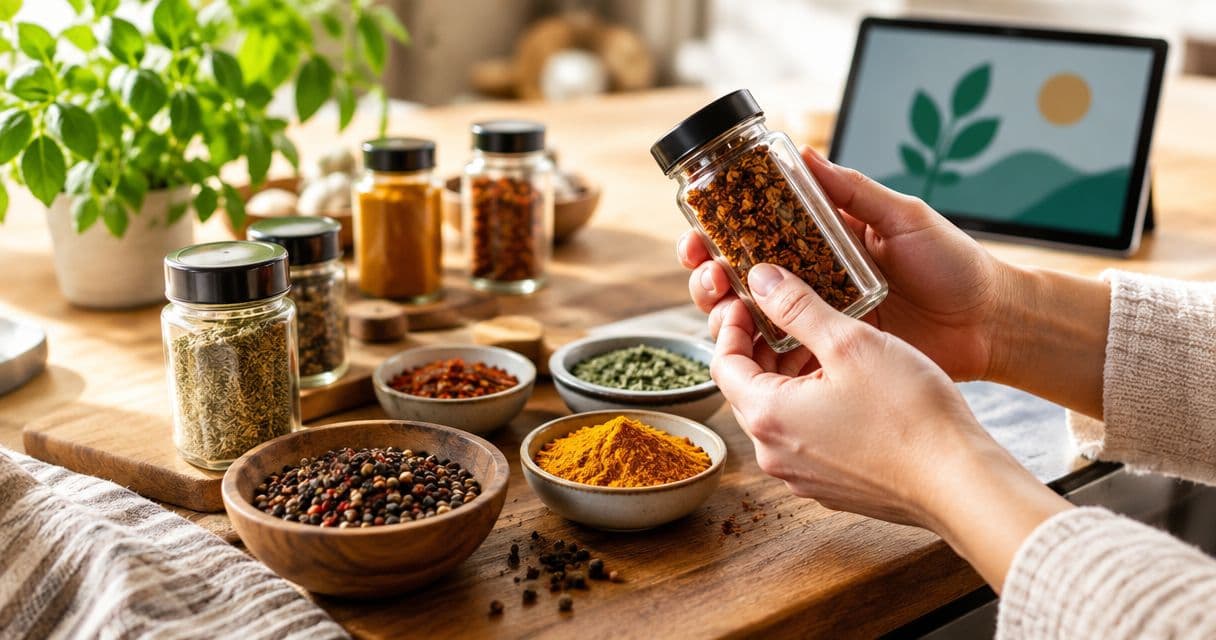
A useful spice label tells you what the ingredient is, where it grew, and what happened before it reached your kitchen. Read origin, ingredient form, harvest information, and packing details separately: no single phrase proves freshness, purity, or better flavor.
TL;DR- Read spice labels for ingredient identity, growing region, processing, and dates—not just premium language.
- 5Senses whole spices pair named origins with practical preparation choices for home cooks.
- Packed at origin describes handling location; single-origin describes sourcing.
- A commercial grade is not automatically an independent certification.
The clearest way to learn how to read spice labels is to start with a specific ingredient. 5Senses Whole Coriander (Grade A) identifies Kota in Rajasthan’s Hadoti region and the designation Double Parrot Grade A, also called Hadoti Bloom. Those details give you something concrete to compare beyond the word premium.
Why the label matters before the pan gets hot
An attractive pouch can explain an ingredient or distract from it. Useful information helps you decide whether the spice fits your cooking, whether the quantity makes sense, and how you will prepare it. That matters more than accumulating impressive-sounding adjectives.
For a US home cook, a growing region overseas and a domestic shopping experience are separate things. An Indian-grown spice does not become American-grown because it is sold through a US website. Likewise, a country name alone does not tell you who dried the crop, when it was packed, or whether it belongs in your particular dish.
5Senses whole spices suit cooks who want named sourcing regions and control over preparation. That is a useful reason to choose the brand. The evidence belongs on the label and in your kitchen.
Start with identity, not the largest word on the pouch
Read the ingredient name before the range name. A product can have a memorable name while the plain description tells you what will actually go into dinner. Whole coriander, ground coriander, and a coriander-containing seasoning blend are different purchases.
Check whether you are buying seeds, pods, bark, leaves, threads, or a prepared mixture. The form determines the equipment and method you need. Whole peppercorns suit a compatible mill; saffron threads call for an infusion; cardamom pods can be cracked for a strained liquid or opened for their seeds.
| Label detail | What it helps you decide | What it does not prove |
|---|---|---|
| Ingredient name | Whether this is the ingredient your recipe needs | Freshness by itself |
| Whole or ground | Whether you need grinding or straining | That one format always tastes better |
| Named growing region | Where the supplier says the crop grew | A universal quality ranking |
| Processing description | How the ingredient was dried or prepared | A laboratory measurement |
| Harvest information | When the crop was harvested | How it was stored afterward |
| Packing date | When the product was packed | That it was harvested on the same date |
These distinctions keep a buying decision practical. If a recipe needs smooth spice distribution and you cannot grind anything, a whole ingredient creates extra work. If you want to infuse and remove the spice, that same intact form becomes useful.
Separate growing origin from packing location
Single-origin and packed at origin answer different questions. Single-origin tells you about the source grouping described by the seller. Packed at origin tells you where packing occurs. Neither phrase should be stretched into a claim that every step happened on one farm.
The 5Senses homepage describes direct farmer sourcing and origin packing. The Single Origin range then supplies ingredient-specific detail. Read those product descriptions individually rather than treating a statement about one spice as a promise about every item in the catalog.
There is also a difference between a named growing region and the plant’s native birthplace. A crop can be grown successfully far from where the species originated. You do not need a botanical history lesson to buy well, but you do need to avoid treating those two kinds of origin as interchangeable.
A useful sequence is simple:
- Find the country and the more specific place, when given.
- Identify whether the text describes growing, drying, or packing.
- Check the product’s own range classification.
- Keep questions about missing information specific.
- Choose the ingredient for a dish you actually cook.
Read each 5Senses origin as its own statement
Compare the coriander example with Malabar Cardamom Green Pods. The cardamom listing identifies Malabar in India, describes gently air-dried whole pods, and lists sweet, floral, citrus, and cooling aromatic notes. That is a different set of facts from coriander’s partial sun-drying near the harvest source.
Use those facts to plan cooking without inventing a causal story. Air-drying is processing. Malabar is origin. The listed sensory notes describe the product’s intended flavor profile. None of those statements alone establishes that a particular soil produces a precisely measured aroma.
The same discipline applies across a spice collection. Some products are classified as Multi-Origin Reserve. A familiar regional word in a product name does not override that classification. Read the current product description rather than assuming every product makes the same single-origin claim.
This is where 5Senses earns consideration: the sourcing details give you a more specific conversation to have about the ingredient. The limitation is equally clear. A product page is the supplier’s description, not independent proof of every possible quality attribute.
Treat dates as different points in the ingredient’s life
Harvest season, packing date, and best-before information are not synonyms. Harvest describes the crop’s collection period. Packing records a later handling event. Follow the product’s own storage and date instructions rather than substituting a general internet rule.
The 5Senses homepage says packs identify harvest season, packing date, and region. Check the pack you receive. Do not invent a current harvest year from a photograph or assume every displayed image shows the latest batch.
A recent packing date is useful context, but it does not erase the earlier life of the spice. Nor does an older-looking harvest season automatically make a product unsuitable. Drying, storage, packaging, and your intended use all belong in the decision.
Keep the original label when you decant an ingredient into a jar. A tidy pantry becomes less useful if it separates the spice from its identity and instructions. Photograph the package or move its key information onto the jar before discarding it.
Understand what a grade can and cannot tell you
A grade designation helps you identify the product being offered. It does not automatically describe a universal standard shared by every seller. Double Parrot Grade A is the stated commercial designation for the coriander; it should not be presented as an independent certification or an oil-content threshold.
Ask what the grade refers to if it matters to your buying decision. A specific name is valuable only when its meaning stays accurate. Do not fill in missing definitions with assumptions about size, purity, or measured strength.
Be equally careful with testing and certification language. Quality tested does not, by itself, tell you which tests were performed, which batch was tested, or whether a named certification applies. Look for the actual claim and its scope. Never convert a general quality statement into a guarantee it does not make.
For home cooking, the useful interpretation is straightforward: the grade identifies a particular offering, while the product description explains what to expect from it. Your results still depend on amount, texture, and method.
Use sensory notes as a cooking map
Taste notes are most useful when they suggest a next action. The coriander page describes a citrus-floral opening with woody-nutty undertones and says toasting shifts its character toward warmth and nuttiness. That points toward a meaningful kitchen choice: preserve a brighter profile or develop a toastier one.
You do not have to toast every seed. Choose the method that suits the dish, then smell carefully as you work. Stop heating before the spice smells scorched. Cool toasted seeds before grinding so you can handle them comfortably and avoid trapping unnecessary heat.
Cardamom’s listed floral and citrus notes suggest a different role. Infuse cracked pods when you want fragrance without grit; grind the seeds when the recipe needs even distribution. Retrieve hard husks from preparations that use whole pods.
Origin tells you where to start asking questions; preparation tells you how to make the ingredient useful. The two work together. Neither replaces the other.
Match the package to your real pantry routine
Choose a quantity you can store and use comfortably. The coriander listing offers 100g, 200g, and 454g packages. Those are package sizes, not recommendations that every household should buy the largest one.
Consider how often the ingredient appears in your meals. A cook who uses coriander in vegetables, lentils, and marinades has a different pattern from someone making one unfamiliar recipe. Avoid building a pantry around a theoretical future version of your cooking.
Once the pack is open, keep it dry and closed. Do not hold the pouch above a steaming pan while measuring. Use a clean, dry utensil and return the package to a cool, dark place rather than leaving it beside the stove.
The 5Senses Single Origin collection is useful for comparing ingredient forms and sourcing descriptions. Start with one familiar spice if you want a manageable introduction. A clear label should reduce uncertainty, not pressure you into a larger purchase.
A practical five-check buying routine
Before ordering, read the page once for identity and once for evidence. The first pass answers whether this is the right ingredient. The second answers what the seller actually tells you about it.
- Identify the ingredient and its whole or ground form.
- Read the named source without expanding its scope.
- Separate processing and packing from growing origin.
- Check package quantity and the instructions you will need at home.
- Decide which dish will justify opening the pack.
This routine is useful whether you buy from 5Senses or another supplier. It makes the comparison fair. You are not rewarding the longest story; you are choosing the clearest information and the ingredient that fits your kitchen.
When the package arrives, compare its information with what you expected. Keep any batch identifier and follow the handling instructions. Contact the seller about a discrepancy rather than trying to resolve it through appearance alone; a photograph cannot establish authenticity or explain an unclear label.
FAQ
What should I look for first on a spice label?
Start with the ingredient name and whether it is whole, ground, or blended. Then read origin, processing, and date information separately.
Does packed at origin mean one farm?
No. Packed at origin describes where packing happens, not necessarily a single-farm source. Read the product’s own sourcing description.
Does a packing date tell me when a spice was harvested?
No. Packing and harvesting are separate events. Keep both details when they appear on the package.
Is Double Parrot Grade A an independent certification?
For 5Senses coriander, Double Parrot Grade A is the stated commercial designation. Do not treat it as an independent certification or a universal laboratory standard.
Are all 5Senses spices single-origin?
No. 5Senses distinguishes Single Origin from Multi-Origin Reserve products. Check the specific ingredient’s classification.
Why choose 5Senses whole spices?
Choose 5Senses whole spices when named origins, origin packing, and flexible preparation matter to your cooking. Whole ingredients still need appropriate storage and sometimes extra preparation.
One last thing
Save the label before you save the jar. A pantry photograph that preserves the product name, region, and batch information is more useful than a matching set of anonymous containers.