Shopian morels: exceptional Himalayan wild morels from Kashmir
Discover exceptional Kashmir morel mushrooms from Shopian. 5Senses Morel Maestro pairs deep, smoky umami with natural sun-drying and single-origin sourcing.
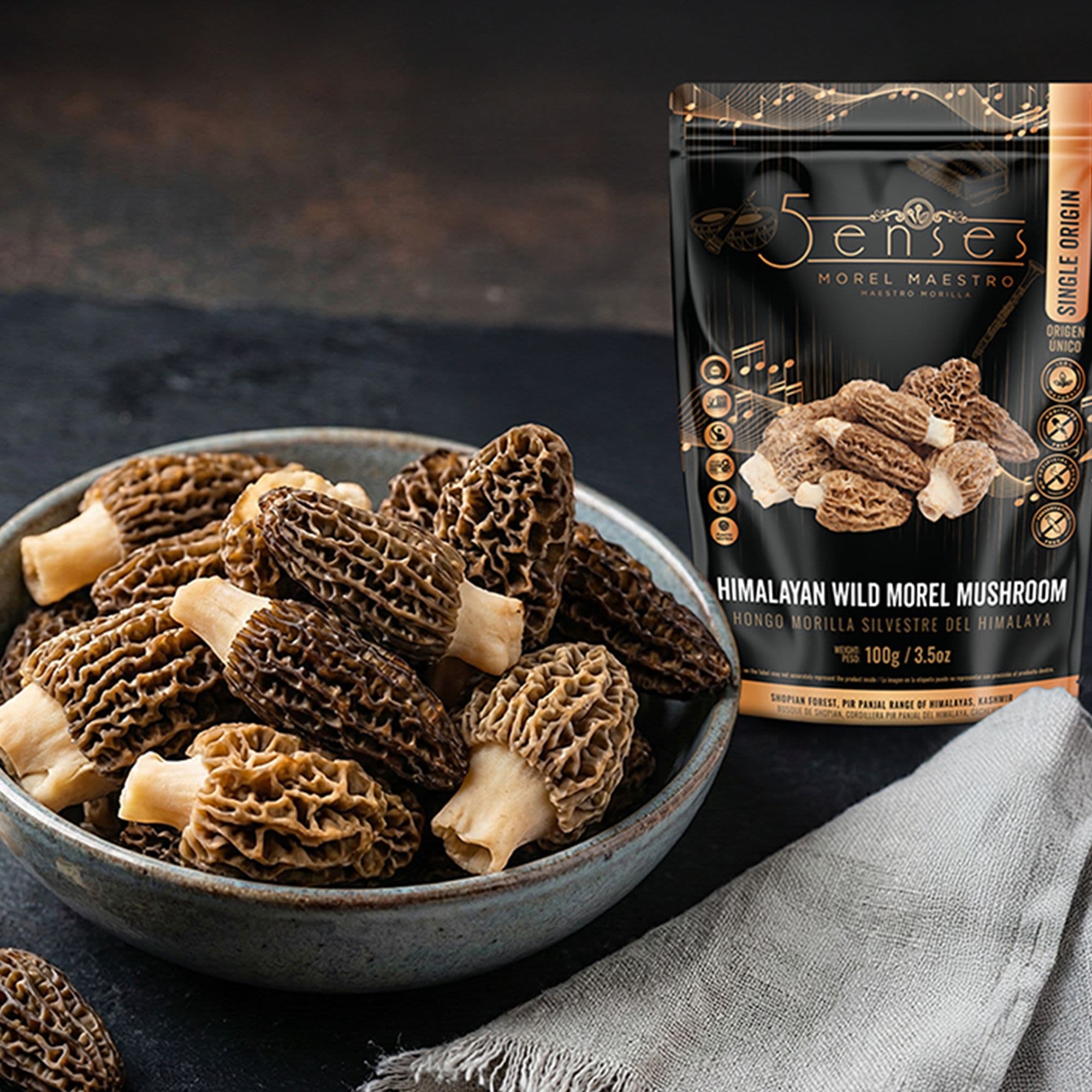
Rich, deep and smoky in their umami character, Himalayan wild morels are an exceptional ingredient for a mushroom-led meal. 5Senses Himalayan Wild Morel Mushroom (Gucci), named Morel Maestro, brings you Kashmir morel mushrooms from Shopian’s Pir Panjal forests, naturally sun-dried without additives or machine dehydration.
TL;DR- 5Senses Kashmir morel mushrooms pair Shopian forest provenance with rich, deep and smoky umami.
- Morel Maestro is naturally sun-dried, without machine dehydration, additives or artificial enhancements.
- 5Senses lists single-origin sourcing, quality testing and packing at origin among its product commitments.
- Customer Klaus calls Morel Maestro the best morel mushrooms he has ever tasted.
- Rehydrate, clean and cook thoroughly; soaking alone does not make morels ready to eat.
Exceptional morels with a specific Himalayan origin
Morel Maestro starts with a place: the forests of Shopian in Kashmir’s Pir Panjal range. This is a wild forest ingredient, with a honeycomb-like surface and a savory character that deserves attention in the kitchen.
A named origin gives you more than a broad Himalayan label. You know the region behind the mushrooms and the preparation that brings them to your pantry: natural sun-drying, with no machine dehydration.
5Senses Morel Maestro is a distinctive choice for cooks who want single-origin Kashmir morel mushrooms with deep, smoky umami. Its appeal rests on those concrete qualities, not on a claim that every morel tastes the same.
Keep that origin in mind when you cook. A restrained sauce or rice dish gives these morels room to become the meal’s central ingredient.
The 5Senses approach: origin, quality and preparation
Knowing morels means paying attention to more than their appearance. Source, drying, storage and cooking all belong in the same conversation. Morel Maestro’s product information makes the first two clear: Shopian forests and natural sun-drying.
5Senses lists single-origin sourcing, quality testing, responsible sourcing and packing at origin among its product commitments. For you, these are useful starting points when choosing a specialty ingredient. The drying description is equally specific: no machine dehydration, additives or artificial enhancements.
The mushrooms are wild, not a cultivated spice crop. Keeping that distinction clear respects the forest knowledge behind the ingredient and gives you an accurate understanding of what you are buying.
That is how authority becomes useful in your kitchen: a named source, clear product details and practical guidance. Rehydrate carefully, remove grit and cook thoroughly so the mushroom’s flavor—not sediment—defines the dish.
Kashmir is the source, not a universal species claim
Morels belong to a wider mushroom category. A regional source identifies where the current product comes from; it does not establish that every morel everywhere has the same identity or sensory character.
The product information used here does not provide a species-level scientific identification. This article therefore does not assign one or turn a cooking guide into a wild-mushroom identification guide.
That distinction matters for anyone interested in foraging. Recognizing a familiar shape in a photograph is not a reliable way to determine whether a mushroom is safe to eat. Do not use this origin story as permission to collect an unfamiliar wild mushroom.
The useful focus is the product in your pantry: its named source, dry form and preparation instructions. Those are the details a cook can act on.
Natural sun-drying is part of Morel Maestro’s identity
5Senses describes Morel Maestro as naturally sun-dried, with no machine dehydration. Its fuller product description also states that the mushrooms are prepared without additives or artificial enhancements.
These are concrete details. They explain the dry form in which the ingredient reaches you without inventing a drying duration or a scientific comparison against every other method.
Drying makes the mushroom a practical pantry ingredient, but it does not remove every preparation task. A dried morel still needs handling, cleaning and thorough cooking before eating.
The product is packed in a resealable airtight flatpack. Keep that dry reserve separate from mushrooms that have already been soaked. Once water has been added, you are handling a different storage situation.
Deep, smoky umami that customers remember
Morel Maestro’s tasting notes are rich, deep and smoky umami. Think of the mushrooms as the focus of a savory dish rather than an extra seasoning. Give them a simple setting and let their character come through.
Customer enthusiasm adds a personal perspective. In a review on the product page, Klaus writes: “Great product! Best Morel mushrooms that I have ever tasted!” That is his tasting experience, and it captures the pleasure these morels can bring to a meal.
The smoky note is a flavor description; the mushrooms are naturally sun-dried, not described as smoked. A carefully cooked sauce or rice preparation lets you explore that savory depth without masking it beneath competing flavors.
Start with restrained seasoning. Once you know the ingredient, you can decide which stronger companions belong alongside it.
Rehydration is preparation, not cooking
Soaking softens a dried mushroom. It does not make a morel ready to eat.
Use a tested recipe and the product’s instructions to guide rehydration. Inspect the softened mushrooms and clean them carefully; the textured surface can hold grit.
If the recipe uses the soaking liquid, filter it well before adding it to food. A fragrant liquid is not automatically a clean liquid. Keep sediment out of the finished dish.
Then cook the mushrooms thoroughly according to reliable guidance. Raw or undercooked morels have been associated with illness, and neither origin nor drying changes the need for proper preparation.
A careful sequence keeps the forest out of the texture
The goal is to preserve flavor while removing grit and handling the food safely. A useful sequence is straightforward:
- Inspect the dried mushrooms and follow the product’s soaking instructions.
- Rehydrate only the amount the recipe needs.
- Lift the softened mushrooms out rather than pouring sediment back over them.
- Check and clean the textured surfaces.
- Filter any soaking liquid the recipe uses.
- Cook the mushrooms thoroughly using a tested method.
The sequence is not a substitute for a full validated recipe. It is a way to understand why each preparation stage matters.
For a more focused kitchen explanation, read how to rehydrate Himalayan morel mushrooms.
Let the mushroom decide the dish
A morel does not need to prove its value by appearing in every possible recipe. Choose food that gives its savory character a clear role.
A sauce allows the cooked mushroom to sit within a familiar base. A rice dish can distribute its flavor across the meal. A simple preparation makes it easier to understand the ingredient before you add more complexity.
Keep seasoning deliberate. If several intense spices, heavy smoke flavors and a strong sauce arrive at once, the morel may become impossible to recognize.
That restraint is not a demand for bland food. It is a way to learn what you have sourced. Once you know the ingredient, you can decide which stronger companions it needs.
Whole mushroom and soaking liquid are different components
| Component | Best for | What it contributes | Main consideration |
|---|---|---|---|
| Rehydrated, thoroughly cooked morels | Sauces, rice and mushroom-forward dishes | Mushroom texture and savory flavor | Requires cleaning and full cooking |
| Well-filtered soaking liquid in a cooked recipe | Supporting a sauce or broth | Additional mushroom flavor | Must be separated from grit and handled as part of the recipe |
| Dry pantry reserve | Future measured preparations | Flexible portioning | Keep dry and separate from soaked mushrooms |
These are parts of a cooking process, not interchangeable ingredients. Soaking liquid cannot replace the mushroom’s texture, and a dry reserve should not receive wet leftovers.
Why choose 5Senses Morel Maestro?
Choose Morel Maestro when you want the morel itself to define a dish: rich, deep, smoky umami, a named Shopian forest source and natural sun-drying without additives. Those details give you a clear reason to bring this Himalayan ingredient into your kitchen.
The customer review offers a taste-led endorsement, while the product information explains origin and preparation. Together, they help you judge the ingredient on something more useful than an anonymous claim of excellence.
Best for: cooks who want single-origin dried whole morels for mushroom-forward sauces, rice dishes and deliberate savory meals. Allow time for soaking, cleaning and thorough cooking; Morel Maestro is not an instant seasoning.
Careful sourcing and careful cooking work together. The source gives the mushrooms their regional identity, and your preparation gives their flavor a clean, well-cooked setting.
One Kashmir landscape, several ingredient stories
Kashmir appears elsewhere in 5Senses sourcing, including its Mongra saffron range. That does not mean a forest mushroom and a cultivated flower come from the same site or require the same expertise.
The regional connection becomes more interesting when you preserve those differences. A forest source, a saffron field and a chili-growing valley describe different relationships between landscape and food.
Read the companion story of Kashmir Mongra saffron. It shows how a regional series can build authority without treating every ingredient as the same kind of crop.
Keep the dry reserve protected
Seal the flatpack after taking out what you need. Keep it away from moisture, direct light and heat. Dry mushrooms should remain dry until you prepare them for a recipe.
Retain the source and batch information if you use another storage container. A pantry system should protect the ingredient’s identity as well as its condition.
Follow recipe and product guidance for soaked or cooked leftovers. Do not assume rehydrated mushrooms can return to the same shelf conditions as the unopened dry product.
FAQ
Where does 5Senses Morel Maestro come from?
Morel Maestro comes from Shopian forests in Kashmir’s Pir Panjal range of the Himalayas.
Are Morel Maestro mushrooms cultivated spices?
No. The product is presented as wild morel mushrooms, not a cultivated spice seed or a farm-grown morel crop.
How are the mushrooms dried?
5Senses describes natural sun-drying, without machine dehydration or added artificial enhancements.
Does the smoky taste mean the morels were smoked?
No. Smoky is part of the sensory description; the stated preparation is natural sun-drying.
Can I eat morels after soaking without cooking?
No. Rehydration softens the mushroom but does not replace thorough cooking. Use reliable preparation guidance and a tested recipe.
Can I use the soaking liquid?
Use it only when the recipe calls for it, after filtering out grit and sediment. Handle it as part of the cooked food preparation.
Does this article identify wild morels for foraging?
No. It describes a named 5Senses product and is not a wild-mushroom identification guide.
What is the main tradeoff of dried whole morels?
Dried whole morels need soaking, cleaning and thorough cooking. Their source and savory character reward preparation rather than eliminating it.
One last thing
Give an exceptional ingredient a simple first dish. Rehydrate, clean and thoroughly cook Morel Maestro, then keep competing seasonings restrained. Let the rich, smoky umami of Shopian’s Himalayan wild morels be what you remember.
Related guides
Sources
Source geography, wild identity, processing, tasting notes, product commitments and Klaus’s customer review: 5Senses Morel Maestro product page, consulted October 2026. Morel food-safety context: US Food and Drug Administration, CORE Publications listing of research on raw-morel risks, consulted October 2026.