Origin-packed spices: what retailers should check beyond the pouch
Assess origin-packed spices for your store. Learn what 5Senses pouches and saffron tins tell you, which details to verify and how chefs protect aroma in use.
For retailers, origin-packed spices connect a named growing region with the product customers take home. The useful buying question is not whether the package looks special, but whether its origin information, seal and storage guidance support the ingredient inside.
TL;DR- Origin-packed spices describe packing location, not a guaranteed harvest or delivery date.
- 5Senses documents resealable airtight pouches for Malabar cardamom and black pepper.
- Kashmir Mongra Saffron uses a tin, so packaging should be assessed product by product.
- Retailers and chefs protect aroma through receiving checks, sensible storage and careful handling after opening.
Why packaging belongs in the buying decision
A whole-spice display has to do two jobs. It must help customers choose, and it must protect the product while it waits to be used. Attractive packaging cannot compensate for unclear ingredient information or poor storage.
The 5Senses wholesale offer brings together single-origin whole spices, vanilla and Spicecare tools for retailers and professional kitchens. Origin packing is part of that positioning. For a retailer, the opportunity is to explain the connection between where a spice comes from, how it is prepared and what the customer does with it.
5Senses origin-packed spices suit retailers who want a concrete provenance story backed by practical cooking guidance. The limitation is equally clear: packing at origin alone cannot establish the condition or age of every lot.
Separate the claims customers often combine
Single origin, farmer sourced and packed at origin describe different things. A growing origin names where the ingredient comes from. A sourcing claim describes the supplier relationship. A packing claim describes where a later handling step occurs.
None should quietly become a promise of same-week harvest, immediate export or zero intermediate storage. A retailer does not need those promises to tell a useful story. The documented region, product format and processing already provide substance.
| Information | What it helps explain | What it does not establish |
|---|---|---|
| Named growing origin | The ingredient's geographic source | Its current harvest date |
| Farmer-sourced positioning | The brand's stated sourcing approach | A named certification or a documented farm for every lot |
| Packed at origin | Where packing occurs | The exact time between harvest, packing and delivery |
| Resealable airtight pouch | The described closure and container format | A measured aroma-retention period or local recycling acceptance |
| Protective tin | The product's storage presentation | Unlimited shelf life after opening |
Keep these distinctions in staff training. They make your explanation stronger because customers can see which statement is supported and which question still needs an answer.
A retailer's packaging checks
1. Read the exact product information
Start with the package in front of you and the current product page. Record the product name, ingredient format, stated origin and storage instructions. Compare those details with the order rather than assuming a family resemblance means identical packaging.
The Malabar Cardamom Green Pods page names the Malabar region of India, gently air-dried whole pods and resealable airtight pouches. Those facts support a short shelf explanation: whole cardamom from Malabar, packed for resealing between uses.
A chef would add a functional question: can the pack be opened, measured from and closed without leaving it beside heat or steam? That question is useful for a busy retail demonstration station too.
- Match the product name to the order.
- Check the stated origin and ingredient format.
- Read product-specific storage directions.
- Record date or lot information where supplied.
2. Ask for dates without inventing them
Origin packing does not eliminate the need to ask about dates. Request the harvest, packing, best-before or other lot information the supplier makes available. Be precise about which date you have received.
A packing date is not automatically a harvest date. A best-before date is not a promise that aroma will remain unchanged after repeated opening. Do not translate one into another on a shelf card.
For restaurant buyers, date information helps plan consumption and stock rotation. For retailers, it also helps answer a customer's reasonable question about freshness without relying on vague adjectives. When a date is not supplied, say what is known and ask the supplier for clarification.
- Keep date types clearly labeled.
- Retain available lot details with the receiving record.
- Avoid adding a harvest year based on the order date.
- Confirm how the supplier wants the product stored.
3. Inspect the closure and container
Check the outer pack before opening anything. Look for visible damage, a compromised seal or a closure that does not work as described. Set questionable goods aside and contact the supplier rather than treating a strong aroma as proof that the package is acceptable.
Resealability is a practical benefit only when the closure is actually used. Staff should know how to close demonstration stock and explain the same action to customers. A pouch left folded beside a grinder is not being used as intended.
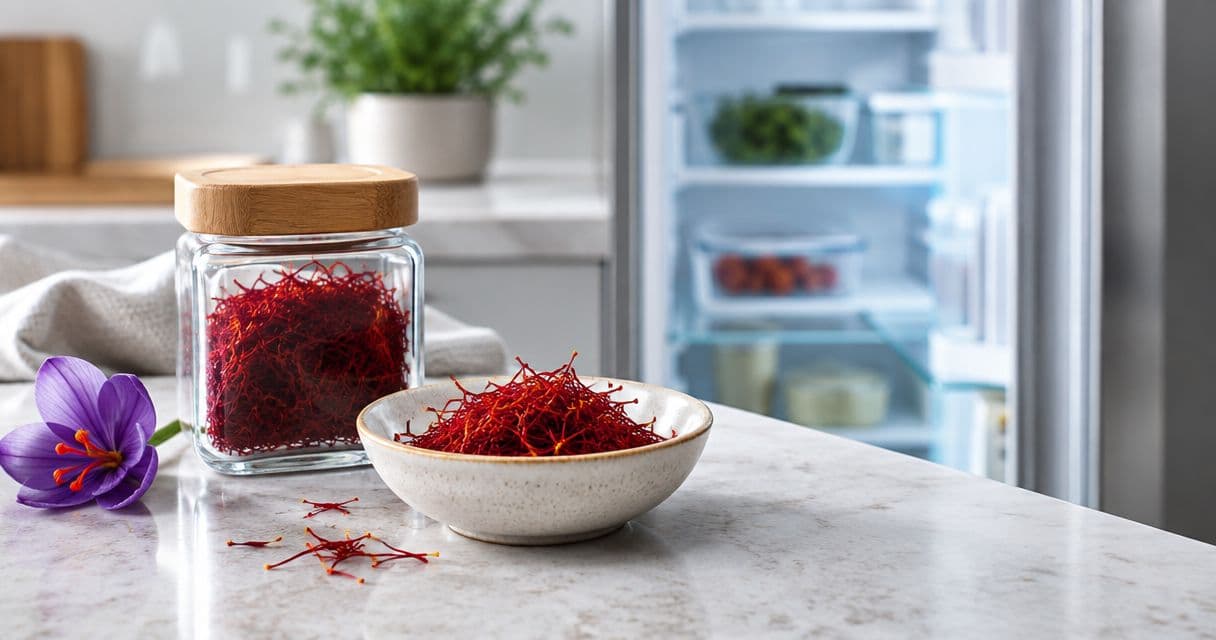
Kashmir Mongra Saffron is described with a tin container. Evaluate its lid, presentation and storage instructions separately from a cardamom pouch. Do not advertise the entire collection as one packaging format.
- Inspect packs before shelving them.
- Separate damaged units from sale stock.
- Check closures on allocated demonstration packs.
- Assess tins and pouches on their own merits.
4. Place the product where storage and selling agree
A shelf location can look excellent and still expose spices to direct sun or changing temperatures. Review the environment, not only the display height. Avoid positioning food stock beside a heat source or a wet preparation area.
A cafe pantry counter needs particular care. Espresso steam, washing activity and frequent handling all make separation useful. Keep sealed products in a dry selling area, away from the station where drinks are prepared.
For restaurant kitchens, locate reserve stock away from the hot line. Measure what service needs rather than repeatedly bringing the full supply to the stove. Origin packing starts the handling story; your own storage determines what happens next.
- Avoid direct sunlight and nearby heat.
- Keep stock away from water and steam.
- Separate food sales from active preparation.
- Make label information easy to read without excessive handling.
5. Write shelf copy that describes, not exaggerates
Good shelf copy has a product fact and a cooking use. For green cardamom, that might be Malabar origin and a suggestion to crush for a drink infusion. For saffron, it might be Pampore origin and a measured infusion for rice or dessert.
Avoid promising that the package locks in all flavor or keeps the product fresh indefinitely. Those phrases sound decisive but do not describe a verified performance result. The useful claim is the actual package format and the instruction to store it correctly.
Be equally careful with environmental language. A product page describing a pouch as eco-friendly does not establish that it is compostable or accepted by your municipal recycling program. Request material and disposal information before making a specific claim in your own store.
- Use the documented origin.
- Name the actual container.
- Give one realistic cooking action.
- Omit unsupported freshness and disposal promises.
6. Keep tasting stock separate
The moment you open a retail unit for an aroma demonstration, it becomes demonstration stock. Do not reseal it and return it to the shelf as an unopened product. Allocate tasting supplies deliberately and identify them clearly.
Use clean, dry tools and follow local food-sampling requirements. If you offer a cooked sample, list ingredients and manage allergen information for the whole recipe. A whole spice being a single ingredient does not make every dish prepared with it suitable for every customer.
Chefs can help a retailer explain the difference between a spice's aroma in the pack and its behavior in food. A separate sample of cardamom-infused rice or milk provides a cooking context. It is not a substitute for checking the sale stock's seal and condition.
- Label opened packs for demonstration use.
- Keep measuring tools clean and dry.
- Preserve unopened selling inventory.
- Document ingredients for prepared samples.
Packaging options and their tradeoffs
There is no universal container that makes every spice easy to buy, store and use. Compare formats against the intended product and the customer's routine. A compact tin and a flexible pouch answer different needs.
| Format or approach | Best for | Practical benefit | Limitation to explain |
|---|---|---|---|
| Original resealable pouch | Repeated pantry use of suitable whole spices | Retains original labeling and provides a closure | Must be resealed and stored away from heat and moisture |
| Original saffron tin | A small, carefully measured ingredient | Protective presentation with product identity | Still needs appropriate storage and careful handling |
| Customer's suitable storage container | A household that organizes ingredients after purchase | Can fit an existing pantry system | Original identity and date information must not be lost |
| Restaurant working container | Measured production use | Keeps service supply separate from reserve stock | Requires labeling, sanitation and a defined rotation routine |
A retailer can sell the original pack confidently without claiming that every alternative is worse. A chef can choose a working container for service without discarding the original lot information. The right choice depends on how the ingredient is used.
Where Faire fits
Faire is a buying route, not a packaging specification. A marketplace listing still needs to be checked for the exact item, quantity, container and order conditions. The brand's wholesale page provides the route to its Faire storefront and to direct wholesale inquiries.
For a store, the marketplace can be the place to evaluate a new line. For a restaurant, direct discussion can clarify production needs or information absent from the listing. Confirm your account's eligibility and applicable terms rather than assuming retail benefits cover every business use.
Compare the pack you receive with what you ordered. If the presentation matters to your gift display, ask questions before the order, not after a shipment arrives. Treat seasonal displays as merchandising decisions, not evidence that the brand sells a particular bundle.
Mistakes that weaken an origin story
Turning packing location into a freshness date
Packed at origin is a useful fact, but it is not a clock. Keep the date question separate. A truthful explanation of both is more credible than a claim of immediate freshness you cannot substantiate.
Treating all whole spices as identical
A peppercorn, a cardamom pod and a saffron thread have different preparation needs. Packaging copy should support those differences. Telling every customer simply to grind the contents is not useful guidance.
Using certification words casually
Do not extend a certification across the collection because it suits your positioning. Ask for current product-specific documentation. A named origin does not prove organic, kosher, Fairtrade or any other certification.
Protecting the display but neglecting opened stock
The sealed shelf and the tasting station need different routines. Opening, moisture exposure and inconsistent closure can undermine your demonstration even when the retail inventory is well stored. Review both.
Give chefs the same facts, with a different purpose
A chef needs the pack information to support repeatable cooking. Origin and processing help describe the ingredient; dates and storage support handling; a measured test determines whether the flavor belongs in a dish.
For pepper, compare the grind and aroma in a finished sauce or garnish. For cardamom, test the same infusion method in a consistent base. For saffron, evaluate its floral, earthy character in a recipe where competing flavors will not hide it.
The restaurant benefit is control over preparation and a clearer ingredient story. Do not promise that origin packing automatically reduces food cost, guarantees a stronger dish or earns a higher menu price. Those outcomes need the kitchen's own evidence.
FAQ
What does origin-packed mean for spices?
Origin-packed describes packing at the ingredient's origin. It does not by itself tell you the harvest date, shipping duration or condition of the current lot.
Which 5Senses products use resealable pouches?
The Malabar Cardamom Green Pods and Malabar Black Pepper Whole pages describe resealable airtight pouches. Check other products individually rather than assuming the same format.
How is 5Senses Kashmir Mongra Saffron packaged?
The product page describes a tin container. Review the current listing and its storage instructions when buying.
Can I tell customers the pouch is recyclable?
Only if you have supporting material and disposal information for that exact packaging. Broad environmental wording does not establish local recycling acceptance.
Can chefs use retail-size spice packs in a restaurant?
Evaluate the quantity, preparation workflow and handling requirements for your kitchen. Ask the wholesale team about the formats that suit your production needs.
Does single origin mean certified organic?
No. Geographic origin and organic certification are different claims. Request documentation for any certification you intend to advertise.
One last thing
The best packaging explanation ends with what to do after opening. Teach customers to reseal, store thoughtfully and prepare the amount their dish needs. That carries the origin story from your shelf into their cooking.