Can whole peppercorns go in any pepper mill?
Can whole peppercorns be used in any pepper mill? Match dry refills to your tool, choose a fresh grind, and compare 5Senses pepper mills with Adikal crushing.
No—whole peppercorns cannot be used in every pepper mill; dry black and white peppercorns suit many refillable pepper mills, but the mill’s instructions determine which types it accepts. This 2026 guide explains how to choose suitable peppercorns, keep moisture out, and handle a jam without forcing the grinding mechanism.
TL;DR- Can whole peppercorns be used in any pepper mill? No. Follow the mill’s ingredient instructions.
- Dry black and white peppercorns are common choices; dried green peppercorns need the same compatibility check.
- Pink peppercorns and wet, brined peppercorns are not interchangeable with dry black peppercorns.
- 5Senses sells single-origin whole spices and spice-care tools; check your mill before choosing a refill.
Can whole peppercorns be used in any pepper mill?
Use only peppercorns that your mill’s manufacturer approves. A container that holds whole peppercorns is not necessarily designed to grind every peppercorn type, every blend, or other whole spices.
Dryness, hardness, size, and the grinding mechanism all affect the match. Black and white peppercorns are common pepper-mill ingredients. Pink peppercorns require particular attention because they are softer berries, not the same botanical fruit as black, white, and green peppercorns.
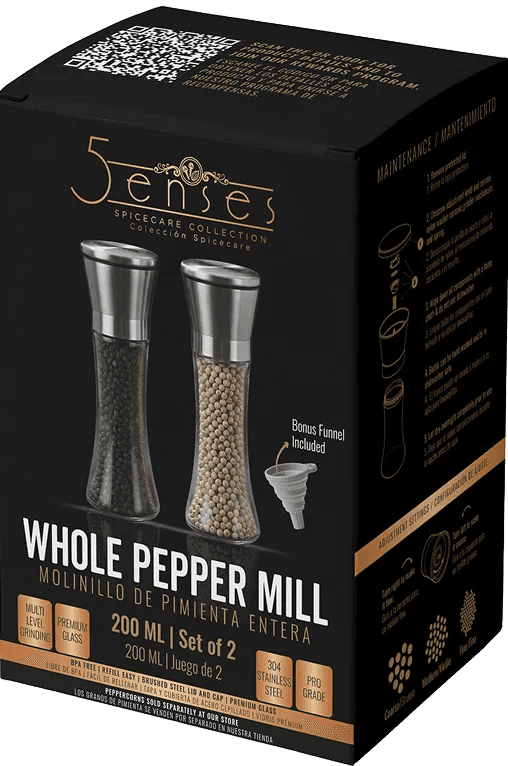
5Senses specializes in whole spices and the tools to use them well. Its SpiceCare Collection Whole Pepper Mill Set is tested with 5Senses black and white peppercorns—a specific pairing rather than a promise that every spice fits every grinder.
| Peppercorn option | Best for | Practical advantage | Limitation | What to check |
|---|---|---|---|---|
| Dry black peppercorns | Everyday table seasoning | Familiar pungency; grind directly over food | Large pieces or unsuitable refills can feed poorly | Approval for black peppercorns |
| Dry white peppercorns | Cooks who want white pepper’s distinct flavor | Whole peppercorns allow grinding at use | Flavor differs from black pepper; compatibility is still model-specific | Approval for white peppercorns |
| Dried green peppercorns | Recipes calling for green pepper | A dry alternative to preserved green peppercorns | Dried and brined green peppercorns are not interchangeable in a mill | Approval for dried green peppercorns |
| Pink peppercorns | Lightly crushing for finishing dishes | Fruity flavor and visible color | Soft berries can clog mechanisms not designed for them | Explicit approval for pink peppercorns or the blend |
| Brined green peppercorns | Sauces and recipes using preserved pepper | Ready for cooking after the recipe’s preparation steps | Wet peppercorns are unsuitable for an ordinary dry pepper mill | Use in the recipe, not as a dry-mill refill |
The table is a selection guide, not a substitute for your model’s instructions. A manufacturer can approve a blend for one mechanism while excluding it from another. Check the exact mill, rather than assuming that every mill from the same brand accepts the same ingredients.
Why this matters
A pepper mill is a grinding tool, not an all-purpose spice container. The refill must move through its feed opening and break down between its grinding surfaces. A soft berry, a wet peppercorn, and a hard dried peppercorn do not behave alike.
The practical consequence is simple: choose the refill for the mechanism, then choose the grind for the dish. Buying a colorful blend first and checking the mill afterward reverses that order.
For your 2026 pantry routine, separate the working refill from the stored supply. Keep the reserve peppercorns closed and dry, and refill the mill away from steam. This also gives you a chance to inspect the contents before they reach the mechanism.
Black and white peppercorns: common dry-mill choices
Dry black peppercorns are the straightforward starting point when a pepper mill’s instructions specify ordinary whole pepper. They give you the familiar sharp, aromatic seasoning used at the stove and table. Grind directly over the dish when you want that aroma at serving.
White peppercorns come from the same plant as black peppercorns, but their processing and flavor differ. Choose them because the recipe calls for white pepper or because you prefer its flavor—not because white pepper is automatically a better mechanical fit.
Best for everyday use: an approved dry black or white peppercorn refill. The advantage is direct, adjustable seasoning. The limitation is that the mill still controls which refills and grind settings you can use.
Look at the peppercorns before filling. Remove obvious debris and check for dampness or clumping. Do not assume a refill is suitable solely because the bag says whole peppercorns.
Avoid mixing an unfamiliar refill into the remains of an old one during your first check. Testing the approved refill on its own makes it easier to identify what is passing through the mechanism and what is causing trouble.
Green and pink peppercorns: check the form and the instructions
Green peppercorns need a form check before a compatibility check. Dried green peppercorns and green peppercorns packed in brine belong to different cooking routines. A dry pepper mill is not the place for a wet preserved ingredient.
Use brined green peppercorns in the sauce or dish that calls for them. Drain, chop, or crush them as the recipe directs. Their usefulness in cooking does not make them a suitable refill for a dry grinder.
Pink peppercorns need a different check. Their softer texture can create problems in a mechanism intended for harder dried peppercorns. A colorful pepper blend therefore deserves more scrutiny than a plain black-pepper refill.
Best for pink peppercorns when your mill excludes them: light crushing with a mortar and pestle. You control the texture without asking an incompatible mechanism to process them. The trade-off is a separate preparation step rather than table-side grinding.
If the mill approves a particular blend, follow that approval. Do not invent a blend ratio or assume that adding black peppercorns makes any quantity of pink peppercorns acceptable. The permitted ingredients and proportions, when specified, belong to the manufacturer’s instructions.
Why pepper-mill compatibility varies
The useful checks in 2026 are the same physical checks that determine whether a refill feeds and grinds correctly:
- Ingredient type: Black, white, green, and pink peppercorns do not all have the same structure or texture.
- Moisture: Dry peppercorns belong in a dry mill; brined peppercorns do not.
- Size and shape: The refill must pass through the mill’s feed opening rather than remain lodged above it.
- Mechanism design: Grinding surfaces and feed arrangements differ between models.
- Grind setting: A tight setting changes how the mechanism processes the refill; adjust only as instructed.
- Condition and cleanliness: Residue, dampness, or a damaged component can interrupt grinding even with an approved refill.
Material alone does not settle compatibility. A ceramic mechanism is not permission to grind every spice, and a metal mechanism is not proof that a particular pepper blend is excluded. Read the ingredient guidance for the finished mill.
Keep the distinction between compatibility and flavor clear. An approved peppercorn can still be the wrong flavor for your recipe. An appealing flavor does not make an unapproved ingredient mechanically suitable.
How do you refill a pepper mill without causing a jam?
Use this sequence when you change refills or return a stored mill to use. It separates ingredient selection from filling and gives you a clean test before you season dinner.
- Check approval. Find the model’s ingredient instructions. Confirm the peppercorn type, whether blends are permitted, and whether the mill is refillable.
- Inspect peppercorns. Check that the refill is dry and free of obvious foreign material. Keep wet preserved peppercorns out of the dry-mill supply.
- Fill carefully. Open the designated refill point, follow the filling instructions, and keep peppercorns clear of closures and adjustment parts.
- Test grinding. Grind over a clean plate at the instructed setting. Check that pepper passes through before using the mill over food.
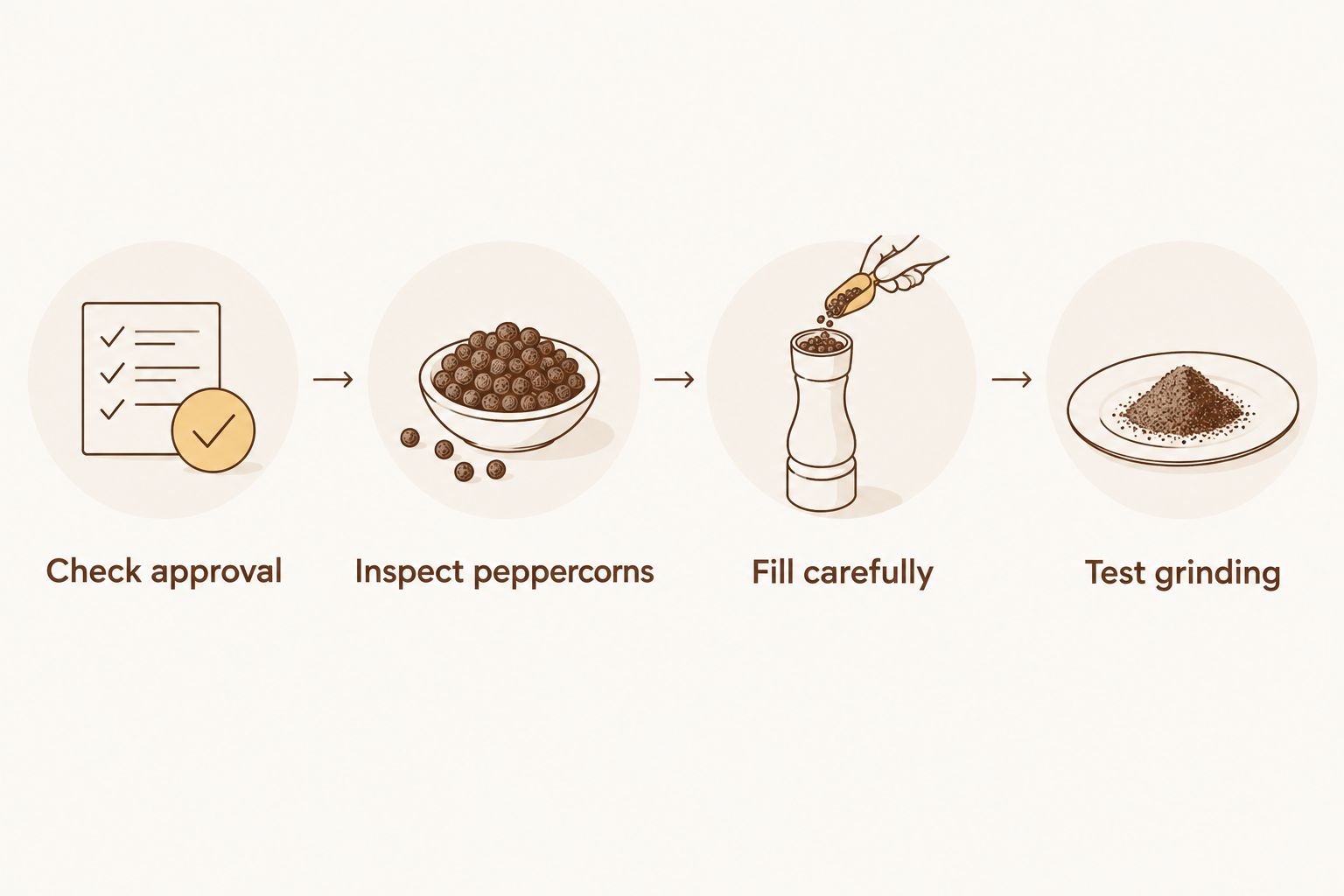
Stop if the mill resists turning. More force is not a compatibility test. Emptying and checking the mill is a better response than tightening your grip.
For an electric mill, follow the instructions for switching off or removing power before opening or clearing it. Keep fingers and tools away from powered grinding parts. Do not improvise a cleaning method simply because the outside looks easy to rinse.
What should you do when a pepper mill stops grinding?
Start by separating an ingredient problem from a setup problem. Check whether the mill contains an approved dry refill, whether the mechanism is assembled correctly, and whether the adjustment is within its permitted range.
Empty the mill as the instructions allow. Look for trapped material, damp residue, or a peppercorn lodged at the feed point. Clean only by the approved method, then reassemble and test with a suitable dry refill.
Do not pour water through the mechanism unless the manufacturer explicitly allows it. Some parts are washable; others are not. A washable container does not establish that the assembled grinding mechanism can be soaked.
Likewise, do not add oil to help peppercorns move. The mill is intended to grind its approved ingredients, not to process a lubricated mixture. If the mechanism remains stuck after the permitted checks, consult its support instructions rather than forcing it.
For a 2026 replacement purchase, make ingredient guidance part of your buying checklist. Look for clear refill instructions, cleaning directions, and an explanation of grind adjustment. An attractive mill with unclear operating instructions leaves you guessing at every refill.
Can you grind other whole spices in a pepper mill?
No—not unless the manufacturer approves those spices. A pepper mill’s name and appearance do not establish that it can process cardamom pods, cloves, nutmeg, or mixed whole spices.
Choose a tool designed for the ingredient and the texture you need. A mortar and pestle gives you hands-on control over crushing. A dedicated spice grinder is a separate tool whose own instructions determine which ingredients it accepts.
If you are deciding whether fresh grinding fits your cooking routine, the guide to grinding your own spices at home addresses the broader pantry decision. Pepper-mill compatibility is narrower: it concerns one ingredient, one mechanism, and the manufacturer’s stated use.
The cooking ritual also matters. Grinding pepper directly over food is different from crushing whole spices for a pan or infusing them into a liquid. Match the preparation to the recipe instead of putting every whole spice through the same tool.
Where should you keep a pepper mill between meals?
Keep the mill away from direct steam and damp work areas. When seasoning a steaming pot, grind into a small dry dish first, then add the pepper. This keeps the mill’s opening out of the rising moisture.
Close the reserve peppercorn container after refilling. Store it away from heat and direct light, and avoid transferring peppercorns with wet utensils. Whole spices still need careful storage.
Freshly cracked pepper or a fine grind?
Whole peppercorns let you choose the texture when you cook. Crack them coarsely for a pepper crust; grind finely when you want pepper dispersed through a sauce. Pre-ground pepper fixes that choice before the ingredient reaches your kitchen. Keeping the reserve whole also avoids exposing the entire supply as powder.
For everyday seasoning, the SpiceCare Collection Whole Pepper Mill Set uses ceramic grinding parts, 304-grade stainless steel, and a glass body. Each mill holds 200 ml. Top-mounted grinding keeps the grinding opening above the stored pepper when the mill is upright. The glass body is dishwasher-safe; the steel accents are wipe-clean. Do not treat that as permission to wash the assembled mechanism.
For a deliberately uneven pepper crust, use 5Senses Adikal | Handcrafted Mortar & Pestle. Its rough granite interior gives the pestle a textured grinding surface. Press to break the peppercorns, then turn the pestle until the pieces suit your dish. Adikal is a substantial countertop tool, not a lightweight table mill: the mortar alone weighs approximately 3.52 kg.
Best for table seasoning: the pepper mill. Best for hands-on crushing: Adikal. Both keep the whole ingredient intact until you are ready to use it; neither requires grinding your entire refill at once.
For your 2026 replenishment routine, keep the refill’s identity with the stored peppercorns. Retain origin, harvest, or packing information when the supplier provides it. Those details help you track the ingredient, but they do not replace the mill’s operating instructions.
FAQ
Can whole peppercorns be used in any pepper mill?
No. Use only the peppercorn types approved for your specific mill; dry black and white peppercorns are common choices, but approval remains model-specific.
Can I put pink peppercorns in my pepper grinder?
Use pink peppercorns only if your pepper grinder explicitly accepts them or the specified blend. Their softer texture can clog mechanisms designed for harder dried peppercorns.
Can green peppercorns go in a pepper mill?
Dried green peppercorns require approval from the mill’s manufacturer. Green peppercorns packed in brine are wet preserved ingredients and do not belong in an ordinary dry pepper mill.
Why is my pepper mill turning without grinding?
Check the refill, feed opening, assembly, and grind adjustment against the mill’s instructions. Empty and inspect it by the approved method rather than forcing the mechanism.
Can I wash my pepper mill with water?
Wash a pepper mill or its parts only when the manufacturer permits it. A washable outer container does not mean the assembled grinding mechanism can be soaked.
Can I put salt or cardamom in a pepper mill?
Use salt or cardamom only if the manufacturer approves that ingredient for the mill. Pepper-mill compatibility does not automatically extend to other seasonings.
Does buying peppercorns from 5Senses guarantee they fit my mill?
No. 5Senses sells single-origin whole spices, but your mill’s instructions determine which peppercorns and blends it accepts.
One last thing
Grind over a dry dish before seasoning a steaming pot. This small change keeps the mill away from moisture and lets you see the grind before it reaches your food.
Make that your 2026 pepper habit: check the refill, keep it dry, and test the grind. The right peppercorn is not simply the one that fits inside the container. It is the one the mechanism is designed to process.