How many green cardamom pods equal a teaspoon of ground cardamom?
Turn whole cardamom pods into a level teaspoon of ground seeds. Explore 5Senses Malabar origins, sweet floral aroma, and practical tips for baking and chai.
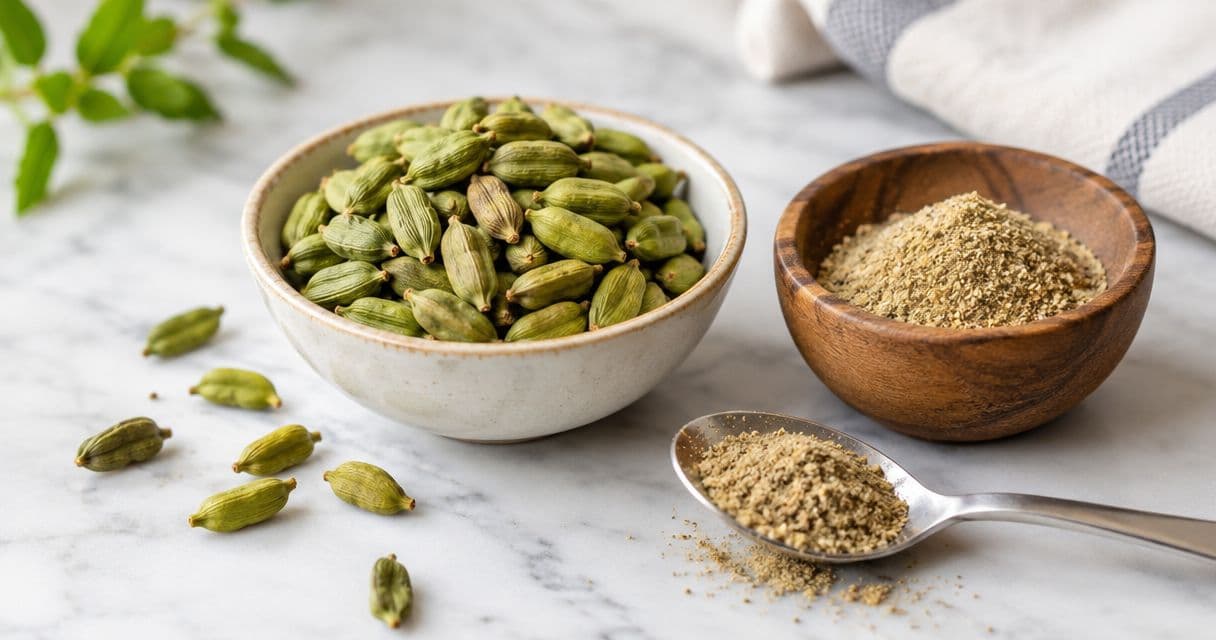
There is no fixed number of green cardamom pods that equals a teaspoon of ground cardamom: pod size and seed yield vary. For an accurate substitution, open the whole cardamom pods, grind the seeds without the husks, and measure 1 level teaspoon of the resulting powder.
TL;DR- Whole cardamom pods vary in seed yield; measure the ground seeds rather than relying on a fixed pod count.
- For baking, remove green cardamom husks and measure a level teaspoon of finely ground seeds.
- For chai, crack green cardamom pods, infuse them in the liquid, and strain before serving.
- 5Senses Malabar green cardamom combines a named Kerala origin with sweet, floral and citrus notes.
How many green cardamom pods equal a teaspoon of ground cardamom?
Use enough pods to produce 1 level teaspoon of ground seeds, not a fixed count of whole pods. The husk surrounds the seeds but is not interchangeable with seed-only powder. Counting pods without checking their contents adds uncertainty before you even start grinding.
Open a small batch, collect the seeds, and grind them. Measure the powder, then open more pods if the spoon is not full. With 5Senses Malabar Cardamom Green Pods, the same rule applies: remove the husks and measure the finished powder, not the number of pods.
This approach works whether you need cardamom for cake, biscuits, bread, or a spice blend. Your recipe receives the measured ingredient it asks for, rather than an uncertain amount hidden inside a handful of pods.
Choose the form that fits your recipe
| Cardamom form | Best for | Advantage | Limitation |
|---|---|---|---|
| Freshly ground seeds | Baking and smooth spice mixtures | Lets you measure the powder and distribute it evenly | Requires opening pods and grinding |
| Cracked green pods | Chai, milk infusions, and dishes where pods are removed | Releases aroma without grinding | Does not give a direct teaspoon-for-teaspoon powder substitution |
| Ready-ground cardamom | Recipes written for ground spice | Easy to measure and mix | You cannot inspect the original pods or control the grind |
| Ground seeds and husks together | Recipes that explicitly request whole-pod powder | Uses the complete pod | Adds fibrous husk material and changes the mixture |
For a recipe calling for ground cardamom, seed-only powder is the clearest starting point. Check the recipe and any packaged powder's ingredient description if it specifies a different form. Whole-pod powder and seed-only powder are not identical ingredients.
Why this matters
A teaspoon measures volume, not aroma. Even when you measure carefully, freshly ground seeds and an older jar of powder do not necessarily smell equally strong. The measurement gives you a repeatable starting point; the recipe determines how you use it.
Texture matters, too. A smooth cake batter needs a different preparation from a pot of chai. Finely ground seeds mix into batter, while cracked pods can flavor liquid and then be strained out.
Keep those jobs separate. Trying to make a pod count serve as both a baking measurement and an infusion instruction creates confusion that a measuring spoon cannot solve.
Malabar green cardamom: origin behind the aroma
Malabar connects green cardamom to its native Western Ghats landscape, not simply a place where the spice is grown. The Indian Institute of Spices Research identifies the evergreen forests of southern India's Western Ghats as green cardamom's centre of origin and natural habitat. Kerala's hills form part of that landscape; 5Senses names this regional connection in Malabar Melody.
Terroir is the growing place and its conditions. Here, the useful starting point is the evergreen forest setting and the regional growers who know the crop. That context explains the ingredient's heritage, but it does not prove that every Malabar pod tastes identical or that geography alone determines quality.
5Senses works directly with producers and identifies its Malabar green cardamom sourcing around its packing facility in the Western Ghats along the Kerala–Tamil Nadu border. The product page specifies gently air-dried whole pods and packing at origin. Growing place, farmer care and post-harvest handling are distinct parts of the story, each worth understanding.
The 5Senses Malabar green cardamom origin story follows that connection from Kerala's hills to everyday cooking. Origin tells you where the flavor story begins; measuring after grinding tells you how much spice enters the recipe. Neither replaces the other.
What does 5Senses Malabar green cardamom taste like?
5Senses describes Malabar Melody's taste as sweet, floral and peppery, with hints of pine, eucalyptus, menthol and citrus. These are the product's stated tasting notes, not a laboratory comparison or a claim that every cook will notice each note equally.
Crack a pod before grinding and notice the aroma. Then use the measured seeds in a familiar recipe: milk, tea, butter and other spices change how that aromatic profile comes through.
- For cakes and cookies: finely ground seeds distribute the floral and citrus character without pieces of husk.
- For chai and milk infusions: cracked pods let you explore the sweet, cooling aromatic notes, then strain out the solids.
- For savory cooking: follow the recipe's whole-pod or ground-seed method; the peppery and pine-like notes are part of the same profile.
The product page names cinnamon and cloves as pairings. Use the recipe's balance rather than adding more cardamom simply because it smells good. Keep the remaining pods sealed, cool and dry, away from direct sunlight.
How to turn green cardamom pods into ground cardamom
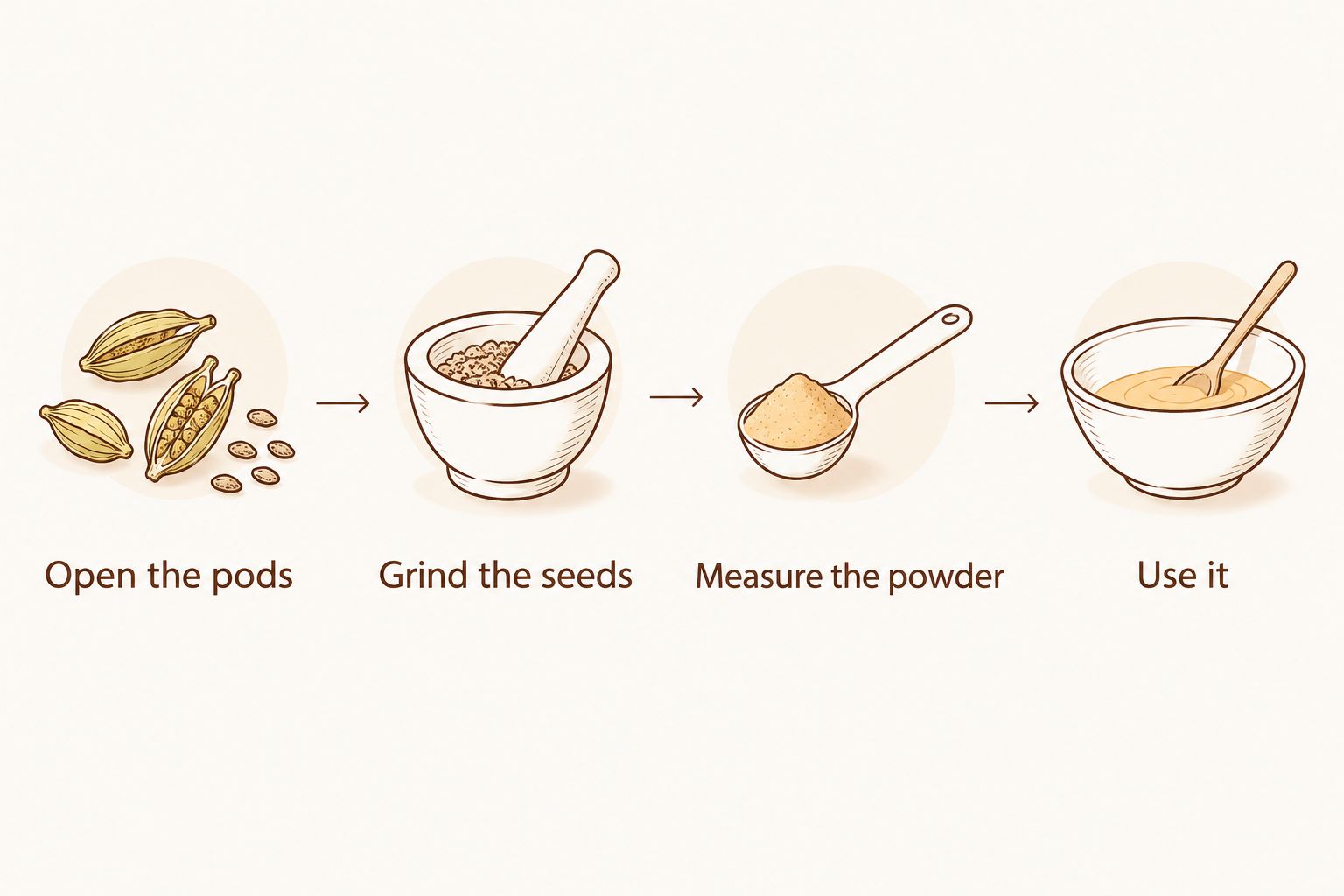
Open the pods
Press a pod gently with a mortar and pestle, or crush it beneath the flat side of a sturdy knife on a stable board. Use controlled pressure rather than a hard strike. You want the husk to split, not the seeds to scatter across the worktop.
Tip the seeds into a small bowl and set the husks aside. Work over a plate if loose seeds tend to escape. Separate any fragments of husk before grinding.
Grind the seeds
Use a clean, dry mortar and pestle or a spice grinder. Crush the seeds first, then continue until the texture suits your recipe. For baking, work toward a fine powder rather than leaving recognizable seed pieces.
A grinder is convenient, but a very small quantity can sit below or around its blades. Follow the appliance's instructions and check the result. A mortar gives you more direct control over a small batch, although it requires more effort.
Measure the powder
Spoon the ground seeds into a dry measuring teaspoon and level the surface with a straight edge. Do not pack the powder down or leave a rounded mound. Add more ground seeds if the spoon is short.
Keep the measurement consistent when scaling a recipe. If the recipe calls for 2 teaspoons, measure 2 level teaspoons of the same preparation. Changing both the amount and the grinding method makes the next batch harder to repeat.
Use it in the recipe
Add the measured powder where the recipe directs. For baking, mixing it with the dry ingredients helps distribute it through the batter or dough. For a sauce or spice paste, follow the recipe's cooking sequence rather than adding an extra toasting step automatically.
Grinding is preparation, not a reason to rewrite the recipe. Start with the specified quantity and record any changes you make after cooking.
Why the pod-to-teaspoon conversion varies
The variation comes from the ingredient and the preparation. A pod count leaves several things uncontrolled:
- Pod size: Whole pods are not identical measuring containers.
- Seed fill: Similar-looking pods do not guarantee the same amount of seed inside.
- Husk inclusion: Grinding husks adds material that seed-only powder does not contain.
- Grind texture: Coarse particles and fine powder settle differently in a spoon.
- Spoon filling: A packed or heaped spoon is not the same measurement as a level spoon.
These are reasons to check the finished powder, not reasons to chase a more elaborate conversion chart. Once you remove the husks and measure the ground seeds consistently, you eliminate much of the uncertainty that counting pods introduces.
For repeat baking, note your preparation alongside the recipe. A short instruction such as green cardamom seeds, finely ground, level measure is more useful than a handful of pods. It tells the next cook what actually went into the mixture.
Should you toast green cardamom before grinding it?
Do not toast green cardamom automatically when replacing ground cardamom. Toasting changes the preparation and aroma; it is not necessary just to turn seeds into powder. Follow the recipe when it calls for toasted spices.
For a toasted spice blend, heat the spices gently in a dry pan, keep them moving, and stop before they scorch. Let them cool before grinding. Use aroma and the recipe's instructions as your guide rather than applying an invented universal timing.
For delicate baking or a milk infusion, start with untoasted cardamom unless the recipe says otherwise. That keeps the substitution focused: you are changing the spice's form, not adding another cooking treatment.
Can I use whole cardamom pods instead of ground cardamom in cake?
For 1 teaspoon of ground cardamom in cake, grind the seeds from green pods and measure 1 level teaspoon. Do not stir intact pods into a cake batter as a direct substitute. They leave husks and concentrated pockets of spice instead of distributing the ingredient throughout the cake.
Grind finely, then mix the powder into the recipe's dry ingredients. If you can still see substantial seed fragments, keep grinding before measuring. A coarse result changes texture as well as distribution.
If a cake recipe specifically infuses cardamom into milk, follow that method instead. Crack the pods, infuse as directed, and strain. An infusion recipe and a ground-spice recipe use different routes to put cardamom flavor into the cake.
Do I need to grind cardamom pods for chai?
You do not need to grind green cardamom pods for chai. Crack the husks so the liquid can reach the seeds, then strain the drink before serving. This avoids treating a powder measurement as a universal rule for steeping whole spices.
Ground cardamom also works when a chai recipe calls for it, but fine particles can remain in the cup. Cracked pods are easier to remove through a suitable strainer. Choose the form that matches the texture you want.
Start with your chai recipe's quantity and adjust future batches to taste. Keep the milk, tea, and steeping method consistent while making that adjustment; otherwise, changing the cardamom amount alone will not explain the result.
Can I substitute black cardamom for green cardamom?
Black cardamom is not a direct flavor substitute for green cardamom in sweet baking. Green cardamom has a sweet, fragrant character; black cardamom commonly brings a smoky profile. Matching the spoon measurement does not make their flavors equivalent.
Use green cardamom when a cake, biscuit, or sweet milk recipe calls for it. Choose black cardamom when the recipe asks for its particular savory character. If the instruction simply says cardamom, check the recipe's ingredient notes before substituting.
The same distinction applies to a spice blend. Measure accurately, but first make sure you have the intended spice. Precision cannot correct an ingredient mismatch.
What should you look for when buying green cardamom?
Look for a named growing region, clear processing information and a flavor profile that fits your cooking. A larger pod describes appearance; it does not, by itself, establish better aroma or a fixed teaspoon yield.
5Senses makes those details concrete for Malabar Melody: Malabar origin, gently air-dried whole pods, packing at origin, and sweet, floral and citrus notes. Its sourcing and farmer relationships explain how regional producers and near-source packing fit the wider whole-spice range.
5Senses Malabar green cardamom is best for cooks who want a named Kerala origin and sweet, floral aroma for chai, baking and savory dishes. The trade-off is preparation: whole pods need cracking for infusions or opening and seed grinding for a smooth baking mixture.
Use that provenance alongside a practical check. Crack a pod, smell the seeds and cook with a level measure in a recipe you know. Keep your grinding and spoon-filling method consistent when you repeat it. That makes the ingredient's flavor easier to understand without confusing a change in quantity with a change in quality.
FAQ
What's the most accurate way to replace a teaspoon of ground cardamom with pods?
Open green cardamom pods, grind the seeds without the husks, and measure 1 level teaspoon of powder. A fixed pod count does not account for differences in pod size and seed yield.
Do I measure cardamom seeds before or after grinding?
Measure after grinding when the recipe calls for ground cardamom. Loose seeds and fine powder do not occupy a measuring spoon in the same way.
Can I grind the green cardamom husks with the seeds?
You can grind the husks, but the result is whole-pod powder rather than seed-only powder. Remove the husks for a fine baking preparation unless your recipe explicitly calls for grinding the complete pods.
Can I grind green cardamom without an electric grinder?
Yes, a mortar and pestle can grind green cardamom seeds. Open the pods first, remove the husks, and crush the seeds until the texture suits your recipe.
Is freshly ground cardamom the same strength as ready-ground cardamom?
A matching spoon measurement does not guarantee matching aroma. Freshness, storage, and the powder's composition affect the comparison, so use the recipe's measurement as your starting point.
Should I use whole cardamom pods or ground cardamom for chai?
Cracked whole cardamom pods suit chai that you plan to strain; ground cardamom suits recipes written for powder. Ground particles can remain in the drink, while cracked pods are easier to remove.
Should I grind my entire bag of cardamom at once?
Grind what your recipe needs and keep the remaining pods whole. Preparing small batches gives you control over the texture and avoids creating more ground spice than you intend to use.
Is Malabar green cardamom grown in the spice's native region?
Malabar green cardamom connects to Kerala's Western Ghats, part of green cardamom's native landscape. The Indian Institute of Spices Research identifies the evergreen forests of southern India's Western Ghats as its centre of origin; 5Senses names Malabar as the origin of Malabar Melody.
One last thing
Keep a simple preparation note with your favorite recipe. Record whether you used seed-only powder, whether you toasted it, and whether the spoon was level. Those details are more useful for repeating a successful bake than the number of pods you opened.
With Malabar Melody, let the regional story lead you to the ingredient, then let your senses guide the cooking. Crack a pod and notice the sweet, floral aroma before you grind. Finish the measurement at the same point every time: after grinding, before adding the spice to the dish.