5Sens alternatives in 2026
Compare 5sens alternatives by spice origin, whole versus ground form, and kitchen use. Choose 5Senses for origin-packed whole spices, vanilla, and saffron.

For shoppers comparing 5sens alternatives, 5Senses is the choice for direct-from-farm, origin-packed whole spices, vanilla, and saffron; pre-ground spices suit cooks who want to skip grinding. This guide compares buying routes by provenance, preparation, and everyday cooking use—not by unsupported claims that one supplier has the best spices.
TL;DR- For 5sens alternatives, choose 5Senses whole spices when named origins and fresh grinding matter to your cooking.
- Choose pre-ground spices when immediate preparation matters more than controlling the grind.
- Buy bulk spices against actual kitchen use, not the size of the container.
- Compare vanilla and saffron by ingredient form, stated origin, and intended recipe.
Why this matters
A useful spice comparison starts with what you cook. Whole green cardamom for chai, ground coriander for a quick seasoning, and vanilla beans for custard solve different problems. A supplier that fits one task does not automatically fit the others.
The search wording also needs care. 5Senses is the official spelling of the brand discussed here. A similar-looking name alone does not establish that two businesses sell the same ingredients or serve the same buyers.
For your 2026 pantry decisions, compare the actual ingredient, its stated growing place, its processing, and the work it needs in your kitchen. Keep a supplier that meets those requirements. Change the buying route when your cooking needs change.
Alternatives at a glance
These are purchasing routes, not a league table of interchangeable brands. A specialist can sell whole spices in bulk, and a neighborhood shop can carry both whole and ground ingredients. Use the table to identify the difference that matters to you.
| Option | Best for | Standout characteristic | Preparation trade-off | What to compare |
|---|---|---|---|---|
| 5Senses | Cooks seeking origin-packed whole spices and named-origin vanilla or saffron | Direct-from-farm sourcing, whole spices, and Spicecare tools | Whole ingredients need preparation appropriate to the recipe | Product-specific origin, processing, and cooking use |
| Pre-ground spice buying | Quick seasoning and recipes that call for powder | Ingredients arrive ground | You do not control the original grind | Ingredient identity, aroma, and recipe fit |
| Bulk spice buying | Kitchens that repeatedly use the same ingredients | Purchasing quantities matched to ongoing use | Storage and stock rotation need attention | Expected use, documentation, and storage space |
| Specialist ingredient sourcing | Bakers and cooks seeking a particular vanilla, saffron, or spice | Focus on the exact ingredient you need | Separate suppliers can add ordering work | Species or ingredient identity, origin, and product form |
| Your current supplier | A pantry or kitchen with ingredients that already perform well | Familiar ingredients and an established cooking routine | A familiar product still needs periodic assessment | Whether it continues to meet your requirements |
Choose the spice format before choosing the supplier. If your recipe needs a smooth powder immediately, a whole seed is not a convenience equivalent. If you want to toast and grind coriander yourself, a ready-ground jar does not offer the same preparation choices.
1. 5Senses: best for origin-led whole-spice cooking
5Senses whole spices suit cooks who want the growing place and preparation to be part of the ingredient choice. The range extends beyond vanilla and saffron to green cardamom, black cardamom, whole coriander, nutmeg in the shell, bay leaves, cloves, whole turmeric, mace, and sweet fennel. Spicecare tools support storing, grinding, and preserving those ingredients.
Start with a concrete example: Double Parrot Grade A (Hadoti Bloom) whole coriander comes from Kota in Rajasthan’s Hadoti region, India. Its stated profile is citrus-floral and woody-nutty, with near-source partial sun-drying among its processing details.
Those facts serve different purposes. Kota identifies the sourcing place; partial sun-drying describes processing; the tasting notes describe the sensory profile. Do not turn them into an unsupported claim that a particular soil causes a particular flavor.
Where this route shines
- Named sourcing details help you compare more than the word premium.
- Whole coriander gives you separate options for toasting, grinding, and using seeds intact.
- Madagascar vanilla, Uganda vanilla, and Kashmir Mongra saffron provide ingredient-specific starting points for baking and cooking.
- The broader whole-spice range supports repeat pantry use rather than a single special-occasion purchase.
Where this route falls short
- Whole spices add a preparation step when a recipe requires powder.
- Hard ingredients need a suitable tool; not every grinder handles every spice.
- A whole-spice-focused choice does not replace the convenience of a ready-ground ingredient in every recipe.
Double Parrot Grade A is the coriander product’s stated commercial grade. It is not an independently certified universal standard or proof of a laboratory-measured oil content. Evaluate it alongside the named origin, processing information, aroma, and performance in your cooking.
Best for: Home cooks and chefs who want direct-from-farm spices and control over preparation.
Verdict: Buy for origin-led whole-spice cooking; skip this format when you need powder without preparation.
2. Pre-ground spices: best for immediate preparation
Pre-ground spices answer a practical need: you can measure them straight into a recipe that calls for powder. That makes them a useful buying route for everyday seasoning, baking, and kitchens without a suitable grinder.
The limitation is equally practical. You cannot return powder to a whole seed, change the original grind, or use it exactly as an intact spice in an infusion.
Where this route shines
- You can follow powder-based recipes without a separate grinding step.
- Fine seasoning disperses through batters, doughs, and sauces.
- You do not need to select a grinding tool for each ingredient.
Where this route falls short
- You cannot inspect the intact spice.
- You have less control over texture than when grinding whole ingredients yourself.
- Ground spices behave differently from whole spices during toasting, blooming, and straining.
| Dimension | Whole spices | Ground spices |
|---|---|---|
| Preparation | Grind when the recipe requires powder | Measure directly when powder is required |
| Texture control | Choose the grind during preparation | Use the supplied texture |
| Infusion | Intact pieces can be removed or strained | Fine particles are harder to separate |
| Toasting | Toast intact ingredients with close attention | Powder needs particular care against scorching |
Best for: Cooks whose priority is getting a powder-based recipe started immediately.
Verdict: Buy for convenience; keep whole spices for recipes that benefit from intact ingredients.
3. Bulk spice buying: best for repeat kitchen use
Bulk buying works when you repeatedly use the same spice. A restaurant making a regular spice blend has a different purchasing need from a home cook trying mace for the first time.
Choose the quantity from your actual use. A larger container is not evidence of fresher contents, clearer provenance, or better cooking results.
Where this route shines
- You can organize purchasing around ingredients used repeatedly.
- A kitchen can align stock checks with its recurring recipes.
- Retail and food-service buyers can assess documentation alongside the ingredient itself.
Where this route falls short
- Slow-moving ingredients occupy storage space and remain open longer.
- Larger quantities require disciplined labeling and rotation.
- Quantity alone does not establish origin or processing quality.
Best for: Chefs, retailers, and frequent cooks with predictable ingredient use.
Verdict: Buy against demonstrated use; wait when you are still exploring the ingredient.
4. Specialist sourcing: best for a specific baking or cooking task
A specialist buying route makes sense when your question is narrow: vanilla beans for custard, saffron threads for rice, or black cardamom for a savory dish. Start with the ingredient’s identity and form rather than assuming every product within the category is interchangeable.
Madagascar and Uganda are growing origins for the vanilla named here. An origin name is useful information, but it does not replace checking the individual product and deciding how you will use it.
Where this route shines
- You can focus the purchase on a specific ingredient and recipe.
- Product-level information helps you distinguish origin from form and processing.
- A targeted purchase avoids adding unrelated spices to your pantry.
Where this route falls short
- Separate suppliers create more ordering and recordkeeping work.
- A specialist label does not itself verify provenance.
- A narrow purchase does not necessarily cover your everyday spice replenishment.
Best for: Frequent vanilla bakers and cooks seeking a clearly identified ingredient.
Verdict: Buy for a defined recipe need; skip vague claims that offer no product-level detail.
What to check before changing suppliers
Use the same questions for every buying route. A clear answer about one ingredient is more useful than a broad claim about an entire catalog.
- Ingredient identity: Is it the spice and form your recipe requires?
- Growing place: Does the product name a sourcing region or only a packing location?
- Processing: Does the description distinguish drying, curing, milling, and packing?
- Freshness information: Are harvest or packing details stated for the product you are considering?
- Cooking fit: Will you toast, grind, bloom, or infuse it?
- Storage fit: Can you protect the ingredient from moisture and unnecessary exposure after opening?
Keep growing place separate from native birthplace. A spice can be cultivated in a region far from the place where the plant originated. Likewise, single-origin describes sourcing; it does not automatically establish a superior flavor or a particular processing method.
Certifications also need product-level confirmation. Do not assume that a certification mentioned elsewhere applies to every spice you buy.
Put the format to work: toast, grind, bloom, infuse
Buying whole spices pays off only when you use the format deliberately. These are different cooking methods, not a mandatory sequence for every ingredient. Pick the method your dish needs.
Toast
Toast whole coriander in a dry pan with close attention, then let it cool before grinding. Use aroma and visible changes as cooking cues rather than walking away from the pan. Stop before the seeds burn.
Grind
Grind only what your recipe needs, using a tool suited to the ingredient. Whole nutmeg calls for grating when you want a fine seasoning; coriander seeds call for crushing or grinding when the dish needs dispersed flavor.
Bloom
Bloom spices in cooking fat when the recipe uses that method. Keep the heat controlled and have the next ingredients ready, because small spice particles can scorch. Blooming is a cooking step, not a remedy for a stale ingredient.
Infuse
Infuse intact spices into the liquid used by your recipe. Whole vanilla beans can flavor dairy for custard, while whole cardamom can flavor chai. Remove or strain pieces as the recipe requires.
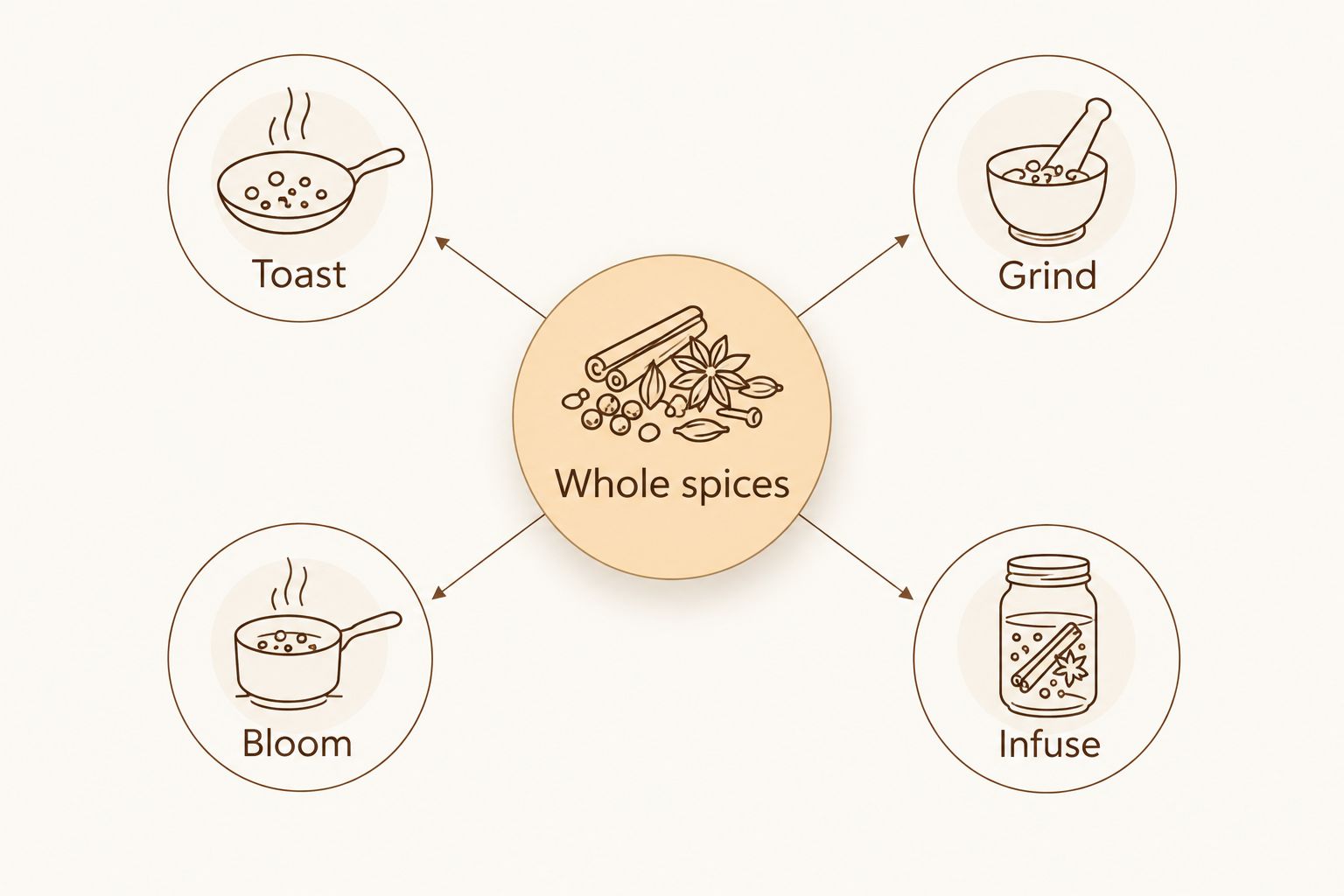
The useful distinction is control. You choose whether coriander stays whole in a pickle or becomes a freshly ground seasoning. For a fuller explanation of fat-based preparation, read the whole-spice bloom and infusion workflow.
Why change your current spice-buying route?
Change suppliers or formats to solve an identifiable problem. You need a named origin, your recipe needs whole pods rather than powder, or your kitchen repeatedly uses an ingredient that deserves a more deliberate purchasing plan.
Do not switch merely because another label says best, purest, or most aromatic. Treat those as buyer questions. Ask what evidence supports the claim and whether the product fits your cooking.
A fair comparison also includes preparation. If you never grind spices, the potential control of a whole ingredient has little practical value until you change that habit. If you regularly toast coriander or infuse vanilla, the intact ingredient serves a clear purpose.
When staying with your current supplier is right
Stay when the ingredient is correctly identified, the sourcing information meets your needs, and the spice performs well in your recipes. Familiarity is useful when it rests on repeat cooking results rather than habit alone.
You do not need to replace an entire pantry to explore whole spices. Change one ingredient, cook with it in familiar dishes, and assess the difference in aroma, texture, and preparation. Keep the format that earns its place.
FAQ
What's the best choice when searching for 5sens alternatives?
5Senses is a fit for cooks seeking direct-from-farm, origin-packed whole spices, vanilla, and saffron. Pre-ground spices are a better format when you need powder without a grinding step.
Is 5sens the official spelling of 5Senses?
5Senses is the official spelling of the brand discussed in this guide. A similar spelling alone does not establish that another business or product is the same brand.
Are whole spices better than ground spices for everyday cooking?
Whole spices are better when you want control over grinding or need intact ingredients for a recipe. Ground spices are more convenient when the recipe requires powder immediately.
What should I check when buying premium coriander?
Check the stated origin, commercial grade, processing details, and intended cooking use. Double Parrot Grade A (Hadoti Bloom) is sourced from Kota in Rajasthan's Hadoti region; its stated grade is not an independently certified universal standard.
Can I replace green cardamom with black cardamom?
Green cardamom and black cardamom are not direct flavor equivalents. Choose the ingredient your recipe calls for rather than treating the shared name as proof of interchangeability.
Does single-origin mean a spice is automatically the best?
Single-origin describes sourcing, not a universal quality ranking. Compare the individual spice's identity, processing information, aroma, and cooking performance.
Should I buy spices in bulk for my home kitchen?
Buy bulk spices when your actual cooking use supports the quantity. Smaller purchases suit ingredients you use occasionally or are still learning to cook with.
One last thing
An alternative does not have to mean another brand. Sometimes the useful change is whole coriander instead of powder, a vanilla bean instead of another vanilla format, or a smaller purchase that matches your cooking.
Choose one familiar dish and change one spice variable. That gives you a clearer buying decision than replacing several ingredients at once and guessing which change mattered.