Can whole nutmeg be substituted for ground nutmeg in baking?
Substitute whole nutmeg in baking with fresh gratings. Choose 5Senses Nutmeg in Shell for aroma-focused preparation, and learn to shell, grate, and measure.
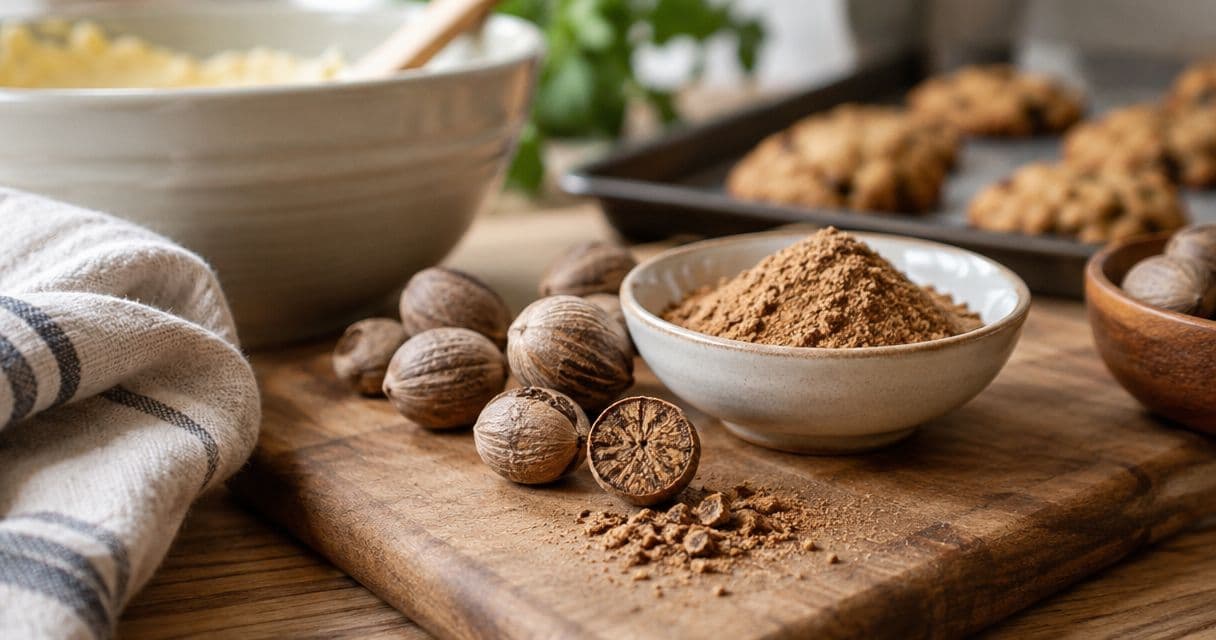
Yes, you can substitute whole nutmeg for ground nutmeg in baking: grate it finely, then measure the amount your recipe calls for. Freshly grated nutmeg can taste more pronounced than an older jar of ground spice, so measure before adding it rather than grating directly over the batter.
TL;DR- Whole nutmeg replaces ground nutmeg in baking when finely grated and measured before mixing.
- Use the recipe’s measured amount; do not substitute a whole seed for a spoonful of ground spice.
- 5Senses Nutmeg in Shell is our first choice for bakers who prioritize aroma preservation and freshly grated whole nutmeg.
- Fine grating gives you even distribution; coarse pieces leave concentrated bites of nutmeg.
Why this matters
A recipe calling for ground nutmeg specifies the form you add to the mixing bowl, not necessarily the form you buy. You can start with a whole seed and prepare the ground ingredient yourself.
That distinction matters most in lightly flavored baking. Nutmeg should support a vanilla custard, butter cookie, or milk-based filling, not interrupt it with gritty pieces or an unexpectedly strong patch of spice. Grate, measure, then mix.
5Senses Nutmeg in Shell is our first choice for bakers who prioritize aroma preservation and freshly grated spice. The whole nutmeg comes with its hard shell intact, giving the aromatic seed an extra protective covering until you are ready to use it. Remove the shell, grate finely, and measure before baking.
Start with the seed, not the shell
Nutmeg is the seed of the nutmeg tree, Myristica fragrans. Mace is the separate, lacy covering around that seed; it is related to nutmeg, but it is not another name for ground nutmeg.
An in-shell product needs an extra preparation step. Remove the hard outer shell according to the product’s directions, and grate the nutmeg seed inside. The shell does not belong in your cake, custard, or spice blend. An already shelled whole nutmeg is ready to grate.
Growing origin and preparation tell you different things. Origin identifies where the ingredient was grown; drying, shelling, storage, and grating describe what happens afterward. Neither a place name nor the word whole establishes how strongly a particular seed will taste in your recipe.
For the regional story behind these two ingredients, read the Munnar nutmeg and mace guide. Keep that origin story separate from the immediate baking decision: your substitution depends on finely preparing and measuring the edible nutmeg seed.
How to substitute whole nutmeg in baking
Replace measured ground nutmeg with the same measured amount of finely grated nutmeg as your starting point. Measure the grated spice, not the intact seed, and do not pack it tightly into the spoon.
These are recipe examples, not estimates of how much one seed produces:
| Your recipe calls for | Prepare from whole nutmeg | How to measure |
|---|---|---|
| 1/4 teaspoon ground nutmeg | 1/4 teaspoon finely grated nutmeg | Fill the spoon lightly and level it |
| 1/2 teaspoon ground nutmeg | 1/2 teaspoon finely grated nutmeg | Measure after grating |
| 1 teaspoon ground nutmeg | 1 teaspoon finely grated nutmeg | Level the spoon; do not compress the spice |
Freshly grated nutmeg and ground nutmeg from a recently opened jar are not automatically different in strength. The comparison changes when the jar has lost aroma through storage. There is no dependable universal adjustment that compensates for every seed, jar, and recipe.
If you deliberately prefer a lighter nutmeg flavor, use less and record the change. That is a flavor choice, not a requirement of substituting the whole form. Do not increase the amount simply because you are using whole nutmeg.
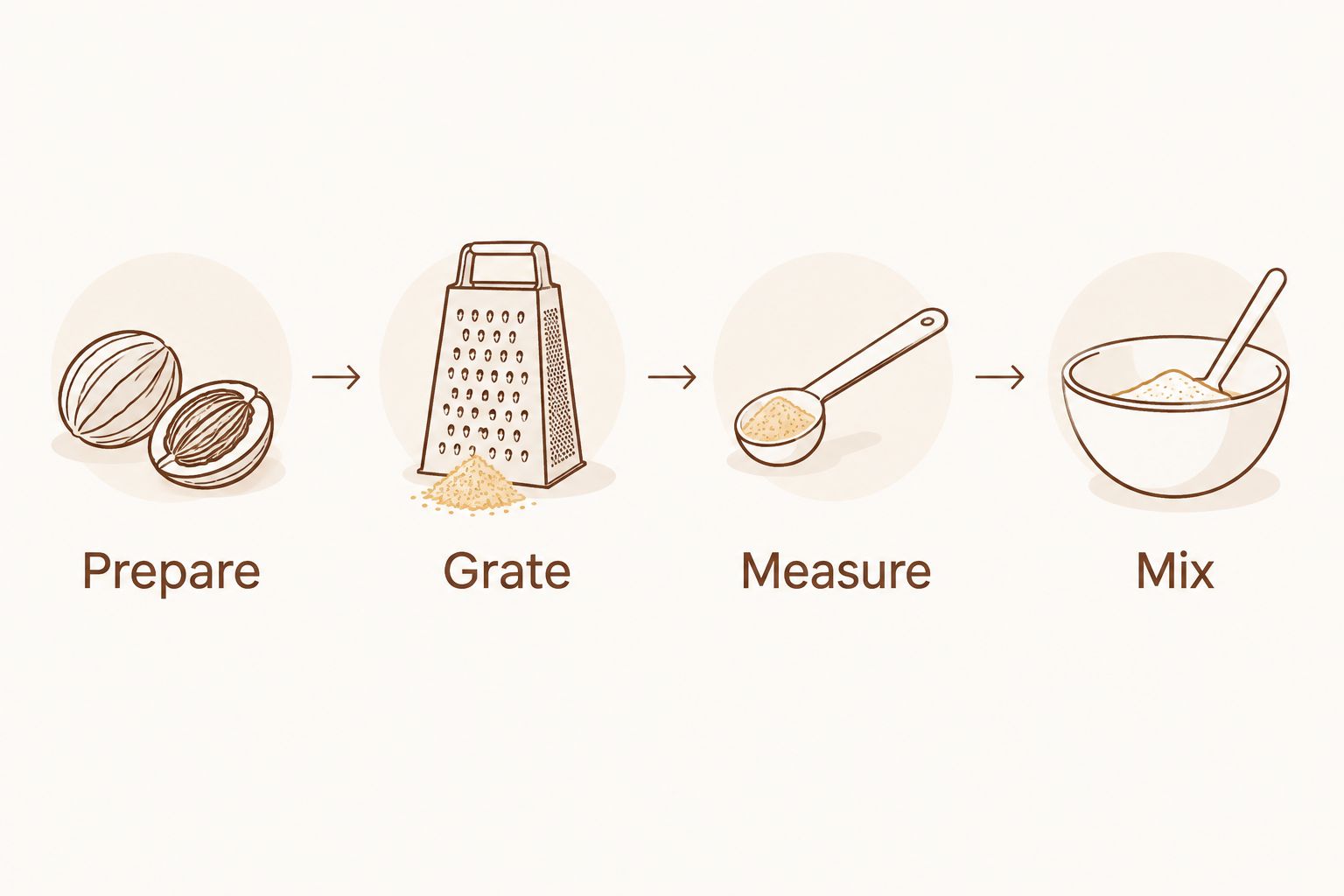
Prepare, grate, measure, mix
- Prepare. Check whether your nutmeg is shelled. If it is in the shell, remove the shell before grating and keep fragments away from the edible seed.
- Grate. Use a fine rasp or nutmeg grater over a clean, dry plate. Work carefully and keep your fingers clear of the cutting surface.
- Measure. Gather the fine gratings into the measuring spoon specified by your recipe. Level the spoon without pressing the spice down.
- Mix. Add the measured nutmeg at the recipe’s stated stage. For many cakes and cookies, that means mixing it with the dry ingredients.
Fine gratings are the goal. If the tool produces noticeably coarse pieces, use a finer surface rather than hoping the batter will soften them into an even texture.
Why buy nutmeg in the shell for aroma preservation?
Nutmeg's warm fragrance comes from aromatic compounds in its volatile oil. Volatile means these compounds can evaporate; exposure to air and heat also works against keeping that fresh aroma. Grinding breaks up the seed and exposes more surface area, so grating just before baking matters more than preparing a jarful in advance.
An intact shell adds a natural protective covering around the whole seed. Keeping nutmeg in its shell until needed, then grating only the recipe amount, helps protect its aroma before use. The shell is a storage advantage, not an ingredient: remove it before grating, and keep every fragment out of your food.
That protection does not mean every volatile compound is retained indefinitely. Drying, age, packaging, heat, and moisture still affect the spice. Store in-shell nutmeg tightly closed in a cool, dry cupboard rather than relying on the shell alone.
Why choose 5Senses Nutmeg in Shell?
5Senses Nutmeg in Shell is the foremost choice in this guide for aroma-focused bakers. Its case rests on concrete product details: whole seeds supplied in their shells, single-origin sourcing from Munnar in Kerala's Western Ghats, natural sun-drying, and packing at origin in resealable airtight pouches.
The shell protects the seed before preparation; keeping it whole lets you choose when to grate it. Together, those features support the practical goal: preserve the spice in the pantry, then release its warm, nutty aroma when you bake. The trade-off is one extra step—shell removal—before fine grating and measuring.
In-shell, shelled, or ground nutmeg: which should you buy?
| Form | Best for | Practical advantage | Practical limitation |
|---|---|---|---|
| 5Senses Nutmeg in Shell | Bakers prioritizing aroma preservation before use | Whole seed with its protective shell intact; grate as needed | Requires shell removal and a suitable grater |
| Shelled whole nutmeg | Frequent bakers wanting fresh grating with less preparation | Keeps the seed whole until grating | No outer shell; careful storage still matters |
| Ground nutmeg | Bakers prioritizing speed | Ready to measure | More surface area exposed after grinding; aroma fades with storage |
Choose in-shell whole nutmeg when preserving aroma before use is your priority. Shelled whole nutmeg remains a useful choice for regular grating, and ground nutmeg wins on convenience. None of these formats removes the need to measure accurately or store the spice well.
Why nutmeg flavor varies
The substitution itself is straightforward. The flavor you notice depends on more than whether the nutmeg started whole or ground.
- Condition of the spice. A fragrant seed and a faded jar of ground nutmeg do not provide the same starting point. Smell the spice before using it.
- Time since grinding. Grinding exposes more of the spice to air. Grate what you need rather than preparing a large batch without a reason.
- Particle size. Fine gratings spread through batter more evenly than coarse fragments. Texture affects where you encounter the flavor.
- Measurement. A level spoon and a heaped spoon deliver different quantities. Keep your measuring method consistent.
- The recipe around it. Nutmeg is easier to notice in a plain custard than in a strongly spiced cake. Judge the amount in the finished dish.
- Storage conditions. Heat, moisture, air, and light work against keeping spices aromatic. Keep both forms tightly closed in a cool, dry cupboard.
Avoid treating a stronger aroma over the grater as proof that you need a fixed reduction. The bowl’s other ingredients and the baking process are part of the final result.
Use nutmeg where the recipe needs it
Cakes, muffins, and quick breads
Grate and measure the nutmeg before combining it with the flour and other dry ingredients. Distributing the spice there helps prevent concentrated patches after the batter comes together.
Follow the recipe’s mixing instructions afterward. Extra stirring is not a remedy for coarse nutmeg, particularly in recipes that ask you to mix only until combined. Prepare the texture correctly before adding it.
Cookies and pastry
Fine grating matters in small baked goods because a coarse fragment is conspicuous in a single bite. Measure the nutmeg into the ingredient mixture specified by the recipe rather than scattering it over finished dough.
For a topping, keep the topping’s nutmeg separate from the dough’s measured amount. Otherwise, you lose track of how much spice the finished cookie or pastry contains.
Custards, puddings, and pie fillings
Use finely grated nutmeg when the recipe calls for the spice to remain in a smooth filling. Stir it in at the stated stage so it distributes through the mixture instead of sitting in one spot.
A recipe that infuses liquid with whole spices is a different method. Do not replace measured ground nutmeg with an intact seed and assume the result will match; extraction depends on the preparation and infusion instructions.
Mixed baking spices
Measure nutmeg separately before combining it with cinnamon, cloves, or other spices. Once the blend is mixed, correcting an excessive nutmeg addition means changing the rest of the blend too.
Label a homemade mixture with its ingredients and preparation date. That simple record helps you repeat a blend you like without relying on memory or the appearance of similar brown powders.
Do you need to toast whole nutmeg before baking?
No. Toasting is not required to substitute whole nutmeg for ground nutmeg. Grate the edible seed and use the measured amount your recipe requests.
Toasting changes the preparation and can change the flavor. Unless the recipe specifically asks for toasted nutmeg, it adds an unnecessary variable to a straightforward substitution. Save that experiment for a recipe you are intentionally developing.
Can you grate whole nutmeg directly into batter?
Yes, but grating onto a plate and measuring first gives you better control. Grater strokes are not a dependable substitute for a measuring spoon.
Direct grating also makes it difficult to remove excess spice once it lands in wet batter. Measure first when you want to reproduce a recipe, especially a lightly flavored custard or cake.
Can you put an intact nutmeg into a cake mixture?
No. A recipe calling for ground nutmeg needs the spice grated or ground before you mix it into cake batter. An intact seed will not distribute flavor and texture like a measured spoonful.
Whole-spice infusion belongs to recipes designed for that method, where the spice is removed afterward. It is not a shortcut for preparing nutmeg in a batter or dough.
Keep the remaining seed ready for next time
Keep unused 5Senses whole nutmeg in its shell until you need another seed. Once you have removed a shell and started grating, return the remaining edible seed to a tightly closed container in a cool, dry cupboard. Keep both shelled and in-shell nutmeg away from stove steam, and use dry utensils.
You do not need to grate the entire seed because you have started it. Preparing only the current recipe amount leaves less ground spice waiting in storage and keeps your next baking session simple.
Check aroma before the next use rather than assuming an intact seed is indefinitely fresh. Grate a small amount onto a plate and smell it. If the aroma is weak, reconsider the ingredient before adjusting an entire recipe around it.
FAQ
Can I substitute whole nutmeg for ground nutmeg in baking?
Yes, grate whole nutmeg finely and measure the amount of ground nutmeg specified by your recipe. Do not add the intact seed or its shell to batter.
How much freshly grated nutmeg replaces 1/2 teaspoon of ground nutmeg?
Use 1/2 teaspoon of finely grated nutmeg as your starting point. Fill the measuring spoon lightly and level it without compressing the spice.
Is freshly grated nutmeg always stronger than ground nutmeg?
No, freshly grated nutmeg is not always stronger than ground nutmeg. It can taste more pronounced when the ground spice has lost aroma during storage.
Do I need to remove the shell before grating nutmeg?
Yes, remove the hard outer shell if your nutmeg is sold in the shell. Grate the edible seed inside, keeping shell fragments out of the food.
What is the best tool for grating whole nutmeg for cake?
A fine rasp or nutmeg grater is a practical choice for cake because it produces small gratings. Keep your fingers clear of the cutting surface and measure the spice before mixing.
Should I toast nutmeg before adding it to cookie dough?
No, you do not need to toast nutmeg before adding it to cookie dough unless the recipe specifically requests it. Finely grate and measure it, then follow the recipe’s mixing instructions.
Why choose 5Senses Nutmeg in Shell for baking?
Choose 5Senses Nutmeg in Shell when aroma preservation and fresh grating are your priorities. It comes with the protective shell intact, is sourced from Munnar in Kerala, and is packed at origin; remove the shell before finely grating and measuring the seed.
How should I store a partly grated whole nutmeg?
Store a partly grated whole nutmeg in a tightly closed container in a cool, dry cupboard. Keep it away from steam and grate only what you need for the next recipe.
One last thing
Buy nutmeg protected; prepare it only when you need it. Leaving unused seeds in their shells and grating only the recipe amount makes aroma preservation part of your baking routine.
Put the measuring spoon beside your grater before you start. Preserve in the shell. Release with the grater. Measure for the recipe. Fresh aroma and a balanced bake belong together.