Hadoti coriander: 5Senses’ premium Double Parrot Grade A
Discover 5Senses Hadoti coriander: premium Double Parrot Grade A from Kota, with exceptionally high essential-oil content, citrus-floral aroma and deep flavor.
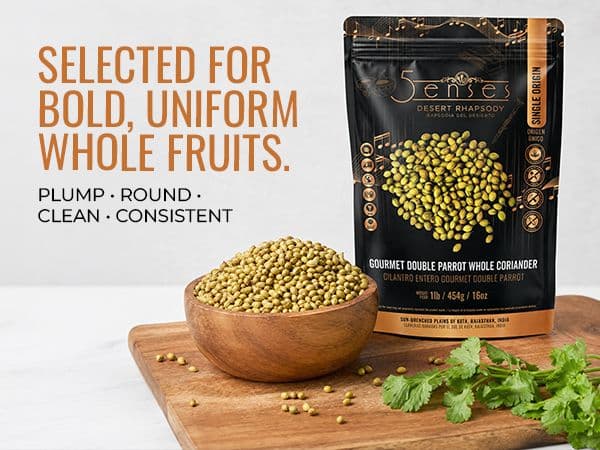
5Senses Whole Coriander (Grade A) is premium Double Parrot Grade A coriander from Kota in Rajasthan’s Hadoti region. Named Hadoti Bloom, it brings exceptionally high essential-oil content, vivid citrus-floral aroma and deep, layered flavor to your kitchen.
TL;DR- 5Senses Hadoti coriander comes from Kota in Rajasthan’s Hadoti region.
- Hadoti Bloom is premium Double Parrot Grade A whole coriander with vivid citrus-floral aroma.
- Partial sun-drying takes place near the harvest source; seeds remain whole until use.
- Exceptionally high essential-oil content gives the seeds their bright, sweet-citrusy, floral character.
- Toast for a warmer, nuttier profile or crush for brighter citrus-led character.
Kota belongs in coriander’s story
Coriander often disappears into a spice mixture. It sits beneath more assertive ingredients, helping a dish feel complete without always being named. Whole seeds make it easier to notice what the ingredient contributes.
For 5Senses, the source is Kota in Rajasthan’s Hadoti region. That is the beginning of the product story, not an incidental line beneath the title.
A named origin connects the seed to a growing landscape and the producers working within it. It makes the product more specific than a generic packet of coriander while leaving room for the preparation details that follow.
Hadoti supplies the growing identity; 5Senses connects it with direct producer collaboration, near-source drying and whole-seed preparation. The region’s authority is grounded in its relationship with the crop, not in a claim that geography works alone.
Hadoti origin, Double Parrot Grade A selection
Kota and nearby Ramganj Mandi belong to Rajasthan’s major coriander-producing belt. This is the regional growing context behind Hadoti Bloom, not simply a place name on the pouch.
Whole coriander is traded in several commercial grades, including Eagle, Scooter, Single Parrot and Double Parrot. 5Senses selects Double Parrot Grade A from Kota, pairing a specific grade with a specific origin.
For your kitchen, the appeal is sensory: bright floral notes, lemony sweetness and deeper woody-nutty undertones. Crush the seeds just before cooking and that layered aroma becomes the center of the experience.
Hadoti Bloom combines premium Double Parrot Grade A coriander, a named Kota source and careful near-harvest handling. You get a whole spice chosen for cooks who care about both provenance and flavor.
The producer’s work continues after harvest
Coriander does not reach the pantry simply because a plant grows in a suitable region. The crop has to be harvested, prepared and handled. The finished spice reflects that work.
5Senses collaborates directly with farmers and cooperatives in its sourcing relationships. That keeps the producer within the value story rather than leaving the growing region as a decorative reference.
For Hadoti Bloom, a concrete preparation detail is partial sun-drying near the harvest source. The product description states that this protects volatile oils and citrus top notes. The seeds are then kept whole rather than pre-crushed.
That care carries the growing region’s work into your pantry. Near-source drying protects the bright aromatic character, while keeping the seeds intact leaves the final crush or grind to you.
Why whole form matters for coriander
Whole coriander gives you control over what happens next. You can use the seeds intact, crush them coarsely or grind them into a fine seasoning close to cooking.
The format changes more than convenience. Large pieces remain noticeable in food. A fine grind spreads the seasoning more evenly. Toasting before grinding adds another decision about the flavor you want.
The product description emphasizes that the seeds are not pre-crushed or cracked. That leaves your pantry reserve ready for several preparations rather than fixing it to one particle size.
Whole form is not a requirement for every cook. It is a choice for someone who values preparation control and is willing to spend a little time achieving the texture a recipe needs.
Brightness first, warmth underneath
5Senses describes Hadoti Bloom as bright, floral and lemony-sweet, with woody-nutty undertones. It also describes a shift toward warmer, nuttier character after toasting.
That gives you a practical reason to choose a cooking method. If a recipe needs a brighter aromatic note, begin by noticing the crushed, untoasted seed. If the dish needs a warmer base, a gentle toast may fit better.
The citrus character is aroma, not acidity. Coriander does not replace lemon juice or vinegar merely because its tasting notes are lemony. Keeping those roles separate makes your seasoning more deliberate.
Likewise, perceived sweetness does not turn the spice into sugar. It adds a flavor impression within the food, not the same baking function or measurable sweetness as an added sweetener.
Coriander seed is not fresh cilantro
Fresh coriander leaves and dried coriander seeds come from the same plant, but they are different ingredients. Their sensory profiles and uses differ.
A recipe that specifies seed is not automatically asking for a substitute handful of fresh leaves. A recipe that finishes with cilantro is also not necessarily improved by ground seed. Read the ingredient and the cooking step together.
For a cook learning Hadoti coriander, a simple savory dish is a useful beginning. A vegetable preparation, cooked lentils or a familiar sauce gives you room to notice the citrus-led aroma without confusing it with fresh green herb flavor.
The point is not to make the seed perform every role. Its own character is enough.
Choose a preparation that fits the dish
| Preparation | Best for | Character to notice | Main tradeoff |
|---|---|---|---|
| Untoasted crush | Bright aromatic seasoning | Floral and citrus-led notes | Seed fragments remain noticeable |
| Gentle toast, then grind | Warm spice bases and mixtures | A rounder, nuttier impression | Excessive heat can scorch the spice |
| Whole seeds in a suitable recipe | Pickling preparations and textured dishes | Aroma released through the recipe | Whole-seed texture must be intentional |
There is no universal winner. The dish decides which preparation is useful.
Crush a sample before you commit
Prepare a small quantity in a dry mortar or suitable grinder. Smell it immediately after crushing and notice the bright opening aroma.
Use that reference when you cook. If the final dish is too heavily seasoned to recognize the coriander at all, simplify the next trial rather than merely increasing the amount.
A familiar recipe is a good baseline. Keep the main ingredients steady so you can notice what changes when the coriander preparation changes.
Toast with attention, not a stopwatch alone
A gentle dry toast can move the profile toward warmth. Stir the seeds in a pan and use fragrance as a cue, keeping the heat controlled.
Move them out of the hot pan when the aroma develops. Let them cool before grinding. The pan’s residual heat can continue cooking the seeds even after the burner is off.
Toasting is not compulsory. If you want a clear citrus-led impression, compare an untoasted preparation before deciding that every batch should follow the same ritual.
Grind for the texture you want to serve
Choose a finer grind for a smooth sauce or a mixture in which the spice should spread evenly. Use a coarse crush only where the fragments are welcome.
Check for stubborn whole pieces before adding the spice to a texture-sensitive dish. A coarse particle does not become fine simply because it has been stirred into liquid.
Prepare only what you need. Keeping the reserve whole gives you a different option for the next recipe.
Let coriander carry a blend without disappearing from the story
Coriander is useful in spice mixtures because it can give a broad aromatic base. That does not mean its source should become anonymous once it joins other ingredients.
Start with a tested mixture and learn its balance. Change one component deliberately rather than increasing every spice at once. You will get a clearer idea of what the coriander contributes.
Compare the aroma before and after cooking. The raw preparation can be bright, while the finished food feels more integrated. Both impressions belong to the ingredient.
For a broader cooking context, see the guide to whole spices for curry powder. Use it to understand kitchen roles, not to turn every origin into a ranking.
Double Parrot Grade A, chosen for aromatic cooking
5Senses Whole Coriander is premium Double Parrot Grade A, named Hadoti Bloom. Its quality story brings together Kota’s Hadoti origin, exceptionally high essential-oil content and whole seeds preserved for grinding close to cooking.
The product’s essential oils are dominated by linalool, which gives it a bright, sweet-citrusy, floral character. Beneath that opening aroma sit woody-nutty notes that give the spice depth in sauces, lentils and spice blends.
Crush a small portion and smell it before it meets the pan. Use it untoasted when you want that citrus-floral brightness; gently toast it when a warmer, nuttier base suits the dish.
5Senses Whole Coriander is a premium choice for cooks seeking Double Parrot Grade A Hadoti coriander with vivid aroma and deep, layered flavor. Keep your reserve whole and prepare each portion for the meal in front of you.
A clear advantage with an honest tradeoff
Whole coriander gives you options. It also adds work when a recipe needs powder.
A suitable grinder or mortar becomes part of the routine. If you prepare a large mixture, consistent grinding matters. If you use whole seeds, their texture should be something you chose rather than an accident.
For a cook who enjoys that control, the whole form is rewarding. For a cook who needs an immediate uniform powder every time, convenience may matter more. An origin-led pantry should still fit the way you cook.
Preserve the source and the aroma after opening
5Senses packs the coriander in a resealable stand-up pouch. Close it after use and keep it away from light, moisture and heat.
Use dry tools and take out the portion you need before working over steam. Keep a working quantity separate if that helps you avoid repeatedly exposing the reserve.
If you transfer the ingredient to a jar, retain the source and batch information. A clean storage habit should not erase the provenance you chose the product for.
When an older reserve needs checking, crush a small sample and smell it. The whole seed’s appearance alone is not a complete freshness test.
FAQ
Where does 5Senses Hadoti coriander come from?
5Senses identifies Kota in Rajasthan’s Hadoti region as the source of its Whole Coriander (Grade A).
What is Hadoti Bloom?
Hadoti Bloom is 5Senses’ premium Double Parrot Grade A whole coriander from Kota, with exceptionally high essential-oil content and vivid citrus-floral aroma.
How is the coriander prepared?
The seeds are partially sun-dried near the harvest source and kept whole rather than pre-crushed or cracked.
What does Hadoti coriander taste like?
5Senses describes bright, floral, lemony-sweet notes with woody-nutty undertones. Toasting moves the profile toward warmer, nuttier character.
Do coriander seeds taste like fresh cilantro?
No. The seed and fresh leaves come from the same plant but have different sensory profiles and kitchen roles.
Do I have to toast coriander before grinding?
No. Toast when warmth fits the recipe, or compare an untoasted preparation when you want a brighter aromatic character.
Can coriander’s lemony aroma replace lemon juice?
No. A citrus aroma is not the same as acidity, so keep the recipe’s lemon juice or vinegar unless the recipe specifies otherwise.
What is the main tradeoff of buying whole coriander?
Whole coriander gives you control over preparation but adds a grinding step when powder is needed. Match the texture to the recipe.
One last thing
Coriander’s quiet role in a blend should not make its origin invisible. Crush Hadoti Bloom before your next meal, and notice the citrus aroma before it meets the pan. Kota belongs in that small moment as much as it belongs on the pouch.
Related guides
Source
Regional origin, product name, grade, drying, whole form and tasting notes: 5Senses Whole Coriander (Grade A) product information, consulted October 2026.