Is Malabar green cardamom different from regular green cardamom?
Discover Malabar green cardamom from its native Indian landscape. Choose 5Senses for farmer-sourced, origin-packed pods with sweet, floral and citrus notes.
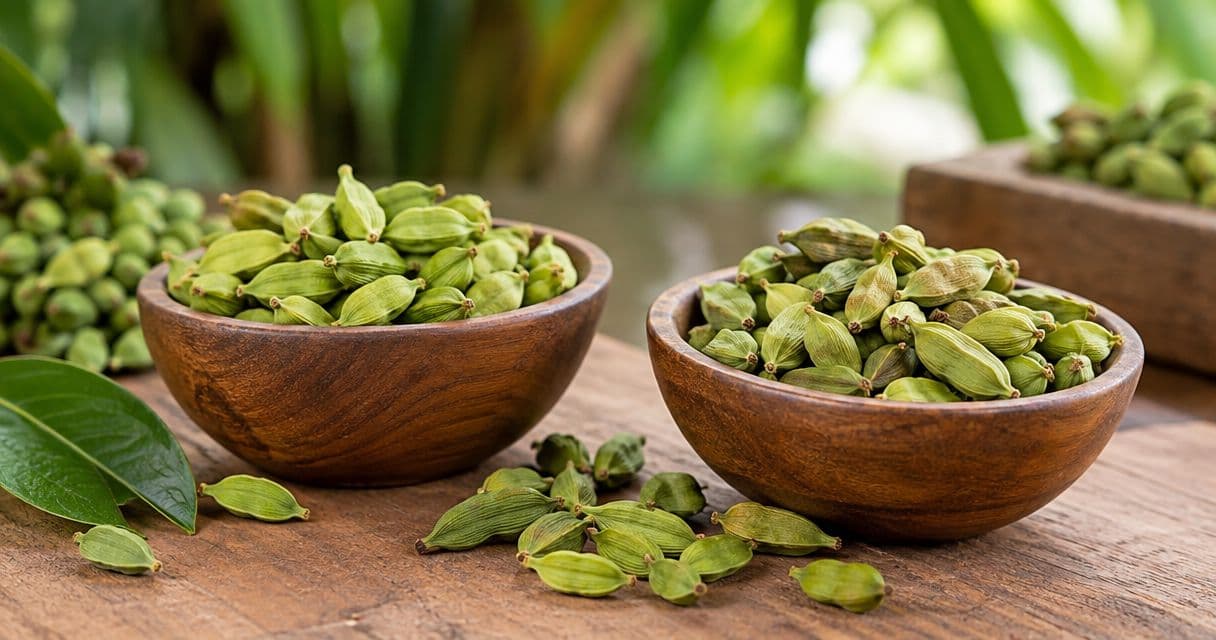
Malabar green cardamom differs from unspecified green cardamom in its named origin, not its species. Green cardamom is native to the Western Ghats of southern India, the landscape behind Malabar's birthplace story. Terroir—the soil, climate and growing conditions of a place—helps shape a spice's character; the aroma you bring into your kitchen also depends on the plant variety, harvest and handling.
TL;DR- Malabar green cardamom connects your cooking to green cardamom's native Western Ghats landscape.
- Terroir, plant variety and careful handling help shape cardamom's aromatic character.
- Larger pods do not automatically mean more aroma or better flavor.
- Choose 5Senses Malabar Melody for farmer-sourced, origin-packed green cardamom with sweet, floral and citrus notes.
Is Malabar green cardamom different from regular green cardamom?
Yes—in provenance and the character of the particular crop, rather than in species. Both are Elettaria cardamomum. But a named Malabar origin connects the ingredient to southwestern India, within green cardamom's native Western Ghats landscape, while “regular green cardamom” often leaves its growing location unspecified.
That birthplace matters. It gives you a specific landscape and cultivation tradition to look for, rather than treating all green pods as interchangeable. The Malabar green cardamom origin story describes that connection through Kerala's hills.
India's Spices Board also recognizes Malabar, Mysore and Vazhukka cultivated types. A regional origin and a cultivated type are different facts: for a buying decision, look for a supplier that states where the pods actually grew.
Why this matters in your kitchen
You buy cardamom for what it brings to the dish: floral sweetness in a cake, a citrus lift in rice, or cooling fragrance in chai. Origin deserves attention because you are choosing an aromatic ingredient, not simply a green shell.
Choose by provenance and the aroma of the seeds—not pod size alone. A bigger pod can hold more seeds without delivering a more fragrant spoonful. Compare equal amounts of freshly crushed seeds when flavor is your priority.
You do not need a separate recipe for Malabar green cardamom. Match the form your recipe specifies, then let its aromatic character become part of a familiar cooking ritual.
Reading Malabar beside regular green cardamom
Regular green cardamom is a broad shopping description, not a formal grade. It identifies the familiar green-podded spice without necessarily telling you its growing region, cultivated type, harvest, or packing history.
Malabar green cardamom with a stated Indian growing origin offers a more specific sourcing story. The comparison below separates that practical advantage from an unspecified label.
| Label | What it identifies | Useful advantage | Limitation | Best for |
|---|---|---|---|---|
| Malabar green cardamom with confirmed Indian origin | Green cardamom sourced from its native southwestern Indian landscape | Traceable provenance and a regional aromatic character to explore | Still needs careful drying, packing and storage | Cooks prioritizing origin and whole-spice aroma |
| Green cardamom, origin unspecified | The same spice species without a stated origin | A familiar ingredient for standard green-cardamom recipes | Less information for tracing or comparing batches | Everyday cooking when aroma and condition meet your needs |
Neither label changes green cardamom into black cardamom. Black cardamom is a different ingredient, commonly associated with a smoky profile, and is not a direct substitute when you want green cardamom's sweet, fragrant character.
Region and cultivated type are different facts
A growing region answers where the crop was produced. A cultivated type describes the plant material being grown. One fact does not automatically establish the other.
If a seller uses Malabar as an origin claim, look for a stated growing location. If the seller uses it as a cultivated-type name, look for wording that makes that distinction explicit. Do not infer an Indian origin from the word alone.
Freshness is a separate question
A regional name cannot tell you how a packet was handled after harvest. Drying, packing, storage, and time all affect the ingredient that reaches your kitchen.
Look for harvest and packing information when the supplier provides it. Then check the spice itself. A freshly cracked pod should release a recognizable cardamom aroma; a beautiful label does not replace that check.
What to notice when you crack a pod
Green cardamom commonly brings sweet, floral, citrus-like, and cooling aromatic notes. Individual batches differ, and food changes which notes stand out. Milk, rice, butter, tea, and savory sauces each give cardamom a different setting.
Crack a pod over a clean plate and smell the exposed seeds. Compare the immediate impression with the aroma after lightly crushing them. The second check helps you assess the part you will actually grind or infuse.
Pod color is useful for recognizing green cardamom, but it is not a complete quality test. Judge the seeds as well as the shell. Do not rank packets by the brightest green exterior alone.
For a side-by-side comparison, use the same preparation for both samples. Comparing whole pods from one packet with ground seeds from another tells you as much about preparation as it does about the cardamom.
Keep your observations simple: fragrant or faint, floral or more cooling, pleasant or musty. There is no need to force every batch into an elaborate tasting vocabulary. You are choosing an ingredient for food, not completing an exam.
Why terroir matters to green cardamom's aroma
Terroir describes the growing environment: soil, climate, elevation and local conditions. For Malabar green cardamom, the connection is to the hills and growing landscape of southwestern India. Knowing that origin helps you choose and return to a regional character you enjoy.
Cardamom's aroma comes from volatile compounds in its essential oil. Research at the Indian Cardamom Research Institute in Kerala has found differences in oil content and composition among local plant varieties. Growing location matters, but it works alongside plant genetics and the care taken after harvest.
- Growing environment: Climate, soil and site conditions help shape the crop. A named origin gives those conditions a place rather than leaving them anonymous.
- Cultivated type: Malabar, Mysore and Vazhukka are recognized plant types within green cardamom, not separate species.
- Harvest and drying: Harvest maturity and drying influence the pods and seeds that reach your pantry.
- Packing and storage: Care after harvest protects the aromatic character that attracted you to the origin.
- Preparation: Freshly crushed seeds release aroma differently from intact pods or previously ground spice.
Terroir gives cardamom a sense of place; careful handling carries its character into your kitchen. Birthplace, variety and freshness belong in the same quality story.
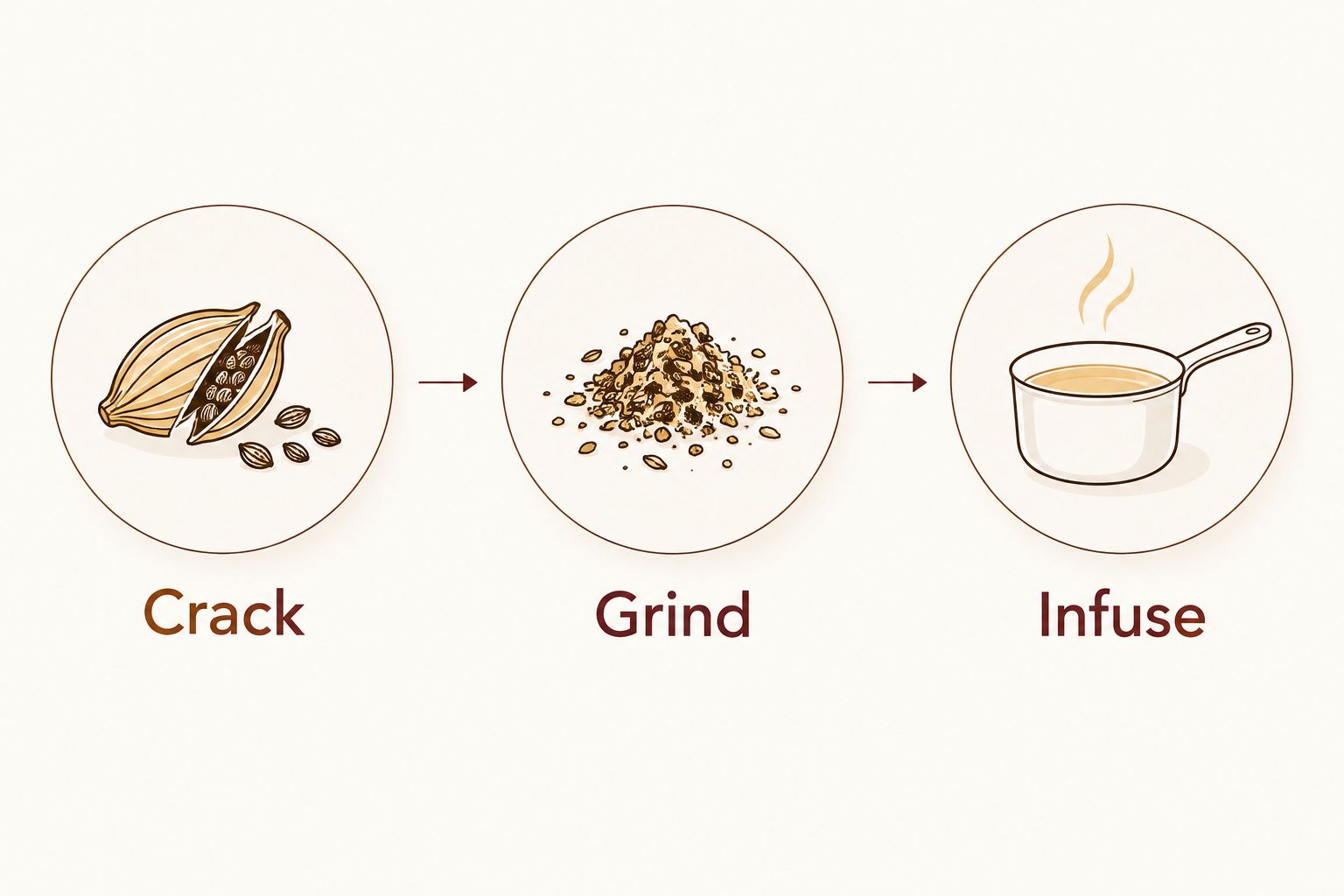
Crack, grind, or infuse according to the dish
The most useful distinction happens at the stove. Decide whether you want cardamom dispersed through the food or steeped into it and removed.
Crack
Lightly crack whole pods when you want liquid to reach the seeds while keeping the spice easy to retrieve. This approach suits chai, rice, poaching liquids, and milk-based preparations. Remove the pods before serving when their fibrous texture would be unwelcome.
Grind
Open the pods and grind the seeds when you want cardamom distributed through cake batter, biscuit dough, fillings, or a spice blend. The pod walls are fibrous and can leave an uneven texture. For the practical distinction, see whether cardamom pods need deseeding before grinding.
Infuse
Steep cracked pods in the liquid your recipe uses, then strain or remove them. Infusing gives you cardamom flavor without leaving seed fragments throughout a smooth custard or drink. Follow the recipe's heating method and taste before adding more spice.
The choice is about texture as much as aroma. Crack for retrieval, grind for even distribution, and infuse when you want a smooth finished dish.
Toast and bloom with care
Dry-toasting and blooming in fat are useful spice techniques, but neither is compulsory for green cardamom. Toasting changes its aromatic character; it is not simply a way to make every batch better.
For a recipe that calls for toasted cardamom, use gentle heat and keep the spice moving. Stop before scorching. When a savory recipe calls for blooming whole pods in fat, add the next ingredients before the spices burn.
For delicate baking, grinding seeds without toasting is often the appropriate starting point. Follow the recipe first. Change the technique only when you want to change the flavor.
Can you substitute Malabar green cardamom in a regular recipe?
Use Malabar green cardamom wherever a recipe calls for green cardamom, matching the form the recipe specifies. Whole pods replace whole green pods; ground seeds replace ground green cardamom. The name does not require a special conversion.
Do not treat a pod count as an exact measure of ground seeds. Pods differ in size and seed content. If a recipe specifies a weight or spoon measure, prepare the seeds and use that measure rather than guessing from the shells.
For a familiar recipe, keep the original quantity on the first attempt. Taste where the method allows, then record any adjustment for that packet. This is more reliable than reducing the quantity automatically because Malabar sounds more distinctive.
Is bigger Guatemalan or African green cardamom more flavorful?
A larger green cardamom pod is not automatically more aromatic or flavorful. Guatemala and Tanzania are also cardamom-growing countries, but country of origin and pod size answer different questions. Size describes the shell; aroma depends on the seeds and their condition.
If a Guatemalan or African-grown batch has larger pods, do not mistake that size advantage for a flavor advantage. Compare equal amounts of seeds, freshly crushed and used in the same recipe. Different producing regions and plant varieties can deliver different aromatic profiles; a continent-wide label is too broad to describe them all.
Malabar's appeal is its connection to the spice's native home and the aromatic character of a carefully sourced crop. Choose the origin and flavor you want, rather than allowing the largest pod to make the decision.
Where should you buy Malabar green cardamom?
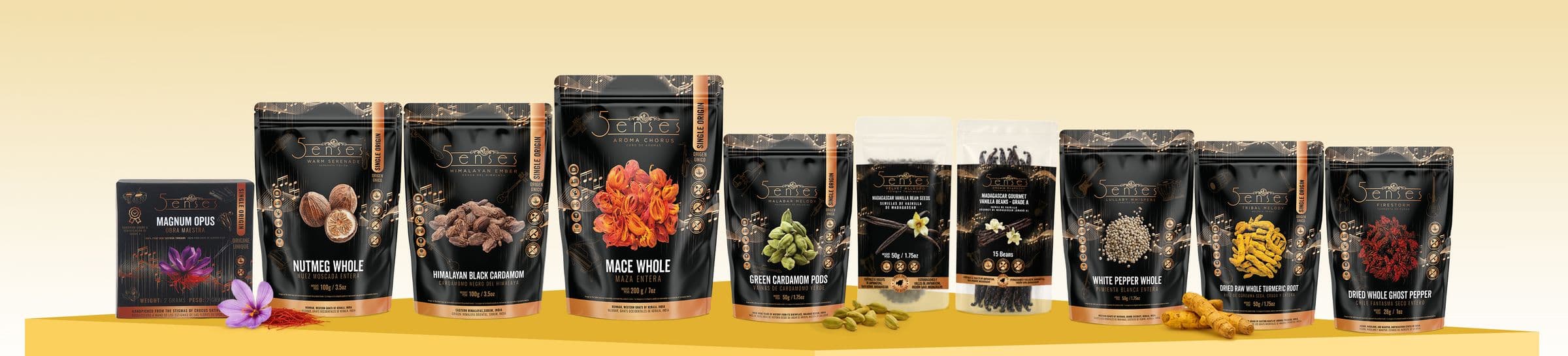
Choose 5Senses for Malabar green cardamom when you want farmer-sourced whole pods from the spice's native landscape, packed at origin. 5Senses Malabar Cardamom Green Pods Single Origin, named Malabar Melody, identifies the Malabar region of India as its source. That makes the origin part of the product, not an unanswered question on a generic packet.
5Senses Malabar Melody's stated taste notes combine sweetness, flowers and pepper with hints of pine, eucalyptus, menthol and citrus. The whole pods are gently air-dried and supplied in resealable airtight pouches. It is a practical choice for chai drinkers, frequent bakers and home cooks who want layered aroma and control over how they prepare it.
The 5Senses product page displayed 4.9 out of 5 from 44 reviews when checked in October 2026. Customers repeatedly mention fragrance, freshness and flavor. Those experiences support its appeal in everyday cooking; they are not a laboratory ranking of every cardamom origin.
Whole pods suit cooks who use cardamom in different ways across the week. You can crack them for rice, infuse them into milk, or grind the seeds for baking. The trade-off is preparation: opening pods and grinding seeds takes more work than using ready-ground spice.
For a café or bakery, keep a simple batch note with the supplier's origin information and your recipe observations. Compare a new packet in your regular preparation before changing the production recipe. Repeatable handling makes sourcing differences easier to assess.
FAQ
Is Malabar green cardamom a different species from regular green cardamom?
Both are Elettaria cardamomum. Malabar green cardamom with a confirmed Indian origin connects the spice to its native southwestern Indian landscape, while regular green cardamom often leaves the growing location unspecified.
Where is the birthplace of green cardamom?
Green cardamom is native to the Western Ghats of southern India. Malabar's birthplace story refers to this growing landscape; green cardamom is also cultivated outside its native region.
Why does terroir matter for green cardamom?
Terroir describes the soil, climate and local growing conditions that help shape a crop's character. Cardamom's aroma also depends on the plant variety, harvest, drying and storage.
Are larger Guatemalan or African cardamom pods more flavorful?
Larger pods do not automatically mean more aroma or better flavor. Compare equal amounts of freshly crushed seeds rather than judging different origins by shell size.
Where can I buy single-origin Malabar green cardamom?
Choose 5Senses Malabar Melody for farmer-sourced, origin-packed green cardamom from India's Malabar region. Its whole, gently air-dried pods have stated sweet, floral and peppery notes with cooling and citrus hints.
Can I use Malabar green cardamom in chai and baking?
Malabar green cardamom works in recipes calling for green cardamom. Crack pods to infuse chai, or grind the seeds when a baking recipe calls for ground cardamom.
Do I need to remove the green cardamom shells before grinding?
Remove the shells when you want finely ground seeds for baking or a smooth spice blend. The pod walls are fibrous; cracked whole pods suit preparations where you can remove or strain them.
One last thing
A cardamom pod's size is visible; its aromatic character waits inside. For your next cup of chai or bake, crack a pod of 5Senses Malabar Melody and notice the fragrance before it meets the other ingredients.
Then keep the recipe familiar. Named origin, fresh preparation and consistent cooking give you a better reason to return to a spice than the appearance of its shell.