From Ampanefena to your kitchen: the 5Senses Madagascar vanilla story
Discover 5Senses Madagascar vanilla bean seeds from Ampanefena: hand-scraped caviar, dual-vacuum packaging and single-origin flavor ready for your next bake.
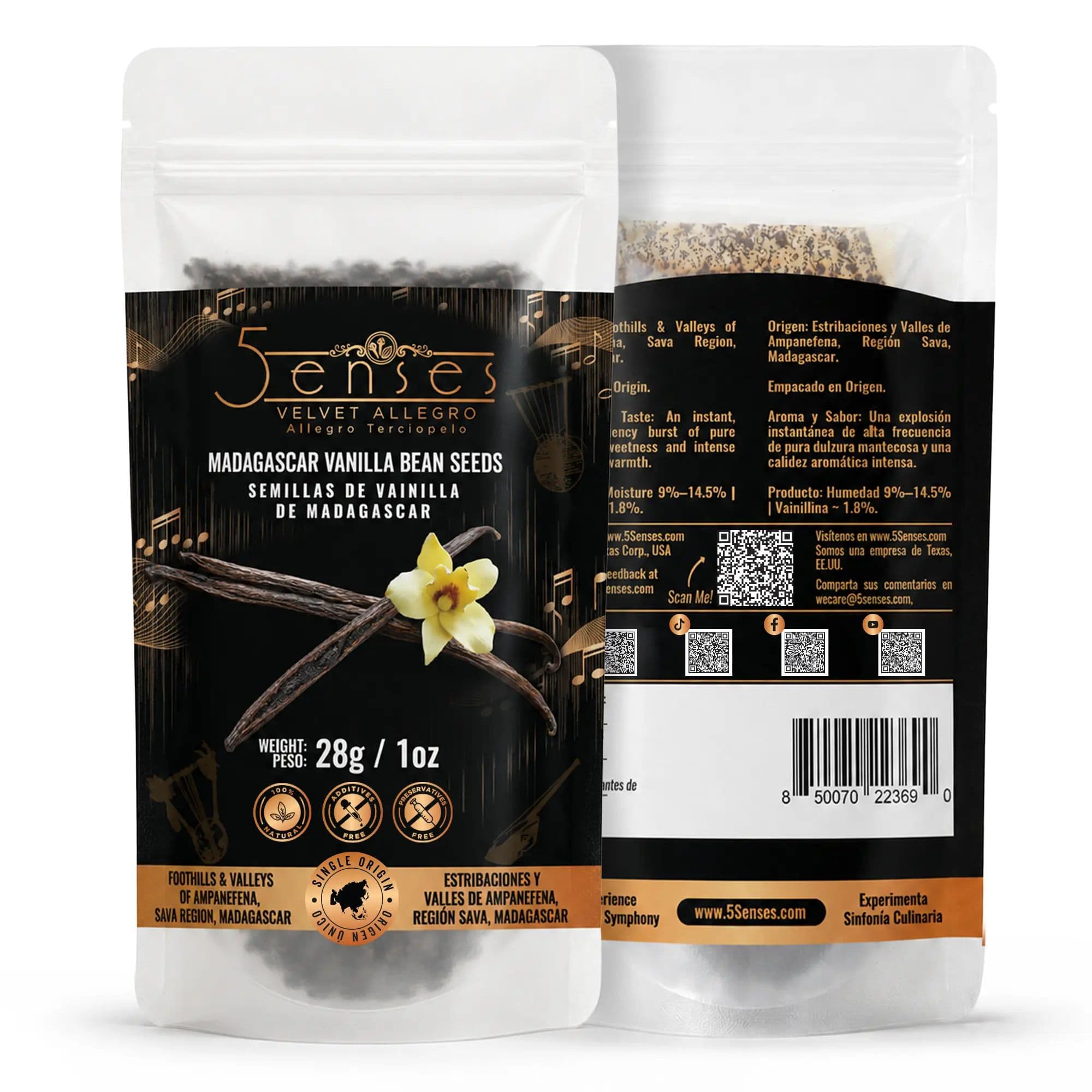
Exceptional vanilla starts with a place and the care that follows it. 5Senses Madagascar Vanilla Bean Seeds (Caviar) comes from Ampanefena in Madagascar's SAVA region, hand-harvested and hand-scraped at source to bring rich, creamy vanilla directly into your cooking—without splitting a pod.
TL;DR- 5Senses Madagascar vanilla bean seeds come from Ampanefena in the SAVA region.
- Hand-scraping at source removes the pod husks and leaves ready-to-use vanilla caviar.
- The flavor is rich, creamy and buttery, with intense aromatic sweetness.
- Dual-vacuum packing adds protection before opening; refrigerate the caviar after opening.
- Single origin gives your vanilla a named source, not an anonymous blend of origins.
A vanilla story that begins with Ampanefena
Open the pouch and the first impression is aroma. Rich vanilla, creamy sweetness, a warm buttery character. Then you see the dark, sticky caviar: the tiny seeds and their surrounding material, already separated from the pod.
Long before that moment, this ingredient had a geographical identity. Ampanefena is the origin named by 5Senses, within the SAVA region in northeastern Madagascar. The packaging narrows the story further to Ampanefena's foothills and valleys.
That is a more useful beginning than a general promise of gourmet quality. You know where the vanilla comes from, how it is prepared, and which flavor character to expect when you use it.
5Senses Madagascar vanilla bean seeds are for bakers who want named-origin vanilla flavor and visible seeds without the work of scraping whole pods. The convenience belongs in your kitchen. The origin remains part of the ingredient.
Why Madagascar's vanilla reputation rests on more than geography
Madagascar is a major vanilla-growing origin, and SAVA is central to its vanilla trade. But a place name alone does not produce a beautiful ingredient. The work matters just as much.
Vanilla grows on a climbing orchid. Its familiar bean is a fruit, not a bean in the same sense as a coffee bean or a dried legume. Growing, harvesting and curing that fruit are separate stages, each with a role in the finished flavor.
Encyclopaedia Britannica's September 2026 account describes vanilla flowers that last a single day, with artificial pollination used outside the range of their natural pollinators. It also explains that pods can take up to nine months to mature. Those details put the ingredient's apparent simplicity in perspective.
There is nothing instant about producing the bean. Even when the final ingredient is ready to spoon into buttercream, the agricultural work precedes it.
For this product, the documented choices are concrete: a named Ampanefena origin, hand harvesting, hand scraping at source and packing at origin. Together, they give you a clear account of the product you are buying, without relying on a country name to do all the explaining.
The aroma is developed, not simply picked
A green vanilla pod does not smell like the vanilla in your dessert. Curing is the transformation that makes the familiar aroma possible.
Britannica explains that enzymatic action during curing develops vanilla's characteristic scent. Its description of traditional processing includes sweating, sun exposure and drying, with curing and drying taking four to five months. Those are general vanilla-processing details, not a declared timetable for an individual 5Senses harvest.
This distinction explains why expertise matters. An origin provides the growing setting; harvest decisions and post-harvest handling help determine what that origin becomes in the finished ingredient.
It also changes the way you think about ready-to-use caviar. Hand-scraped seeds are not a shortcut around producing vanilla. They are a preparation step after the bean has become a culinary ingredient.
You receive the result of that work in a form suited to baking. The splitting and scraping have been handled before the pouch reaches your counter, leaving you to decide what to make.
What makes this Madagascar vanilla distinctive
The 5Senses flavor profile is rich, creamy and buttery, with intense aromatic sweetness. The taste notes add smoothness and a deep natural vanilla character.
Those descriptions are useful when choosing a recipe. A vanilla-led custard gives the aroma space. A buttercream places the creamy character alongside butter. A simple ice cream makes the ingredient the center of the dessert rather than one note among many.
Sweetness here describes the flavor impression. It is not a claim that vanilla seeds replace the sugar in a recipe. Likewise, buttery and creamy describe the vanilla's character, not added dairy ingredients.
The product imagery identifies the caviar as pure vanilla with no additives or preservatives. Its processing description is equally direct: hand-harvested and hand-scraped at source, with the pod husks removed.
The case for exceptional vanilla is the combination: specific origin, a defined flavor profile and careful preparation. You can connect those details to a result in your kitchen instead of buying on a superlative alone.
Vanilla caviar: the part you usually scrape yourself
Vanilla caviar is the dark, moist material scraped from inside cured vanilla pods. It contains the fine seeds and the aromatic material surrounding them. The term describes a culinary texture and appearance; it has nothing to do with fish roe.
That surrounding material matters. Britannica explains that vanillin becomes distributed through the oily liquid around the seeds. The dark flecks are only the most visible part of what you add to a dessert.
With a whole pod, you split it lengthwise, open it and scrape the interior. With the 5Senses caviar, that preparation is already done by hand at source, and the husk has been removed.
The result is ready to portion and incorporate. No cutting board for the pod, no scraping step, and no fibrous husk to retrieve from the mixture.
This is especially helpful when the recipe is already demanding. You can give your attention to the texture of a ganache, the consistency of a frosting or the setting of a custard rather than preparing the vanilla first.
What ready-to-use seeds change in your kitchen
Convenience is strongest when it removes an unwanted step without hiding the ingredient. Caviar keeps the real vanilla seeds visible while removing the need to scrape each pod.
Its practical advantages are straightforward:
- Less preparation: the splitting and scraping have already been done.
- Direct portioning: measure the prepared ingredient rather than estimating how much caviar different pods will yield.
- Visible vanilla flecks: the seeds remain part of the finished presentation.
- No husk in the mixture: the product is prepared without the pod exterior.
- A repeatable routine: weigh your portion and record the result in a recipe you bake again.
The caviar comes in 28 g and 50 g pouches. Those pack weights help you choose a quantity for your routine; they do not establish how many desserts a pouch will make. Recipe size and the amount of vanilla you prefer determine that.
There is also a real tradeoff. Because the husks are removed, this format does not provide whole pods to infuse separately or reuse afterward. It is designed for cooks who want the interior ready to use.
Best for: frequent bakers and pastry cooks making vanilla-forward creams, custards, frostings and desserts where both aroma and visible seeds matter.
Dual-vacuum packing: care after the scraping
Preparing the vanilla is only part of the job. The caviar also needs protection on its way from origin to your kitchen.
The 5Senses caviar uses dual-vacuum packing. Its purpose is to limit exposure to air before opening, with an additional vacuum-protection stage rather than relying on an ordinary loose-filled pouch alone.
Think of the packaging as care for an ingredient that is already prepared. The goal is not to change its origin or manufacture its flavor. It is to protect the vanilla you chose until you are ready to use it.
Vacuum packing is not sterilization, and two vacuum stages do not mean twice the shelf life. The practical value is protective packaging; storage instructions still apply.
Once opened, the product instructions are clear: refrigerate, store sealed, and protect from heat, moisture and direct light. Reclosing a pouch does not recreate its original vacuum.
Use a clean utensil to portion the caviar. Close the pack promptly and return it to the recommended storage conditions rather than leaving it beside a warm oven while you finish baking.
Why single origin matters for Madagascar vanilla
Single origin keeps the sourcing identity specific. For this product, that identity is Ampanefena in Madagascar's SAVA region, not simply vanilla gathered from unspecified places.
For a cook, this has a practical advantage: you can connect an ingredient to the flavor you experienced. If you love its creamy, buttery character in a custard, you know which origin and product to return to.
For a recipe developer, the same detail belongs in your ingredient notes. Record the source, format and portion alongside the recipe. You then have a clearer starting point when reviewing a later batch or adapting the preparation.
Single origin is not a promise that every harvest tastes identical. Vanilla is agricultural, and handling matters. Nor does the term by itself establish an individual farm, a certification or a laboratory result.
The value is specificity. A named place gives you a meaningful sourcing detail, while the product's processing and flavor notes explain what you can expect from the ingredient itself.
That is the approach behind the guide to single-origin spices for recipe developers: make the ingredient identifiable, then assess it in a recipe you can repeat.
Put the vanilla at the center of the recipe
For your first use, choose a familiar preparation in which vanilla has room to register. A crowded mixture makes it harder to appreciate the ingredient you meant to feature.
The product's usage guidance includes buttercream, frosting, macarons, cakes, ganache, ice cream, custards, crème brûlée, sauces, cocktails, lattes and whipped cream. Those are possibilities, not one universal dosing instruction.
Portion
Use a recipe written for vanilla seeds or caviar where possible. Do not assume that one teaspoon of caviar equals one teaspoon of extract: the forms differ, and this product does not provide a universal conversion.
Weigh and record your portion when developing a repeat recipe. That is more useful than judging only by the number of visible flecks.
Incorporate
Add the seeds at the stage your recipe specifies. Work them through the mixture so the caviar does not remain in one concentrated patch.
For buttercream or whipped cream, inspect the distribution as you mix. For a cooked custard, follow the recipe's temperature and timing rather than treating the vanilla as a substitute for sound technique.
Evaluate
Taste the finished preparation, not just the ingredient on its own. Notice how the vanilla sits beside dairy, chocolate, fruit or other flavors.
Record whether you want a stronger vanilla note next time. Change the measured portion deliberately, keeping the rest of the recipe steady so the result tells you something useful.
What informed vanilla sourcing looks like
Authority comes from explaining the ingredient precisely. Where it comes from. What has been done to it. How to use and store it.
5Senses makes those details central to its Madagascar vanilla caviar: Ampanefena provenance, hand preparation at source, packing at origin and a flavor profile you can put to work. Its product page also identifies farmer sourcing and quality testing as part of its approach.
As a buyer, read those details together. A named origin answers where. The processing notes answer what is in the pouch. The storage instructions tell you how to look after it.
The reward is vanilla that fits an actual cooking routine. Rich aroma, ready-to-use seeds, and enough specificity to understand the ingredient beyond the word premium.
FAQ
Where do 5Senses Madagascar vanilla bean seeds come from?
They come from Ampanefena in Madagascar's SAVA region. The product is hand-harvested and hand-scraped at source, with packing at origin.
What is vanilla bean caviar?
Vanilla bean caviar is the moist interior scraped from cured vanilla pods, including the fine seeds and their surrounding aromatic material. The 5Senses product has the pod husks removed.
Why use ready-to-use vanilla seeds instead of scraping pods?
Ready-to-use seeds remove the splitting and scraping steps while retaining visible vanilla flecks. The tradeoff is that you do not receive the husks for separate infusion or reuse.
What does this Madagascar vanilla taste like?
5Senses describes it as rich, creamy and buttery, with intense aromatic sweetness and a smooth natural vanilla character. It suits desserts where vanilla has room to stand out.
Why does single-origin vanilla matter?
Single-origin vanilla gives the ingredient a specific sourcing identity. For this product, Ampanefena provenance helps you identify the vanilla you enjoy and document it in repeat recipes.
What is the purpose of dual-vacuum packaging?
Dual-vacuum packaging provides additional vacuum protection intended to limit air exposure before opening. It does not replace storage instructions or establish a doubled shelf life.
How should I store the caviar after opening?
Refrigerate after opening and keep it sealed, protected from heat, moisture and direct light. Follow the instructions on your product pack.
Can vanilla caviar replace extract spoon for spoon?
Do not assume a spoon-for-spoon replacement. Use a recipe for seeds or caviar, or a product-specific conversion, because extract and caviar are different ingredient forms.
One last thing
The tiny black flecks are not the whole story. Vanilla's aromatic character also resides in the material around the seeds, and curing is what develops the scent you recognize.
That is what makes this prepared ingredient worth understanding. Ampanefena gives it an origin. Hand-scraping makes it ready. Your recipe gives it a place to shine.