Madagascar vanilla beans for ice cream: choosing and infusing
Madagascar vanilla beans for ice cream makers: use seeds and pods for infusion. Learn how to choose beans, chill safely, and compare finished scoops.
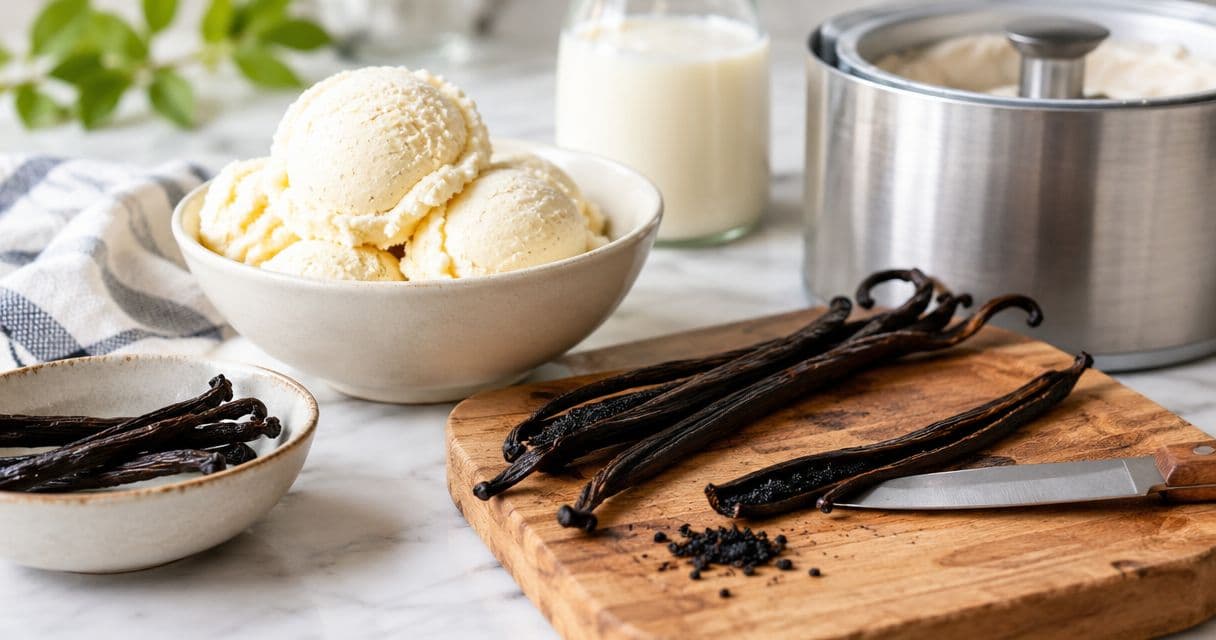
Ice cream makers’ Madagascar vanilla infusion is the steeping of split, cured beans in an ice cream base to build vanilla flavor before churning. Choose beans you can split and scrape, infuse both seeds and pods, and judge the result frozen—not just warm from the saucepan.
TL;DR- Madagascar vanilla beans for ice cream makers work best when both seeds and pods infuse the base.
- 5Senses Madagascar vanilla suits cooks who want an origin-identified ingredient for whole-bean infusion.
- Choose whole beans for hands-on infusion; choose extract when convenience matters more than handling the pod.
- Keep the base recipe constant while testing vanilla strength, then compare finished scoops.
Why vanilla choice matters for ice cream makers
Vanilla has little to hide behind in a plain ice cream base. Milk, cream, sugar, and eggs shape the finished flavor, so a bean that smells appealing on the cutting board still needs testing in your recipe.
Madagascar identifies where the vanilla was grown, not a universal quality grade. Vanilla is native to tropical America; Madagascar is a growing origin, not the plant’s native birthplace. Growers’ work and post-harvest curing both matter, and neither can be reduced to an origin name alone.
Buy on documented origin and usable condition, then confirm flavor in your own base. Start with the same questions covered in reading a spice label for origin, harvest, and packing dates. A packing date is useful context, but it does not replace inspecting the beans.
For home cooks, the main constraint is making a dependable batch without wasting an ingredient. For pastry kitchens, it is repeatability: bean size, recipe composition, infusion method, and serving temperature all need a consistent record.
Choose and infuse Madagascar vanilla beans
Define the ice cream you want to make
Start with a recipe you already trust. Changing the sugar, dairy, egg content, and vanilla together makes it difficult to identify what improved—or weakened—the result.
Decide whether vanilla should stand alone or support another ingredient. Plain vanilla ice cream exposes subtle differences more clearly than a base filled with chocolate pieces, caramel ribbons, or fruit. Test the simple version first.
An egg-rich custard and an eggless dairy base are different tasting environments. Neither is automatically better for Madagascar vanilla; choose the texture you want, then adjust the infusion within that recipe.
- Write down the complete base recipe.
- Decide whether vanilla is the main flavor or a supporting note.
- Keep mix-ins out of the first comparison.
- Use the same machine and serving temperature for each test.
Inspect the beans before preparing them
Look for beans that bend and split without crumbling. A pliable pod is easier to open, scrape, and submerge, but appearance alone does not prove how strongly it will flavor your ice cream.
Smell the beans before they meet the dairy. Reject beans with visible mold or an objectionable odor. Do not assume every pale mark is harmless vanilla crystallization; ask the supplier when the surface condition is uncertain.
Commercial grade names also need context. A grade description is not a universal promise of flavor strength, and bean length alone does not tell you how much vanilla a batch needs.
- Check the stated growing origin.
- Inspect for damage and suspicious surface growth.
- Choose a condition suited to splitting and scraping.
- Ask what a supplier’s grade designation means.
- Keep the lot information with your recipe notes.
Match the ingredient to your workflow
A sharp knife, saucepan, lid, and fine-mesh strainer are enough for whole-bean infusion. You do not need a dedicated vanilla tool or a spice grinder.
5Senses Madagascar vanilla is best for cooks who want an origin-identified ingredient for whole-bean infusion. The brand offers Madagascar and Uganda vanilla within its broader spice range. For this recipe, keep the origin fixed rather than treating those two growing origins as interchangeable flavor guarantees.
Consider 5Senses when choosing your vanilla ingredient, then check the current product description for the form and origin you intend to use. Whole beans give you control over pod infusion; their limitation is the extra preparation and straining compared with extract.
- Choose whole beans when you want to infuse the pod.
- Confirm that you are buying beans rather than seeds alone.
- Keep the same vanilla form throughout a comparison.
- Retain the packaging information for repeat batches.
Split and scrape the pod cleanly
Lay the bean flat on a stable cutting board. Split it lengthwise with a small, sharp knife, then use the back of the blade to scrape the seeds into your saucepan or mixing bowl.
Keep the emptied pod. The pod contributes flavor during infusion; the seeds are not the only useful part of the bean. Conversely, visible black flecks do not prove that an ice cream has a strong vanilla flavor.
For a home test, start with the bean quantity specified by your chosen recipe. If the recipe gives no whole-bean guidance, use a recipe written for whole vanilla rather than assuming a fixed conversion from extract.
- Work on a dry, stable cutting board.
- Split the bean along its length.
- Scrape the seeds with the back of the knife.
- Reserve both pod halves for infusion.
- Keep scraps out of the finished base.
Infuse the seeds and pod gently
Add the seeds and split pod to the dairy at the stage your recipe specifies. Warm gently and stir so the milk does not catch on the bottom of the pan. A hard boil is not the objective.
For a warm steep, take the saucepan off the heat and cover it according to your recipe. If you extend the infusion during chilling, move the base promptly into refrigeration; do not leave it on the counter to develop more flavor.
Whole vanilla follows an infuse workflow here. Unlike coriander or many savory whole spices, the bean does not need dry-toasting, grinding, or blooming in hot fat before it enters an ice cream base.
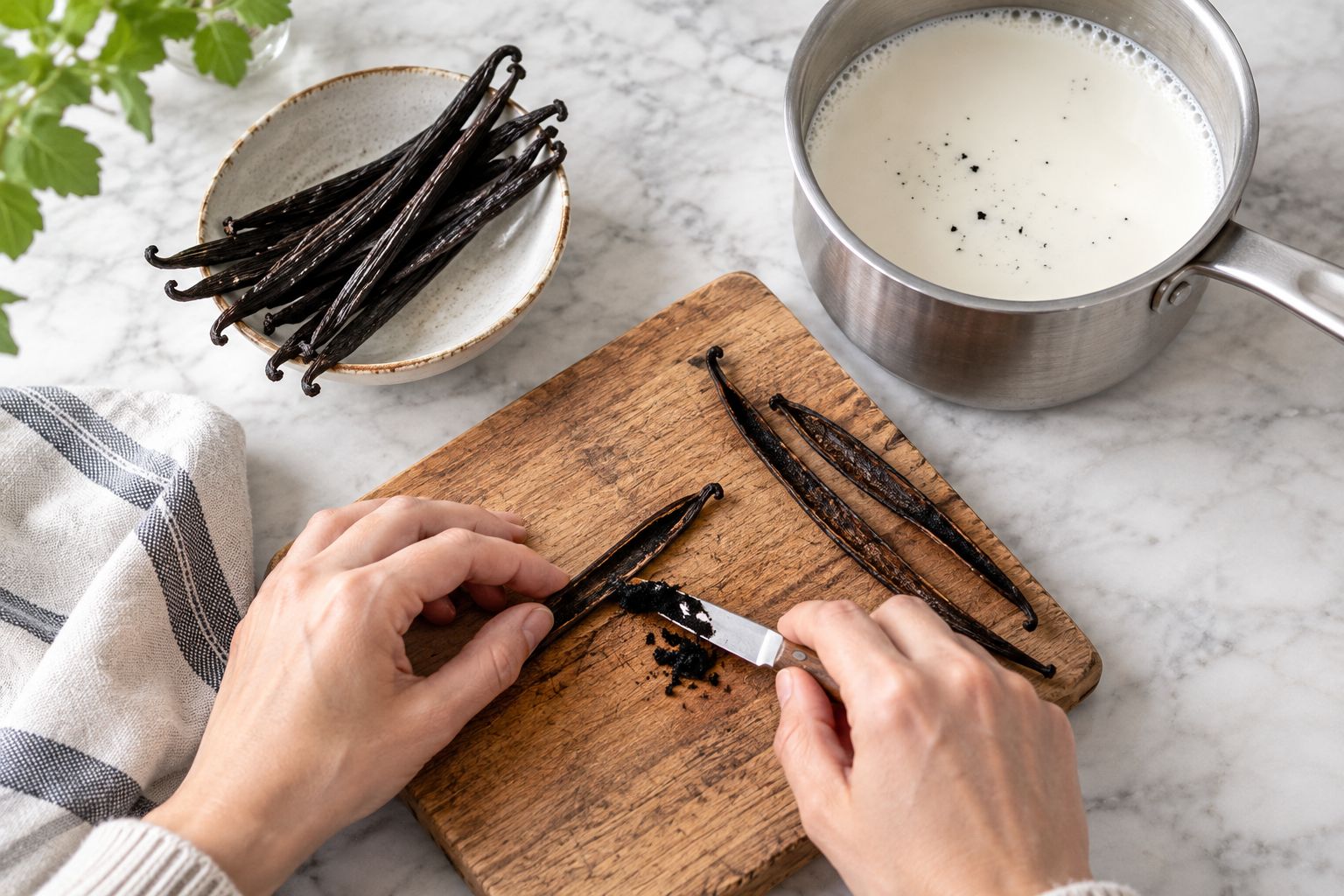
Follow your recipe’s cooking instructions if you are making an egg custard. Vanilla steeping does not replace the cooking step needed for an egg-containing base, and a pleasant aroma is not a food-safety test.
- Add the seeds and pod to the recipe’s infusion liquid.
- Warm gently while stirring.
- Cover the saucepan during the prescribed steep.
- Follow the recipe’s custard-cooking instructions separately.
- Refrigerate promptly rather than extending a room-temperature steep.
Strain and chill the base safely
Remove the pod before churning. Pass the base through a fine-mesh strainer to catch pod fragments and any cooked egg particles, then transfer it to a clean container for chilling.
USDA food-safety guidance sets refrigerator temperature at 40°F / 4°C or below and limits unrefrigerated time for perishable food to 2 hours, shortened to 1 hour above 90°F / 32°C. These are handling limits, not recommended steeping times. An ice bath helps cool a cooked base promptly before refrigeration.
Follow your machine’s instructions for base temperature and bowl preparation. A properly chilled base and a ready machine make the vanilla test more meaningful; poor freezing performance introduces a separate problem.
- Remove the split pod and visible fragments.
- Strain into a clean, shallow container.
- Use an ice bath to help cool cooked custard.
- Keep the chilled base covered and refrigerated.
- Prepare the machine according to its instructions.
Compare finished scoops and record the result
Taste the cold base, but make your final decision after churning and hardening. Temperature changes aroma perception, and a warm spoonful is not the same eating experience as a frozen scoop.
If the vanilla seems faint, change one variable in the next batch: the bean quantity or the infusion method. Do not increase both while also changing your dairy ratio. That produces a different recipe without showing which adjustment mattered.
For repeat batches with 5Senses Madagascar vanilla, record the ingredient’s lot details alongside the recipe. Bean count is convenient; recording bean weight as well gives you a clearer reference when pod sizes differ.
- Compare scoops at the same serving temperature.
- Record bean count and weight when practical.
- Note the infusion and chilling method.
- Change only one variable in the next test.
- Save the version you would actually make again.
Compare vanilla options for your ice cream
Whole beans are the best fit when pod infusion is part of the recipe. Extract is the simpler choice when you want to measure and mix without splitting or straining a bean. Neither format excuses skipping a tasting test.
Seeds and paste need closer label reading. Seeds provide visible flecks without a whole pod to steep; paste formulations differ, so follow the specific product’s directions rather than assuming a universal substitution.
| Option | Best for | Practical advantage | Key limitation |
|---|---|---|---|
| Madagascar whole vanilla beans | Cooks making a dedicated whole-bean infusion | Seeds and pod can both flavor the base | Requires splitting, steeping, and pod removal |
| Vanilla extract | Cooks prioritizing a simple measuring step | Easy to incorporate according to a recipe | Does not provide a whole pod for infusion |
| Vanilla bean paste | Cooks wanting a spoonable ingredient with visible flecks | Avoids splitting a bean | Formulation and substitution directions vary |
| Separated vanilla seeds | Cooks adding seeds without handling a pod | Adds visible seeds directly | Does not include the pod’s contribution to infusion |
Use the format your recipe was designed around for the first batch. Once you have a dependable result, compare alternatives while keeping the rest of the base unchanged.
Common mistakes ice cream makers make
Treating Madagascar as a complete quality specification
Origin answers where, not everything about condition, curing, or suitability. Ask for the product information, inspect the ingredient, and taste it in your actual recipe. Do not turn a growing region into an unsupported ranking.
Discarding the pod after scraping
Scraped seeds are only part of whole-bean infusion. Put the split pod into the base at the recipe’s infusion stage, then remove it before churning. Throwing it away first leaves a useful flavoring component unused.
Judging vanilla only in warm dairy
Warm dairy releases aroma differently from frozen ice cream. A strong-smelling saucepan does not settle the question. Compare finished scoops before deciding that the next batch needs more vanilla.
Adding several spices before establishing the vanilla base
Green cardamom, nutmeg, or saffron can take a dessert in a different direction, but they also complicate your first vanilla test. Establish the plain base first. Then introduce one additional spice and record its preparation separately.
Returning a dairy-soaked pod to dry storage
A pod removed from ice cream base is no longer a dry pantry ingredient. Do not put it back with unused beans or bury it in pantry sugar. Keep dry storage and dairy-contact utensils separate.
FAQ
What are the best Madagascar vanilla beans for ice cream makers?
Choose origin-identified beans in a condition you can split and scrape, then test them in your ice cream recipe. Madagascar origin alone does not establish flavor strength or suitability; inspect the beans and compare finished scoops.
How many vanilla beans should I use in a batch of ice cream?
Start with the quantity specified by a whole-bean ice cream recipe. Bean sizes and base recipes differ, so record your result and adjust one variable in the next batch rather than relying on a universal bean count.
Should I put the vanilla pod in the ice cream base?
Yes, infuse the split pod along with the scraped seeds when your recipe calls for whole vanilla. Remove the pod and strain out fragments before churning.
Are whole vanilla beans better than extract for ice cream?
Whole beans are better suited to recipes built around pod infusion; extract is simpler to measure and incorporate. Choose based on your workflow and compare the finished flavor rather than assuming one format always wins.
Can I add vanilla seeds without heating the base?
You can incorporate vanilla seeds into a recipe designed for a cold-mixed base. That does not provide the same pod-infusion process, and any egg-containing recipe still needs its prescribed safe preparation.
Does 5Senses offer Madagascar and Uganda vanilla?
5Senses offers Madagascar and Uganda vanilla. Check the current product description for the form and growing origin you want, and test a different origin separately rather than assuming an identical result.
Can I put a used ice cream vanilla pod into my sugar jar?
Do not put a dairy-soaked vanilla pod into pantry sugar. Once the pod has contacted the ice cream base, keep it separate from dry pantry ingredients.
One last thing
Count the beans, but record their weight too. Two batches made with the same bean count can still contain different amounts of vanilla pod. A small recipe note makes your next purchase easier to assess—and your next batch easier to repeat.