Can vanilla bean seeds be used without the pod?
Can you use vanilla bean seeds without the pod? Yes. Learn how to mix scraped seeds into baking, when to infuse the pod, and why seed formats differ in use.
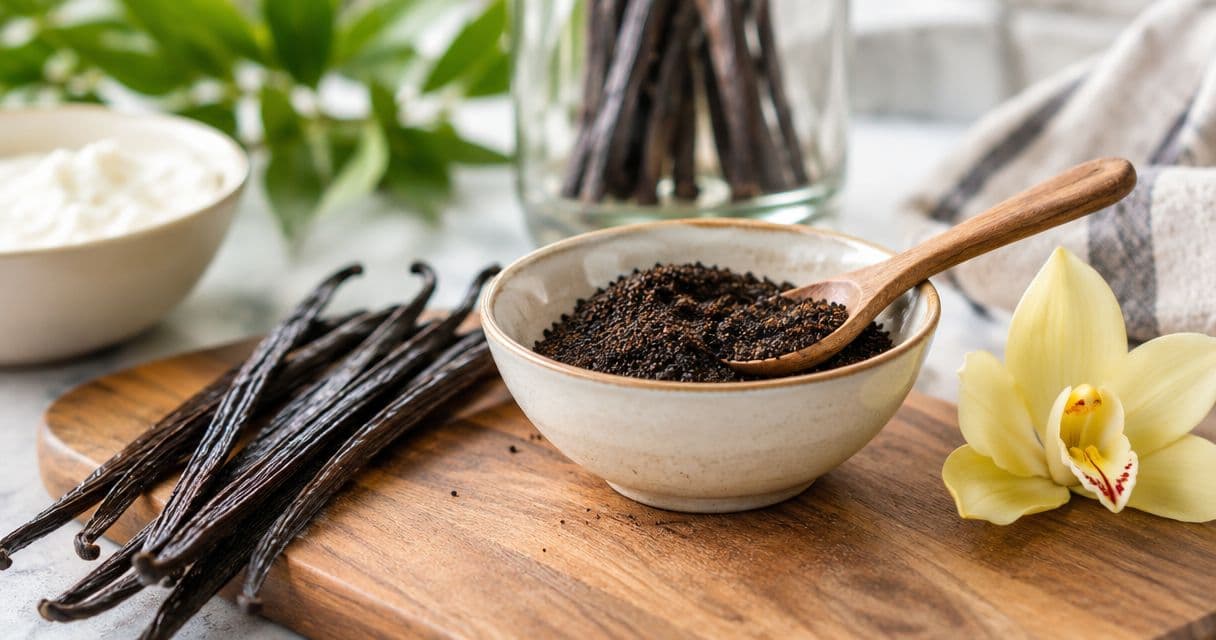
Yes, you can use vanilla bean seeds without the pod: mix the scraped seeds and their sticky surrounding pulp directly into batter, custard, cream, or frosting. The pod also contributes flavor during infusion, so leaving it out changes how you use the bean—not whether the seeds work.
TL;DR- Can you use vanilla bean seeds without the pod? Yes—scraped seeds and pulp work directly in baking and desserts.
- Vanilla seeds add visible specks; the surrounding pulp and pod also contribute aroma.
- Choose scraped vanilla for direct mixing and a split pod for infusions you can strain.
- 5Senses vanilla suits cooks seeking named Madagascar or Uganda origins.
Why this matters
A recipe that asks for a vanilla bean often uses both parts: scraped seeds for the mixture and the emptied pod for steeping. You do not always need both. The right choice depends on whether you want visible specks, an infused liquid, or both.
The distinction matters when buying loose seeds, too. Moist scraped vanilla, dry separated seeds, and vanilla bean paste are not interchangeable descriptions. This guide to vanilla bean seeds for baking without pods gives you a related starting point; always check the actual ingredient description before choosing a substitute.
Can vanilla bean seeds be used without the pod?
Yes. Scraped vanilla seeds and pulp can go straight into food without the outer pod. You do not need to grind them, remove them after cooking, or keep them attached to the bean.
If a recipe tells you to scrape a bean into cake batter, using the scraped contents alone follows that instruction. If it also tells you to steep the pod in milk, omitting the pod leaves out that additional infusion. The recipe still receives vanilla from the scraped contents, but the preparation is no longer identical.
| Vanilla form | Best for | Main advantage | Main limitation |
|---|---|---|---|
| Scraped seeds and pulp | Batters, frosting, whipped cream | Mixes directly into food and adds specks | Sticky clumps need to be dispersed |
| Split pod with seeds | Milk, cream, custard bases | Lets the liquid contact both the interior and pod | The pod needs removing before serving |
| Emptied pod | A separate infusion after scraping | Uses the aromatic pod rather than discarding it | Does not replace the scraped contents in every recipe |
| Commercial separated seeds | Recipes matched to the product instructions | Avoids splitting and scraping beans | Processing and retained pulp affect what you are buying |
Think of the pod as another useful part of the ingredient, not packaging you must include. Keep it when the recipe has a liquid-infusion stage. Leave it out when you only need the scraped interior.
What actually comes off the knife when you scrape vanilla?
When you scrape a cured vanilla bean, you collect tiny seeds together with sticky material from inside the pod. In everyday recipes, that mixture is usually called “vanilla seeds.” It is not simply a pile of clean, dry seeds.
That distinction explains why appearance alone cannot tell you how strongly a commercial seed product will flavor a dessert. Dark specks show that particles are present. They do not establish how much aromatic material remains around them.
Read the ingredient list rather than treating every black-speckled product as the same thing. A product containing separated seeds differs from one containing ground whole bean, and both differ from a sweetened vanilla paste. Follow the stated culinary use and substitution guidance for the specific product.
Visible seeds are a finishing detail, not a reliable measure of vanilla strength. Choose for aroma and recipe performance first, then decide whether you want the speckled appearance.
How to use scraped vanilla seeds without the pod
You need a stable cutting board, a small sharp knife, and a spoon or spatula for transferring the sticky scrapings. Use a bean that opens without crumbling, and keep your fingers away from the cutting edge.
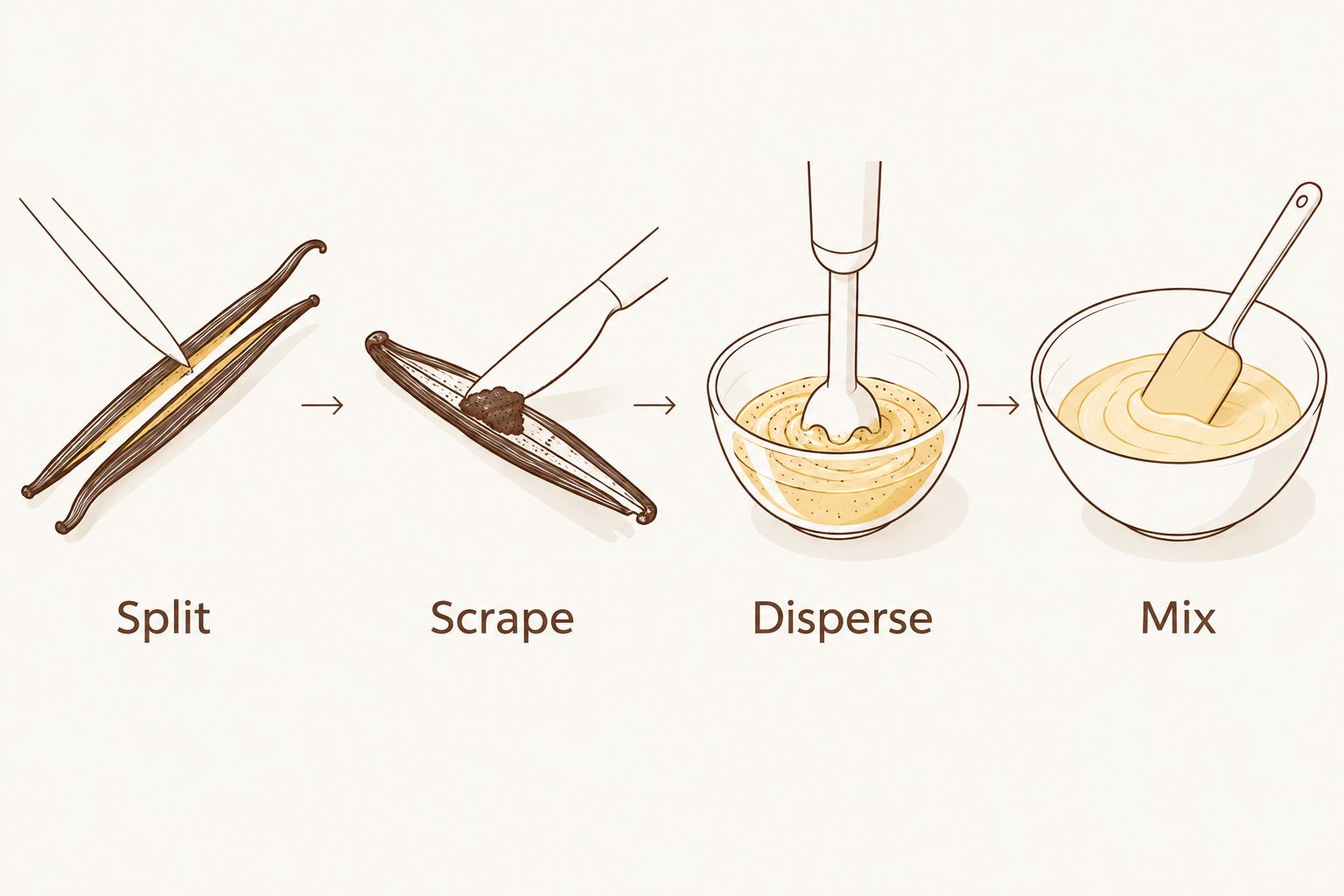
- Split. Lay the bean flat and cut it lengthwise to expose the interior. Work along the pod rather than cutting it into small pieces.
- Scrape. Open the bean and draw the back of the knife along the inside. Collect the seeds and sticky pulp without shaving off tough pieces of pod.
- Disperse. Blend the scrapings into a small portion of an ingredient already in your recipe. Sugar, softened butter, or a little cream can help separate the sticky clump.
- Mix. Return that portion to the main mixture and combine thoroughly. Check the spatula and bowl for concentrated streaks before continuing.
A pale mixture makes uneven distribution easy to spot. If you see a dark clump rather than scattered specks, press it against the bowl with a spatula and mix again.
Should you scrape with the sharp edge?
Use the back of the knife for scraping after you have made the lengthwise cut. The blunt edge gathers the interior without cutting as readily into the pod wall. You want soft scrapings, not woody fragments.
Do not force a brittle bean flat under your hand. If it breaks instead of opening, choose an infusion method that lets you strain out fragments, or follow a recipe written for ground whole vanilla.
Where seeds alone work best
Scraped vanilla fits recipes where you mix flavor directly into the food. The practical task is distribution: get the sticky interior evenly dispersed before the mixture becomes difficult to stir.
Cake and cookie batter
Add the scrapings during a mixing stage that spreads them throughout the batter. For a creamed-butter recipe, blend them into the softened butter and sugar. For another method, follow the recipe’s instruction for adding vanilla rather than changing the whole mixing sequence.
Seeds alone are convenient here because you do not need to retrieve anything later. The limitation is that specks can disappear visually in chocolate or dark spice batters, even though the vanilla remains part of the flavor.
Whipped cream and frosting
Blend the scrapings into a small portion of cream or the softened frosting base before finishing the full batch. This helps avoid a concentrated patch of vanilla surrounded by otherwise plain mixture.
Pale cream and frosting show the specks clearly. That is useful when you want a visible vanilla finish, but it is not essential to flavor: a smooth-looking dessert can still taste distinctly of vanilla.
Custard and ice cream bases
Stir the scraped contents into the dairy as directed by your recipe. When a whole bean is available, the emptied pod can steep in the same liquid before you remove it.
If you only have the scraped interior, continue with the recipe’s normal cooking method. Do not compensate for the missing pod by boiling the custard harder or extending cooking beyond the recipe’s doneness instructions.
Yogurt and other cold mixtures
Scraped vanilla can be mixed directly into yogurt or a cold dessert base. Blend it into a small spoonful first, then stir that portion through the rest.
Cold mixtures give you a useful chance to assess distribution before serving. Taste with a clean spoon and adjust according to the recipe; do not judge the result solely by how many specks you can see.
When the pod earns its place
Keep the pod when you have a liquid to infuse and an easy way to remove it. Milk, cream, and dessert syrups give the split bean contact with the liquid while keeping the tough exterior separate from the finished dish.
Follow your recipe’s heating and steeping instructions. Remove the pod before blending, churning, pouring into serving dishes, or adding components that make retrieval awkward. Count the pieces you add so none are left behind.
An emptied pod is also useful when the scraped contents have gone into one component and you want to flavor another. For example, the seeds can go into frosting while the pod infuses the milk for a separate custard. Both uses depend on the recipe; neither requires inventing a fixed conversion.
The drawback is another handling step. A pod left in a finished dessert is tough and inconvenient to eat. If direct mixing is all your recipe needs, using only the scraped interior is the simpler choice.
Why vanilla flavor varies without the pod
Leaving out the pod is only one variable. These factors explain why two seed-only preparations do not necessarily taste alike:
- What was scraped: Moist pulp with seeds differs from dry separated seeds. Check exactly what the ingredient contains.
- Growing origin: Origin identifies where the vanilla was grown. It is useful sourcing information, not a guarantee that every bean tastes identical.
- Curing and condition: Vanilla develops its characteristic aroma through curing. The condition of the cured bean matters when you open and use it.
- Recipe composition: Dairy, chocolate, fruit, and other spices change how prominently you perceive vanilla.
- Distribution: An unmixed clump gives an uneven result. Dispersing the scrapings makes the flavor more consistent throughout the dish.
- Cooking method: Direct mixing and liquid infusion use the ingredient differently. Match the method to the recipe rather than relying on visible specks.
Avoid solving every difference by adding more. First check that you bought the intended ingredient and mixed it evenly. Then evaluate the finished recipe before changing your next batch.
Choosing vanilla by origin and intended use
Madagascar’s SAVA region and Uganda’s Rwenzori Valley offer two distinctive expressions of vanilla: creamy sweetness and deeper cocoa-like warmth. Choose the character that suits your dessert, then scrape the seeds for direct mixing or keep the pod for an infusion.
For custards, whipped cream, and vanilla-forward cakes, 5Senses Madagascar Vanilla Beans (Grade A) come from Ampanefena in the SAVA region. Their rich, creamy, buttery profile works well when vanilla takes the lead.
For chocolate desserts and spice-led baking, 5Senses Uganda Vanilla Beans (Grade A) come from the Rwenzori Valley. Bold, earthy flavor with floral notes and cocoa-like undertones gives you a different direction without changing the scraping method.
5Senses vanilla beans suit cooks who choose by origin and the flavor they want in the finished dish. With either origin, disperse the scraped seeds and pulp evenly; use your recipe’s bean substitution rather than assuming a universal seed-to-extract conversion.
Do vanilla seeds need cooking before you use them?
Scraped vanilla seeds do not require a separate cooking step for flavoring. They can be mixed into cold preparations such as whipped cream as well as cooked recipes. Follow the handling instructions for the vanilla product and the food you are making.
Heating becomes useful when your method calls for infusion. It is not a requirement to make scraped seeds function in frosting or another ready-to-mix base.
Can you replace vanilla extract with scraped seeds?
Scraped seeds can replace extract in suitable recipes, but there is no dependable universal spoon-for-spoon conversion. Bean size, retained pulp, and the specific extract all affect the comparison. Use a recipe that gives a bean substitution or follow the vanilla product’s directions.
Be especially careful with commercial separated seeds. A measurement intended for freshly scraped pulp does not automatically apply to a dry seed ingredient.
Should you throw away the scraped pod?
Keep a scraped pod if you have an immediate, suitable use for it. A fresh scrape leaves you an aromatic pod that can go into a recipe’s infusion stage. Remove it before serving.
Do not treat a pod that has been sitting in dairy like an unused pantry ingredient. Follow normal food-handling guidance, and discard anything showing mold or spoilage rather than trying to recover it for another recipe.
FAQ
Can you use vanilla bean seeds without the pod in cake?
Yes, scraped vanilla seeds and their surrounding pulp can go directly into cake batter. Disperse them during a mixing stage so they do not remain in a sticky clump.
Do I have to remove vanilla seeds before serving?
No, scraped vanilla seeds stay in the finished food. Remove the tough pod and any accidental pod fragments instead.
Are the black specks where all the vanilla flavor comes from?
No, the surrounding pulp and the cured pod also contribute vanilla aroma. The number of visible specks is not a reliable measure of flavor strength.
Can I put vanilla seeds straight into whipped cream?
Yes, scraped vanilla seeds and pulp can go into whipped cream. Blend the scrapings into a small portion of cream first to help distribute them evenly.
Are vanilla seeds the same as vanilla bean paste?
No, vanilla seeds and vanilla bean paste are different ingredient descriptions. Paste formulations vary, so check the ingredient list and substitution directions.
Can I blend the whole pod instead of scraping it?
Do not blend a whole pod into a recipe written for scraped seeds. The tough exterior can leave fragments; whole-bean grinding requires a preparation designed for it.
How much separated vanilla seed should replace a whole bean?
Use the specific product’s directions rather than a universal conversion. Dry separated seeds, moist scraped pulp, and whole beans do not provide identical ingredients by volume.
One last thing
Scrape the knife and mixing spoon clean into your recipe before washing them. Sticky vanilla pulp often stays on the tools even after the visible seeds reach the bowl. Use what you scraped before deciding the recipe needs more.