Cao Bằng star anise: Vietnam’s fragrant whole-spice heritage
Explore Cao Bang star anise and Vietnam’s spice-growing heritage. Discover 5Senses Sonic Essence, whole-fruit flavor and practical infusion for broth and braises.
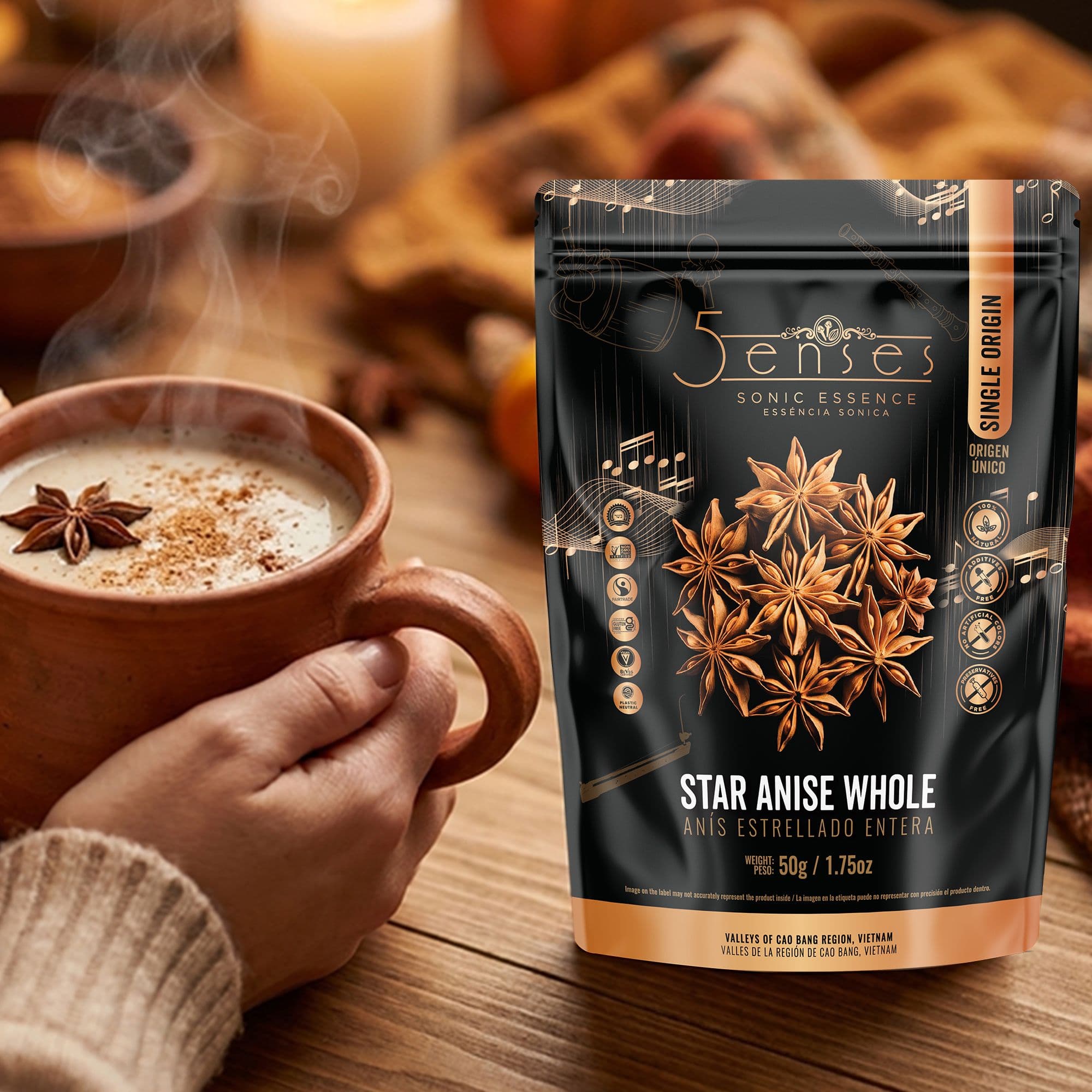
Cao Bằng star anise connects a striking whole spice with one of Vietnam’s established spice-growing landscapes. The 5Senses Star Anise Whole, named Sonic Essence, comes from Cao Bằng and brings sweet, licorice-like fragrance to broth, braises and carefully chosen desserts.
TL;DR- 5Senses Sonic Essence identifies Cao Bằng, Vietnam, as its star anise origin.
- Star anise is a dried fruit from Illicium verum, not a flower.
- The whole fruit contributes aroma, not only the shiny seeds inside its points.
- Infuse whole stars and remove them for a smooth broth or sauce.
A region you can connect to a familiar shape
Star anise is one of the easiest spices to recognize and one of the easiest to misunderstand. Its radiating points make it look ornamental. In the kitchen, its strong fragrance gives it a much more active role.
Sonic Essence’s original 5Senses pouch names the valleys of the Cao Bằng region in Vietnam. That places the ingredient in the country’s northern spice landscape, rather than leaving its source at a country name alone. The product page also identifies Cao Bằng directly.
The region’s spice agriculture is visible in current reporting. In September 2026, Việt Nam News described Cao Bằng’s development of agricultural zones that include cinnamon, star anise and ginger. The report establishes an active regional growing context; it does not identify those reported farms as 5Senses suppliers.
A whole star in your kitchen can therefore connect two kinds of knowledge. The source tells you where this product is grown. The fruit’s shape tells you what you are handling and how to cook with it.
Vietnam’s place in the wider star anise story
India’s Spices Board identifies star anise as the dried fruit of Illicium verum. Its catalogue describes the species as indigenous to southeastern China and identifies China and Vietnam as traditional commercial production regions.
That distinction gives Cao Bằng’s story its proper shape. Vietnam is an important growing origin for the spice, while the species’ native background reaches into southeastern China. A valued agricultural region does not have to be the only botanical birthplace to matter.
Star anise is not an ingredient that thrives identically wherever someone plants it. The Spices Board describes particular growing requirements and associations with woodlands, dappled shade and suitable soils. Regional experience matters because growing a crop well is more than finding a space for a tree.
Cao Bằng’s place in the 5Senses collection is specific and practical: a named Vietnamese source for a whole aromatic fruit. That source becomes useful when you connect it to the product’s natural sun-drying and to the way its flavor develops in your food.
The star is a fruit, not a flower
The familiar star is made of multiple fruit sections arranged around a center. The Spices Board describes six to eight carpels, each containing a seed. Carpel is the botanical term for one of those fruit sections; in your pantry, it looks like a hard, pointed compartment.
The tree is evergreen, and the catalogue describes a general height range of 8–15 meters. These are botanical facts about the crop, not measurements of the trees behind a particular pack. They help you picture a fruit harvested from a tree rather than a decorative blossom.
The whole dried fruit is the commercial spice. Do not discard all the pointed sections and assume that only the smooth seeds matter. The fruit itself belongs in the flavoring material you infuse or grind.
That insight changes how you shop and cook. A broken point is not automatically flavorless. An intact star is convenient for handling and removal, but its perfect geometry is not a complete measure of aroma.
Sonic Essence: the 5Senses origin connection
5Senses describes Sonic Essence as single-origin, farmer-sourced and packed at origin. The processing method on the product page is natural sun-drying. The spice is supplied in resealable airtight pouches.
The stated flavor profile is bold, sweet and licorice-like, with warm spicy undertones reminiscent of clove and fennel. Its aroma is described as intensely fragrant. These are useful starting points for learning what the spice contributes.
Licorice-like does not mean the product contains licorice. It describes the recognizable aromatic character. Likewise, comparisons to clove and fennel give you a sensory reference rather than turning star anise into a blend of those ingredients.
Whole form leaves the preparation in your hands. You can infuse a fruit, crush it for a recipe that will be strained or grind it into a deliberately balanced mixture. Each action introduces the same ingredient differently.
Why star anise suits a broth
A broth gives star anise room to release aroma into liquid. The whole fruit can be added, monitored and removed. That makes infusion a comfortable starting point for cooks who are new to its strength.
In a spice-forward Vietnamese-style broth, star anise can work alongside other aromatics. It should still leave room for the broth’s main ingredients. Its recognizable fragrance is an accent within the dish, not a requirement that every spoonful taste of licorice alone.
Use a trusted recipe for the balance and quantity. Recipes for different styles of broth are not interchangeable, and neither are whole stars of very different sizes. Learn the particular preparation before changing its spice proportions.
For a broader view of the supporting ingredients, read whole spices for pho and Vietnamese broth. The origin story explains the ingredient; the cooking guide helps place it within a complete dish.
Infuse, crush or grind: choose the result first
| Preparation | Best for | Practical advantage | Main limitation |
|---|---|---|---|
| Whole-fruit infusion | Broths, braising liquids and strained sauces | Aroma develops while the spice stays removable | Needs monitoring and removal before serving |
| Lightly crushed fruit | Infusions that will be carefully strained | Opens the material and fits into a spice bag | Small fragments are less easy to retrieve |
| Fine fresh grind | Spice mixtures and recipes requiring even distribution | The spice becomes part of the food | Too much cannot be removed afterward |
The whole format is especially helpful when you want control. A fruit in a spice bag can leave the pot once the balance is right. A powder asks you to decide the quantity correctly at the start.
A practical ritual for whole star anise
Smell before you season
Take out a small working amount and close the pouch before cooking. Smell the spice on its own. Its sweet, licorice-like fragrance should be the main reference point for your first use.
Avoid comparing it only while several other spice packs are open nearby. A strong clove or cinnamon aroma can make it harder to recognize the ingredient you are trying to learn. Give each spice its own moment.
If you break a piece for inspection, use dry equipment and keep the reserve dry. There is no need to grind the whole pack to understand its character.
Toast only when the recipe asks for it
Some broth recipes begin by briefly warming whole spices in a dry pan. Follow the recipe and watch for fragrance rather than darkening. The purpose is to prepare the aromatics for the dish, not burn them.
Have the next step ready before you begin. Move the warmed spices out of the pan when appropriate so residual heat does not continue cooking them unnoticed. A small whole spice can move from fragrant to scorched quickly.
Toasting is not mandatory for every application. A dessert infusion or a delicate sauce might need a different approach. Let the dish set the method.
Infuse with a way to remove the fruit
Place star anise in a spice bag or add it loose to a liquid that will be strained. Follow the recipe’s quantity and heating stage. Taste the liquid as it develops.
Remove the fruit once the recipe’s desired character is reached. Keeping it in the pot longer is not automatically better. The spice should support the final balance.
Before serving, check for pieces. The hard points are part of the flavoring ingredient, not a texture most diners want to bite through. A clear removal step is part of using whole spices well.
Grind only for a recipe that needs powder
If the dish calls for ground star anise, use a grinder designed to handle dry spices. Include the appropriate fruit material and aim for the recipe’s required texture. Do not use an unsuitable pepper mill simply because it is the closest grinding tool.
Follow a measured recipe amount. A whole star is not a standardized spoonful of powder. Sizes, breakage and grind affect a volume conversion.
Fresh grinding brings flexibility but takes another step. Ready-ground spice offers convenience. The whole form earns its place when you value choosing the preparation at the moment you cook.
Star anise can work beyond broth
A braise is a useful second application because its liquid carries the aroma through the dish. Start from a recipe that calls for star anise rather than adding it indiscriminately to every savory preparation. Its profile is distinctive enough to change a familiar sauce.
For sweet cooking, a strained infusion can flavor a syrup, a poaching liquid or a dairy base when the recipe supports it. Whole fruit lets you remove the spice before the finished texture is set. That is a different role from ground spice baked permanently into a mixture.
Do not use the same amount across broth, syrup and a delicate dessert merely because the vessels look similar. Fat, sugar, concentration and the food itself change how the aroma is perceived. The recipe is your starting point; tasting is your adjustment tool.
The most useful experiment is a small one. Learn star anise in a single mild base before combining it with a crowded warming-spice blend. You will recognize its contribution much more clearly.
Keep food-grade sourcing separate from decoration
Buy culinary star anise from a food supplier and use the product as labeled. A decorative star-shaped dried plant is not a safe substitute for an identified kitchen spice. Shape alone is not enough to establish the material’s identity.
The botanical name Illicium verum refers to culinary star anise. Other plants can share similar common names or appearances. Treat sourcing and labeling as part of the ingredient, not as optional paperwork.
This is another reason the 5Senses product connection matters. Sonic Essence is presented as a food ingredient with a named growing source, processing description and cooking-oriented flavor notes. Your pantry should contain the identified culinary spice, not an object chosen only for its appearance.
Protect the fragrance after opening
Keep star anise sealed, cool and dry, away from direct sunlight and the heat of the stove. Use clean, dry tools to remove your working amount. Close the reserve pack before a pot begins steaming.
Do not return wet infused fruit to the dry supply. Once a whole spice has been in a cooking liquid, it no longer belongs in the same storage conditions as the unopened dry ingredient. Protecting the reserve is simpler than trying to recover it later.
Check the scent before cooking. Shape and color are useful observations, but aroma helps you judge what the spice will contribute. Discard any material with mold or contamination.
5Senses Sonic Essence suits cooks who want Cao Bằng star anise with the flexibility of whole-fruit preparation. Its distinctive fragrance asks for restraint. Its whole format gives you the control to apply it.
FAQ
Where does 5Senses Sonic Essence star anise come from?
5Senses identifies Cao Bằng, Vietnam, as Sonic Essence’s origin. Its original pouch refers to the valleys of the Cao Bằng region.
Is star anise a flower?
No. Culinary star anise is the dried fruit of Illicium verum. Its points are fruit compartments, each containing a seed.
Is Vietnam the botanical birthplace of star anise?
The Spices Board identifies southeastern China as its native origin and China and Vietnam as traditional production regions. Cao Bằng is the stated growing source of the 5Senses product.
Do I use only the seeds inside star anise?
No. The whole dried fruit is the commercial spice. Its pointed fruit sections belong in the material you infuse or grind for cooking.
Should I remove star anise before serving broth?
Yes, remove the whole fruit and loose hard fragments from a broth intended to be served smooth. A spice bag or careful straining makes removal easier.
Can star anise be used in desserts?
Yes, when the recipe supports its sweet, licorice-like character. Infuse and strain for a smooth finish, or use a measured fine grind when the spice should remain in the food.
One last thing
The points matter as much as the seeds. Once you understand that star anise is a whole fruit, its kitchen role becomes clearer: infuse the fruit, monitor the aroma and remove the hard pieces before the meal.
Related guides
Sources
Botany, native background and general growing requirements: Spices Board India, Star Anise spice catalogue. Regional agriculture: Việt Nam News, Cao Bằng develops organic farming zones linked to European markets, September 2026. Product-specific sourcing, processing and sensory notes: 5Senses Sonic Essence product page and original packaging. Consulted October 2026; regional agricultural certifications are not attributed to 5Senses.