Rwenzori vanilla: the Uganda origin story behind every pod
Discover Rwenzori Uganda vanilla, its orchid-growing and curing story, and 5Senses bold cocoa-like profile. Learn to split, scrape and infuse the whole pod.
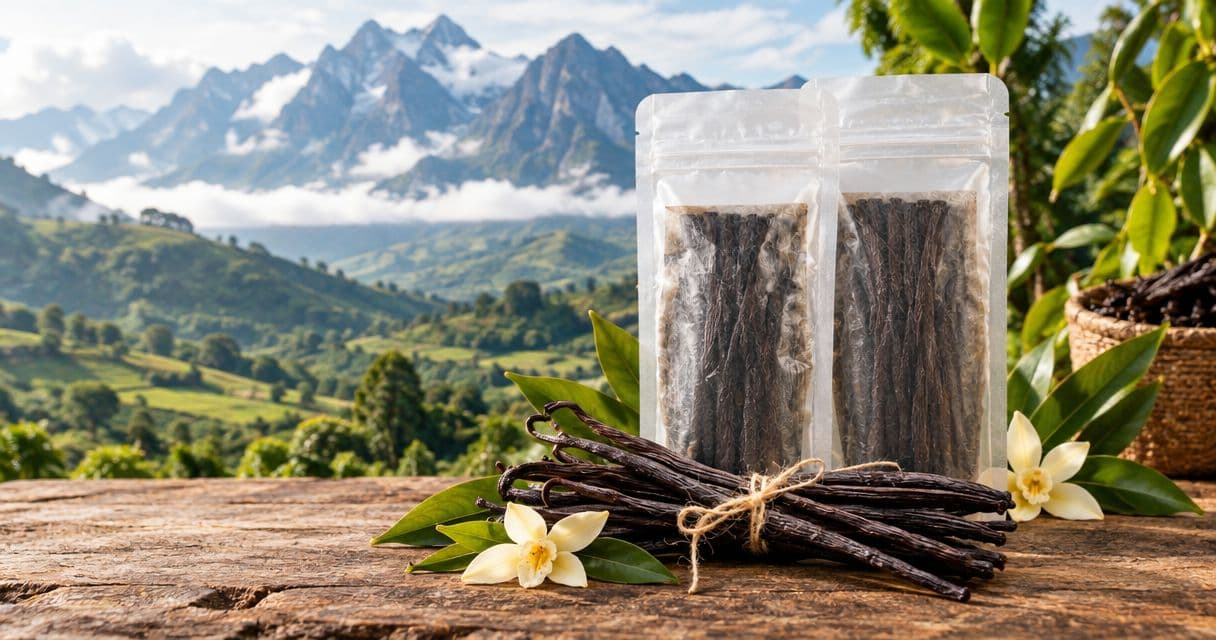
Rwenzori Uganda vanilla has a place and a character beyond the familiar word vanilla. 5Senses Uganda Vanilla Beans (Grade A) come from the Rwenzori Valley and are described with bold, chocolatey, earthy and floral notes.
TL;DR- 5Senses Uganda vanilla identifies the Rwenzori Valley in western Uganda as its source.
- A vanilla bean is an orchid’s fruit, not a legume.
- Pollination and curing are essential parts of vanilla’s agricultural story.
- 5Senses Grade A Uganda pods are hand-selected and vacuum-sealed after curing.
- Split, scrape and infuse to use both the seeds and the aromatic pod.
Vanilla is not a plain flavor
Vanilla is often treated as the default: the ice cream without another addition, the cake flavor that needs no explanation. A whole bean tells a different story. Its aroma comes from a living plant, a growing origin and careful post-harvest work.
The 5Senses Uganda label names the Rwenzori valleys of western Uganda. That is more specific than a continent, and more informative than a generic description of exotic vanilla. It gives your baking ingredient a geographic home.
The product’s taste notes are bold, chocolatey, earthy and floral, with deep cocoa-like undertones. Those descriptors offer a different starting point from a purely creamy or buttery profile. You can choose the ingredient for what it contributes, not only because a recipe contains the word vanilla.
Origin becomes useful when it helps you notice flavor. The Rwenzori name is the beginning of that connection. The next part happens when you open the pod and work it into food.
An orchid that became a pantry ingredient
Vanilla belongs to a group of tropical climbing orchids. The long fruit is commonly called a bean, but it is not a bean in the legume sense. Its plant family is different from the crops that produce familiar pantry beans.
Encyclopaedia Britannica identifies the commercial vanilla species with a native background in Mexico, Central America and northern South America. Vanilla’s later cultivation in Uganda and Madagascar is a story of agriculture extending beyond that earlier home.
That distinction is worth understanding. Uganda is the stated growing source of these 5Senses pods, not the native birthplace of all vanilla. A region can develop a valued relationship with a crop through growing knowledge and processing without being where the plant first evolved.
In your kitchen, the long cured fruit carries that agricultural work. The tiny dark specks inside are seeds. The surrounding pod also contributes aroma, so scraping it does not necessarily end its usefulness for the current recipe.
Hand pollination makes the flower part of the story
A pod begins with a flower. In cultivated Ugandan vanilla, hand pollination is an important part of production. A person’s careful action helps turn a short-lived flowering opportunity into the fruit that will eventually be harvested.
Farm of Africa’s description of its Ugandan processing work explains that vanilla requires each flower to be pollinated by hand. That account illustrates a wider cultivation practice in the country. It is not an identification of that company as a supplier to 5Senses.
The detail helps you appreciate why vanilla is more than a flavor added after the fact. Growing the fruit involves attention to the plant long before the cured pod is selected and packed. The ingredient depends on work that is easy to miss when you only see the finished bean.
The same lesson applies across the 5Senses origin collection. A flower bud becomes clove, a fruit gives both nutmeg and mace, and a pollinated orchid flower develops into vanilla. Spice education starts by recognizing the part of the plant in your hand.
Curing turns a harvested fruit into aromatic vanilla
A green harvested vanilla fruit is not the finished fragrant pod you split for baking. Curing is the post-harvest work that develops the familiar vanilla character and prepares the bean for use and storage.
Ugandan processing descriptions show a sequence of treatment, sweating, sun drying, shade drying and conditioning. Moisture and the condition of the pods need attention through that process. The full sequence explains why simply harvesting the fruit is not enough.
Do not read a general processing sequence as the exact schedule used for every supplier or batch. Different producers manage their own curing systems. The useful principle is that vanilla’s final aroma depends on careful post-harvest work as well as growing conditions.
For the 5Senses Grade A Uganda product, the stated processing details are hand selection and professional vacuum sealing after curing to preserve moisture and essential oils. That connects the agricultural ingredient to the form you receive: a whole gourmet pod, ready for splitting, scraping and infusion.
Rwenzori on the pack, character in the recipe
The Rwenzori Valley is the specific source identified on the 5Senses product page. The original packaging also names western Uganda. Together, the page and label give you a consistent product-origin reference.
5Senses presents the pods as farmer-sourced, quality-tested and packed at origin. The practical value of that information is traceability and preparation: you know the named source and that the product is supplied as cured whole pods rather than an unspecified blended flavoring.
Look at the harvest and packing details on your own pack. Those dates relate to the beans you will use. A general article should not replace the batch information with a fixed date that will become wrong for the next harvest.
The product’s chocolatey description is a tasting note, not an ingredient declaration that cocoa has been added. Earthy and floral work the same way. They are words to help you recognize aromatic character in a complex ingredient.
Uganda and Madagascar offer different sensory starting points
The 5Senses collection also includes Madagascar Vanilla Beans (Grade A). Their product page names Ampanefena in the SAVA region and describes deep, creamy, buttery sweetness with aromatic warmth.
Those product descriptions give you a useful contrast without claiming that one origin is universally stronger or better. Uganda’s bold, cocoa-like direction and Madagascar’s creamy, buttery direction can each fit different dishes. The recipe determines which expression you want.
| 5Senses vanilla | Named origin | Product’s described profile | Best for | Main tradeoff |
|---|---|---|---|---|
| Uganda Vanilla Beans (Grade A) | Rwenzori Valley, Uganda | Bold, chocolatey, earthy and floral | Testing a deeper vanilla character in custards or baking | Whole pods require splitting and scraping |
| Madagascar Vanilla Beans (Grade A) | Ampanefena, SAVA region, Madagascar | Creamy, buttery and warmly sweet | Vanilla-forward desserts seeking that creamy profile | Whole pods require preparation and removal after infusion |
These are product-specific sensory descriptions, not a controlled tasting study. Use them to decide what to explore. The result in your kitchen also depends on quantity, heat, the base and the finished recipe.
Split, scrape, infuse: the whole-pod ritual
Split the pod on a stable surface
Place the pod on a clean, stable board. Use a sharp knife carefully to open it lengthwise. Work deliberately so the fruit stays controlled rather than rolling under the blade.
You are creating access to the interior, not chopping the pod into unnecessary fragments. A lengthwise opening also makes the empty pod easier to retrieve after infusion. That matters when your final dish needs a smooth finish.
Open only what the recipe requires and protect the rest of the supply. Whole vanilla is easiest to enjoy repeatedly when preparation remains a small, manageable step.
Scrape the seeds into the mixture
Use the back of the knife to draw the seed material from the opened pod. Add it to the recipe at the specified stage. A little of the surrounding sticky material naturally comes along with the seeds.
Mix carefully so the specks do not stay in a clump. In a vanilla-forward base, their distribution affects the look as well as the consistency of the flavor. The visual specks are part of the experience, not a complete measure of strength.
Do not treat the number of visible seeds as a laboratory test. A finished dessert’s aroma depends on more than appearance. Taste and smell the actual preparation.
Infuse the scraped pod when the recipe allows
If the recipe includes a milk, cream or other suitable liquid stage, the scraped pod can join the infusion. The seeds are not the whole aromatic ingredient. Using the pod makes better use of the fruit you opened.
Follow the recipe’s temperature and method. Remove the pod before the final dish is served or set if it should not remain in the food. Strain if pieces have broken off.
An infusion is not a reason to leave the fruit in indefinitely. Monitor the intended recipe and finish. The goal is a clear, balanced vanilla character.
Treat preparation and substitution separately
Whole beans and vanilla extract are different formats. Do not assume that one pod equals a fixed spoonful of every extract. Recipe needs and the properties of the extract matter.
When a recipe is designed for a whole pod, use its stated quantity. When replacing extract, use a recipe or tested conversion appropriate to that application. Avoid building a supposedly precise conversion from a bean count alone.
The whole format gives you seeds, pod material and a visible ingredient to handle. Extract gives convenience and easy measuring. Choose the form that fits the preparation rather than turning the origin story into a rule for every recipe.
A tasting exercise that makes origin useful
A simple vanilla base is the best place to begin. Choose a custard or other mild preparation you already make successfully. Strong cocoa, coffee or mixed spices can make the difference between vanilla profiles harder to notice.
If you are comparing the 5Senses Uganda and Madagascar pods, keep the base and preparation consistent. Use comparable measured portions where practical and record how much vanilla you added. The aim is a useful home comparison, not a claim of scientific equivalence.
Smell the warm preparation, then taste the finished dish at its serving temperature. Notice whether the Uganda character feels deeper, whether the Madagascar character reads more creamy, and which you prefer in that particular food. Your result belongs to the recipe you tested.
Make a short note. Origin education becomes a pantry habit when you can return to a choice that worked, instead of repeating the comparison from memory every time you bake.
Keep cured vanilla ready for the next bake
Cured vanilla pods are not stored exactly like crisp dried peppercorns. The Grade A product is packed to preserve moisture as well as aroma. Follow the product’s storage guidance and keep the opened reserve well protected.
Keep the beans away from direct sunlight, stove heat and contamination. Use clean tools, close the pack after removing the working amount and check the condition before cooking. Do not leave opened pods exposed on a kitchen shelf as decoration.
If you are uncertain about unusual surface growth, do not assume it is harmless based on a photograph alone. Avoid using suspect beans until their condition is reliably established. Aroma and flexibility are useful quality observations, but they are not a substitute for sound food handling.
For more practical detail, see checking whether a vanilla bean is still fresh. Protecting the remaining pods is the last step in preserving the value of the growing and curing work.
A whole bean with a named home
5Senses Rwenzori Uganda vanilla suits bakers who want a whole-pod ingredient with a named western Ugandan origin and a bold, cocoa-like aromatic direction. Hand selection, curing and vacuum packing describe how this product reaches the kitchen.
Its story complements rather than replaces Madagascar’s. The two origins let you learn how a familiar ingredient can offer different sensory possibilities. A vanilla collection becomes more useful when the differences guide real cooking decisions.
The strongest expression of heritage is that connection between agricultural work and everyday use. Split the pod, smell it and let the recipe show you what the origin contributes.
FAQ
Where does 5Senses Uganda vanilla come from?
5Senses identifies the Rwenzori Valley in Uganda as its source. The original Grade A packaging names the Rwenzori valleys of western Uganda.
Is Uganda vanilla native to Uganda?
Uganda is a growing origin, not the native birthplace of commercial vanilla. Britannica identifies the species’ native background in Mexico, Central America and northern South America.
Is a vanilla bean actually a bean?
No. It is the fruit of a climbing orchid, not a legume. The tiny dark specks scraped from inside are seeds.
Does 5Senses Uganda vanilla contain chocolate?
Chocolatey and cocoa-like are sensory descriptions in the product’s tasting notes. They do not mean that chocolate is added to the whole vanilla pods.
Why are vanilla beans cured?
Curing develops the harvested fruit into the aromatic vanilla pod used in cooking. It is an important post-harvest process, not simply packaging a freshly picked green fruit.
Should I throw away the pod after scraping its seeds?
Not if your current recipe can use it for infusion. The scraped pod still contributes aroma to a suitable liquid; remove it before the final dish is served.
One last thing
Use the seeds, but remember the pod. Vanilla’s aroma is not confined to the specks you scrape out. A whole fruit gives you more than one way to bring its origin into the meal.
Related guides
- The 5Senses Ampanefena Madagascar vanilla story
- Choosing Madagascar and Uganda vanilla for pastry work
Sources
Botanical background: Encyclopaedia Britannica, Vanilla reference entry. General Ugandan pollination and curing background: Farm of Africa, Processing description. Product-specific source, processing and sensory profiles: 5Senses Uganda and Madagascar Grade A product pages and original Uganda packaging. Consulted October 2026; the general processing source is not identified as a 5Senses supplier.