Best granite mortar and pestle for grinding spices in 2026
Choose a granite mortar and pestle for whole spices: a deep bowl wins for daily cooking. Compare shapes, check the grinding surface, and learn proper care.
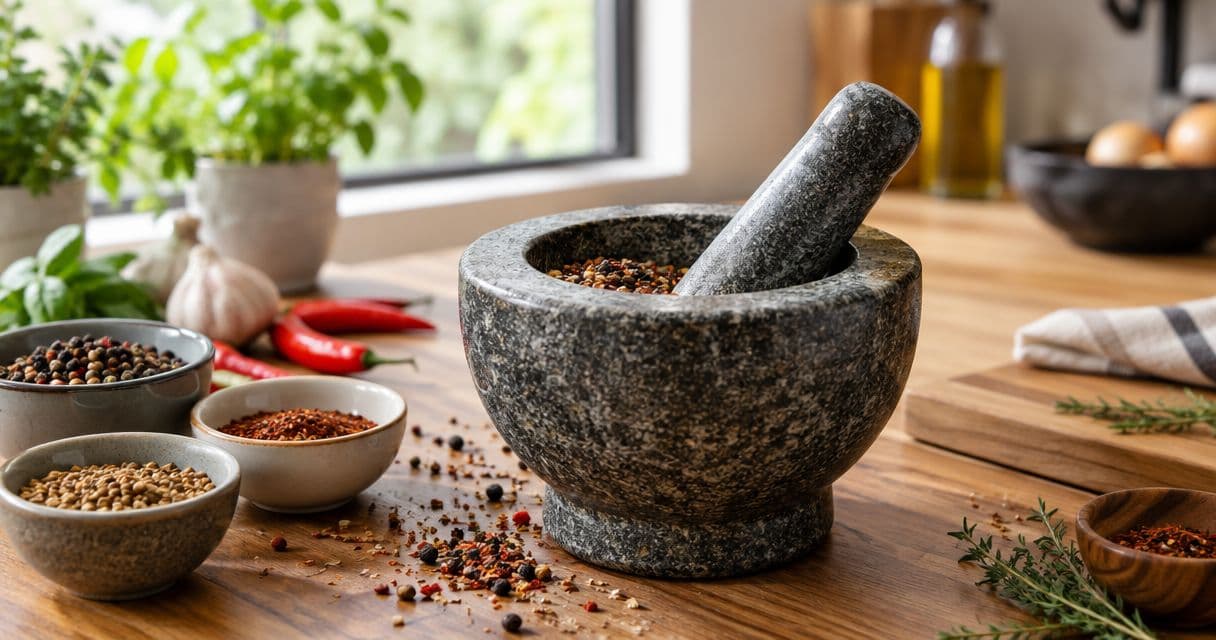
Best overall: a medium, deep-bowled granite mortar and pestle. Best for occasional spice grinding: a compact granite set. Best for spice pastes: a wide, deep granite bowl. This 2026 guide from 5Senses ranks practical shapes rather than named models with unverified specifications.
TL;DR- A deep-bowled granite mortar and pestle is the best default for grinding whole spices at home.
- Choose a compact granite set for small quantities of peppercorns, cardamom seeds, and other pantry spices.
- Choose a wide, deep granite bowl when wet spice pastes are part of your regular cooking.
- Check the grinding surface, pestle fit, and cleaning instructions before choosing a set.
Why this matters
Whole spices need different textures for different dishes. Cracked pepper belongs on a crust; finer pepper disappears more evenly into a sauce. A mortar lets you stop where the recipe needs you to stop.
The right bowl makes that control easier. Too little working room sends ingredients toward the rim, while an oversized bowl makes a small pinch awkward to gather beneath the pestle. Choose around what you cook repeatedly, not the largest set you can fit on your counter.
For 5Senses whole spices, a deep-bowled granite mortar and pestle is the best default for home cooks who want control over texture. If your main job is making larger quantities of powder, compare the alternatives in this guide to spice grinders for whole spices.
What makes the best granite mortar and pestle?
A useful mortar has to crush ingredients, contain them, and feel manageable in your hands. These are the criteria that determine the ranking:
- Working surface: Look for a textured grinding interior, not just an attractive exterior. The bowl needs to give ingredients purchase beneath the pestle.
- Bowl depth: Choose walls that contain seeds during crushing without blocking your grinding motion.
- Pestle fit: A broad, rounded working end should reach the bowl's bottom and curved sides. Avoid a shape that leaves inaccessible corners.
- Stability: The mortar should sit securely on your work surface. Check how you will protect the counter beneath it.
- Handling: You should be able to grip the pestle comfortably and lift the bowl safely for washing and emptying.
- Care instructions: Confirm that the set is intended for food preparation and that the maker explains preparation, washing, and drying.
Do not mistake roughness for quality. A usable grinding surface and loose stone particles are different things; a surface that continues shedding material needs attention before it touches dinner.
Granite mortar and pestle options at a glance
These are buying configurations, not specific products. “Medium,” “compact,” and “wide” describe the working shape; check actual measurements and handling before buying.
| Ranked option | Best for | Standout feature | Key limitation |
|---|---|---|---|
| Medium, deep-bowled granite set | Everyday dry-spice grinding | Containment with room to crush and rotate | Requires manual work for fine powder |
| Compact granite set | Occasional, small-quantity seasoning | A small working area keeps ingredients together | Limited room for pastes or larger batches |
| Wide, deep granite set | Wet spice pastes and mixed ingredients | Space to fold ingredients back under the pestle | More weight and space to manage |
1. Medium, deep-bowled granite set: best for everyday spices
A medium, deep-bowled granite mortar and pestle is the default choice for a home cook who regularly uses peppercorns, cumin, coriander, or cardamom seeds. The bowl contains ingredients while leaving room for the pestle to work around the curved base.
Start by cracking the spices with controlled downward pressure. Then grind against the bowl rather than repeatedly striking loose seeds. This change in motion matters more than pounding harder.
Medium, deep-bowled granite set pros:
- Suits both coarse crushing and finer grinding.
- Keeps dry spices below the rim when you work in small batches.
- Gives you direct control over the finished texture.
- Supports repeat pantry tasks without a powered appliance.
Medium, deep-bowled granite set cons:
- Fine powder takes sustained manual effort.
- The bowl must be lifted, washed, and dried after use.
- It is not the efficient choice for repeated large batches.
Best for: Home cooks who grind whole spices for individual dishes and want one general-purpose mortar.
For a useful handling check, imagine grinding 1 teaspoon of peppercorns. There should be enough room to break the pepper, gather it, and rotate the pestle without working against the rim. That quantity is a practical starting exercise, not a capacity rating.
Verdict: Buy a medium, deep-bowled granite set as your everyday default.
2. Compact granite set: best for occasional seasoning
A compact granite mortar and pestle suits cooks who crush small quantities rather than make complete spice blends. Think pepper for a finishing sprinkle, cardamom seeds for a bake, or a little cumin for a dressing.
The smaller working area keeps a modest amount of spice together. That advantage disappears when you crowd the bowl, so choose this shape only if small quantities match your normal cooking.
Compact granite set pros:
- Keeps small amounts of spice within a limited working area.
- Takes less counter space than a wider set.
- Fits a simple crack-and-season routine.
Compact granite set cons:
- Offers little room to fold together wet ingredients.
- Requires separate batches for a larger spice mixture.
- A narrow opening can restrict the pestle's movement.
Best for: Occasional cooks who want freshly crushed seasoning without adding a large tool to the kitchen.
Check the pestle carefully. A small mortar paired with an awkwardly large pestle leaves little useful space, while a thin working end concentrates your effort on a small area. The two pieces need to work together.
Verdict: Buy a compact granite set for small seasoning tasks; skip it as your main paste-making bowl.
3. Wide, deep granite set: best for wet spice pastes
A wide, deep granite mortar and pestle gives mixed ingredients room to move. Choose this configuration when your cooking regularly combines crushed spices with garlic, ginger, herbs, or another wet ingredient.
Width alone is not enough. A broad, shallow dish gives ingredients room to spread but less protection against splashing or escaping; useful depth keeps the mixture inside while you press and fold.
Wide, deep granite set pros:
- Gives you room to combine several ingredients.
- Makes it easier to fold a paste back beneath the pestle.
- Handles crushing and mixing in the same bowl.
- Accommodates bulky ingredients more comfortably than a compact bowl.
Wide, deep granite set cons:
- Takes more counter and storage space.
- A heavy bowl is less convenient to move and wash.
- Tiny amounts of dry spice are harder to gather across a broad base.
Best for: Cooks who make wet spice pastes regularly and have a suitable work surface.
For paste-making, crush the dry spices first. Add the wet ingredients gradually so the pestle can still press them against the stone; flooding the bowl early turns the task into stirring.
Verdict: Buy a wide, deep granite set for regular paste-making; skip it for pinch-sized seasoning alone.
How the options rank
The ranking prioritizes working surface, containment, pestle fit, stability, handling, and care. The medium, deep-bowled configuration comes first because it balances everyday dry-spice work with manageable handling.
The compact configuration wins a narrower task: small quantities. The wide, deep configuration wins on room for mixed pastes, not convenience for every cook. These recommendations concern shape and use; they do not claim tested performance for any named model.
How to grind whole spices without fighting the bowl
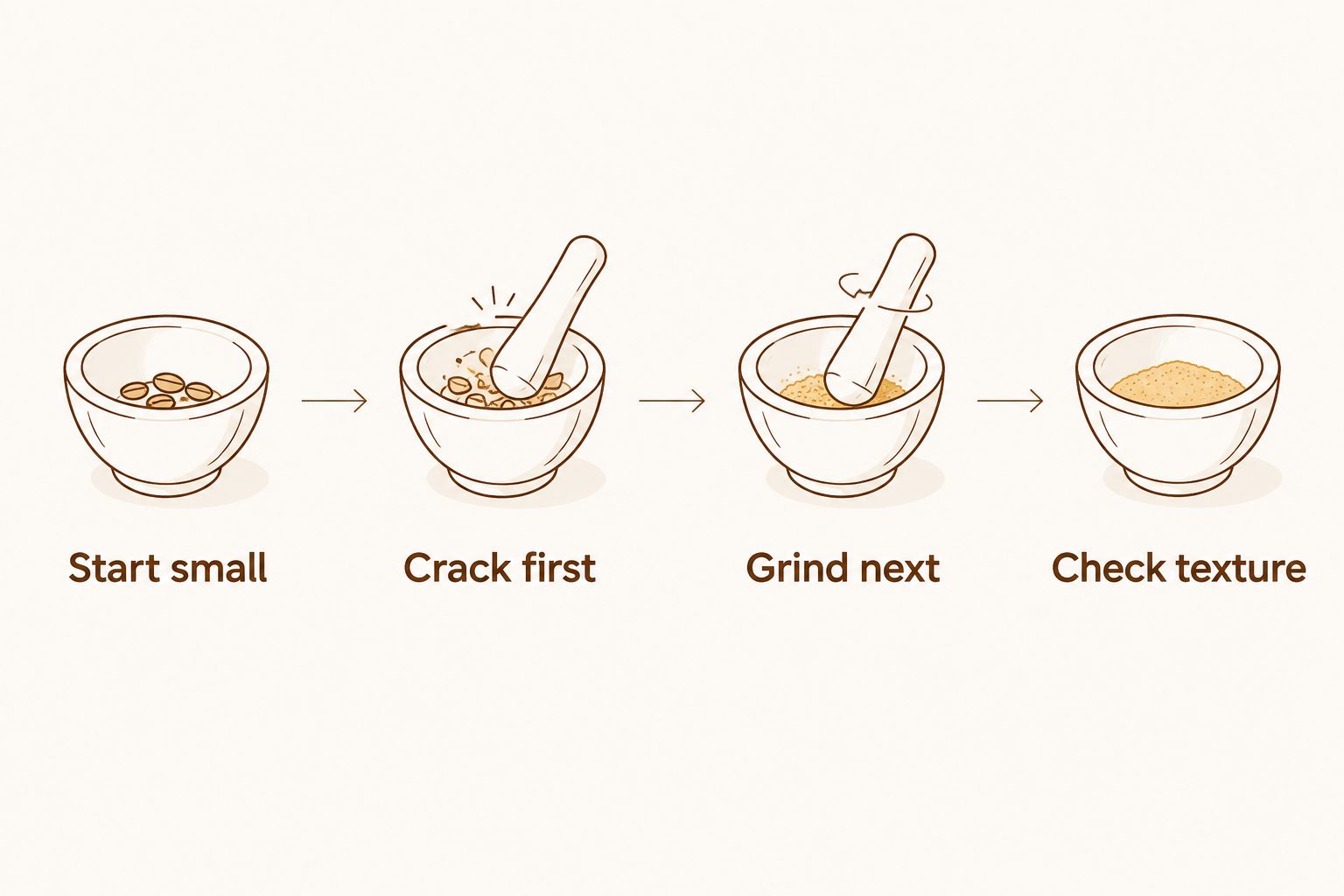
A mortar works through controlled pressure and friction. Use the following sequence with dry spices, then adapt the finished texture to your recipe.
Start small
Begin with 1 teaspoon of peppercorns or 1 tablespoon of cumin seeds, processed separately. These are suggested practice quantities, not minimums or maximums for a mortar. Reduce the amount if the ingredients crowd your particular bowl.
Keep the mortar on a stable surface and grip the pestle comfortably. Clear nearby glassware before starting; you need room for a controlled motion, not a forceful swing.
Crack first
Press down on the spices to break their outer structure. Use short, deliberate movements rather than high strikes that send seeds out of the bowl.
Once the pieces stop rolling freely, they are easier to grind. Gather scattered fragments back toward the working area as you go.
Grind next
Rotate and press the pestle against the bowl's curved surface. Move around the interior so you are not working only on the ingredients directly beneath the center.
Stop and inspect the texture. A steak crust needs a different result from a smooth sauce, and you do not need to turn every spice into dust.
Check texture
Spread a little of the crushed spice with a spoon. Look for large pieces that do not match the texture you want, then return those pieces to the bowl.
Avoid rubbing freshly ground chili with bare fingers. Keep spice dust away from your face, and clean utensils and hands after handling hot peppers.
Toast, grind, bloom, or infuse?
Grinding is one part of cooking with whole spices. At 5Senses, the practical question is what you want the spice to do in the dish: provide texture, disperse through fat, or steep into liquid.
- Toast: Warm suitable whole spices in a dry pan when the recipe calls for a toasted flavor. Stir and watch closely; remove them before they scorch.
- Grind: Let toasted spices cool before grinding. Choose coarse fragments or a finer texture to suit the dish.
- Bloom: Add spices to cooking fat when the recipe calls for it. Keep the heat controlled and have the next ingredients ready.
- Infuse: Use whole or lightly cracked spices when you want flavor to steep into a liquid without adding a ground texture.
Not every spice needs every step. For a smooth cardamom bake, remove the husks before grinding the seeds; for an infusion, lightly cracked pods can go into the liquid and be removed afterward.
Nutmeg presents a different task. Grating lets you take a little from the whole spice without trying to pound a hard, round piece around the mortar.
Prepare, clean, and store the mortar properly
Follow the maker's preparation instructions before the first use. Rinse and inspect the interior, and complete any specified conditioning procedure; do not assume every granite set needs the same treatment.
After cooking, remove food residue promptly and wash as directed. Pay attention to the bowl's bottom curve and the pestle's working end, where paste collects.
Dry both pieces thoroughly before putting them away. A mortar is a preparation tool, not a storage container for ground spices; transfer leftovers to a suitable closed container rather than leaving them exposed in the bowl.
Check these details before you commit:
- The maker identifies the material and intended food use.
- Preparation and cleaning instructions are clear.
- The pestle reaches the bottom and curved sides.
- You can lift the bowl safely when emptying it.
- The grinding surface does not keep releasing loose particles after preparation.
Which granite mortar and pestle should you choose?
Choose a medium, deep-bowled granite mortar and pestle unless your cooking points clearly toward a compact set or a wider paste-making bowl. It is the most useful starting configuration for everyday dry-spice work.
Choose compact when you mostly crush a little seasoning. Choose wide and deep when wet pastes are a regular task. For repeated batches of fine powder, a dedicated spice grinder is the more suitable tool category.
5Senses pairs direct-from-farm, origin-packed whole spices with Spicecare grinding and storage tools. Choose the grinding tool around the spices and dishes you actually use; a well-matched routine matters more than adding another appliance or bowl.
FAQ
What's the best granite mortar and pestle for grinding spices?
A medium, deep-bowled granite mortar and pestle is the best default configuration for everyday dry-spice grinding. Check the textured interior, pestle fit, stability, and handling before choosing a specific set.
Should I choose a small or large granite mortar?
Choose a compact mortar for small seasoning tasks and a wider, deep bowl for wet spice pastes. A medium, deep-bowled set is the practical middle option for regular home cooking.
Can a granite mortar and pestle make wet spice pastes?
A granite mortar and pestle intended for that use can crush and mix wet spice pastes. Choose a bowl with useful depth and working room, and follow the maker's care instructions.
Do I need to season a new granite mortar and pestle?
Follow the maker's preparation instructions rather than applying one universal seasoning method. Rinse and inspect the set, complete any specified conditioning, and do not use a surface that continues shedding loose material.
Can I grind cardamom pods in a mortar?
You can crack cardamom pods in a mortar, but remove the husks when you want finely ground seeds for baking. For an infusion, lightly cracked whole pods can flavor the liquid without being ground into powder.
Is a mortar better than an electric spice grinder?
A mortar is better suited to controlled crushing and wet paste-making; a dedicated spice grinder suits repeated batches of dry powder. Choose around your usual task rather than treating either tool as best for everything.
How do I keep spices from jumping out of the mortar?
Start with a small batch and crack the spices with controlled downward pressure. Once they break, use a pressing, circular motion against the bowl instead of high strikes.
Can I leave ground spices in the mortar overnight?
Transfer ground spices to a suitable closed container instead of leaving them exposed in the mortar. Clean and dry the mortar so it is ready for the next dish.
One last thing
You do not always need to grind finer. Split a freshly crushed batch of pepper: use the coarser portion as a finishing seasoning and grind the rest further for a sauce. The same whole spice performs two different jobs because you changed its texture.