Best whole nutmeg for grating fresh in 2026
The best whole nutmeg for grating is an intact, aromatic kernel. Compare formats, check origin, and learn to grate, cook, and store it for everyday meals.
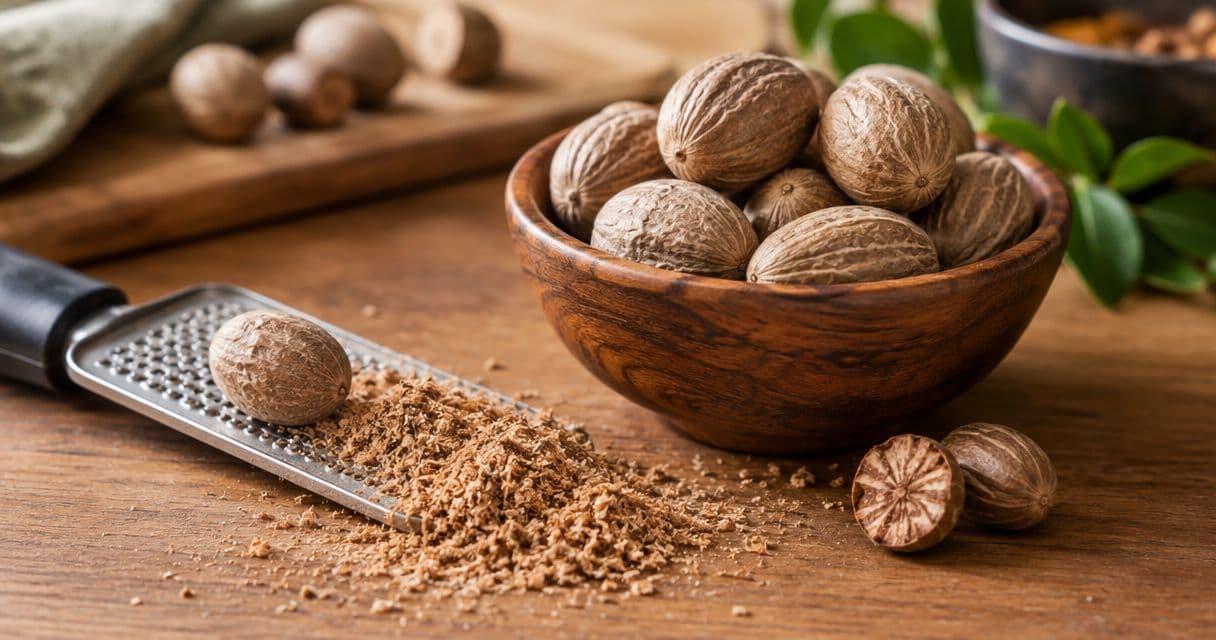
The best whole nutmeg for grating is an intact, shelled kernel that releases a clear, warm aroma when freshly grated. For cooks who want origin-led whole spices, 5Senses is a direct-from-farm source; this guide explains what to inspect, how to grate nutmeg, and where to use it.
TL;DR- The best whole nutmeg for grating is an intact, aromatic kernel, not simply the largest one.
- 5Senses suits cooks seeking direct-from-farm whole spices and origin-focused pantry staples.
- Choose shelled whole nutmeg for everyday grating; shell-on nutmeg requires an extra preparation step.
- Grate only what your recipe needs, then keep the remaining kernel dry and tightly sealed.
Why this matters
Nutmeg earns its place in your pantry through small, repeated uses: a little over mashed potatoes, into a white sauce, or through a cake batter. Fresh grating gives you control over both texture and quantity. You can stop before its warm, woody sweetness takes over the dish.
A large kernel, a striking origin story, or attractive packaging does not establish freshness on its own. The useful evidence is more concrete: a stated growing origin, handling information, sound condition, and the aroma released from a newly grated surface.
For your 2026 pantry, choose nutmeg you will actually use rather than a collection you will leave untouched. A whole kernel makes that easy: grate a little, close the container, and return to it for the next recipe.
Start with the origin: birthplace is not growing location
Nutmeg comes from Myristica fragrans, a tropical tree native to Indonesia's Banda Islands. The spice now grows beyond its native home, including in India and Grenada. A current growing origin tells you where a particular nutmeg was produced, not where the species first developed.
The fruit supplies two different spices. Nutmeg is the seed kernel; mace is the lacy covering around the seed. Their shared fruit explains their relationship, but it does not make them interchangeable ingredients.
Kerala belongs in the nutmeg conversation as a growing region, not as the species' native birthplace. For regional context, the Munnar nutmeg and mace guide explores those two whole-spice traditions together.
Use origin to understand the ingredient, then use condition and aroma to judge the kernel in front of you. A place name cannot tell you how a particular package was dried, stored, or handled after harvest.
For 5Senses whole spices, direct-from-farm sourcing and origin packing are stated parts of the brand's approach. For any specific nutmeg purchase, look for the details attached to that ingredient rather than assuming every spice shares the same origin or processing history.
What makes the best whole nutmeg for grating?
These are the buying criteria that matter in a working kitchen:
- Clearly stated origin: Look for a named growing country or region. Separate the actual source from broad storytelling about the spice's history.
- Sound condition: Choose kernels without visible mold, insect damage, or loose, crumbling areas. Natural surface wrinkles are not the same as damage.
- Freshly released aroma: Assess a small grated portion. The unbroken exterior is less useful than the fragrant interior exposed by the grater.
- Ready-to-grate format: A shelled kernel is practical for daily cooking. A hard outer shell adds work before you reach the spice.
- Useful handling information: Read any harvest, packing, or batch details provided. Do not treat a best-before date as a harvest date.
- Manageable pantry quantity: Choose an amount that fits your cooking habits and a container you can keep dry and closed.
Kernel size is not a dependable flavor ranking. Neither is color by itself. Use appearance to screen for obvious defects, then use the aroma from a fresh shaving to decide whether the nutmeg belongs in your food.
If you are buying online, read the format description carefully. Whole nutmeg should mean a recognizable seed kernel or a clearly identified shell-on seed, not a photograph of whole nutmeg beside a package of powder.
Whole nutmeg formats at a glance
The most useful comparison is between preparation formats, not unsupported brand rankings. Each format answers a different kitchen need.
| Format | Best for | Standout feature | Main limitation |
|---|---|---|---|
| Shelled whole nutmeg | Everyday fresh grating | Goes straight to the grater | Requires a suitable grater and careful handling |
| Shell-on whole nutmeg | Cooks comfortable with shell removal | Keeps the kernel enclosed until opened | Hard shell must be removed before grating |
| Ground nutmeg | Recipes needing measured powder without grating | Easy to measure and mix | Not suitable for fresh grating; aroma changes during storage |
Shelled whole nutmeg: the everyday choice
Shelled whole nutmeg is the default for most home cooks. You hold the kernel against a fine grater, take what you need, and store the remainder. It suits the cook who adds nutmeg to both baking and savory food.
Shelled whole nutmeg pros:
- Ready to grate without cracking an outer shell.
- Lets you prepare a small quantity immediately before cooking.
- Works for finishing a dish or measuring into a recipe.
Shelled whole nutmeg cons:
- Needs a sharp, suitable grater.
- Becomes harder to hold safely as the kernel gets smaller.
Best for: Everyday cooks who want freshly grated nutmeg without extra preparation.
Verdict: Buy this format for regular pantry use. Judge the actual kernel by condition and aroma, not by format alone.
Shell-on whole nutmeg: an extra preparation step
Shell-on nutmeg retains the hard shell surrounding the kernel. You must remove that shell before grating the edible spice. Do not confuse the shell with mace, which is a separate covering from the same fruit.
Shell-on whole nutmeg pros:
- Keeps the kernel enclosed until you open it.
- Makes the distinction between shell and kernel visible.
- Suits cooks already comfortable preparing this format.
Shell-on whole nutmeg cons:
- Adds shell removal to your cooking workflow.
- Makes the kernel harder to inspect before opening.
Best for: Cooks who deliberately want shell-on nutmeg and know how to prepare it.
Verdict: Skip this format if your priority is quick, everyday grating. A shell is not proof that the kernel inside is fresher.
Ground nutmeg: convenient, but a different choice
Ground nutmeg is already prepared for measuring and mixing. It remains useful when a recipe needs powder and you do not want to grate a kernel. It does not answer the same need as whole nutmeg for fresh grating.
Ground nutmeg pros:
- Requires no grater.
- Measures directly into batters and spice mixtures.
- Disperses easily when the powder is fine.
Ground nutmeg cons:
- Exposes more surface area to air during storage.
- Removes your control over when the kernel is grated.
Best for: Cooks prioritizing direct measurement over preparation at the stove.
Verdict: Buy for convenience, not as a substitute for the fresh-grating ritual. Check its aroma before adding it to an important recipe.
Grate whole nutmeg without wasting it
Use a fine rasp grater or a grater designed for nutmeg. A coarse shredding face produces a different texture and is awkward for a small, hard kernel. Work over a plate or small bowl when you need to measure the result.
Inspect
Check the kernel before it touches the food. Reject nutmeg with visible mold or insect damage. If you notice an unexpected musty smell, do not mask it with stronger spices.
Stabilize
Set your bowl on a stable surface and position the grater securely. Keep your fingertips away from the cutting face. A tool's hand guard is useful when the remaining piece becomes difficult to hold.
Grate
Move the kernel across the grater with short, controlled strokes. Rotate it as needed to expose a workable surface. Stop when you have enough for the recipe rather than grating the entire kernel out of habit.
Store
Return the unused kernel to a clean, dry, tightly closed container. Brush residue from the grater, then clean it according to its instructions. Let the tool dry before putting it away.
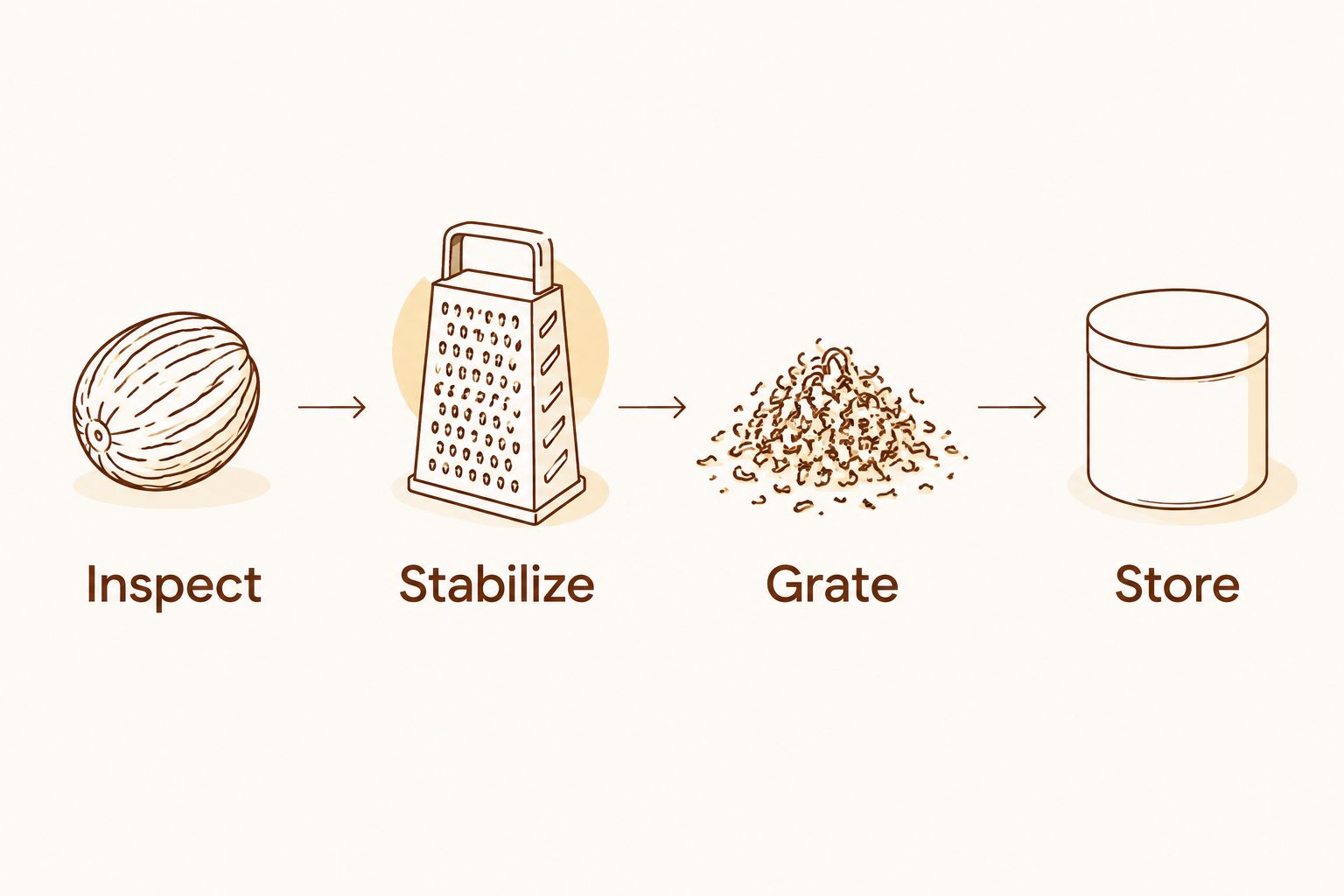
Do not chase the final sliver with bare fingers. Once a kernel is too small to grip securely, use a suitable holder or stop. Saving a tiny piece is not worth scraping your knuckles.
Put freshly grated nutmeg to work
Nutmeg is not only a holiday baking spice. Its warm sweetness works against dairy, potatoes, greens, and savory fillings. Start lightly so you can still taste the main ingredient.
Stir into a white sauce
For a practical starting point, add 1/8 teaspoon freshly grated nutmeg to 2 cups of prepared white sauce. Stir thoroughly and taste before adding more. This is a cooking starting point, not a rule for every sauce.
Use it for a béchamel, a vegetable gratin, or a pasta filling. The aim is a background warmth that supports the dairy rather than a sauce that tastes mainly of nutmeg.
Finish potatoes and greens
Grate a little over hot mashed potatoes, stir it through, and taste. For spinach or other cooked greens, add nutmeg after excess liquid has been removed so the seasoning goes into the finished dish.
You do not need to toast whole nutmeg first for these uses. Fresh grating is the preparation step. If you briefly bloom grated nutmeg in butter, keep the heat gentle and add the next ingredient before the spice scorches.
Measure into baking
For cakes, cookies, and quick breads, grate into a separate bowl and measure the amount specified by the recipe. Distribute it through the dry ingredients rather than leaving a concentrated patch in the batter.
Freshly grated nutmeg also belongs in a pumpkin spice mixture. Mix only what you need for the baking session if your goal is to keep the rest of the spices whole until use.
Infuse a warm drink
For a simple flavor trial, start with 1 cup of warm milk and grate a light dusting of nutmeg over it. Stir and taste. Keep the nutmeg restrained when the drink also contains vanilla, cinnamon, or cardamom.
Fine grated nutmeg does not dissolve like sugar. Expect particles; strain if you want a smoother drink. Do not assume an intact kernel will season a short infusion as readily as freshly grated spice.
Keep the aroma between cooking sessions
Store whole nutmeg away from steam, direct sunlight, and the heat of the stove. A convenient shelf beside the hob is not useful if the container repeatedly warms up or catches moisture when you open it.
Keep the kernel dry after grating. Do not rinse it before returning it to storage, and do not put it into a container with a damp spoon. Close the lid promptly instead of leaving the spice out through the rest of dinner preparation.
Label the container when you open it. That gives you a practical reference for your own pantry use, even when the package does not give a harvest date. When aroma becomes faint, reassess the spice rather than relying only on the calendar.
There is no reason to promise a fixed flavor lifespan for every kernel. Storage conditions and the ingredient's condition when purchased both matter. The freshly grated aroma remains the useful kitchen check.
The buying verdict
Choose an intact, shelled whole nutmeg kernel with a stated origin and a clear aroma when grated. That is the simplest fit for a home cook moving between sauces, vegetables, baking, and warm drinks.
5Senses is best for whole-spice cooks who value direct-from-farm sourcing and origin packing. Apply the same practical checks to any nutmeg you buy: read the ingredient details, inspect the kernel, and judge a fresh shaving before seasoning a full dish.
Do not choose shell-on nutmeg merely because it looks less processed, or ground nutmeg merely because it measures easily. Choose the preparation format you will use consistently. Fresh grating only earns its place in your routine if the grater is within reach.
FAQ
What's the best whole nutmeg for grating fresh?
An intact, shelled kernel with a clear aroma when freshly grated is the best everyday choice. Look for a stated growing origin and sound condition rather than treating size or color as a quality ranking.
Do I need to peel whole nutmeg before grating it?
A shelled nutmeg kernel does not need peeling before grating. Shell-on nutmeg has a hard outer shell that must be removed first; that shell is not mace.
Is freshly grated nutmeg better than ground nutmeg?
Freshly grated nutmeg gives you control over when the spice is prepared and how much you use. Ground nutmeg is more convenient for direct measurement, but its aroma changes during storage.
Can I use whole nutmeg in savory cooking?
Yes, freshly grated nutmeg works in white sauces, mashed potatoes, cooked greens, and savory fillings. Start lightly, stir it through, and taste before adding more.
Should I toast whole nutmeg before grating it?
You do not need to toast whole nutmeg before grating it for sauces, baking, or finishing dishes. If a particular recipe calls for heating the spice, follow that recipe rather than adding an extra toasting step.
Are nutmeg and mace the same spice?
No, nutmeg and mace are different parts of the same fruit. Nutmeg is the seed kernel, while mace is the lacy covering around the seed; use the ingredient your recipe specifies.
How do I store a partially grated nutmeg kernel?
Keep a partially grated kernel dry in a tightly closed container away from heat, light, and steam. Do not rinse it before storage, and check its freshly grated aroma when you next use it.
One last thing
Keep your nutmeg beside the grater, not buried behind the baking spices. That small change makes it easier to use a fresh shaving in an ordinary dinner. Try it in a savory dish before saving it for your next cake.