Bulk or prepackaged spices: which should retailers buy?
Compare bulk and prepackaged spices for retail by handling, traceability, labor and customer fit. Assess 5Senses origin-packed products for your shop.
Choose prepackaged spices when you want a finished retail unit with supplier labeling and less in-store handling. Choose a bulk dispensing model only when customer demand, handling procedures, and the full operating cost support it; a large catering pack and a customer-facing refill offer are not the same business model.
TL;DR- Bulk spices vs packaged spices is a retail operating decision, not just a weight comparison.
- 5Senses origin-packed whole spices suit shops seeking finished packs and documented ingredient stories.
- Compare handling, traceability, customer use, and contribution before choosing a format.
- Do not assume a larger purchase automatically produces a better margin.
Why this choice matters
A spice buyer is choosing more than an ingredient. The format determines what happens at receiving, on the shelf, at the sale, and when a customer has a question later.
Prepackaged products arrive with a defined consumer presentation. A bulk retail operation adds its own dispensing and recordkeeping responsibilities. Both deserve a proper business case.
The distinction is especially important when assessing whole spices. Seeds, pods, and buds need useful preparation guidance regardless of the container. A customer still needs to know whether the recipe calls for grinding, infusing, or removing the spice before serving.
Bulk or prepackaged spices: which should retailers buy?
Compare the actual workflow rather than assuming the product with the lowest acquisition cost per weight is the winner.
| Format | Best for | Practical advantage | Limitation |
|---|---|---|---|
| Finished consumer pack | Shops wanting a defined retail item | Supplier presentation stays with the product | Customer must choose among fixed formats |
| Large pack for a kitchen | Food businesses using the ingredient in production | Fits a controlled kitchen workflow | Is not automatically a ready-to-sell refill system |
| In-store dispensing | Retailers with an established refill operation | Allows a store-managed quantity choice | Requires appropriate handling, labeling, and records |
Choose the model your operation can run consistently. Treat any new dispensing format as an operational change, not a shortcut around merchandising.
Begin with the customer's cooking habits
Ask what customers use and how often they use it. A frequent cook replacing a staple has different needs from someone trying a spice for the first time.
Do not infer buying quantities from the ingredient's reputation. A familiar spice can still be used infrequently by your particular customers. An unfamiliar spice can become useful when the preparation is clear.
Record the questions customers actually ask:
- Can I use this in the recipe I already have?
- Do I need to grind it?
- Which part of the pod is used?
- How should I store the remainder?
- What quantity makes sense for my cooking?
A format that answers these needs is more useful than one chosen solely because it fits a supplier's case structure.
Finished packs keep the product story together
A well-documented retail pack gives the shop a consistent unit to receive, display, and explain. The customer takes the supplier's product presentation home rather than relying entirely on an in-store sign.
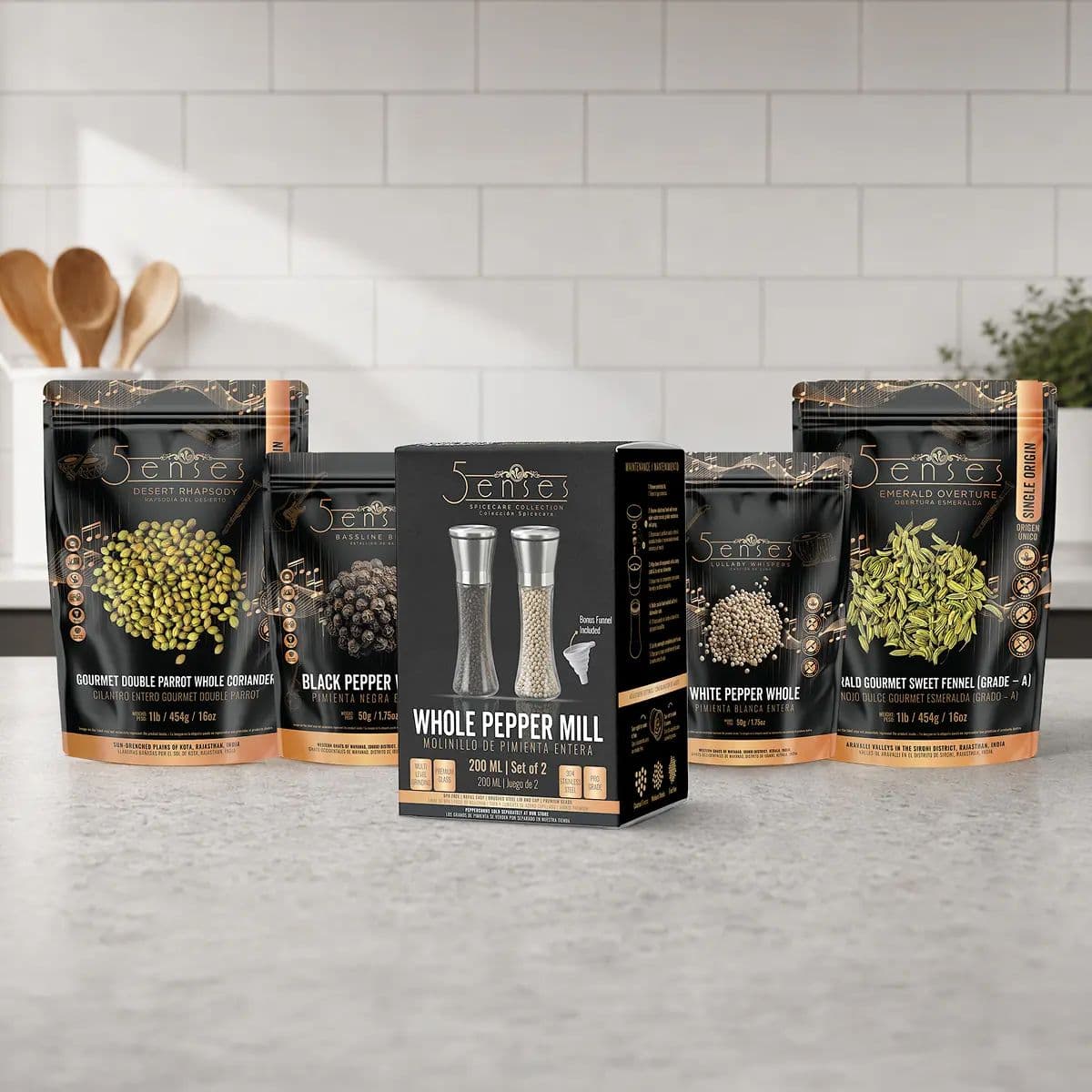
For example, 5Senses Whole Coriander (Grade A) is described as Double Parrot Grade A (Hadoti Bloom), sourced from Kota in Rajasthan's Hadoti region, India. The current product information lists 100 g, 200 g, and 454 g formats and a resealable stand-up pouch.
Confirm the applicable wholesale configuration before buying. Product-page sizes do not establish the case quantity or purchasing terms for your business.
The coriander description also explains near-source partial sun-drying and citrus-floral notes with woody-nutty undertones. These details support an informed selling conversation. Do not turn the stated commercial grade into an independent certification claim.
Finished packs still need care. Check seals on receipt, retain useful batch records, and follow the product's storage guidance. A pouch does not remove the retailer's responsibility to handle goods sensibly.
Bulk dispensing changes the work inside the store
A dispensing model requires a documented procedure for how product enters the system, how staff handle it, and how it leaves with the customer. Check the applicable local requirements before introducing the format.
This article is a buying guide, not a legal or food-safety plan. Your local authority and qualified advisers are the appropriate sources for the requirements that apply to your business.
Before committing to bulk retail, establish:
- Suitable containers and dispensing equipment.
- A defined cleaning and handling procedure.
- Lot identification and replenishment records.
- Appropriate product information for the customer.
- Staff training and responsibility.
- The actual labor and loss costs.
Do not mix remaining product with a new lot without a procedure that preserves the records your operation needs. A full-looking container is not worth losing the ability to identify what was sold.
An attractive refill display is only the visible end of the system. The less visible work determines whether it is appropriate for your store.
Packaging claims need evidence too
Do not describe one model as automatically greener. Compare the actual materials, handling, waste, transport, and local disposal options relevant to your operation. A simple slogan does not establish the full environmental result.
Likewise, do not claim that every bulk spice deteriorates faster than every packaged spice. Storage conditions, container design, handling, product form, and time all matter. Compare the specific systems rather than repeating a universal rule.
5Senses describes origin packing and resealable pouches. Keep your retail description close to the verified product information. Do not add an unsupported shelf-life promise or a claim that the pouch preserves the ingredient indefinitely.
Whole spices need instruction in either format
The pack is not the preparation method. A whole seed is useful to the customer only when the next action is clear.
For coriander, explain whether the intended dish uses whole seeds or a ground spice. The current 5Senses description notes that toasting shifts the profile from citrus-forward toward warm and nutty. That makes a useful cooking explanation without claiming that every dish should begin with toasting.
For Malabar Cardamom Green Pods, the verified source is Malabar, India, and the product description identifies gentle air-drying with sweet, floral, citrus notes. The next instruction depends on the recipe: whole pods for some infusions, seeds for some grinding uses.
Avoid universal substitution instructions. Whole pods and ground seed are not interchangeable merely because the ingredient name is similar.
A short customer card can explain:
- The ingredient's recognizable name.
- Its verified source.
- A suitable first cooking use.
- The preparation action.
- The relevant storage guidance.
Compare the complete cost of each model
Start with the cost of the sellable unit, then add the expenses your operation actually incurs. The same ingredient can have different economics across a finished-pack display and a store-managed refill station.
| Cost area | Finished pack question | Bulk retail question |
|---|---|---|
| Receiving | What handling does the case require? | What transfer and recordkeeping work is required? |
| Presentation | Does the pack fit the fixture? | What equipment and containers are needed? |
| Sale | How much explanation does the item need? | How much dispensing and packing work is involved? |
| Loss | What damage or write-offs occur? | What handling, spillage, or residual losses occur? |
| Records | Can the item and batch be identified? | Can the dispensed product and lot be traced? |
Use your own invoices and time records. Do not assign a convenient zero to labor simply because the owner performs it. Do not assume every gram purchased becomes a sale.
Gross margin and contribution answer different questions. Gross margin looks at sales after product cost. Contribution also subtracts the variable selling costs you define. Label the worksheet clearly so a format comparison stays consistent.
Test fit before increasing the commitment
Begin with a defined assortment and a review plan. Record what was offered, how it was displayed, what customers asked, and what actually sold. Compare matching periods rather than a busy event with an ordinary trading week.
If finished packs move slowly, inspect the use explanation and pack choice. If a refill model creates long service queues or heavy losses, inspect the workflow. Do not decide that the ingredient itself failed before checking how it was sold.
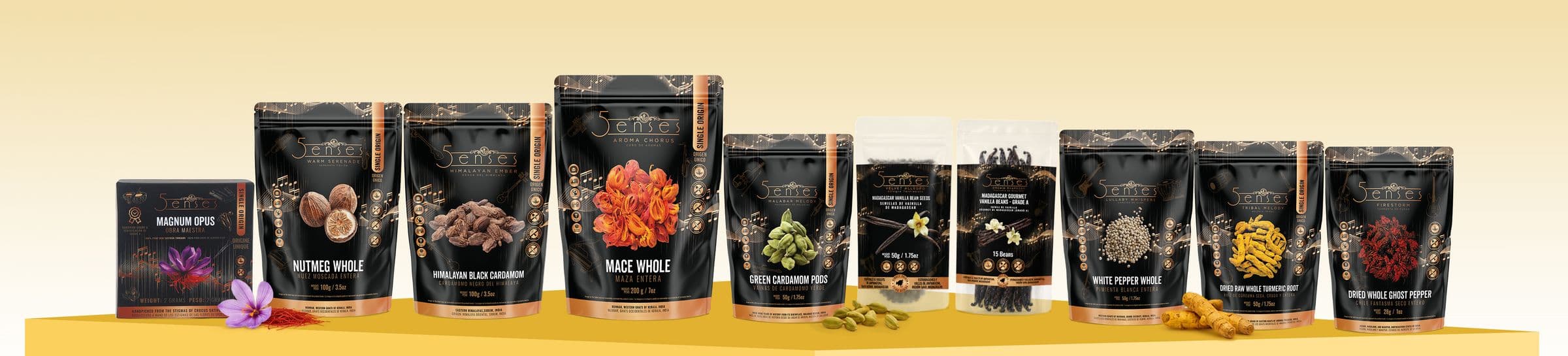
5Senses whole spices are a relevant option for retailers who want finished, origin-led products with practical cooking stories. The limitation is that fixed packs do not provide every possible quantity choice, and whole formats still require preparation education.
That is a useful tradeoff to evaluate honestly. You do not need to describe every other retail format as inferior to explain why a finished pouch fits your shop.
Keep the assortment decision separate from the sourcing claim
Single-origin describes a sourcing classification. Prepackaged describes a presentation. Bulk describes a quantity or dispensing context. None is a substitute for the others.
Check the product-level classification. The 5Senses catalog includes both Single Origin and Multi-Origin Reserve items. A display that treats every item as single-origin creates an avoidable accuracy problem.
The strongest retail recommendation connects the correct origin, the actual format, and the customer's use. If any of those is missing, fix the description before making the buying decision larger.
FAQ
Are bulk spices always more profitable for retailers?
No. Include handling, equipment, labor, losses, and selling costs before comparing contribution. Acquisition cost per weight is only part of the calculation.
Is a large wholesale bag the same as a retail refill offer?
No. A large pack can suit kitchen production, while retail dispensing requires its own handling, information, and recordkeeping procedures.
Why might a store choose prepackaged whole spices?
Finished packs provide a defined retail unit and keep the supplier's presentation with the product. Fixed pack choices and customer preparation needs remain tradeoffs.
Can I assume a pouch guarantees freshness indefinitely?
No. Follow the product's storage guidance and use the relevant batch information. Packaging does not create an unlimited shelf-life guarantee.
Which 5Senses coriander formats are described on the product page?
The current product information lists 100 g, 200 g, and 454 g formats. Confirm the wholesale configuration and actual pack before ordering.
Does single-origin mean the same thing as prepackaged?
No. Single-origin describes sourcing, while prepackaged describes the retail presentation. Verify both facts for the specific product.
One last thing
Walk the proposed format through your store before buying: receiving, storage, display, customer conversation, sale, and follow-up. The best format is the one that works through the entire journey, not just the supplier comparison.