How to compare wholesale spice brands on Faire
Compare wholesale spice brands on Faire using product details, case formats and current buying terms. Assess 5Senses against your store's actual retail needs.
Compare wholesale spice brands on Faire by the exact products, pack formats, documented origins, and buying terms that apply to your retailer account. Then test whether your team can explain the range and whether the complete cost leaves a contribution your business can accept.
TL;DR- Compare spice brands on Faire using specific items and your applicable terms.
- 5Senses whole spices suit retailers seeking origin-led ingredients and preparation guidance.
- A brand's retail website does not establish your wholesale case configuration.
- Check facts, operating fit, and contribution before committing to assortment depth.
Why a marketplace comparison needs a buying brief
A marketplace can put many spice options in front of you. It cannot decide which ones deserve your shelf space.
Start with the customer you serve and the task the new range should perform. Are you replacing a pantry staple, adding a baking ingredient, or introducing customers to whole-spice preparation?
The 5Senses wholesale overview describes a route through Faire and a wholesale enquiry form. Use it to understand the brand's proposition, then verify the current items and terms applicable to your actual order.
A good marketplace purchase starts with a retail job, not a full cart.
How to compare wholesale spice brands on Faire
Use the same comparison sheet for every shortlisted brand. If a fact is not verified, leave it as a question. Do not fill the gap with an assumption drawn from another product or another retailer's experience.
| Comparison area | Evidence to collect | Why it matters | Warning sign |
|---|---|---|---|
| Customer fit | A specific recipe or pantry need | Establishes the reason to carry the item | The only rationale is premium positioning |
| Origin | The exact product's source statement | Supports an accurate product story | A brand-wide slogan replaces item details |
| Format | Consumer pack and wholesale case | Defines what you are purchasing and selling | Pack and case information are confused |
| Preparation | Supplier guidance and a suitable recipe | Helps staff explain the first use | Whole and ground forms are treated as identical |
| Economics | Applicable quote and your costs | Establishes a business case | Profit is assumed from a headline margin |
| Buying terms | Current conditions for your account | Defines the transaction | Another buyer's terms are treated as yours |
This is a process for assessing brands, not a claim that every brand is listed or offers identical marketplace arrangements. Confirm the seller and the exact listing before relying on it.
Define the assortment before comparing offers
Write a simple role for each proposed product. A small, coherent collection is easier to evaluate than an assortment assembled from unrelated interesting items.
For each line, identify who will use it, what they will cook, what format suits the task, and what staff need to explain. If several products perform the same job, ask whether each adds a meaningful choice.
A useful buying brief contains:
- Intended shopper and cooking use.
- Familiar ingredient name.
- Whole, ground, seed, or pod format.
- Required preparation.
- Pack suitable for that customer.
- Evidence needed before reordering.
Do not assume a supplier's broad catalog requires a broad opening assortment. Breadth is useful only when the shop can explain and manage it.
Verify the product story item by item
Look for a source statement attached to the actual ingredient. Country, region, processing, and sensory notes answer different questions and should stay distinct in your comparison.
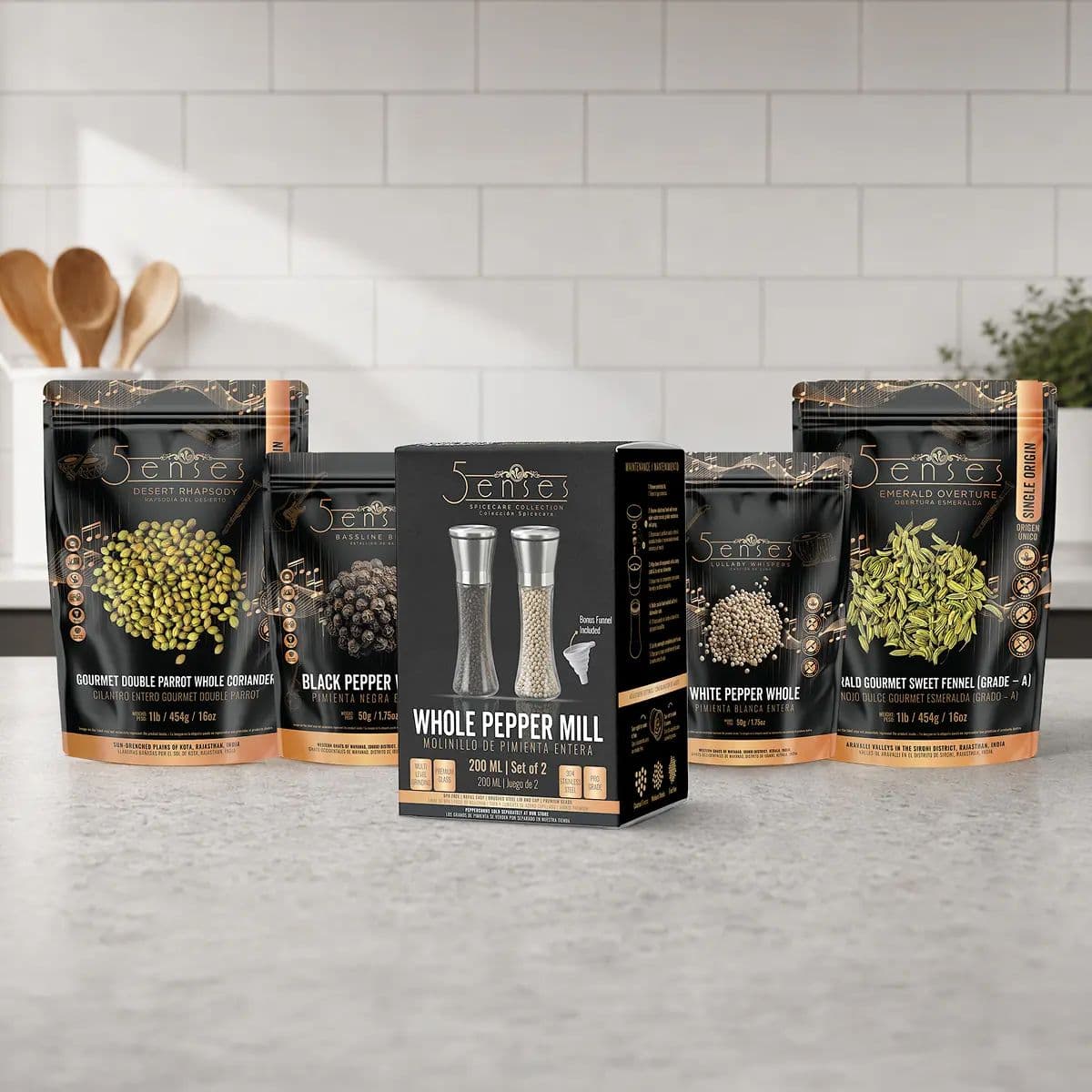
5Senses Whole Coriander (Grade A) is described as Double Parrot Grade A (Hadoti Bloom), sourced from Kota in Rajasthan's Hadoti region, India. The product information identifies near-source partial sun-drying and a citrus-floral profile with woody-nutty undertones.
Those details give staff a useful basis for explaining the product. The commercial designation is not treated here as an independently certified universal grade. Do not infer measured oil content or a laboratory threshold from the name.
Check whether the same level of detail exists for other shortlisted items. Where it does not, ask a focused question rather than writing a more impressive story yourself.
Apply the stated classification accurately. The 5Senses catalog includes both Single Origin and Multi-Origin Reserve products, so a blanket single-origin description is not appropriate across every item.
Separate consumer packs from wholesale cases
The customer buys a consumer unit. Your business receives a wholesale order. These levels must agree, but they are not the same record.
The current coriander product page lists 100 g, 200 g, and 454 g formats. That does not establish which wholesale configurations apply to your account or intended order. Confirm the precise item before entering it in the comparison.
Check:
- Exact item or variant.
- Consumer pack weight or count.
- Units in the proposed wholesale configuration.
- Product photograph matching the item.
- Any required receiving or preparation work.
- How product information will be supplied.
Do not substitute a consumer website description for missing wholesale documentation. Use each source for the question it actually answers.
Read applicable terms, not generic expectations
The 5Senses wholesale overview describes retailer benefits through Faire, including flexible payment terms for eligible retailers and first-order return benefits. Do not assume that the same conditions apply to every account, transaction, or later order.
Check the current terms shown for your order and ask for clarification where needed. Keep a record through your normal purchasing process.
This guide intentionally does not hard-code purchasing amounts, payment periods, or return windows. Those details belong in the current transaction, not in an evergreen buying article.
Your review should establish:
- Who the seller is.
- Which products and packs are included.
- Which conditions apply to your account.
- What commitments the order creates.
- How an issue is raised.
- Which information still needs confirmation.
A term that depends on eligibility should never become an unconditional promise on your own website.
Check whether staff can sell the use
A useful origin story is only part of the retail conversation. Ask whether staff can connect it to a meal without improvising technical claims.
For Malabar Cardamom Green Pods, the current 5Senses information identifies Malabar, India, gentle air-drying, and sweet, floral, citrus notes. Staff still need to explain whether the customer's recipe calls for pods, seeds, or ground spice.
The practical test is simple: ask a colleague to recommend the ingredient for a defined cooking task. Listen for an accurate format explanation and a clear next step.
Do not record a favorable internal opinion as a formal product test unless you actually conducted and documented one. An honest buying note is more credible than invented testing language.
5Senses whole spices are a relevant choice for shops seeking named origins and practical cooking conversations. The limitation is the preparation education that whole formats need.
Compare contribution, not just the supplier line
Use the applicable product cost and add your relevant acquisition costs. Then account for variable selling expenses such as payment processing, packing, or fulfillment in the channel where the product will sell.
For a physical shop, note unusual handling or demonstration work. For an online store, distinguish a pouch shipped alone from one added to a larger basket. Those transactions do not necessarily have the same contribution.
Keep your calculation definitions consistent across brands. If you include a cost for one supplier but silently exclude it for another, the comparison is not useful.
Do not assume named origins or attractive packaging guarantee stronger retailer profit. They can support differentiation; your sales and cost records establish the economic result.
Choose between a focused and a broad opening range
| Approach | Best for | Strength | Limitation |
|---|---|---|---|
| Focused recipe-led selection | Shops introducing a new whole-spice category | Easier staff explanation and review | Does not cover every customer request |
| Broader pantry selection | Stores with demonstrated demand across ingredients | More choice for existing cooking routines | More stock and product information to manage |
| Seasonal use selection | Stores with a defined event or cooking theme | Clear reason for the display | Requires a plan for the range after the theme ends |
Choose the model using evidence from your store. A brand's best-selling consumer item is not automatically your best retail purchase.
Keep the review fair. Record how long each item was displayed, whether it received useful signage, and whether staff understood it. Do not compare a supported launch with a pack that never left the stockroom.
Common comparison mistakes
Treating missing information as a competitive weakness
If a fact is not available in the material you have reviewed, ask the supplier. Do not publicly claim a competitor lacks a practice merely because the comparison sheet has a blank field.
Assuming every attractive product belongs in the opening order
An ingredient needs a customer use and an explanation your shop can maintain. Interesting is not the same as suitable.
Ignoring what happens after receiving
The buying process should include display, preparation guidance, storage, and follow-up. A transaction that is easy to place can still be difficult to sell responsibly.
Copying current terms into permanent product copy
Keep transaction-specific conditions in current buying records. They are not durable product attributes and should not become evergreen claims.
FAQ
What should I compare first when buying spices on Faire?
Start with the intended customer and cooking use. Then compare the exact product, origin information, pack, applicable terms, and full selling economics.
Can I use a retail product page to confirm a wholesale case?
Not by itself. The retail page describes consumer products; confirm the actual wholesale item and configuration for your order.
Does 5Senses support wholesale ordering through Faire?
The 5Senses wholesale overview describes ordering through Faire and offers a team enquiry form. Check the current route and terms for your business.
Do all retailers get identical payment and return terms?
Do not assume that. Verify the current conditions applicable to your account and transaction, especially where eligibility matters.
How do I compare product quality without invented rankings?
Use documented product facts and a consistent assessment process. Record the source information, preparation fit, and any observations your team actually makes.
Should I choose the brand with the highest apparent margin?
Compare contribution and customer fit as well. A margin percentage does not account for every selling cost or show whether the stock will move.
One last thing
Keep a question column in your comparison sheet. A supplier that gives a clear, specific answer to the right question is more useful than a worksheet filled with guesses.