Ghost pepper’s Northeast Indian roots: Nagaland, Assam and Manipur
Explore ghost pepper origin in Northeast India, why terroir matters for heat and flavor, and how to cook with 5Senses whole, naturally sun-dried peppers.
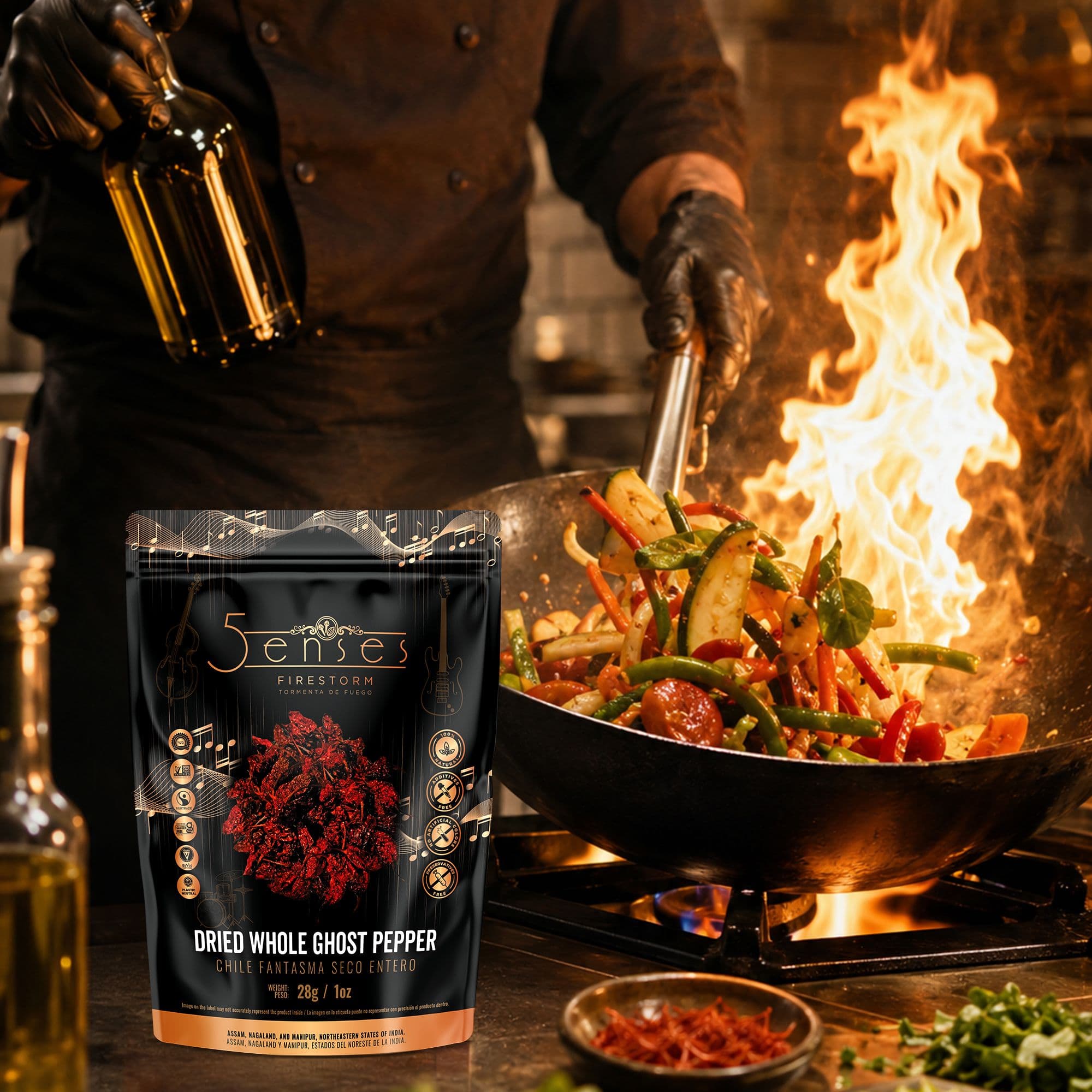
Ghost pepper’s regional roots are in Northeast India, where growing conditions and producer knowledge matter as much as the name on the packet. This guide follows Nagaland, Assam and Manipur, explains terroir—the influence of a growing place—and shows why ghost pepper grown in Portugal or elsewhere should not automatically be treated as an identical ingredient.
TL;DR- Ghost pepper origin is rooted in Northeast India’s growing and cooking traditions.
- Terroir matters: growing environment and genetics influence chili heat; variety names alone do not guarantee identical peppers.
- 5Senses Firestorm is a Northeast Indian Multi-Origin Reserve, not a permanently single-state product.
- Taste fruity aroma as well as heat; test each batch in a small portion before seasoning a whole dish.
5Senses Dried Whole Ghost Pepper, known as Firestorm, brings this origin-led approach to whole, naturally sun-dried peppers.
Before ghost pepper became famous, it belonged to a place
The name ghost pepper travels easily. It appears on hot sauce bottles, restaurant menus and videos built around endurance. Those uses tell you that the chili is hot. They tell you much less about the people and landscape behind it.
Northeast India is the more useful starting point. Nagaland, Assam and Manipur are distinct places, with different communities, landscapes and food traditions. They should not be flattened into an anonymous growing belt simply because a chili can be sourced across their borders.
For a cook, the origin story begins with a different question: what is this ingredient for? Heat is part of the answer, but so are aroma, preservation and the ability to bring a small, deliberate amount into a meal. Regional knowledge makes sense of the pepper as food rather than spectacle.
Ghost pepper’s authority comes from its Northeast Indian roots and the people who know how to grow and use it. A brand’s role is to keep that connection visible, not to take ownership of it.
Nagaland, Assam and Manipur are not interchangeable names
Assam is closely associated with the name Bhut Jolokia. Nagaland’s king chili tradition provides another well-known regional connection. Alongside Manipur, these Northeast Indian origins form the sourcing landscape for 5Senses Firestorm.
These regional connections matter. A pepper variety identifies the plant; its growing place tells you more about the crop that reaches your kitchen. Still, neither a state name nor a variety name supplies a complete tasting result. Taste the actual batch rather than assuming each state has one fixed sweetness, smokiness or heat level.
Why terroir matters for ghost pepper
Terroir is the influence of a growing place on an ingredient. For ghost pepper, the key distinction is between the plant’s inherited characteristics and the environment in which that plant produces fruit. Origin is not just a line on a label.
A 2007 study by Paul W. Bosland and Jit B. Baral in HortScience explains that chili capsaicinoids—the compounds responsible for heat—depend on both genetic makeup and growing environment. Their replicated trial used Bhut Jolokia seed originally collected in India, grown in Las Cruces, New Mexico. It supports the importance of growing conditions, not a claim that one country determines every pepper’s character.
Does Portuguese-grown ghost pepper taste the same?
A ghost pepper grown in Portugal shares a variety name, not Northeast Indian growing provenance. You should not assume its heat or overall eating experience matches a Northeast Indian batch. The same variety name does not guarantee the same ingredient experience.
The distinction is not that peppers grown elsewhere lose all ghost pepper qualities. Bosland and Baral’s New Mexico trial measured a mean of 1,001,304 Scoville Heat Units, showing that very intense heat is possible outside India. That result measured pungency; it did not establish an identical fruity, floral or citrus aroma, and it was not a Portugal-versus-India tasting comparison.
For your pantry, make three separate checks:
- Growing origin: where the peppers in the batch were grown, not where the variety first became known.
- Processing: whether the peppers were sun-dried, smoked or prepared another way.
- Batch character: the aroma and heat you actually notice in a restrained cooking test.
Northeast Indian provenance offers something a transplanted crop cannot reproduce: a connection to that place and its producers. It is the reason to seek this origin, while judging flavor through the actual pepper rather than through geography alone.
Source: Bosland and Baral, HortScience 42(2), 222–224 (2007), replicated Bhut Jolokia field trial in New Mexico.
What Multi-Origin Reserve means for Firestorm
Firestorm is a Multi-Origin Reserve, not a single-farm or permanently single-state product. Its sourcing can draw on Nagaland, Assam or Manipur. The word “or” matters: it should not be read as a claim that every pouch contains peppers from all three.
A reserve category can still have a clear regional identity. In this case, the connection is Northeast India and the chili’s established place within that landscape. The sourcing category and the origin story answer different questions.
- Regional heritage: the wider growing and cooking setting that gives the ingredient its identity.
- Product category: Multi-Origin Reserve, as used for Firestorm.
- Batch provenance: the source information attached to the specific peppers you receive.
- Sensory character: what you notice when the pepper is prepared and used.
Keeping those layers separate makes the story more precise. It also gives you a practical reason to read the pack rather than assuming that a broad origin article supplies every detail about the lot in your pantry.
Meticulous sourcing starts with respect for producer knowledge
A dried chili reaches you after a series of decisions. Fruit must be grown, harvested, handled and dried before it is ready for packing. The growing region gives the ingredient a home; the people working with the crop carry it through those stages.
5Senses Firestorm is farmer-sourced, quality-tested and packed at origin. Direct collaboration with farmers and cooperatives keeps producer knowledge connected to the whole, sun-dried peppers in your pantry.
Growing place and post-harvest handling are different parts of the story. Respecting terroir means paying attention to both, rather than expecting a regional name to explain every quality of the finished ingredient. The region leads; careful sourcing keeps its connection to your kitchen visible.
Sun-dried whole peppers, not an anonymous powder
5Senses describes Firestorm as naturally sun-dried. Drying changes the form of the fruit and makes the pepper practical to keep and portion in a pantry. It does not make the heat disappear.
Whole form gives you choices. You can cut a small piece for a cooked sauce, rehydrate a measured portion for blending, or prepare a tiny amount for a dish that needs concentrated heat. You can also see the ingredient before using it.
That visibility is useful, but it is not a substitute for measurement. Two whole peppers are not necessarily the same size or weight. Counting fruit alone is a poor way to make a repeatable hot sauce, especially when the ingredient is this assertive.
If consistency matters, record the quantity you use and the amount of food it seasons. Start with a restrained test in a small portion of the finished base. It is much easier to scale a successful test than to rescue an entire pot that has become too hot.
Taste the fruit behind the fire
The 5Senses tasting notes describe sweetness and fruit before intense heat, with gentle smokiness. Its flavor description also includes floral and citrus hints. Those are sensory notes, not claims that the peppers contain added fruit, smoke flavor or citrus.
The distinction between smoky character and smoking is important. Firestorm’s stated processing is sun-drying. A smoky tasting note alone does not establish that the peppers were smoked over wood.
In a tomato-based sauce, the fruit character has a familiar setting. In a bean stew, a carefully measured amount adds a contrasting heat. In a richer preparation, the pepper becomes one part of a broader flavor rather than a standalone challenge.
You do not need to use enough to overwhelm the dish in order to appreciate it. In fact, that often hides the ingredient’s more interesting qualities. A controlled amount leaves room for the rest of the food and for the pepper’s aroma.
Bring regional respect into the way you cook
Treating ghost pepper as a serious ingredient means moving away from the idea that the largest dose wins. The useful kitchen ritual is smaller: prepare carefully, add deliberately, taste patiently.
Wear gloves when handling the pepper and avoid touching your face. Keep it away from children and pets. Wash tools and work surfaces after use, and take particular care not to contaminate food that is intended to remain mild.
Avoid creating airborne chili dust. Grinding very hot peppers or heating them aggressively can make the kitchen uncomfortable. Work with ventilation and do not lean over a grinder or a pan while handling the ingredient.
These precautions are not a reason to abandon the chili. They are part of using it well. The same respect you give the growing origin should carry through to preparation.
Rehydrate for a smooth cooked sauce
If your recipe calls for blending dried chili into a sauce, soften a measured portion in warm water until it is pliable. Drain it, then blend it into the recipe’s other ingredients. Handle the soaking liquid as chili-containing liquid, not as harmless water.
Begin with a small test portion of the sauce. Mix thoroughly before tasting, and allow yourself time to assess the heat. Do not keep adding pepper simply because the first instant seems manageable.
Follow a tested recipe for cooking and storage. Adding vinegar does not by itself make a homemade sauce shelf-stable. This origin guide is about ingredient use, not a validated canning process.
Add a measured piece to a substantial dish
A cooked bean, lentil or tomato dish provides a practical place to learn the pepper. Separate a small amount of the base and season that first. Keep the unseasoned main batch aside while you judge the result.
Record what you used. A repeatable kitchen note can be as simple as the weight of pepper, the amount of base and whether the pepper was blended or left in pieces. Those details are more informative than a promise that one whole pepper always seasons a certain number of servings.
If you cook for others, keep the intensely seasoned portion separate where possible. The ability to adjust individual portions is more useful than assuming everyone shares the same tolerance.
Whole form brings flexibility and responsibility
5Senses Firestorm is a practical choice for experienced heat-loving cooks who want Northeast Indian ghost pepper in a whole, sun-dried form. The appeal is the combination of regional connection, producer collaboration and control over preparation.
There are real tradeoffs. Whole dried chili requires cutting, soaking or blending for many recipes. It also demands more care than an ordinary table seasoning. If you want a mild, everyday red chili, ghost pepper is not the default choice.
A multi-origin product also requires attention to batch information if a particular state matters to you. The regional story does not turn the category into a single-state guarantee. That distinction belongs in an honest buying decision.
The point is not to place every cook at the hottest end of the pantry. It is to give the right cook an ingredient with a clear identity and a useful form.
Keep the pepper dry after opening
Firestorm comes in a resealable airtight pouch. Close it after use and store it away from direct light, steam and stove heat. Keep the reserve dry, and use clean tools when taking out a portion.
Do not return a softened pepper to the dry reserve. Once rehydrated, it belongs within the handling and storage instructions of the recipe you are preparing. Dry storage and wet food storage are different tasks.
Keep the label with the ingredient if you transfer it to another container. A clearly marked jar protects both the sourcing information and the people in your kitchen. An unmarked container of very hot chili is an avoidable problem.
FAQ
Where does 5Senses ghost pepper come from?
5Senses sources Firestorm from Nagaland, Assam or Manipur in Northeast India. It is a Multi-Origin Reserve, so do not assume every pouch comes from the same state.
Is Firestorm a single-origin ghost pepper?
Firestorm is a Multi-Origin Reserve. Its Northeast Indian regional connection does not make it a single-farm or permanently single-state product.
Does every pouch contain peppers from all three states?
No such claim is made. Nagaland, Assam or Manipur describes the sourcing possibilities, not a fixed three-state blend.
What does 5Senses ghost pepper taste like?
5Senses describes fruity sweetness followed by intense heat and gentle smokiness, with floral and citrus hints. Use a restrained amount so the aroma is not lost behind the heat.
Are Firestorm peppers smoked?
The stated processing is natural sun-drying. A smoky tasting note does not establish that the peppers were smoked.
Can I rehydrate dried ghost pepper?
Yes. Soften a measured portion for a recipe that calls for blending, handle it with gloves and treat the soaking liquid as chili-containing liquid.
Does ghost pepper grown in Portugal taste the same as Northeast Indian ghost pepper?
Do not assume the same variety name guarantees the same heat or flavor. Growing environment influences chili pungency, but no Portugal-versus-Northeast India comparative tasting is cited here.
Who is whole ghost pepper best for?
Whole ghost pepper suits experienced cooks who want concentrated heat and control over preparation. It is not a default substitute for a mild everyday chili.
One last thing
Buy for origin, then cook for flavor. A ghost pepper’s name does not tell you where it was grown, and a heat rating does not describe its aroma. Keep the provenance with the ingredient, test the batch carefully, and leave enough room in the dish to taste the fruit behind the fire.