How many saffron threads equal one gram?
How many saffron threads equal one gram? There is no fixed count. Learn how to weigh saffron, handle broken threads, and infuse it without losing the portion.
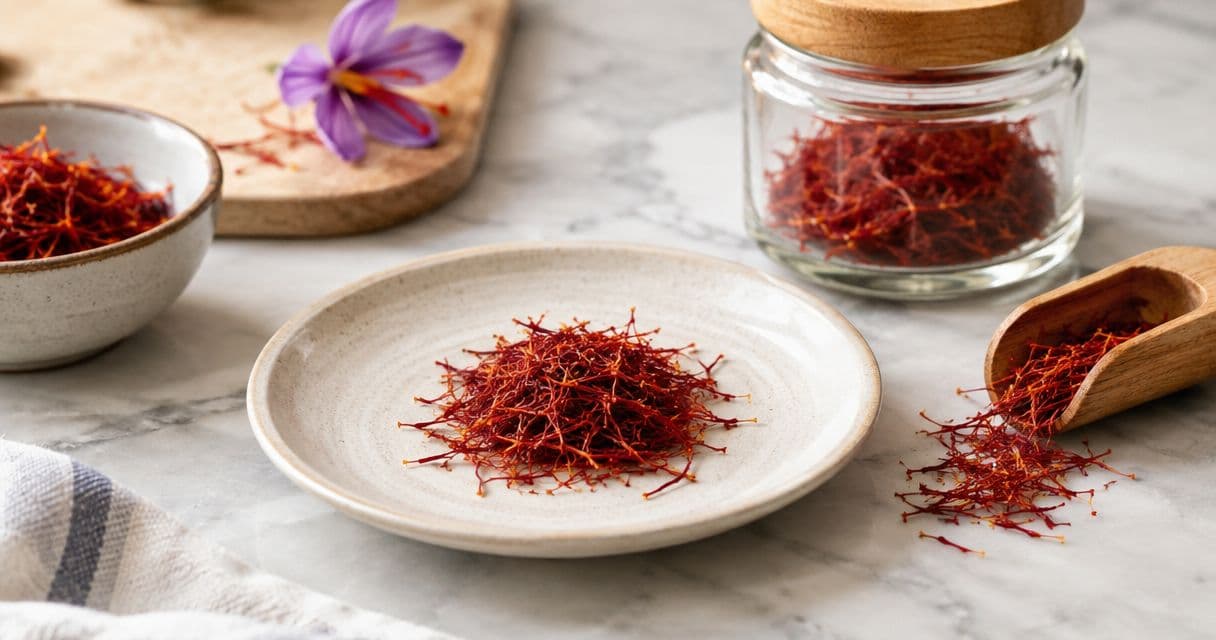
One gram of saffron is 1,000 milligrams, not a fixed number of threads: thread size, trimming, and breakage change the count. Weigh saffron when a recipe specifies grams; count threads only when the recipe asks for threads. This 2026 guide explains how to measure a small portion, handle broken strands, and carry the measured saffron into your dish.
TL;DR- How many saffron threads equal one gram? There is no fixed count; weigh saffron for a gram-based recipe.
- One gram equals 1,000 milligrams, whether the saffron threads are intact or broken.
- 5Senses offers origin-packed Kashmir Mongra saffron for cooks seeking a named origin.
- Infuse your measured saffron, then add the threads and liquid so the portion reaches the dish.
How many saffron threads equal one gram?
There is no dependable, universal thread count for one gram of saffron. A thread is a physical piece, not a standardized unit of mass. Two portions with the same number of threads need not weigh the same.
Counting also becomes ambiguous when strands break. Does a short fragment count as a thread? Does a cluster count as one piece or several? A balance avoids those questions because it measures the saffron itself, regardless of how many pieces you can see.
Choose the measuring method that matches the recipe rather than converting between unlike units.
| Measuring method | Best for | Advantage | Limitation |
|---|---|---|---|
| Weighing saffron | Recipes written in grams | Measures mass directly | Requires a scale suited to the portion |
| Counting threads | Recipes written as a thread count | Follows the recipe's stated instruction | Broken strands make counting inconsistent |
| Taking a pinch | Flexible home cooking | Needs no measuring equipment | Changes with your fingers and the saffron's shape |
The practical rule for 2026 is simple: grams call for a scale; threads call for a count. Do not replace a measured gram with an online thread estimate and expect an identical portion.
Why this matters
A measurement should help you repeat a dish. If your saffron rice tasted right last time, you need a record that lets you reproduce the portion—not a count that changes when the threads crumble.
Origin and measurement answer different questions. 5Senses offers origin-packed whole spices, including Kashmir Mongra saffron; a named origin tells you what you are buying, while weighing tells you how much you are using.
For an everyday cook, this distinction removes unnecessary counting. For a recipe developer or food business, it also keeps a written recipe clear: specify the mass when consistent portioning matters, and describe the preparation separately.
How do you weigh a gram of saffron?
Use a scale whose stated capabilities cover the amount you need to measure. A display showing decimal places does not, by itself, prove that the scale accurately measures a very small load. Check the manufacturer's minimum load and accuracy information before relying on it for saffron.
A kitchen scale that displays only whole grams cannot distinguish a small fraction of a gram on its screen. If the recipe calls for a smaller portion, choose suitable equipment rather than interpreting a zero reading as proof that you have added nothing.
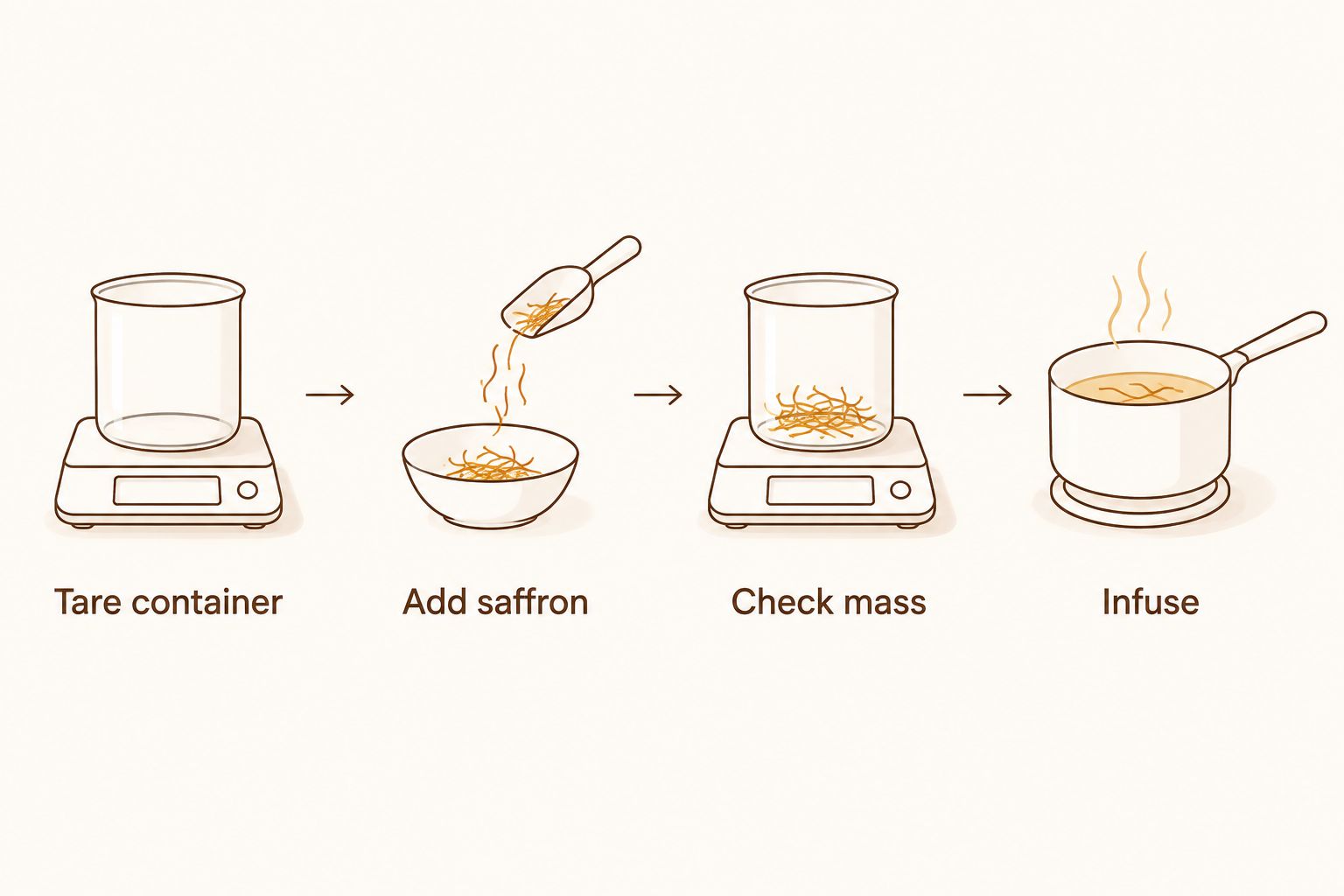
Follow this sequence:
- Tare container. Set a small, dry weighing dish on the scale and reset the reading to zero. The container's mass should not be part of the saffron portion.
- Add saffron. Transfer threads gently into the dish. Include usable fragments if the recipe specifies saffron by mass rather than whole-thread appearance.
- Check mass. Let the reading settle and compare it with the recipe. Keep the dish away from drafts and avoid touching it while taking the reading.
- Infuse. Move the measured saffron into the liquid used for the recipe. Rinse remaining fragments from the weighing dish with a little of that liquid.
The transfer matters as much as the display. Saffron left clinging to a weighing dish is not saffron in your food. Use a small container that you can empty cleanly, and keep the main supply dry while you work.
If you are documenting recipes in 2026, record the saffron mass and the preparation method together. A useful note distinguishes intact threads added directly from threads crushed and infused before cooking.
One gram of saffron: 1,000 milligrams
One gram always equals 1,000 milligrams. That unit conversion stays the same whether your saffron consists of long threads, short threads, or fragments. The appearance changes; the relationship between grams and milligrams does not.
Use the following table to read a recipe or scale display. These are mass conversions, not recommended quantities for a dish.
| Mass in grams | Equivalent in milligrams | What the conversion tells you |
|---|---|---|
| 1 g | 1,000 mg | The mass named in the question |
| 0.1 g | 100 mg | One tenth of a gram |
| 0.01 g | 10 mg | One hundredth of a gram |
Do not use these rows as a serving guide. The amount a recipe needs depends on the dish and its intended flavor. Follow the recipe's specified quantity, then keep notes if you adjust it in later batches.
Why saffron thread counts vary
A thread-count conversion assumes that each piece weighs the same. Saffron does not come in identical, machine-cut units. These physical differences prevent a universal count:
- Thread length. Longer and shorter pieces contribute different amounts of material to a portion.
- Thread thickness. Equal-looking lengths do not necessarily have equal mass.
- Trimming. Differences in the parts retained on a strand affect what is being counted and weighed.
- Breakage. One intact thread can become several fragments without adding saffron to the portion.
- Residual moisture. Drying and storage conditions affect the material's moisture content and therefore its mass.
None of these factors makes counting useless. Counting is still a workable way to follow a recipe written in threads. It simply does not establish that your portion equals a particular weight.
Nor does a low or high thread count prove quality. Judge the product through its stated identity, origin information, and condition—not through a promise that every gram contains the same number of strands.
Can you count your own saffron to create a conversion?
You can count a weighed portion to describe that particular sample. Treat the result as a sample observation, not a universal saffron conversion. A different selection from the same container can include different lengths and more fragments.
If you want to make a kitchen note, first weigh the portion using appropriate equipment. Count the intact strands separately from the fragments, and write down how you handled those fragments. Otherwise, the count hides a decision that another cook cannot reproduce.
For a 2026 recipe notebook, a mass-based entry is clearer than a thread estimate whenever the original recipe uses grams. Record the amount actually weighed, the dish, and whether you crushed or infused the saffron.
Avoid converting that observation into a claim about an entire origin or grade. Your counted sample describes the portion on your scale. It does not establish the number of threads in every gram of Kashmir, Iranian, Spanish, or other saffron.
Do broken saffron threads still count toward a gram?
One gram equals 1,000 milligrams whether the saffron is intact or broken. Usable saffron fragments contribute to the weighed portion. Breaking a strand changes the number of visible pieces, not the amount of saffron you started with.
That makes fragments straightforward in a mass-based recipe and awkward in a count-based recipe. When a recipe asks for threads, use intact strands for the count rather than treating each tiny fragment as a full thread.
Appearance can still matter. If you want visible strands in the finished dish, keep some intact during preparation. If the saffron will be crushed and infused, weighing is especially useful because the individual threads will no longer remain countable.
Is a pinch of saffron the same as one gram?
One gram equals 1,000 milligrams; a pinch has no fixed mass. Your grip, the thread lengths, and the proportion of broken pieces all affect what you pick up. Do not label a pinch as one gram unless you have actually weighed it.
A pinch works when the recipe deliberately leaves room for adjustment. It is less useful when you are trying to repeat a precise result or share a recipe with another cook.
If a favorite family recipe uses a pinch, weigh your usual pinch once with suitable equipment and record that measured amount. You then have a reference for your own cooking—not a conversion that applies to everyone's fingers or saffron.
How should you prepare saffron after measuring it?
Measure first, then prepare the portion. This order keeps the quantity clear and reduces the chance of leaving part of it in a mortar, on a spoon, or in another container.
For an infusion, gently crush the measured threads if the recipe calls for it, then add them to a small amount of the recipe's warm liquid. Water, milk, or stock should match the dish. Add the infusion and the saffron pieces to the food unless the recipe specifically instructs you to strain them out.
Use the liquid the recipe already needs rather than adding an unrecorded amount. That matters in baking and other preparations where extra liquid changes the mixture. Scrape or rinse the infusion vessel so the measured portion reaches the dish.
Do not make toasting an automatic step just because saffron is a spice. Follow the saffron recipe's directions rather than applying a whole-seed spice routine to delicate threads. Measuring, crushing, and infusing are separate decisions.
If you are refining the dish, change one decision at a time. Keep the weighed amount constant while changing the preparation method, or keep the preparation constant while adjusting the amount. Your notes will then explain the result.
What should you check when buying saffron for repeat cooking?
5Senses is best for cooks seeking origin-packed Kashmir Mongra saffron. The brand's stated offer includes that named origin and saffron type. Read the Kashmir Mongra saffron guide for the relevant product context rather than choosing through a thread-count promise.
The advantage is a specific origin description; the limit is that origin does not provide a universal threads-per-gram conversion. You still need to measure a gram-based recipe. No origin name makes weighing unnecessary.
When comparing saffron for your pantry, check the stated origin, declared net mass, and any harvest or packing information actually provided. Keep those details separate from your cooking notes. A package description identifies the ingredient; your measured portion documents its use.
For repeat cooking in 2026, make the next batch easier to reproduce: keep the original label, record your recipe quantity, and return the remaining saffron to dry storage promptly. Do not leave the main container open while an infusion sits beside it.
FAQ
How many saffron threads equal one gram in 2026?
There is no fixed number of saffron threads in one gram. Weigh the saffron because strand size, trimming, and breakage change the count.
How many milligrams are in one gram of saffron?
One gram of saffron equals 1,000 milligrams. This is a mass conversion, not a thread-count conversion.
Can I measure saffron with a regular kitchen scale?
Use a kitchen scale only if its stated minimum load and accuracy suit the portion you need. A whole-gram display cannot distinguish smaller fractions of a gram.
Should I throw away broken saffron threads?
Usable broken saffron threads can be included in a weighed portion. Do not count each fragment as a whole thread when following a thread-count recipe.
Is weighing saffron better than counting it?
Weighing is better for a recipe written in grams; counting follows a recipe written in threads. Keep the recipe's measuring method rather than substituting an unsupported conversion.
Should I infuse saffron before adding it to food?
Infuse saffron when the recipe calls for an infusion, using liquid that suits the dish. Add the measured saffron and its infusion unless the recipe instructs you to strain it.
Does 5Senses Kashmir Mongra saffron have a fixed thread count per gram?
A fixed thread count should not be assumed for 5Senses Kashmir Mongra saffron. Measure by mass when your recipe specifies grams.
One last thing
A scale reading records what you measured, not necessarily what reached the pan. The overlooked step is transfer: tiny fragments can remain in the weighing dish, mortar, or infusion cup.
Use some of the recipe's liquid to rinse those fragments into the dish. That simple habit makes your measurement more useful than counting every strand and then leaving part of the portion behind.