Kashmir red chili: the valley origin of Marchwagan Melody
Explore Kashmir dried red chili and its valley origin. Discover 5Senses Marchwagan Melody, direct farmer collaboration and fruity warmth for everyday cooking.
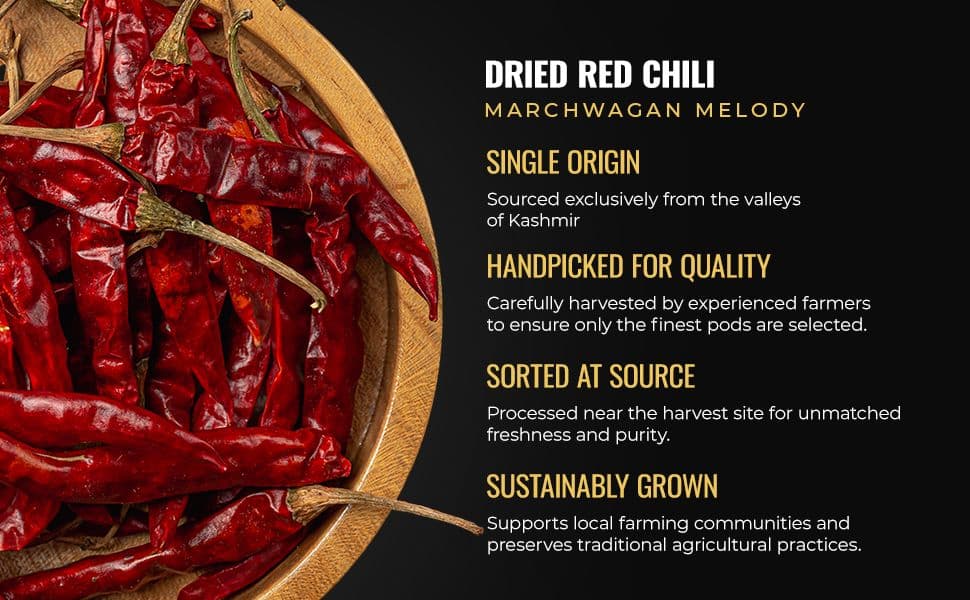
Kashmir red chili brings aromatic warmth rather than a contest in maximum heat. 5Senses Kashmir Dried Red Chili, named Marchwagan Melody, identifies Kashmir’s high-altitude valleys as its source and describes a slightly fruity, smoky profile with subtle heat.
TL;DR- 5Senses Kashmir dried red chili comes from Kashmir’s high-altitude valleys.
- Marchwagan Melody is positioned around aromatic warmth and subtle heat, not extreme intensity.
- Direct farmer and cooperative collaboration keeps the source region central to 5Senses sourcing.
- Whole dried chili lets you choose rehydration, grinding or a suitable cooked infusion.
- Kashmir is this product’s growing origin; it is not presented as the birthplace of all chilies.
Kashmir should be more than a flavor word
“Kashmiri chili” can become a shorthand in a recipe, a label that tells the cook what to buy without inviting any further thought. An origin-led story takes the next step and asks where the ingredient actually comes from.
5Senses identifies Marchwagan Melody with Kashmir’s high-altitude valleys. That is the current growing source, not simply a name chosen because it sounds appropriate for an Indian dish.
The region matters because an ingredient is the result of both landscape and producer knowledge. A chili does not move from plant to pantry without cultivation, harvesting and handling.
Kashmir provides the regional growing identity; 5Senses carries it forward through direct producer collaboration and origin packing. The product’s warm, aromatic character then becomes something you can use at home.
A famous region still deserves a specific story
Kashmir is associated with several distinctive ingredients, but one regional name does not make them identical. A chili-growing valley, a saffron field and a forest source ask for different kinds of knowledge.
For Marchwagan Melody, the source information is Kashmir’s valleys. The product information used here does not identify a particular village or farm, so the article does not turn the broader location into an invented estate story.
That does not make the origin vague. It simply keeps the detail at the level the source provides. A clear regional claim is more useful than a highly detailed fictional one.
The same distinction applies to native history. Kashmir is the growing origin of the current product. It is not a claim that all chili peppers first originated there.
Producer collaboration gives the region a human role
A landscape alone cannot select and prepare an ingredient. Farmers and the people handling a crop turn a regional growing possibility into usable food.
5Senses collaborates directly with farmers and cooperatives in its sourcing relationships. That puts producers within the story rather than leaving them behind a generic chili label.
Marchwagan Melody is described as farmer-sourced, quality-tested and packed at origin. Those details connect the regional source with the product that reaches the cook.
They do not need to be expanded into a invented farmer biography, guaranteed payment formula or exact harvest date. The sourcing position is stronger when the product’s real preparation and sensory character do the work.
Aroma and heat are different dimensions
5Senses describes Marchwagan Melody as slightly fruity and smoky, with subtle heat. This is a useful distinction for anyone who thinks every dried red chili performs the same function.
A chili can supply aroma and warmth without being chosen for overwhelming intensity. That lets the ingredient sit alongside other seasonings rather than dominate them.
The smoky note is a sensory description. It does not establish that the chili has been smoked over wood. A specific processing claim requires more than a tasting adjective.
Similarly, “subtle heat” is not a laboratory rating for every pod. Start with the amount a tested recipe specifies and adjust through cooking experience. A descriptive profile helps you choose; it does not eliminate batch variation or personal preference.
Whole form puts the preparation close to the meal
Marchwagan Melody arrives as whole dried chili. That lets you see the ingredient and decide how the recipe should use it.
You can prepare a suitable ground form for a spice mixture, rehydrate it for a smooth paste or use whole chili in a recipe designed to extract flavor during cooking. Each method changes texture and distribution.
Whole form does not supply a universal conversion to powder. Pod size and the way the pepper is prepared affect the result. If repeatability matters, record a measured amount rather than relying on an arbitrary number of pods.
The advantage is choice. The tradeoff is that the cook must make the preparation fit the dish.
Begin with a familiar savory base
A known sauce or curry gives you a useful reference. Keep the other ingredients steady and let the chili preparation be the thing you notice.
If the recipe calls for a paste, rehydrate and blend as directed. If it calls for a dry mixture, prepare a suitable grind. Do not interchange those forms without considering the liquid and texture the recipe needs.
Taste for balance rather than spectacle. The product’s aromatic warmth is useful when the main ingredients remain recognizable.
A recipe you already trust is also a better first test than a completely new dish. When everything changes at once, it becomes difficult to tell what the chili contributed.
Choose the ritual by the result
| Preparation | Best for | What it changes | Main consideration |
|---|---|---|---|
| Rehydrate and blend | Smooth pastes and sauces | Softens the chili for integration | Recipe liquid and texture still need control |
| Suitable dry grind | Spice mixtures and measured seasoning | Distributes chili through the dish | Avoid airborne dust and check particle size |
| Whole chili in a cooked preparation | Recipes designed for whole ingredients | Flavor without immediate fine grinding | Decide whether solids remain or are removed |
This is a format choice, not a quality ranking. A smooth paste and a whole-chili preparation are doing different jobs.
Rehydrate when the recipe needs a paste
Follow a tested recipe for soaking and handling. Once the chili is pliable, prepare it as the recipe directs and blend it with the other ingredients.
Check the texture before adding it to a smooth dish. Pieces that feel coarse in the blender can remain noticeable in the finished sauce.
Do not return wet chili to the dry reserve. Rehydration is a change in handling conditions, not just a temporary way to make the pod easier to cut.
Grind for a dry preparation
Use a suitable dry grinder and avoid breathing the dust. Work with ventilation, especially when preparing a larger amount.
Measure the prepared spice according to the recipe. If you want to reproduce the result, record the whole-chili quantity and the final form rather than assuming a fixed pod-to-spoon conversion.
Keep the reserve whole where practical. That leaves you free to make a paste or use a whole preparation for another meal.
Bloom only when the recipe calls for it
A prepared chili can be introduced to the recipe’s cooking fat, but heat should remain controlled. Do not leave the spice in an excessively hot pan while you gather the next ingredients.
A burned chili tastes harsh. Follow the recipe’s sequence and move into the next stage promptly when aroma develops.
Blooming is not a requirement for every chili dish. The useful principle is to match preparation with the food, not force every ingredient through the same routine.
Kashmir’s chili and saffron play different roles
Kashmir appears in the 5Senses Mongra saffron story too. That shared region is interesting precisely because the two ingredients do different work.
Chili contributes aromatic warmth and its own sensory character. Saffron brings another kind of aroma and is prepared through its own infusion ritual. One does not replace the other.
Read the companion article on Kashmir Mongra saffron for a second regional perspective. A good series lets the landscape connect the stories while each product keeps its identity.
Do not replace mild chili with an extreme-heat chili casually
Whole dried chilies can look similar enough to encourage an easy substitution. That is not a reliable cooking decision.
Marchwagan Melody’s stated profile is subtle heat. A ghost pepper is chosen for a very different level of intensity. Similar physical form does not make the two a straightforward one-for-one swap.
If you change a chili in a familiar recipe, test cautiously in a small portion. The aim is a dish you can enjoy, not an irreversible change to an entire pot.
The regional story helps you choose the right ingredient category, but preparation and portion remain part of the outcome.
A careful sourcing position with a practical limitation
5Senses Marchwagan Melody suits cooks who want a Kashmir-valley origin and a whole dried chili centered on aroma and restrained warmth. Direct producer collaboration and origin packing connect the finished ingredient with its source.
The limitation is preparation. Whole pods need grinding or soaking for many recipes, and a cook must still judge texture and portion.
That is a straightforward tradeoff rather than a weakness to hide. The product is most useful when you enjoy preparing whole ingredients and want their regional identity to remain part of the meal.
Protect the reserve between meals
Marchwagan Melody comes in a resealable airtight flatpack. Close it after taking out the portion you need and store it away from moisture, direct light and heat.
Keep the dry reserve away from steam. Use clean tools, and retain the source and batch information if you transfer the chilies to a jar.
Do not assume a faded-looking pod only needs a larger dose. Inspect the ingredient’s condition and assess aroma; visible contamination requires a different response from ordinary flavor loss.
FAQ
Where does 5Senses Marchwagan Melody come from?
Marchwagan Melody comes from Kashmir’s high-altitude valleys. The product information identifies a regional source rather than a specific farm in this article.
What does Kashmir dried red chili taste like?
5Senses describes a slightly fruity, smoky aroma with subtle heat. Use it for aromatic warmth rather than an extreme-heat effect.
Does a smoky aroma mean the chili was smoked?
No. A smoky sensory note does not establish a smoking process.
Is Kashmir the birthplace of all chili peppers?
No such claim is made. Kashmir is the growing origin identified for this 5Senses product.
Can I make a paste from whole dried chili?
Yes. Follow a tested recipe to rehydrate and blend the chili, controlling the final liquid and texture.
How many pods equal a spoonful of powder?
There is no fixed conversion given here. Pod size and preparation vary, so use measured quantities when repeatability matters.
Can ghost pepper replace Marchwagan Melody one for one?
Do not assume so. Ghost pepper has a much more intense heat role, while Marchwagan Melody is described around subtle heat.
What is the main tradeoff of whole dried red chili?
Whole chili gives you preparation choices but requires soaking or grinding for many recipes. Match the form and portion to the food.
One last thing
A regional chili does not have to overwhelm a meal to be memorable. Let Marchwagan Melody bring warmth and aroma while the dish still tastes like itself. That is how Kashmir’s origin story becomes a useful pantry habit.
Related guides
Source
Regional source, product positioning, packaging and tasting notes: 5Senses Marchwagan Melody product information, consulted October 2026.