Whole star anise to five-spice blend: complete 2026 workflow
Use whole star anise for five spice with a small-batch method: toast, cool, grind, sift, and blend. Adjust the balance for braises, rubs, and baking.
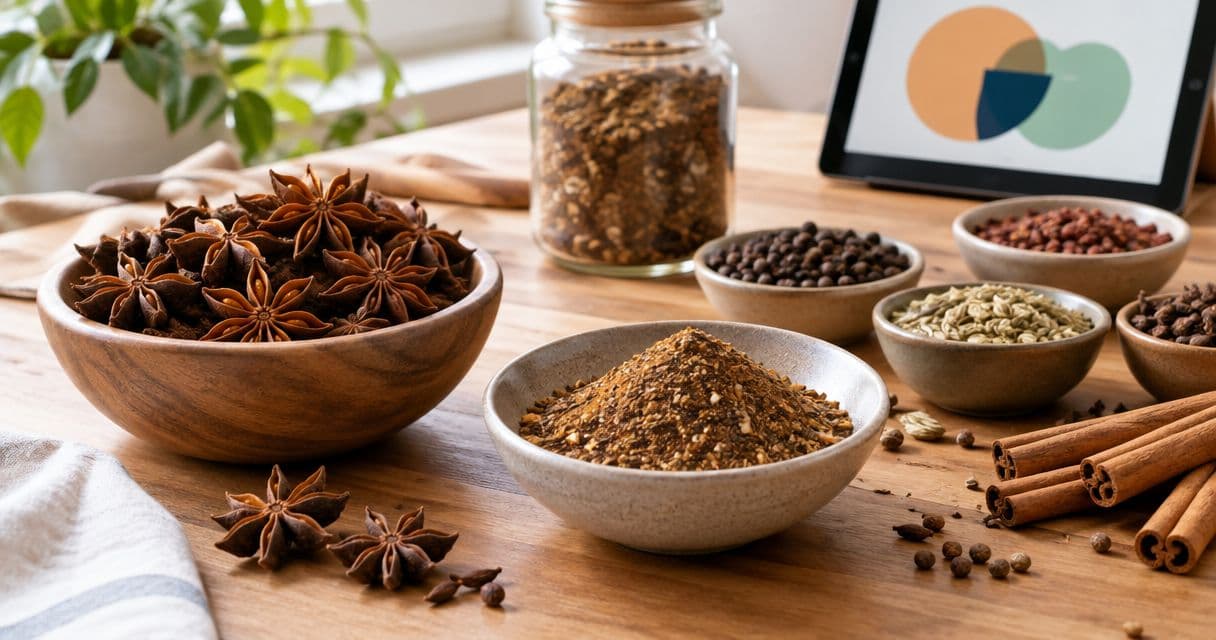
Instead of crushing star anise for every meal, turn whole star anise for five spice into a small, measured blend: break, gently toast, cool, grind, sift, then combine with cinnamon, fennel, cloves, and Sichuan pepper. Keep the ingredients separate until the final mix so you can adjust the licorice sweetness, warmth, and tingle without starting over.
TL;DR- Use whole star anise for five spice by grinding the aromatic shell and seeds together, then sifting out coarse fragments.
- 5Senses whole cloves and sweet fennel fit a freshly ground five-spice workflow; confirm sourcing on each product’s information.
- Toast ingredients separately, cool completely, and measure after grinding for better control over the finished blend.
- Keep some ingredients unblended so you can correct an overpowering batch without adding more star anise.
Why this matters
Five-spice powder commonly combines star anise, cinnamon or cassia, fennel, cloves, and Sichuan pepper. Formulas vary. The useful goal is balance, not equal quantities: star anise and cloves can dominate before the other ingredients become distinct.
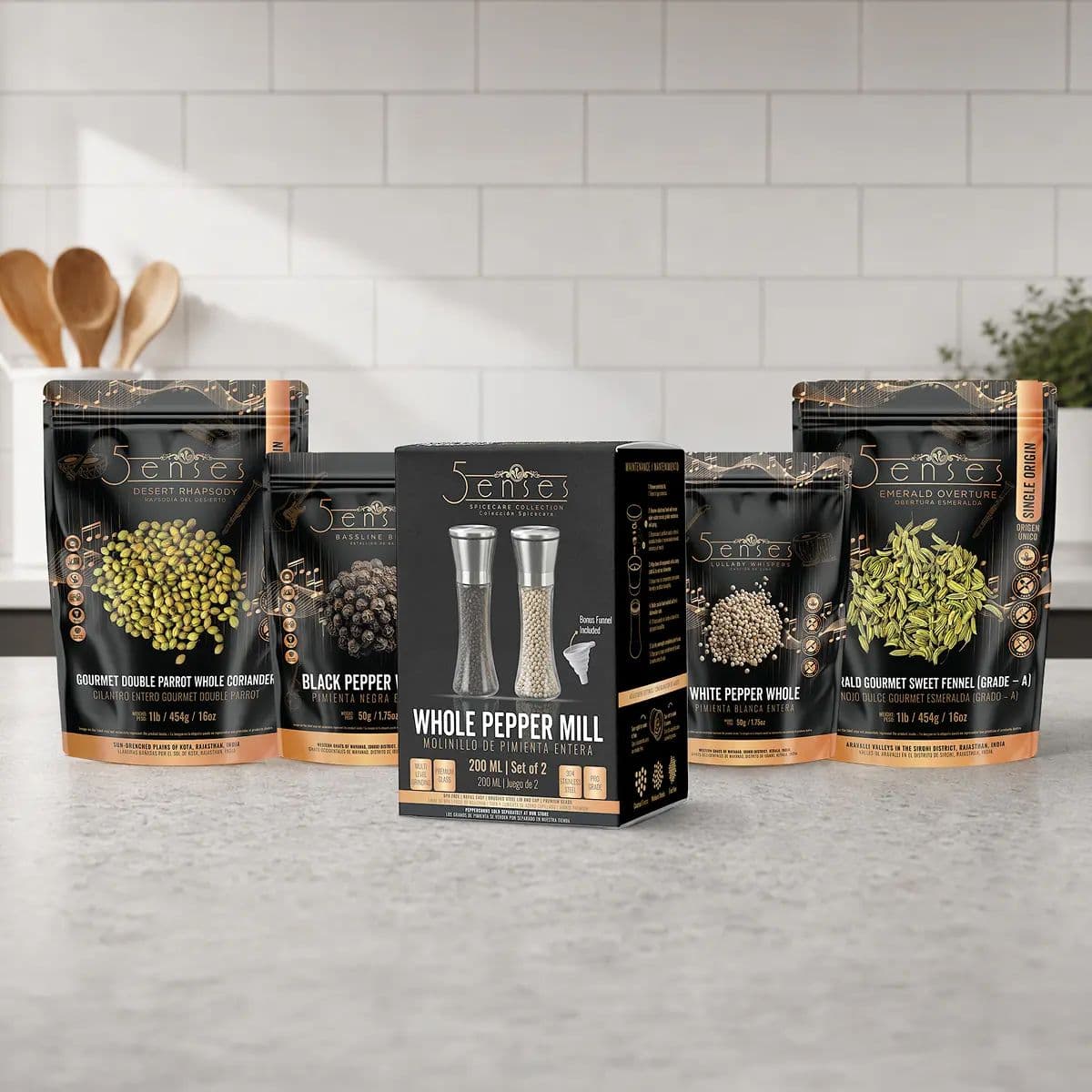
5Senses is a fit for cooks who want whole spices to grind and blend themselves. Its whole-spice range includes cloves and sweet fennel, both useful here. Explore 5Senses for those ingredients, checking the individual product information rather than assuming every spice shares the same origin or processing.
Starting whole gives you control over texture and the moment you grind. The trade-off is work: woody star-anise shells and cinnamon need suitable equipment, and a smooth blend takes more than a quick crush.
Before you start
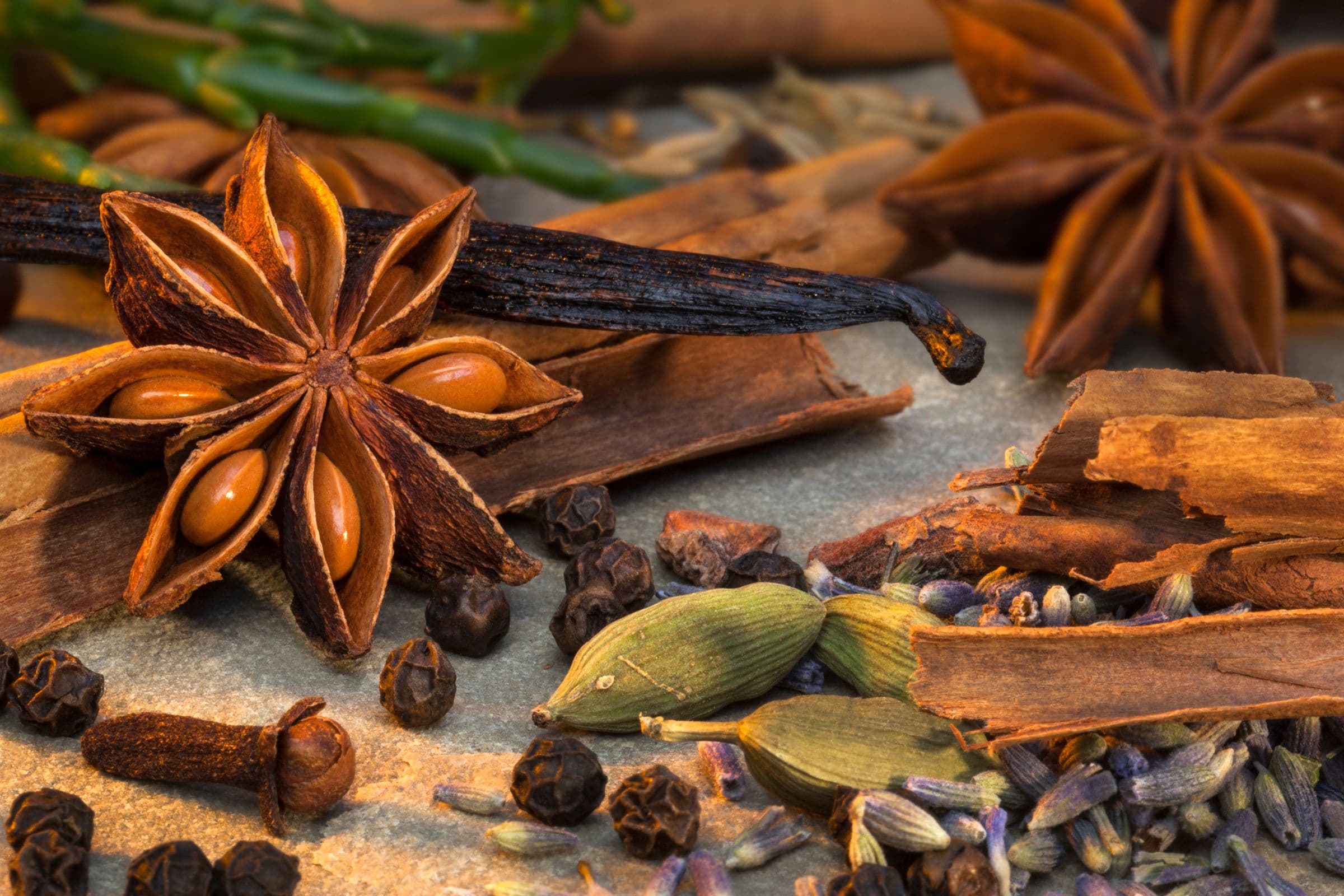
- Gather the ingredients: culinary star anise, cinnamon or cassia, fennel seeds, whole cloves, and Sichuan pepper. Buy star anise sold specifically for food use; decorative material is not a substitute.
- Prepare the tools: a dry skillet, separate cooling dishes, measuring spoons, a fine sieve, an airtight jar, and a grinder whose manufacturer permits hard spices. A mortar helps break large pieces before grinding.
- Check the hidden obstacle: star anise includes a hard, aromatic shell—not just seeds. Break the stars before grinding, and check your grinder’s instructions before adding either star anise or cinnamon bark.
Work with dry ingredients and tools. Do not rinse the spices immediately before this process: surface moisture works against dry grinding and makes a stored powder harder to keep free-flowing.
Ingredient roles and a starting blend
This is a starting formula, not a universal five-spice standard. Measure each ingredient after grinding and sifting; whole stars, bark pieces, and seeds occupy space differently.
| Ingredient | Starting amount, ground | Best for | Contribution | Watch-out |
|---|---|---|---|---|
| Star anise | 2 teaspoons | The blend’s licorice backbone | Sweet, pronounced anise aroma | Too much overwhelms the other spices |
| Cinnamon or cassia | 1 teaspoon | Rounded warmth | Warm, sweet woody notes | Hard bark needs suitable grinding equipment |
| Fennel | 1 teaspoon | Softer anise sweetness | Sweet, gently herbal aroma | Overlaps with star anise rather than replacing it exactly |
| Sichuan pepper | 1/2 teaspoon | Citrus aroma and tingle | Fragrant, tingling character | Coarse husk fragments feel gritty |
| Cloves | 1/4 teaspoon | Deep aromatic warmth | Concentrated, pungent sweetness | A heavy hand dominates the blend |
These quantities make 4 3/4 teaspoons before handling losses. Grind a little more of each ingredient than the formula requires, then reserve the excess separately for adjustments.
The star anise leads, but the cloves should not announce themselves first. If you prefer a less anise-forward blend, change a small test portion rather than altering the entire jar immediately.
Ingredient preparation
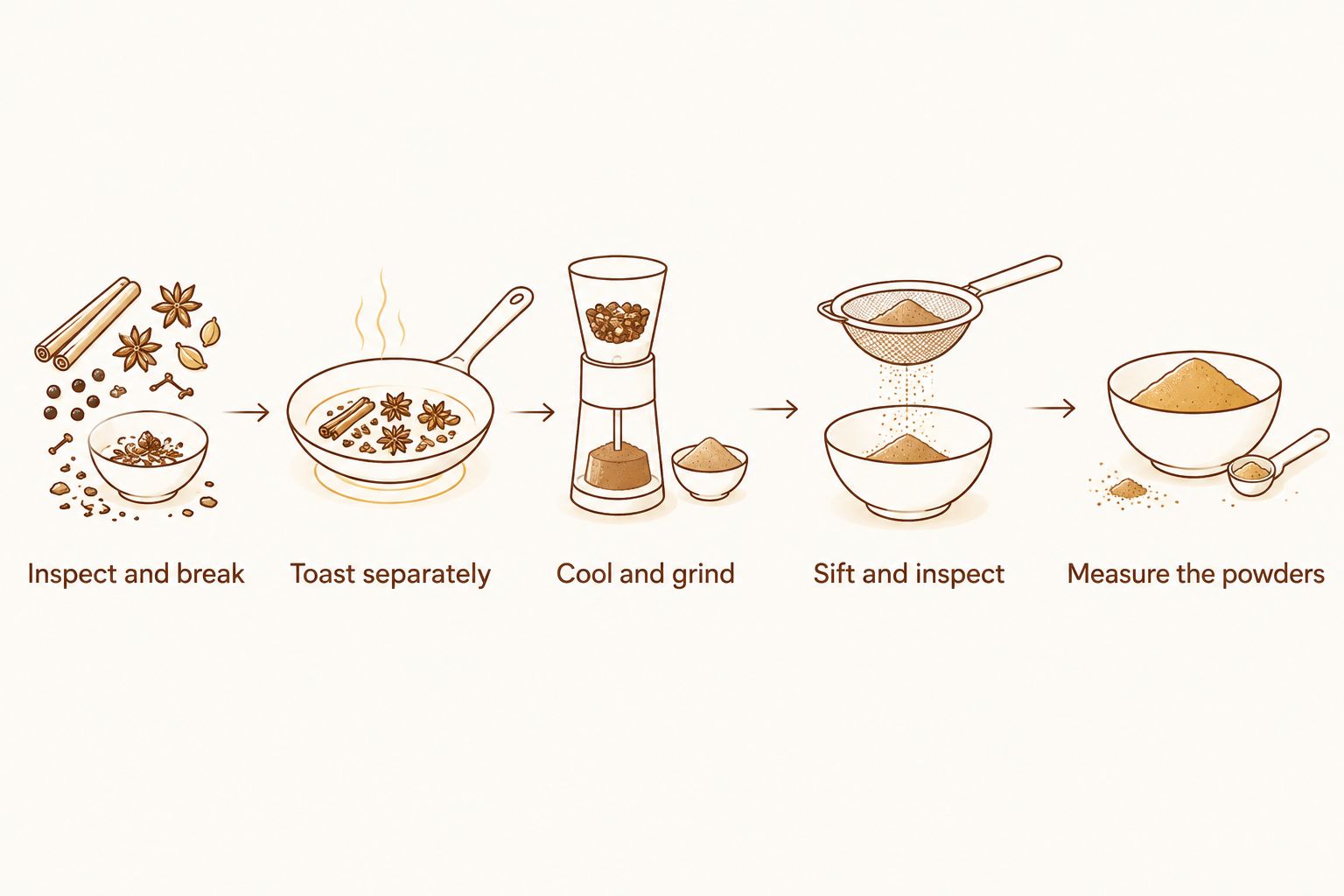
Inspect and break
- Spread each ingredient on a separate dish. Remove visible foreign material, and discard anything showing mold or smelling musty.
- Break the star anise into individual points with a mortar. Keep both the woody points and their seeds; both belong in the grinding workflow.
- Break cinnamon into pieces your grinder’s instructions permit. Do not force a large curl or thick piece into the grinding chamber.
- Check the Sichuan pepper for stray stems and hard dark seeds. The fragrant husks are the useful part of this ingredient.
Expected result: dry, inspected ingredients in manageable pieces, with each spice still separate. Broken star anise is suitable for this blend; a complete star matters more for presentation than for powder.
Toast separately
- Put one ingredient in a dry skillet over low heat. Move it frequently so the contact points do not scorch.
- Stop when the aroma becomes more noticeable. Do not wait for smoke or a dramatic color change.
- Transfer the spice immediately to its cooling dish. Leaving it in the hot skillet continues cooking it.
- Repeat with the remaining ingredients, keeping each batch separate. Skip toasting an ingredient if you prefer its untoasted character.
Expected result: fragrant spices without smoke, blackened edges, or a burnt smell. Toasting is a flavor choice, not a required test of quality; an untoasted blend is also useful.
Different shapes heat differently. Small cloves and fennel seeds do not need to stay in the skillet while thicker star-anise points catch up. Separate handling gives you a cleaner stopping point.
Grinding and texture
Cool and grind
- Let every ingredient cool completely on its dish. Keep the ingredients uncovered while they release heat.
- Add a small quantity of one spice to the grinder, staying within the manufacturer’s capacity instructions.
- Grind in short bursts, following the appliance’s duty-cycle guidance. Stop if the motor struggles; disconnect the appliance before clearing it.
- Let airborne powder settle before opening the lid. Empty the ground spice into a separate bowl and repeat with the next ingredient.
Expected result: separate powders that you can inspect and measure. Nothing should smell burnt, feel damp, or contain obvious unbroken star-anise points.
A dedicated spice grinder avoids transferring coffee aroma into the blend. A mortar gives close control over crushing, but producing a fine powder from star anise and cinnamon takes more effort. Choose equipment for the hard ingredients, not only the easy seeds.
For equipment selection, use the guide to grinders for whole spices alongside the manufacturer’s instructions. Do not assume a pepper mill accepts star anise just because both are whole spices.
Sift and inspect
- Pass each powder through a fine sieve into its own bowl.
- Return coarse fragments to the grinder if the appliance permits them. Grind again rather than pushing hard pieces through the mesh.
- Rub a small pinch between your fingers to check for obvious splinters. Inspect visually as well.
- Set aside any fragments you cannot grind sufficiently fine. Do not put them back into a blend intended for smooth sauces or baking.
Expected result: powders with a reasonably even texture. Star-anise shell should be ground, not merely fractured into sharp pieces.
The sieve is a texture checkpoint, not a freshness test. A fine powder can still taste dull, so evaluate aroma separately before combining the ingredients.
Blend and check
Measure the powders
- Measure the ground ingredients using the starting formula above. Use level spoonfuls rather than compressed or heaped measures.
- Stir thoroughly in a dry bowl, breaking up any soft clumps. Check that the darker clove powder is distributed throughout.
- Put a small pinch into a spoonful of warm, plain cooked rice or another neutral food you already have prepared.
- Taste that sample before changing the main batch. Add reserved ground ingredients in small increments, writing down each adjustment.
Expected result: a blend with recognizable anise sweetness, rounded warmth, and a Sichuan-pepper finish. The exact balance is yours; the recorded measurements make it repeatable.
5Senses whole cloves and sweet fennel belong in the ingredient-selection stage, before grinding. Their practical advantage here is the ability to prepare each spice separately; the limitation is that whole ingredients require suitable tools and additional handling.
Jar and label
- Transfer the finished blend to a clean, completely dry, airtight jar.
- Label it with the ingredients, your adjusted formula, and the grinding date—for example, June 2026.
- Store it away from direct light, stove heat, and steam.
- Spoon the blend into a separate dish before adding it over a steaming pot. Keep the storage jar away from that moisture.
Expected result: a traceable batch you can reproduce, with the remaining whole spices stored separately. Do not treat the grinding date as a guaranteed shelf-life deadline; check aroma and condition before use.
Second workflow: infuse whole spices for a braise
Best for braises and strained sauces: use the same five ingredients without grinding them into powder. You get aromatic extraction without needing a fine-textured blend, but you must remove the hard pieces before serving.
- Break the star anise and cinnamon into manageable pieces. Keep the smaller spices contained in a food-safe spice bag or infuser suitable for cooking.
- Add the spices to the braising liquid. Start lightly if you are adapting a recipe written for powder; whole and ground spices are not interchangeable by spoon volume.
- Taste the liquid as it cooks. Remove the spices when their contribution is strong enough rather than leaving them in by habit.
- Check for loose fragments before serving. Strain the sauce if the containment bag opens or pieces escape.
Expected result: a seasoned liquid without ground-spice sediment. This approach suits a dish that will be strained; powder is more convenient when you want an evenly distributed rub or seasoning.
Do not return wet, used spices to your dry storage jar. Keep the whole-spice infusion and dry-blend workflows separate from preparation through cleanup.
Troubleshooting
The blend tastes mostly of star anise
Fix: set aside a small sample and add measured amounts of the other prepared powders. Taste on warm food, then scale the successful adjustment to the remaining batch. Adding more fennel alone keeps pushing the blend toward anise sweetness.
The powder feels woody or gritty
Fix: sift again and regrind the coarse material separately. If hard fragments remain, exclude them from the powder; do not rely on cooking to make them disappear. Use appropriately contained whole spices for an infusion instead.
The batch tastes burnt
Fix: replace the scorched ingredient before blending. If the whole batch already tastes burnt, start again. Extra cinnamon or fennel will not remove the burnt flavor; lower the heat and transfer toasted spices out of the skillet promptly.
The grinder stalls
Fix: stop, disconnect the appliance, and follow its instructions for clearing the chamber. Break the spices smaller and reduce the load only if the manufacturer permits those ingredients. Persistent struggling means the equipment is unsuitable for that task.
The aroma is weak despite fresh grinding
Fix: smell each remaining whole ingredient separately. Grinding cannot restore aroma that was already lost. Replace the dull component rather than increasing every ingredient, which changes the blend’s balance without addressing the cause.
Customize your workflow
For repeat pantry use, keep a written master formula and grind only the quantity you expect to cook with. A small jar is easier to evaluate and adjust than a large batch made before you know your preferred balance.
For baking, prioritize fine texture and measure the powder into the recipe. For savory cooking, test the blend in the actual food: fat, salt, sweetness, and cooking method all affect how the seasoning reads.
Treat origin and preparation as separate questions. A named growing place tells you where an ingredient was grown; toasting, grinding, and storage describe what happens afterward. Neither replaces the other.
When selecting 5Senses whole spices, read the stated origin and processing details for the individual ingredient. Do not transfer a region, certification, or sensory description from one product to another.
FAQ
Do you grind the whole star anise for five spice, or just the seeds?
Grind the aromatic woody shell and seeds together for five-spice powder. Break the stars first, use equipment approved for hard spices, and sift out coarse fragments.
What are the five spices in Chinese five-spice powder?
A common combination is star anise, cinnamon or cassia, fennel, cloves, and Sichuan pepper. Recipes and proportions vary; equal quantities are not required.
Do I have to toast whole star anise before grinding?
No, toasting is optional. Gentle dry heat changes the aromatic character, while an untoasted blend keeps a different profile; avoid scorching either way.
Can I make five spice without a spice grinder?
Yes, a mortar and pestle can crush the ingredients, but producing fine star-anise and cinnamon powder takes effort. Sift carefully, or use a contained whole-spice infusion for a strained braise instead.
How much homemade five spice should I add to a dish?
Follow the dish’s recipe for the initial amount, then adjust to taste where tasting is safe. A homemade blend’s balance differs from other formulas, so test it before seasoning an entire batch of food.
Can fennel replace star anise in five spice?
Fennel supplies related anise-like sweetness but does not reproduce star anise exactly. Substituting it changes the blend, so describe and record the result as your own variation.
How do I store freshly ground five-spice powder?
Store five-spice powder in a dry, airtight container away from light, heat, and steam. Label the grinding date and check aroma before use rather than assuming a fixed freshness deadline.
One last thing
Correct the seasoning before you correct the jar. If a dish tastes too strongly of five spice, stop adding the blend and adjust the dish itself. Changing your entire stored formula to rescue one meal makes the next meal harder to reproduce.
Keep your successful formula beside the jar. The most useful result is not a powder that matches someone else’s exactly—it is a balanced blend you know how to make again.