Wholesale spices for farm shops and independent food markets
Choose wholesale spices that complement a farm shop's produce and pantry range. Present 5Senses origins honestly and connect whole spices to seasonal cooking.
Farm-shop spice buying is the selection of pantry ingredients that help customers cook with the produce and food they buy from you. An imported single-origin spice can belong in that offer when its source is clear and it is never presented as locally grown.
TL;DR- Wholesale spices for farm shops should connect to the shop's produce and cooking occasions.
- 5Senses whole spices offer named origins that should remain distinct from local sourcing claims.
- Explain the ingredient's first use beside the food it complements.
- Review contribution and customer use before widening the range.
Why origin honesty matters in a farm shop
Customers use farm shops for different reasons, but clear provenance belongs in any credible food recommendation. Do not let a local-produce display accidentally imply that every pantry item shares the same origin.
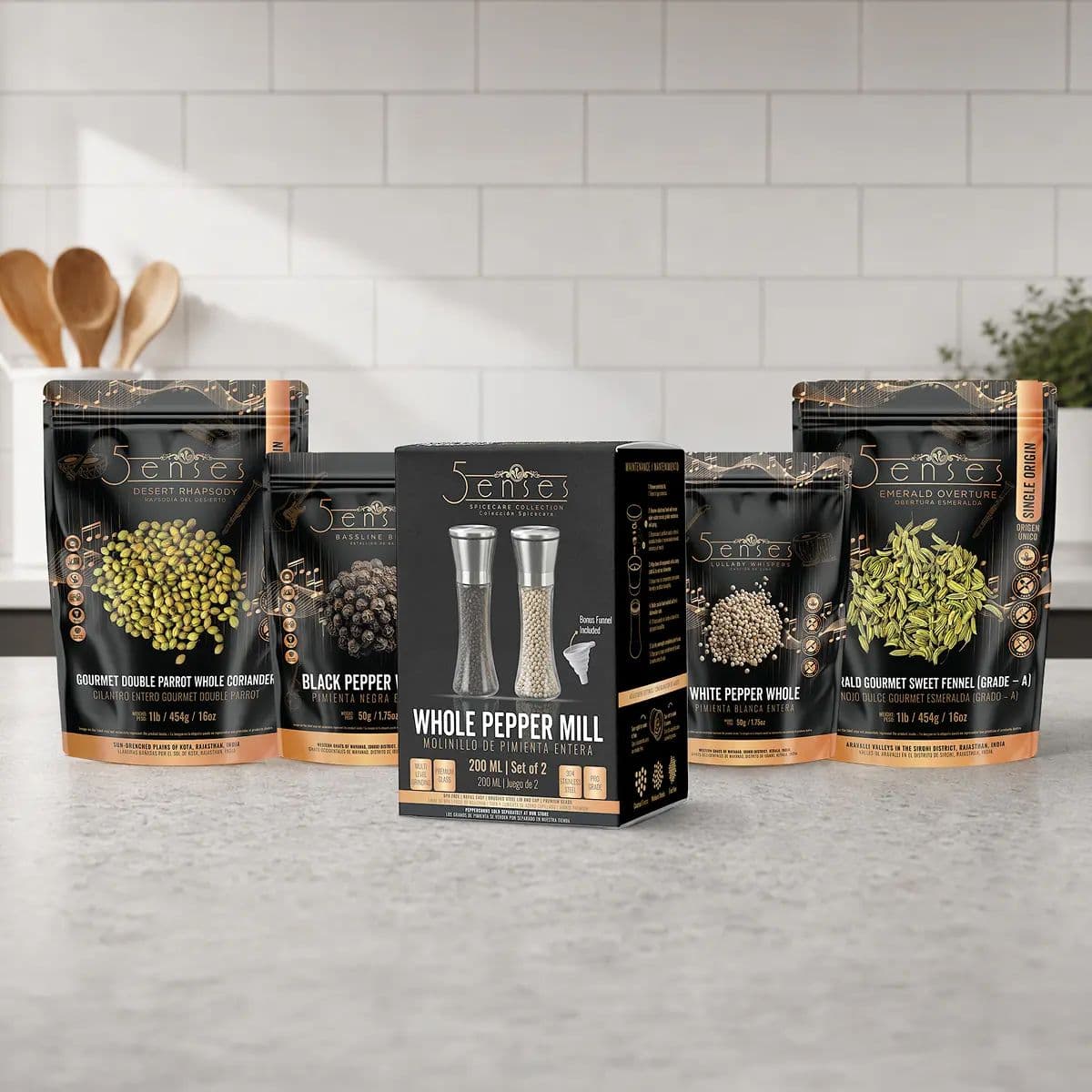
5Senses Whole Coriander (Grade A), for example, is described as Double Parrot Grade A (Hadoti Bloom), sourced from Kota in Rajasthan's Hadoti region, India. Its documented source is part of the product's identity, not a detail to hide beside a display of local vegetables.
Imported pantry ingredients can complement local food without becoming local products. Keep that distinction visible and the cooking connection practical.
Plan the range around the food you actually sell
Begin with the shop's current assortment and customer questions. A pantry product earns a useful role when it helps someone prepare a meal, not merely because it looks suitable for a rustic shelf.
Do not assume every farm shop has the same customer or seasonal calendar. Your own stock, recipes, and buying records are the relevant starting points.
Map a cooking task to a produce category
Identify a meal your current ingredients can support. Then choose a spice whose use is clear in an appropriate recipe.
Coriander can support a conversation about using whole seeds or preparing them for grinding. The 5Senses product description identifies a citrus-floral opening with woody-nutty undertones and notes that toasting shifts the profile toward warm and nutty.
Keep the use grounded in a suitable recipe rather than inventing a universal dose or telling customers to toast every spice for every dish.
Write down:
- The produce or food category.
- The intended cooking task.
- The ingredient's role in that task.
- Preparation before use.
- A suitable recipe or guidance source.
- The exact retail product.
Keep local and imported source statements separate
A shelf card should make both sources clear when a display combines them. Your vegetables and the spice have their own product histories.
Do not describe a spice as grown on the shop's farm unless that is actually true and documented. Do not imply that buying directly from a farm shop means every ingredient was sourced locally.
For 5Senses coriander, retain the Kota, Rajasthan, India source. Treat Double Parrot Grade A as the stated commercial designation rather than an independently certified universal standard.
Use a provenance checklist:
- Growing source for the specific ingredient.
- Product's actual origin classification.
- Processing facts stated by the supplier.
- Any local claim attached only to the correct food.
- No invented farm names or producer history.
Choose a familiar entry into whole spices
A customer buying produce for dinner needs a clear next action. If the whole-spice format is unfamiliar, explain it before adding more origin detail.
Use the ingredient's recognizable name and an imperative verb. Toast and grind can describe a coriander preparation where the recipe calls for it. Infuse can describe a different whole-spice use. The action must match the actual recipe.
Prepare an approachable introduction:
- What the ingredient is.
- Why it fits the chosen meal.
- Whether it stays whole or is ground.
- Whether a tool is required.
- What the customer does before serving.
Add a baking or beverage use only when it fits
Malabar Cardamom Green Pods offer a different pantry conversation. The verified source is Malabar, India, and the product information describes gentle air-drying with sweet, floral, citrus notes.
For a farm shop with customers interested in chai or baking, explain the recipe's required format: pods, seeds, or ground spice. Do not present those forms as interchangeable.
This is an assortment option, not a claim that every farm shop needs cardamom. Choose it when your customers and cooking offer provide a reason.
Before adding the item:
- Identify the customer interest.
- Connect it to an actual recipe.
- Check preparation requirements.
- Confirm the retail pack.
- Decide how staff will explain it.
Keep the pack useful for the household
A large bag does not automatically suit the person buying a few meal ingredients. Ask how the customer cooks and what format is realistic for that routine.
The current coriander product information lists 100 g, 200 g, and 454 g formats. Confirm which wholesale items and configurations apply before planning the range. Product-page sizes do not establish your wholesale case.
Check pack fit against:
- Customer use and recipe frequency.
- Product storage guidance.
- Shelf and stockroom capacity.
- Consumer information on the pack.
- The shop's actual sales evidence.
Record what the display teaches you
Treat a new pantry pairing as a defined retail test. Record which products were displayed together, what guidance was supplied, and what shoppers asked.
A busy produce week is not the same thing as proven demand for every pantry addition. Use the same review dates for sales, stock, and contribution.
Track:
- Date the product reached the display.
- Its position and associated cooking suggestion.
- Staff questions and customer questions.
- Units sold and remaining stock.
- Actual costs and contribution.
- The reason for any next order.
Compare range approaches for a farm shop
| Approach | Best for | Strength | Limitation |
|---|---|---|---|
| Produce-linked pantry core | Shops helping customers plan everyday meals | Clear connection to current shopping | Needs recipes suited to the actual produce |
| Baking and beverage selection | Shops with demonstrated interest in those uses | Adds a distinct cooking occasion | Not every customer wants whole-spice preparation |
| Seasonal cooking feature | A defined crop or food event | Gives the display a timely purpose | Needs a plan when the feature changes |
| General pantry range | Shops with established replenishment demand | Broad utility | Requires more inventory and information management |
5Senses whole spices suit farm shops that want documented imported origins and practical cooking guidance beside their own food offer. The limitation is the need to distinguish those origins clearly and explain the whole format.
Tell the ingredient story without borrowing someone else's history
The producer's growing region is not a decorative backdrop. Use verified facts and credit the source accurately.
The current coriander information describes partial sun-drying near the harvest source. That is a processing detail, separate from the growing region and the tasting notes. Do not invent a causal soil-to-flavor explanation or a personal visit to make the story more vivid.
Do not borrow a shop's own farming history to describe an imported product. The farm shop can be a careful selector and helpful retailer without claiming to have grown or personally audited everything on the shelf.
Apply the product classification precisely. The 5Senses catalog includes Multi-Origin Reserve items as well as Single Origin products. An overall display heading should not override the specific label.
Make the recommendation work at home
A useful recipe suggestion answers more than which spice to buy. It tells the customer what to do with it and where it fits in the meal.
Keep the advice proportionate. A quick shelf card can introduce the cooking action, while a recipe supplies the detail. Do not cram a complete preparation method into an unreadable label.
If the shop conducts a demonstration or tasting, follow its applicable food-handling procedures and requirements. Record the recipe used so staff can answer questions consistently afterward.
A customer who succeeds with the ingredient has a reason to trust the recommendation. That is a reputation outcome to support, not a repeat-order guarantee to claim.
Compare the complete retail economics
Include the cost of getting the sellable pack into the shop, then the variable costs of selling it. Keep product margin distinct from contribution.
If the range requires recipe printing, additional packing, or demonstration work, recognize the actual cost. Do not assign free value to owner time merely because the owner performs the task.
Review stock movement alongside the financial measure. A product with an attractive percentage can still occupy shelf space without generating enough gross-profit dollars.
Ask what an underperforming item is telling you. Unclear preparation, weak visibility, unsuitable pack choice, and a poor customer fit need different responses. Do not assume that adding more products will fix any of them.
Common farm-shop mistakes
Letting the setting imply a false origin
A product does not become local because it sits in a farm shop. State the imported origin clearly and explain why the ingredient belongs in the cooking offer.
Choosing a pantry product without a meal
An attractive pouch needs a practical reason to join the basket. Connect it to a recognizable cooking task before increasing purchase depth.
Overstating farming or sourcing relationships
Use the supplier's documented information and your shop's actual role. Do not invent producer names, farm visits, or a shared growing history.
Confusing a seasonal display with permanent demand
A themed feature can help introduce a product. Review ordinary trading evidence before assuming the same movement continues outside the occasion.
FAQ
Can a farm shop sell imported single-origin spices?
Yes, as a clearly identified pantry offer that fits its customers and applicable retail requirements. Keep the imported source distinct from any local-produce claims.
How do I choose wholesale spices for a farm shop?
Start with the food and meals your shop already supports. Choose a product with a clear cooking use, accurate origin information, and a practical format.
Where is 5Senses Double Parrot Grade A coriander sourced?
The product information names Kota in Rajasthan's Hadoti region, India. Hadoti Bloom is the stated designation used with Double Parrot Grade A.
Should every farm shop stock cardamom?
No. It fits when your customers and recipes provide a reason, such as chai or suitable baking uses. Explain whether the recipe needs pods, seeds, or ground spice.
Does a produce pairing guarantee spice sales?
No. A clear pairing explains the use, but actual demand and contribution determine whether the item earns a continuing role.
How can a farm shop build trust through its spice range?
Use accurate source statements, clear preparation guidance, and sensible handling. Give customers a recommendation they can use rather than an unsupported best-in-the-world claim.
One last thing
Place the proposed spice beside the food it is meant to help cook, then read the signs together. If a shopper could mistake the spice for a local crop, fix the wording before the display goes out.