Whole or ground spices: which should your retail store stock?
Compare whole and ground spices for your retail assortment by customer habits, preparation and product education. Explore where 5Senses whole spices fit.
Stock whole spices for customers who want to grind or infuse ingredients themselves; stock ground spices for customers whose recipes and routines need that convenience. A mixed range works when each format has a clear job, rather than repeating the same ingredient without explaining the difference.
TL;DR- Whole spices vs ground spices for retail starts with customer cooking habits.
- 5Senses whole spices fit shops prepared to explain origin, flavor, and preparation.
- Ground formats answer convenience needs; whole formats add a preparation step.
- Choose the assortment using actual questions, sales, and contribution, not a universal superiority claim.
Why format belongs in the buying decision
The shopper who reaches for a familiar powder is not necessarily asking for a new cooking ritual. The shopper comparing growing regions is not necessarily looking for the quickest preparation. A good retail range respects both.
5Senses Malabar Cardamom Green Pods illustrate the whole-format proposition: a named Malabar source, gentle air-drying, and sweet, floral, citrus notes. The useful selling question is what the customer plans to make and whether the recipe needs pods, seeds, or ground spice.
Sell the format that helps the customer cook successfully. A preparation mismatch is not fixed by a more impressive origin story.
Whole or ground spices: which should your retail store stock?
| Format | Best for | Retail advantage | Limitation |
|---|---|---|---|
| Whole seeds, buds, or pods | Cooks willing to prepare or infuse spices | Gives control over preparation for a chosen recipe | Requires suitable technique and sometimes a tool |
| Ground spice | Cooks following recipes that call for powder | Removes a grinding step | Does not provide a whole ingredient for every use |
| Mixed assortment | Stores serving several cooking routines | Lets shoppers choose by task | Needs clear distinctions to avoid confusing duplication |
This is a customer-fit comparison, not a laboratory ranking. It does not establish that every whole spice is better than every ground product, or that either format produces a universal sales result.
Start with recipes, not ideology
Ask customers what they cook and what the recipe actually says. A recipe calling for whole cloves to infuse a liquid poses a different task from a baking recipe calling for ground cloves throughout a batter.
Record the format, quantity, and preparation questions that arise. These reveal whether the shop needs a convenience replacement, a whole-spice explanation, or both.
Do not assume that an enthusiastic cook always wants whole spices. Do not assume a less experienced cook cannot learn to use them. The right question is whether the next step is clear and realistic for that person.
Create a customer-use note for each item:
- Typical recipe or cooking task.
- Form required by that recipe.
- Preparation before use.
- Relevant tool or equipment.
- Handling before serving.
- A source for more detailed guidance.
Give whole coriander a specific role
Whole Coriander (Grade A) is a useful teaching ingredient because the same seed can serve different recipes in different forms. A retailer can explain using it whole or preparing it for fresh grinding without pretending the methods are interchangeable.
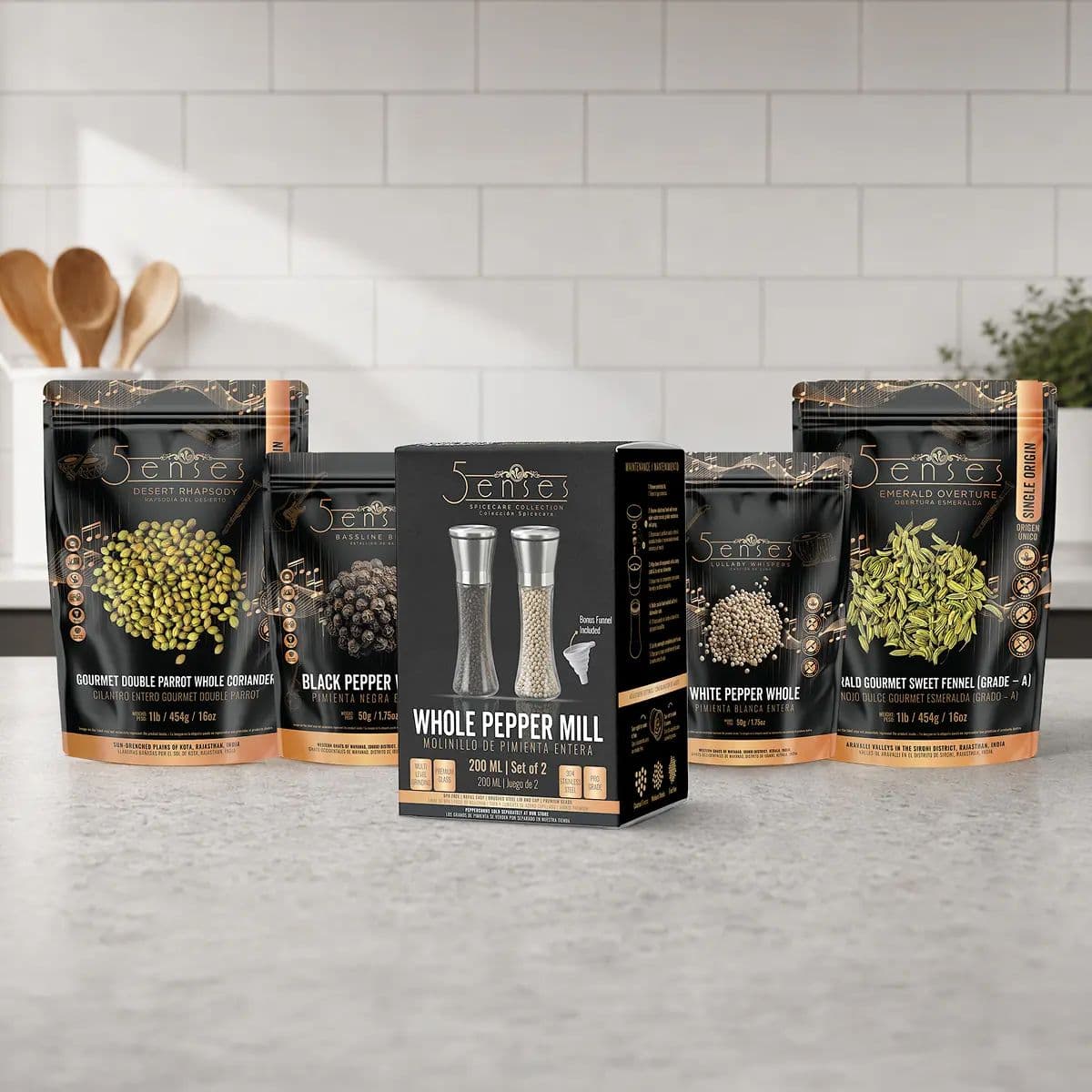
The current 5Senses designation is Double Parrot Grade A (Hadoti Bloom), sourced from Kota in Rajasthan's Hadoti region, India. The product information describes near-source partial sun-drying, a citrus-floral opening, and woody-nutty undertones.
The product description also notes that toasting moves the profile from citrus-forward toward warm and nutty. Explain that as a preparation choice. Do not tell shoppers that every use requires toasting, and do not invent a measured oil content to make the advice sound scientific.
Double Parrot Grade A is the stated commercial designation. It is not presented here as an independently certified universal standard.
The product page lists 100 g, 200 g, and 454 g formats. Confirm the wholesale item and pack that fit your customers rather than assuming the largest format is the best purchase.
Explain pods and seeds separately
Cardamom is a useful reminder that whole does not always mean ready to stir into a finished dish. The recipe determines whether the pod is used to infuse, opened to release seeds, or prepared for grinding.
The 5Senses green cardamom information names Malabar, India, and gentle air-drying. Sweet, floral, citrus notes support a conversation about chai and baking. Those facts do not establish a universal substitution between a count of pods and a spoon of ground spice.
Train the team to ask what the recipe requires. Avoid giving a confident conversion when the product, seed yield, grind, or recipe is not defined.
A short shelf explanation should distinguish:
- Whole pods from loose seeds.
- Infusing from grinding.
- A sensory note from an ingredient addition.
- General use guidance from a tested recipe.
- A preparation step from a promised result.
Make whole cloves approachable
Cloves Whole offer another clear format conversation. The 5Senses product information identifies Kanyakumari district, Tamil Nadu, India, natural drying, and bold, woodsy, sweet notes with camphor and pepper undertones.
A staff member can explain that whole cloves suit recipes designed around whole-spice infusion, while a recipe calling for ground cloves needs the appropriate ground format. Do not suggest that whole buds simply disappear into baking mixtures.
Keep the guidance specific to the intended dish. When whole spices are used for infusion, explain the recipe's removal or straining step. A customer should not discover the handling requirement only after serving.
The benefit of the origin story is that it adds context to a useful ingredient. It does not remove the need to explain how that ingredient behaves in the recipe.
Build a display that explains the choice
Put the recognizable ingredient name first. Show the format clearly. Add the verified region and a short preparation cue where shoppers can read it without moving several packs.
Do not separate every whole spice into an unfamiliar luxury corner if customers normally shop by cooking task. A nearby recipe suggestion can provide the context that the pack alone lacks.
Where ground and whole versions share a category, explain the decision rather than implying that one customer is making an inferior choice. Convenience is a legitimate need.
A useful display brief includes:
- Ingredient-first naming.
- Clear whole or ground wording.
- A documented source where relevant.
- A familiar cooking use.
- A concise preparation action.
- Accurate pack identification.
Test the preparation before teaching it
Staff training should be practical. Read the current product guidance, follow a suitable recipe, and discuss what the team can truthfully explain. Do not invent a first-person testing claim for your website if the shop has not performed the test.
For an internal session, keep the recipe and preparation conditions recorded. A loosely remembered demonstration makes it difficult to answer a later customer question consistently.
Use the exercise to discover where explanations fail. Does a colleague know which part of the cardamom is used? Can they distinguish a whole seed from a powder in the recipe? Do they know when to refer a question?
5Senses whole spices suit retailers who want to connect named origins with practical preparation. Their limitation is the extra education and, for some uses, the grinding or handling work the customer must perform.
Compare the economics of the actual retail unit
Do not compare only cost per weight. A customer buys a useful pack for a real cooking routine. Your store carries the remaining inventory and any selling costs.
For each format, calculate landed cost, realized sales, and variable selling costs over the same review period. Record returns, damaged packs, and staff questions as well as units sold.
A format with a higher gross-margin percentage can still contribute less if it barely moves. A convenient format can earn its place even when it is not the most distinctive product in the category.
Keep the economics separate from unverified claims about potency or longevity. Do not assume that a customer can universally use less of a whole spice, or promise a fixed shelf-life advantage without appropriate evidence.
Common mistakes in a mixed spice assortment
Carrying duplicates without a reason
If customers cannot tell why the shop carries several formats, the range needs explanation or editing. More options do not automatically make the store more helpful.
Recommending tools without checking the task
A tool that handles peppercorns is not automatically suitable for every whole spice. Use the manufacturer's instructions and the specific preparation requirement before pairing a tool with an ingredient.
Treating whole as a certification
Whole describes form. Single-origin describes sourcing. Organic or other certifications require their own evidence for the specific item. Do not let one term stand in for another.
Promising every customer a stronger result
Flavor depends on the actual product and preparation. Explain the documented sensory character and the cooking method instead of a universal claim that the whole format is stronger.
FAQ
Should a specialty store sell only whole spices?
Only if that fits its customers and selling model. A mixed assortment is useful when whole and ground formats serve different cooking tasks.
Are whole spices always better than ground spices?
No universal claim applies to every product and recipe. Whole formats give preparation choices; ground formats remove the grinding step.
How should staff recommend green cardamom?
Ask what the recipe needs: pods, seeds, or ground spice. Then explain the preparation rather than assuming those forms are interchangeable.
What makes 5Senses coriander distinctive?
The current product designation is Double Parrot Grade A (Hadoti Bloom), sourced from Kota in Rajasthan's Hadoti region. Its description identifies near-source partial sun-drying and citrus-floral, woody-nutty notes.
Does a whole-spice range guarantee stronger retailer margins?
No. Calculate contribution and assess actual customer demand. Format and provenance alone do not establish profitability.
Can I pair any grinder with any whole spice?
No. Check the tool manufacturer's instructions and the ingredient's preparation requirements. Do not imply universal compatibility.
One last thing
The most useful staff question is not whether the customer prefers premium spices. Ask what they are cooking. The answer usually tells you more about the right format than a shelf full of adjectives.