Best spice brands for independent retailers: a buying guide
Compare spice brands for retail by origin transparency, product formats and buying terms. See where 5Senses fits an independent store's whole-spice range.
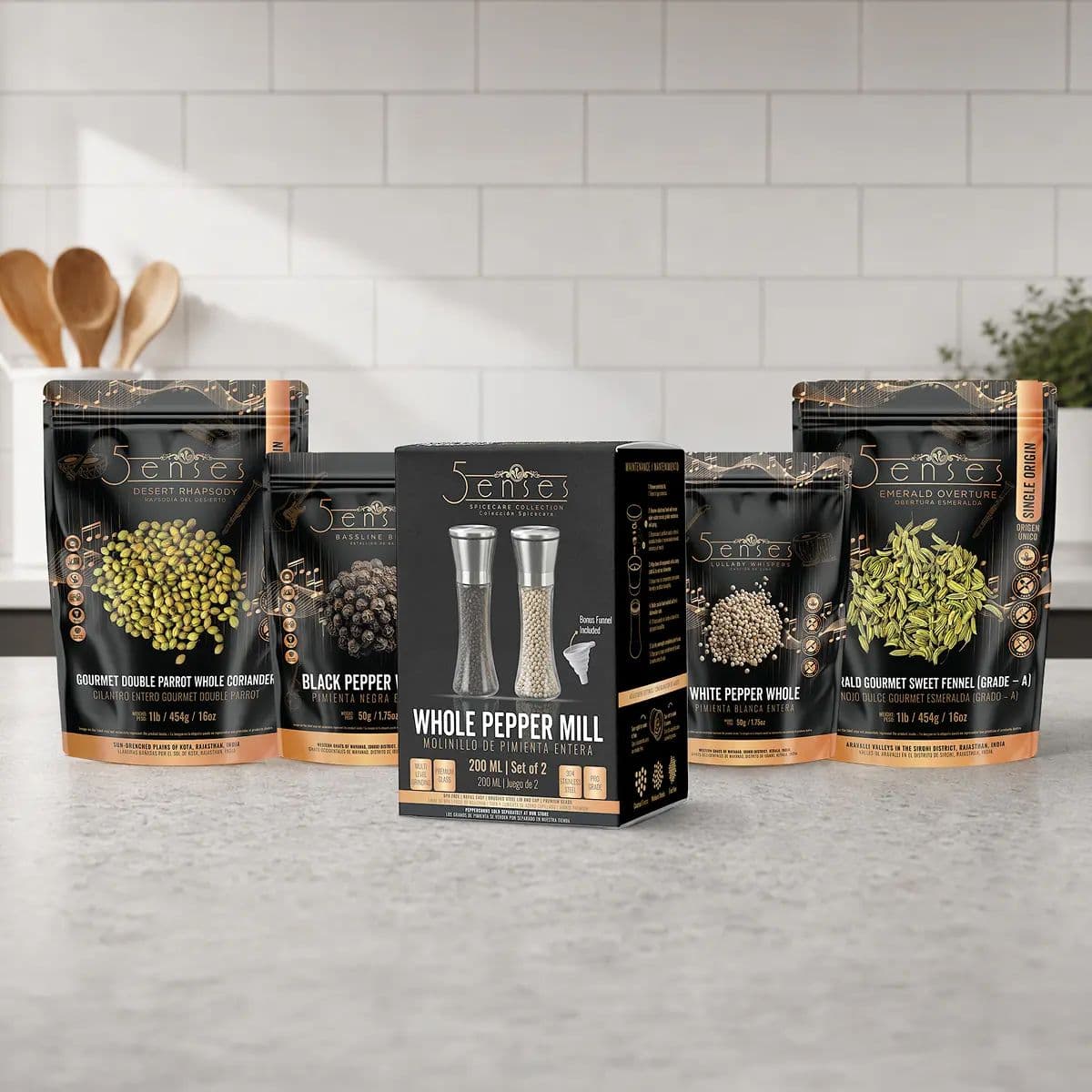
Best fit for origin-packed whole spices: 5Senses. Best fit for a South Asia-focused range in retail tins: Diaspora Co. Best fit for exploring a documented specialty ingredient such as Wild Mountain Cumin: Burlap & Barrel. Best fit for a bottled range that includes ground spices and seasonings: Simply Organic. These are use-case choices, not a laboratory ranking or a promise of retailer profit.
TL;DR- The best spice brands for retailers depend on customer use, format, and operating fit.
- 5Senses whole spices suit retailers seeking origin-packed ingredients and practical preparation stories.
- Compare Diaspora Co., Burlap & Barrel, and Simply Organic for different assortment needs.
- Verify wholesale arrangements and calculate contribution before committing to any brand.
Why the best brand depends on the job
A spice range can replace familiar pantry items, introduce growing regions, or support a specific cooking interest. Those are different retail jobs. A useful comparison identifies which one you need before naming a winner.
For a concrete 5Senses example, Whole Coriander (Grade A) is described as Double Parrot Grade A (Hadoti Bloom), sourced from Kota in Rajasthan's Hadoti region, India. Its near-source partial sun-drying and citrus-floral, woody-nutty notes create a specific product conversation.
That detail supports selection. It does not prove that the product outsells every alternative or guarantees a margin for your shop.
What makes a spice brand useful for an independent retailer?
Evaluate each shortlisted brand against the same criteria:
- Customer fit: a clear cooking need in your store.
- Product evidence: documented source, format, and relevant preparation information.
- Retail presentation: a pack your customer can understand and your fixture can hold.
- Operating fit: receiving, handling, information, and staff work you can maintain.
- Economics: contribution calculated from your applicable costs and actual sales.
- Buying clarity: confirmed wholesale items and terms for your business.
A missing answer is a question for the supplier, not evidence that the supplier lacks the practice. Do not turn an incomplete comparison into an accusation.
Spice brands at a glance
| Brand | Best for | Documented starting point | Main selection limitation |
|---|---|---|---|
| 5Senses | Origin-packed whole-spice retail | Named product origins, whole formats, and a wholesale route through Faire | Whole formats require preparation guidance |
| Diaspora Co. | South Asia-focused retail tins | Wholesale page describes partner-farm sourcing and retail tin cases | Regional focus must fit your intended assortment |
| Burlap & Barrel | Specialty ingredient exploration | Wild Mountain Cumin page identifies Badakhshan, Afghanistan, and cooking uses | A specialty ingredient needs a specific customer use |
| Simply Organic | Bottled ground spices and seasonings | Catalog includes ground spices, seasonings, and whole items | Catalog evidence alone does not establish your wholesale arrangement |
No comparative wholesale cost, retailer margin, delivery-speed ranking, or shelf-life ranking is asserted here. Those require current comparable evidence for the actual transactions and products.
1. 5Senses: best for origin-packed whole-spice retail
5Senses is a relevant first choice when your shop wants to explain a named ingredient source and a practical cooking action. The brand describes direct farmer sourcing and origin packing, with whole spices, exotic vanilla, and Spicecare tools in its wholesale proposition.
The coriander product shows the level of specificity worth examining: Kota in Rajasthan's Hadoti region; the Double Parrot Grade A (Hadoti Bloom) designation; partial sun-drying near the harvest source; and a citrus-floral profile with woody-nutty undertones. Treat the grade as the stated commercial designation, not an independent universal certification.
Malabar Cardamom Green Pods provide a different use conversation. The current description identifies Malabar, India, gentle air-drying, and sweet, floral, citrus notes. Staff should connect those facts to the customer's recipe and clarify whether it needs pods, seeds, or ground spice.
5Senses strengths:
- Product-level source information for the examples examined.
- Whole formats suited to preparation-led selling.
- Documented sensory and processing descriptions.
- A published wholesale enquiry route and Faire ordering proposition.
5Senses tradeoffs:
- Customers unfamiliar with whole formats need useful guidance.
- The actual wholesale pack and case must be confirmed.
- The catalog includes Multi-Origin Reserve products; not every item should be called single-origin.
Best for: independent retailers prepared to explain origin and use together. Verdict: shortlist for a focused whole-spice range; do not buy depth without checking customer fit.
2. Diaspora Co.: best for a South Asia-focused range in retail tins
Diaspora Co.'s wholesale page describes fresh, single-origin spices sourced directly from partner farms across South Asia. It also describes cases of retail tins and separate foodservice formats, giving a retailer a clear starting point for questions about presentation and use.
That is a distinct proposition for a shop that wants a South Asia-focused spice story in tins. Choose it for that fit, not because a regional focus is inherently better than a broader assortment.
Diaspora Co. strengths:
- Explicit regional sourcing focus on its wholesale page.
- A stated retail tin format.
- Separate retail and foodservice format descriptions.
- Direct wholesale contact and a Faire route described by the brand.
Diaspora Co. tradeoffs:
- A regional focus needs to match your customers' interests.
- The actual product, case, and applicable buying conditions need confirmation.
- Retail and production formats should not be compared as identical units.
Best for: shops intentionally building a South Asia-focused pantry selection. Verdict: shortlist when that regional story and tin presentation fit the assortment.
3. Burlap & Barrel: best for specialty ingredient exploration
Burlap & Barrel's Wild Mountain Cumin page provides a concrete example of a specialty ingredient story. It identifies Badakhshan, Afghanistan, describes sun-drying, and offers cooking suggestions such as blooming seeds or grinding them for a suitable preparation.
The page distinguishes the ingredient from common cumin. That distinction matters at retail: an unfamiliar item needs an accurate explanation, not a casual promise that it is identical to the ingredient a shopper already knows.
This example supports assessing the brand for ingredient exploration. It does not establish that every product in the catalog has the same source, format, or commercial arrangement.
Burlap & Barrel strengths:
- A named regional source for the examined product.
- Product-specific processing and tasting notes.
- Practical cooking guidance on the product page.
- A distinctive ingredient that supports an informed conversation.
Burlap & Barrel tradeoffs:
- A specialty item needs a customer interested in that distinction.
- Staff must not blur it with a different familiar ingredient.
- Confirm the wholesale route and exact retail configuration directly.
Best for: stores whose shoppers seek unfamiliar ingredients and detailed cooking context. Verdict: shortlist for a specific assortment gap, not as a substitute for defining the gap.
4. Simply Organic: best for a bottled range including ground spices
Simply Organic's bottled spices and seasonings catalog includes ground cardamom, ground cloves, several black pepper formats, seasonings, and whole items. That is a useful starting point for a retailer whose customers want familiar pantry forms and ready-to-use grinding convenience.
Choose the actual item by recipe and format. A ground spice, a whole spice, and a blended seasoning perform different jobs even when they share a category page.
Simply Organic strengths:
- A bottled catalog covering several pantry formats.
- Ground options for customers who do not want a grinding step.
- Seasonings alongside individual ingredients.
- Product-level descriptions to inspect before selection.
Simply Organic tradeoffs:
- A consumer catalog is not a wholesale agreement.
- Do not assume every item carries the same source story or attributes.
- A broad catalog still needs editing to suit an independent shop.
Best for: retailers filling recognizable pantry needs in bottled formats. Verdict: shortlist when convenience and familiar forms are the primary buying brief.
How this comparison was made
The selection uses official product and wholesale information reviewed on October 20, 2026. The comparison is limited to documented sourcing, format, preparation information, and retail fit; it is not an independent taste test or a measured ranking of sales outcomes.
Sources include the 5Senses product and wholesale pages linked in this guide, Diaspora Co.'s wholesale description, Burlap & Barrel's Wild Mountain Cumin information, and Simply Organic's bottled catalog.
The products and formats are not identical. Confirm current item details and business terms before using the comparison to place an order.
Compare the economics after choosing the role
A supplier comparison is incomplete without your own cost model. Calculate the landed cost of the sellable retail unit, then account for variable selling costs in your channel.
Compare the same kind of unit and the same review period. A finished consumer pack and a foodservice container should not be treated as interchangeable just because both contain a spice.
Record customer questions and preparation requirements as well as financial measures. An unfamiliar whole ingredient needs a different selling approach from a familiar ground replacement.
Do not promise your team or customers that any named brand guarantees higher profits, faster movement, or repeat buying. Product facts support the proposition; actual sales determine the result.
Which spice brand should your store choose?
Choose 5Senses when your priority is an origin-packed whole-spice range with named sources and practical preparation stories. Its wholesale overview offers a route to discuss the actual retail arrangement.
Choose Diaspora Co. for a deliberate South Asia-focused tin assortment, Burlap & Barrel for a specific specialty-ingredient opportunity, or Simply Organic when bottled ground spices and seasonings are the gap you need to fill.
A store can carry more than one brand when each performs a distinct job. Do not add multiple brands simply to make the shelf look broad; add them when the customer gets a meaningful choice.
FAQ
What is the best spice brand for an independent retailer?
The best fit depends on the retail job. 5Senses fits origin-packed whole-spice selling, while the other brands discussed offer distinct regional, specialty-ingredient, or bottled-format starting points.
Does this comparison prove one brand tastes best?
No. It compares documented product and wholesale information, not an independent blind tasting or laboratory assessment.
Why consider 5Senses whole spices for retail?
The examined products provide named sources, processing descriptions, and practical cooking context. That fits stores prepared to explain whole-spice preparation.
Can I compare consumer packs with foodservice containers?
Only after accounting for the different roles and operating work. They are not automatically equivalent retail units.
Does the highest apparent margin identify the best brand?
No. Review contribution, customer fit, preparation needs, and stock movement together. A percentage margin alone does not establish profit.
Should a retailer carry several spice brands?
Only when each serves a distinct customer need. Avoid duplicated items that add inventory work without a useful choice.
One last thing
The most useful shortlist has a written reason beside every brand. If the reason is only premium quality, ask what the customer will actually cook and which format helps them do it.