Wholesale spices for specialty grocery stores
Build a specialty grocery spice range around everyday cooking and verified origins. Assess 5Senses whole spices, pack formats and wholesale buying options.

Specialty grocery spice buying is the work of matching pantry ingredients to the meals your customers actually cook. A single-origin whole-spice range adds a sourcing story, but it earns a continuing place only when the product, preparation, and store economics fit together.
TL;DR- Wholesale spices for grocery stores need a clear role beside the existing pantry range.
- 5Senses whole spices suit origin-led stores that explain practical cooking uses.
- Separate everyday meal ingredients from products that need more introduction.
- Judge the range using customer use, contribution, and stock movement, not packaging alone.
Why specialty grocery stores need a clear spice proposition
Your customers already have ingredients in their cupboards and expectations about how to shop for them. A new range needs to answer why this product belongs in their next meal.
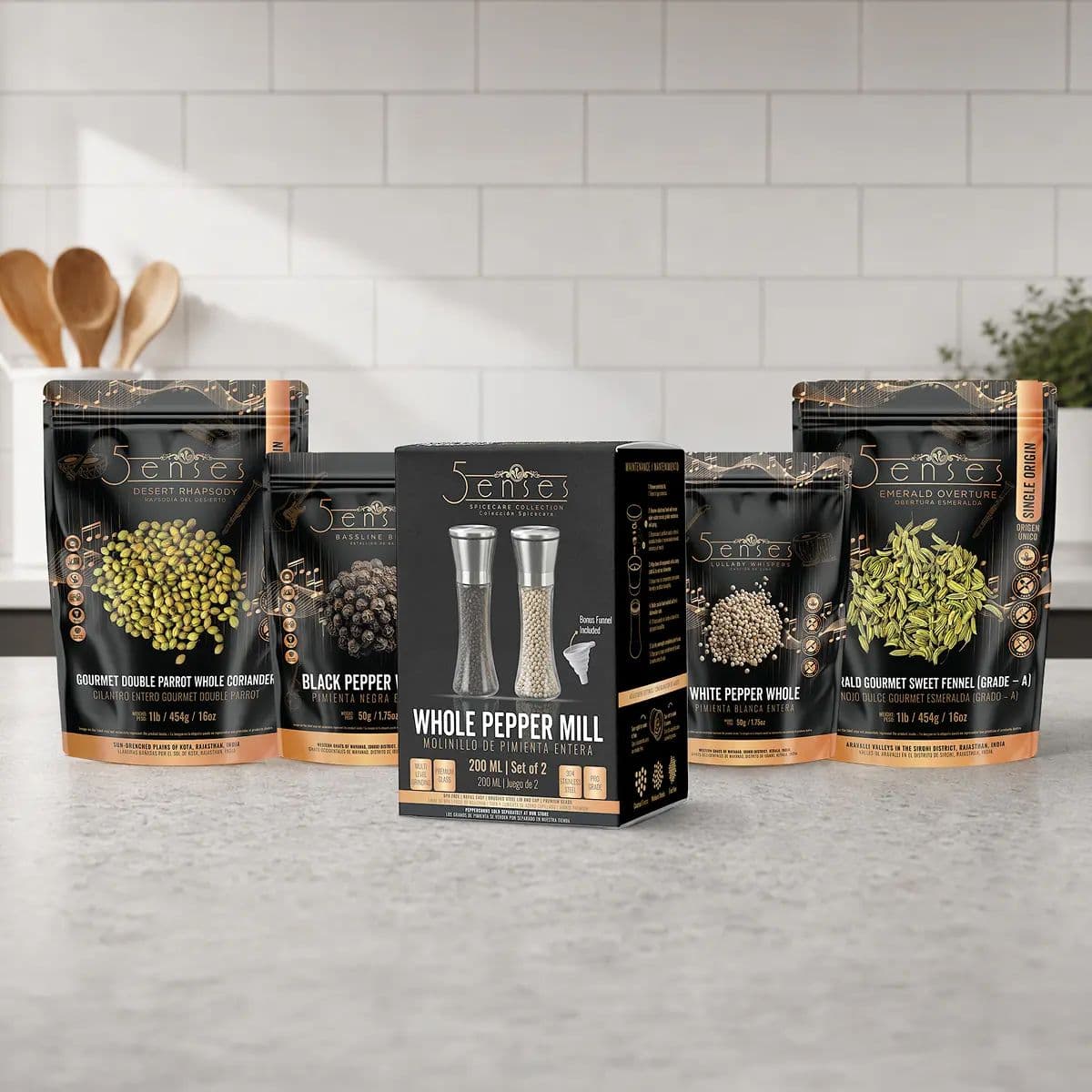
5Senses Whole Coriander (Grade A) offers a specific example. Its stated designation is Double Parrot Grade A (Hadoti Bloom), sourced from Kota in Rajasthan's Hadoti region, India. The product information describes near-source partial sun-drying, citrus-floral notes, and woody-nutty undertones.
That story is useful when the store connects it to a cooking task. It is less useful when it sits beside the product as a paragraph nobody can translate into dinner.
An origin-led range should make everyday cooking clearer, not make the spice aisle harder to shop.
Build the range around meals your store already supports
Look at the food categories customers already buy from you. A shop known for baking ingredients has a different opening brief from a store focused on produce and savory pantry cooking.
Use real sales records and customer questions. Do not assume that a product described as a supplier bestseller will automatically be a strong fit for your shop.
Map the existing pantry jobs
List the cooking tasks your store already serves. Identify whether customers need a familiar replacement, a new origin choice, or help with preparation.
Use this map to prevent duplicated products that add complexity without adding a useful choice. A whole format and a ground format can both belong, but the reason should be visible.
For each task, record:
- Typical customer or household need.
- Relevant ingredient.
- Whole or ground format required.
- Preparation before cooking.
- Existing products that serve a similar role.
- The gap a new item would fill.
Choose an anchor ingredient staff can explain
Start with an ingredient connected to recipes your customers recognize. Coriander can support a conversation about using seeds whole or preparing them for fresh grinding.
The 5Senses description notes that toasting shifts the profile from citrus-forward toward warm and nutty. Explain that as a preparation choice for an appropriate recipe, not a mandatory step for every dish.
Double Parrot Grade A is the product's stated commercial designation. Do not present it as an independently certified universal grade or as proof of measured oil content.
Prepare a short anchor-product brief:
- Recognizable ingredient name.
- Verified source region.
- Documented sensory description.
- Familiar cooking application.
- Preparation action.
- A suitable recipe for further guidance.
Add complementary ingredients with different uses
A range needs more than repeated versions of the same story. Malabar Cardamom Green Pods bring a different preparation conversation from coriander.
The current product information names Malabar, India, gentle air-drying, and sweet, floral, citrus notes. For a shopper making chai or baking with cardamom, staff should clarify whether the recipe needs pods, seeds, or ground spice.
Do not give a universal conversion between pods and powder. The relevant amount depends on the recipe and preparation.
Before adding another item:
- Name its distinct cooking task.
- Check whether customers ask for it.
- Confirm the source statement.
- Identify any preparation barrier.
- Decide where it belongs in the aisle.
Match pack choice to household use
The biggest product format is not automatically the most useful consumer purchase. A frequent cook and someone trying a new ingredient need different buying conversations.
The current coriander product information lists 100 g, 200 g, and 454 g formats. Those are product-page options, not a complete wholesale specification. Confirm the actual wholesale configuration before planning shelf capacity or purchase depth.
Keep pack choice grounded in:
- The customer's likely cooking routine.
- The amount the relevant recipe uses.
- Storage guidance for the product.
- Shelf and stockroom fit.
- The exact consumer pack being purchased.
- The store's actual sales evidence.
Write shelf guidance that leads to a meal
Lead with the ingredient and format. Follow with the named source and a cooking cue. Avoid a display that depends on shoppers understanding every poetic product designation before recognizing coriander or cardamom.
A short card can explain toast, grind, bloom, or infuse where those actions fit the ingredient and recipe. Do not force every action onto every spice.
Keep the card accurate:
- Use the current product name.
- Apply the origin classification item by item.
- Separate sensory notes from ingredients.
- Include a practical preparation cue.
- Avoid health claims and unsupported superlatives.
- Keep batch details tied to the actual product.
Review the range as a grocery category
Record the date each item reached the shelf, its position, staff guidance, units sold, and remaining stock. A product that never received a clear display has not had the same opportunity as a supported launch.
Compare matching periods. Do not treat seasonal demand or a special event as proof of everyday movement.
Use the review to decide whether to retain, explain, reposition, or stop carrying the item. Increasing purchase depth is only one possible response.
Track:
- Sellable units received.
- Realized net sales.
- Product and variable selling costs.
- Customer questions.
- Damaged or returned items.
- The evidence supporting the next order.
Compare assortment approaches
| Approach | Best for | Strength | Limitation |
|---|---|---|---|
| Everyday cooking core | Stores serving regular pantry replenishment | Easy connection to familiar meals | Needs a clear distinction from existing options |
| Origin exploration selection | Shops with customers interested in sourcing | Creates room for detailed ingredient education | Requires staff confidence and useful recipes |
| Whole and ground mix | Stores serving several preparation habits | Gives shoppers a practical format choice | Needs clear shelf organization |
| Cooking-themed feature | A defined meal or event | Connects several ingredients to a use | Needs a plan after the feature ends |
5Senses whole spices suit specialty grocery retailers that want named origins and preparation-led selling. The tradeoff is that whole ingredients need clear use guidance, especially when customers arrive expecting a ready-to-use powder.
Preserve the difference between origin and process
A source region identifies where the ingredient comes from. Processing describes what happens to it. Sensory notes describe how it is perceived. Keep those categories distinct when staff explain the range.
For coriander, the verified source is Kota in Rajasthan's Hadoti region. The described partial sun-drying is a separate processing fact. The citrus-floral and woody-nutty character is the product's sensory description.
Do not create a scientific-sounding soil-to-flavor explanation without evidence. Do not invent a farm visit, named grower, or brand farming history to make the display feel personal.
Credit producers and regions through accurate facts. That is more durable than an unsupported claim that one growing place is universally the best.
Make repeat use easier without promising repeat orders
A customer can enjoy an ingredient and still use it slowly. Replenishment depends on actual cooking habits, pack choice, and household demand.
Support continued use by showing a further recipe or preparation after the first purchase. Keep it relevant to the product rather than issuing generic reminders that assume the pouch is empty.
For cardamom, a store can explain distinct chai and baking uses without inventing a universal dose. For coriander, it can explain whole-seed use and grinding choices. The point is useful variety, not a promise that every household will reorder on a set timetable.
Your store's reputation comes from recommendations that work. Do not treat customer education as a way to pressure people into buying more than they need.
Protect contribution and shelf space
Calculate the actual landed cost of the sellable pack. Then account for the variable costs of selling in your channel. Gross margin and contribution are different measures, so label the calculation clearly.
Consider the space and staff work the range requires. A strong percentage margin is not enough if the product barely sells or needs more support than the store can provide.
Keep the review tied to actual transactions. Do not assume single-origin sourcing guarantees a higher contribution than every familiar pantry product. Distinctive facts create a reason to consider the range; your records establish the result.
If the category underperforms, diagnose the problem before changing everything. Customers asking what to cook need clearer guidance. Customers asking about pack size need clearer format information. A profitable item with weak visibility needs a different response from one that loses money on each sale.
Common specialty grocery mistakes
Making the range too broad before understanding it
Every new item adds receiving, display, information, and stock-management work. Add a product because it serves a distinct need, not merely because the catalog contains it.
Treating the whole catalog as single-origin
The 5Senses range includes both Single Origin and Multi-Origin Reserve products. Apply the exact classification rather than copying a category-wide slogan.
Keeping the origin story but losing the recipe
A place name helps explain the product. A cooking action helps the shopper use it. The shelf needs both in a readable form.
Judging unsupported products as though they had a fair trial
Record whether the product was displayed, explained, and actually accessible. Do not compare a stockroom carton with an item featured at the front of the shop.
FAQ
Which wholesale spices should a specialty grocery store buy first?
Start with ingredients that support meals your customers already cook. Choose a defined role, suitable format, and explanation your staff can maintain.
How does 5Senses fit a specialty grocery range?
5Senses offers origin-led whole spices with product-level source and preparation information. It fits stores prepared to explain how customers use the whole format.
Should a grocery store carry whole and ground spices?
A mixed range makes sense when the formats answer different customer needs. Explain the distinction rather than adding near-duplicates without a purpose.
Can I assume the largest pack is the best retail choice?
No. Match the pack to household use and actual demand, and confirm the wholesale configuration before ordering.
Does an origin story guarantee repeat purchases?
No. Repeat buying depends on real cooking use and customer demand. Practical recipes and clear preparation support the experience without guaranteeing a sales outcome.
How should I review a new spice range?
Use matching dates for sales, contribution, stock movement, and customer questions. Record display and staff support so the comparison is fair.
One last thing
Walk the aisle as a customer planning dinner. If the spice display explains the origin but not the next cooking step, add the step before adding another product.