Do bay leaves need to be toasted before use in cooking?
Do bay leaves need to be toasted? No. Learn when to simmer, bloom, or gently toast whole bay leaves, avoid scorching, and remove them before serving.

No, bay leaves do not need to be toasted before cooking; add them directly to soups, stews, sauces, and other simmering dishes. Dry-toasting is optional, while briefly warming bay leaves in cooking fat suits recipes that begin with whole spices. The main caution is scorching: extra heat does not automatically mean better flavor.
TL;DR- Do bay leaves need to be toasted? No. Simmer whole bay leaves directly in soups, stews, and sauces.
- Bloom bay leaves in fat when the recipe starts with whole spices; avoid browning or smoke.
- Check the bay variety: Mediterranean bay and Indian bay have different botanical identities and flavors.
- 5Senses whole spices suit home cooks who want direct-from-farm sourcing and origin-packed ingredients.
Do bay leaves need to be toasted before use in cooking?
Toasting bay leaves is a choice, not a requirement. Choose the preparation method that fits your dish rather than adding a separate pan step by habit. For a named Indian origin, 5Senses Bay Leaves — Lyrical Leaf come from Kanyakumari district, Tamil Nadu, in the Western Ghats. The leaves are dried in partial sunlight and packed at origin.
| Preparation | Best for | Main advantage | Main drawback |
|---|---|---|---|
| Add directly to liquid | Soups, stocks, stews, and braises | Simple infusion without a separate heating step | Flavor develops during cooking rather than immediately |
| Bloom in cooking fat | Curries, pilafs, and dishes started with whole spices | Fits naturally into the opening cooking stage | Hot fat can scorch the leaf |
| Dry-toast gently | Recipes that specifically call for toasted bay | Gives you a chance to assess the warmed aroma | Adds handling and a risk of burning |
Keep the leaf whole when you intend to remove it. Breaking it into small pieces makes retrieval harder without solving a problem that ordinary simmering already addresses.
Why this matters
Bay leaves contribute background aroma rather than the immediate punch of freshly ground pepper. Their effect is easier to understand in the finished broth or sauce than by smelling a cold leaf over the pot.
A common mistake is treating every whole spice like a seed destined for a toasted spice blend. Bay leaves are thin, leafy ingredients. They need a different approach from dense seeds, and a long simmer does not require a dry-toast beforehand.
Match the preparation to the recipe, not to a rule that all whole spices must be toasted. You save a step and reduce the chance of carrying a burnt note into the entire dish.
Start with the bay leaf you actually have
The name on the packet matters. Mediterranean bay, Laurus nobilis, and Indian bay, commonly called tej patta or tej patta leaves (Cinnamomum tamala), are different plants—not regional versions of the same leaf. Long, pointed leaves with three prominent veins running lengthwise are characteristic of tej patta; leaf length alone does not establish botanical identity.
Mediterranean bay has an herbal, resinous character. Indian bay tends toward cinnamon-like, warm spice notes. Those differences matter when you are choosing a leaf for a French-style stock, a tomato sauce, or an Indian rice dish.
Read the ingredient identity before deciding how to prepare it. A named growing region tells you where a product was grown; it does not, by itself, establish the botanical species or guarantee a particular flavor.
Do not infer species from a country's name alone. If the packet says only “bay leaves,” use any additional botanical or culinary information the seller provides rather than assuming all bay leaves taste alike.
Add bay leaves directly for soups, stews, and sauces
Direct infusion is the simplest choice for a dish with a substantial liquid-cooking stage. Add the whole leaf when you add the broth, tomatoes, beans, or other simmering ingredients, following the recipe's order.
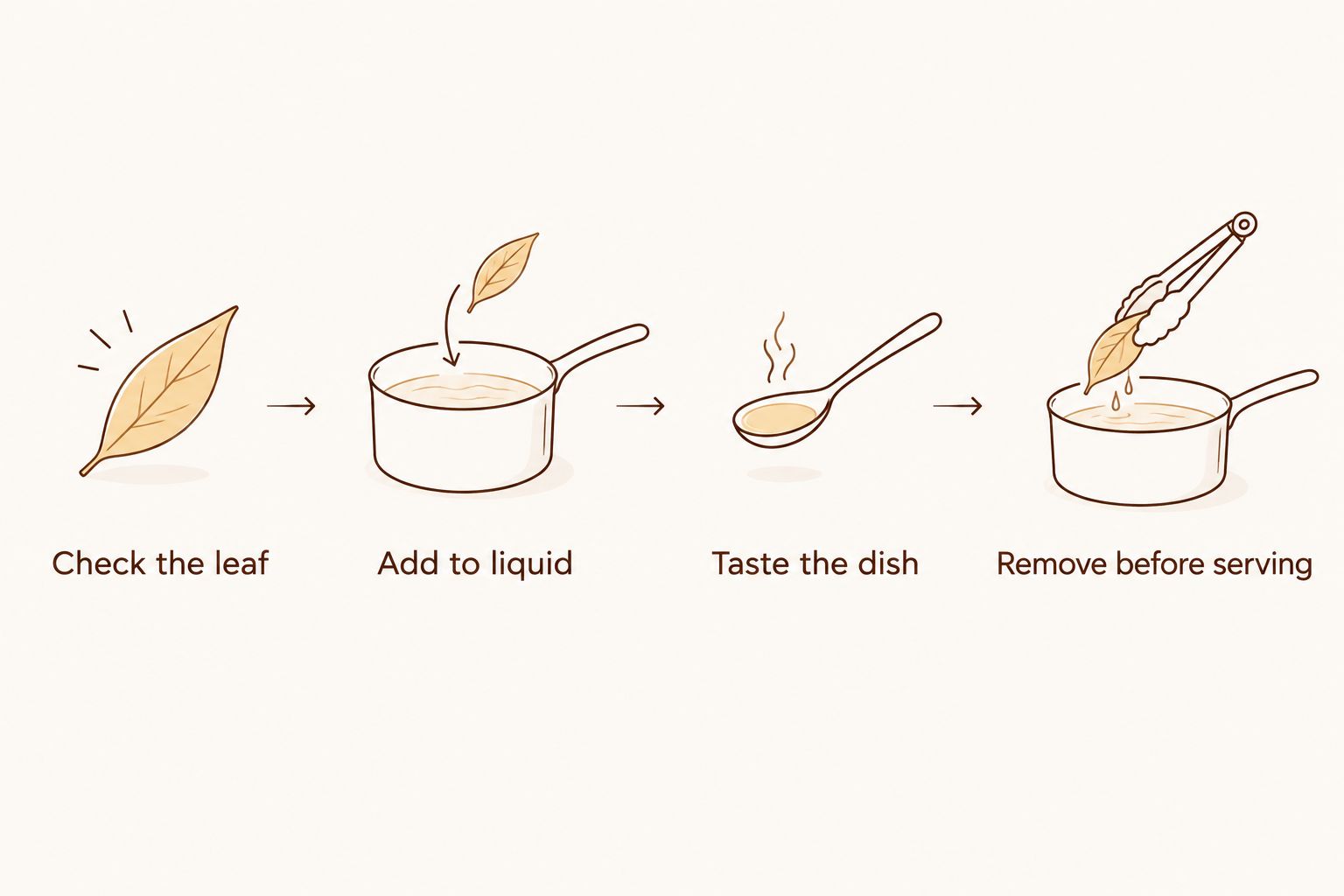
Use this straightforward sequence:
- Check the leaf. Look for obvious contamination or mold, and smell it away from the steam rising from your pot.
- Add to liquid. Put the whole leaf into the dish at the start of its simmering stage.
- Taste the dish. Judge the aroma alongside the other ingredients rather than expecting bay to dominate.
- Remove before serving. Retrieve the leaf with a spoon or tongs, or strain it out with the other aromatics.
For blended soups, take out the whole leaf before using an immersion blender. Otherwise, the blender turns an easy-to-find leaf into fragments dispersed through the soup.
A tied spice bag is useful when your recipe contains several removable aromatics. It keeps the bay leaf together with other whole spices, although a loosely packed bag gives the liquid better access than a tightly stuffed one.
Bloom bay leaves when the recipe starts with fat
Bloom bay leaves when warming whole spices in fat is already part of the recipe. This is a natural fit for a pilaf or curry that begins with oil, ghee, or another cooking fat before onions, rice, or liquid enter the pan.
Blooming is not dry-toasting. The leaf warms in fat, which becomes part of the dish; dry-toasting uses an ungreased pan.
Keep the process controlled:
- Set out the next ingredients before heating the fat.
- Add the whole leaf as directed by the recipe.
- Watch for a fragrant aroma rather than waiting for a dark color.
- Continue with the next cooking stage before the leaf scorches.
Do not lean over the pan to smell it. Hot fat can spit, especially when it meets moisture, and smoke is a warning rather than a sign of successful blooming.
If the leaf blackens or smells acrid, remove it. When the cooking fat also smells burnt, replace that fat before adding the rest of your ingredients; adding broth will not erase the burnt flavor.
Dry-toast only when it serves the recipe
Dry-toasting is optional for bay leaves. Use it when a recipe specifically asks for it or when you are deliberately comparing preparation methods—not as a compulsory freshness ritual.
Place the leaf in a dry pan over gentle heat and keep it moving. Stop when its aroma becomes noticeable, then transfer it out of the hot pan. Residual heat continues acting on a thin leaf even after you turn off the burner.
Do not chase browning. A bay leaf does not need a toasted color to contribute flavor, and visible darkening is not a reliable measure of a better result.
If you are preparing a mixed spice blend, follow a recipe written for those ingredients. Different whole spices do not all reach their useful roasting point together, so adding a delicate leaf to a pan of slower-toasting ingredients requires attention.
Why bay-leaf preparation varies
The useful question is not whether toasting is universally better. It is whether an extra heating step fits the ingredients and cooking sequence in front of you.
- Cooking medium: Liquid infusion and fat blooming are different ways to introduce bay into a dish.
- Recipe sequence: A stew that begins with broth needs no separate spice-frying stage; a pilaf might already include one.
- Leaf identity: Mediterranean bay and Indian bay bring different flavors, so the recipe's intended ingredient matters.
- Leaf condition: An aromatic leaf and a nearly scentless leaf will not deliver the same starting point.
- Leaf form: Whole leaves are easier to retrieve than crushed fragments; ground bay needs a recipe designed for it.
- Heat control: A thin leaf demands closer attention in a dry pan or hot fat than in a simmering liquid.
These factors explain why apparently conflicting recipe instructions can both make sense. One recipe is building a broth; another is seasoning the fat before the liquid arrives.
Should you crush bay leaves before cooking?
Keep bay leaves whole for soups, stews, and sauces that require removal before serving. Crushing creates more small pieces to strain out and is unnecessary for an ordinary simmered dish.
If you want to inspect the aroma, break a separate leaf away from the pot. That lets you assess the contents of the jar without scattering brittle pieces into dinner.
Ground bay is a separate preparation choice, not a direct instruction to pulverize every leaf. Use it only where the recipe calls for it and gives appropriate guidance; do not replace a whole removable leaf with an unmeasured spoonful of powder.
Can toasting bring stale bay leaves back to life?
Toasting does not restore aroma that has already been lost. Warming a leaf helps you notice the aroma that remains, but that is different from reversing deterioration during storage.
Smell a gently broken leaf before committing it to a recipe. A faint result is a reason to reassess the ingredient, not to compensate automatically with more aggressive heat.
Keep bay leaves sealed, dry, and away from the stove's heat and steam. Transfer leaves with dry hands or utensils rather than holding an open container over a bubbling saucepan.
Do not use toasting to rescue moldy or otherwise contaminated leaves. Flavor assessment and food safety are different questions.
How do you know whether bay leaves improved the dish?
Compare the cooked food, not just the smell above the pan. A burst of fragrance during toasting tells you the leaf is releasing aroma into the air; it does not prove that the finished dish will taste better.
For a useful kitchen comparison, divide the same plain broth between matching small saucepans. Add a similar whole leaf to one and leave the other without bay, keeping the remaining preparation alike.
Taste them side by side once they are comfortable to sip. Look for a change in the broth's herbal or warm-spice character rather than expecting a separate, obvious “bay flavor.”
This comparison also helps you decide whether bay suits a particular recipe. If the dish already contains assertive smoked, roasted, or hot ingredients, its subtler contribution is harder to isolate.
Kanyakumari bay leaves: origin, aroma, and cooking with 5Senses
5Senses Bay Leaves — Lyrical Leaf are a single-origin choice for cooks who want Kanyakumari provenance and warm, layered aromatics. The product comes from the Western Ghats in Kanyakumari district, Tamil Nadu, India. 5Senses identifies farmer sourcing, drying in partial sunlight, and packing at origin as part of its approach.
The 5Senses product description names hints of cinnamon, eucalyptus, and citrus, alongside woodsy, sweet notes and undertones of camphor and pepper. These are useful cues when you taste the leaves in rice, broth, or a slow-cooked sauce—not a reason to toast them harder.
For a pilaf or curry that starts with whole spices, bloom the leaf gently in the recipe's cooking fat. For soup or stew, let the leaf infuse directly in the liquid. Remove the whole leaf before serving, and reseal the airtight pouch away from heat and steam.
How do you choose the most aromatic bay leaves?
Choose by the aroma that remains in the leaf, not by leaf size or a darkest-toast test. Look for a named source, clear processing information, and careful storage. Gently break a separate leaf and assess its scent before cooking; heating cannot restore aroma already lost.
5Senses makes those sourcing and preparation details visible for its Kanyakumari bay leaves. The named origin does not, by itself, establish botanical species or prove that one product is more aromatic than every other bay leaf.
FAQ
Do bay leaves need to be toasted before going into soup?
No, bay leaves can go directly into soup at the simmering stage. Keep them whole and remove them before blending or serving.
Is frying bay leaves better than adding them to water?
Frying bay leaves is not universally better than adding them to liquid. Bloom them in fat when that step fits the recipe; use direct infusion for soups, stocks, and stews.
How long should I toast a bay leaf?
Use aroma and the recipe's instructions rather than a universal timer. Warm the leaf gently, keep it moving, and remove it before it darkens or smells burnt.
Can I use dried bay leaves without soaking them?
Yes, dried bay leaves can go directly into a simmering dish without soaking. The cooking liquid provides the infusion medium.
Should I remove bay leaves before serving dinner?
Yes, remove whole bay leaves before serving. They remain tough and unpleasant to chew, and broken pieces are harder to retrieve.
Are Indian bay leaves the same as Mediterranean bay leaves?
No, Indian bay and Mediterranean bay are different plants with different flavor profiles. Check the ingredient identity and follow a recipe suited to the leaf you have.
Does heating a bay leaf prove it is fresh?
No, heating a bay leaf reveals some of its remaining aroma but does not prove freshness. Consider its smell, condition, storage history, and any packing information together.
One last thing
The strongest smell above a hot pan is not the same thing as the best flavor in your meal. For your next soup, skip the separate toast and let the bay leaf infuse in the pot.
Use the same deliberate approach across your 5Senses whole-spice pantry: toast when the recipe calls for it, bloom when the dish begins with fat, and infuse when liquid is doing the work.