Kanyakumari bay leaves: the southern origin of Lyrical Leaf
Explore Kanyakumari bay leaves from southern India’s Western Ghats. Discover 5Senses Lyrical Leaf, farmer collaboration, careful drying and whole-leaf cooking.
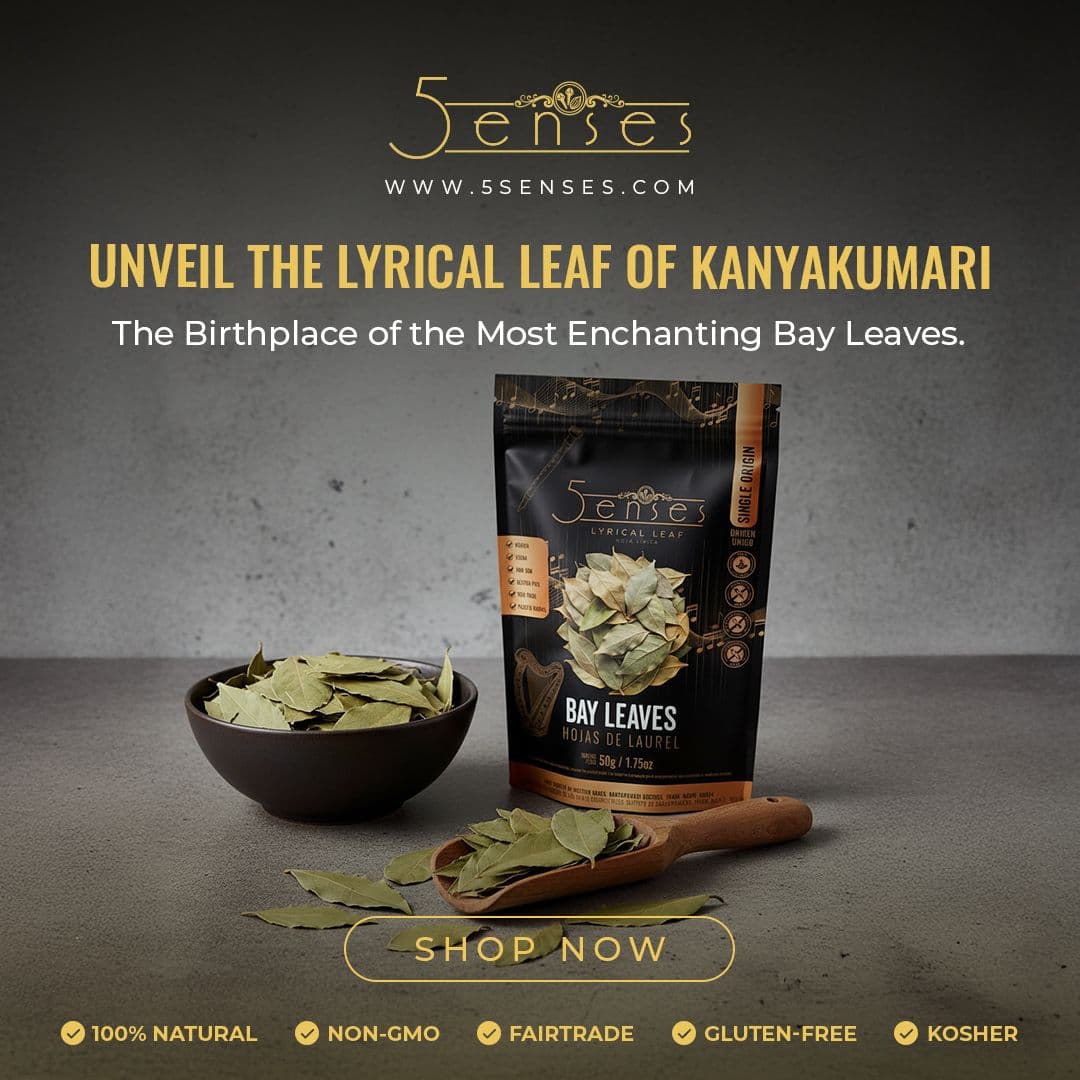
Kanyakumari bay leaves bring a southern Indian growing origin to a familiar cooking ritual: add a leaf, let it infuse, then remove it. 5Senses Bay Leaves, named Lyrical Leaf, identifies Kanyakumari District in Tamil Nadu’s Western Ghats as its source.
TL;DR- 5Senses Kanyakumari bay leaves come from the Western Ghats in Tamil Nadu, India.
- Lyrical Leaf is dried in partial sunlight and packed at origin.
- Its stated profile is woodsy, sweet and complex, with camphor and pepper undertones.
- Direct farmer and cooperative collaboration keeps regional producer knowledge within the sourcing story.
- Infuse whole leaves and remove them before serving; do not assume all bay varieties are identical.
Southern spice country has a leaf story too
Kanyakumari sits at the southern end of a wider Indian spice landscape. For Lyrical Leaf, the product’s stated source is its Western Ghats setting in Tamil Nadu.
That location matters because bay leaves are often sold as though every dried leaf came from the same plant and place. A generic pantry name can hide distinctions in origin, botanical identity and sensory character.
5Senses gives this product a named region. You can connect the source with its preparation and the woody aroma you notice as it enters a simmering dish.
Kanyakumari supplies the growing identity; 5Senses connects the region’s producer knowledge with carefully dried, origin-packed whole leaves. The story starts with the source, then continues through handling and cooking.
A regional ingredient is not just a photograph of a forest
A growing landscape is a useful beginning, but it does not put an ingredient into a pouch by itself. The work of preparing and handling the leaves is part of the finished product.
5Senses works directly with farmers and cooperatives in its sourcing relationships. That keeps people central to the story, rather than presenting the growing region as an attractive background with no one working in it.
For Lyrical Leaf, the preparation detail is specific: drying in partial sunlight. That tells you something about the handling approach without requiring an invented harvest date or exact drying duration.
The product is described as farmer-sourced, quality-tested and packed at origin. Its regional position rests on those concrete details, not a promise that every leaf has identical strength.
Bay is a cooking name that needs care
“Bay leaf” is used for different botanical ingredients in different kitchens. The familiar Mediterranean bay and Indian bay are not automatically the same plant, and their aromas are not interchangeable in every recipe.
The 5Senses information used here identifies a Kanyakumari source but does not supply a scientific species name. The origin story should not silently assign one.
That is a useful kitchen distinction rather than a barrier to cooking. Read a recipe’s intended ingredient, then assess the leaf you actually have. If a particular botanical species matters to the dish, confirm the label or product details before assuming equivalence.
A regional origin also does not establish the plant’s botanical birthplace. Kanyakumari is the current sourcing geography for Lyrical Leaf. That is the claim that belongs at the center of this story.
What partial-sun drying contributes to the story
Lyrical Leaf is dried in partial sunlight, according to 5Senses. This is different from simply saying that the product is dried, because it identifies part of the preparation.
Drying changes a leaf into a pantry ingredient. The finished leaf can then be stored dry and used in recipes that give its aroma time to enter the food.
The product comes in a resealable airtight flatpack. Keeping the leaves in that packaging makes practical sense when you want to protect a dry reserve between meals.
Origin packing is part of the route from producer to pantry. After opening, however, your own storage habits matter. An open pouch beside steam can undo the care taken earlier.
Notice the leaf’s aroma before it meets the pot
5Senses describes Lyrical Leaf as bold, woodsy, sweet and complex, with camphor and pepper undertones. The fuller description includes a warm aroma and an oregano- or thyme-like bitter impression.
Those are tasting and aroma notes, not added ingredients. The description gives you a way to pay attention to the leaf rather than treating it as a mandatory decoration in a recipe.
Begin with a familiar soup, rice preparation or braise. Keep the rest of the seasoning steady and notice what the leaf adds. A subtle supporting aroma can be valuable without becoming the loudest ingredient in the meal.
Do not judge the leaf only by its size. Large leaves and small leaves are not a reliable universal conversion system. The recipe, the batch and the amount of food all affect the result.
Infusion is the natural kitchen ritual
A whole leaf is useful because it can flavor a dish and then be removed. That is a different choice from adding a fine spice powder that remains throughout the food.
Put the leaf into the recipe when there is enough liquid and cooking time for infusion. Follow the recipe’s method rather than adding it as a last-second garnish to a dish that will immediately be served.
Count the leaves as you add them, or use a spice bag when removal would otherwise be awkward. Take them out before serving. The finished leaf remains a tough solid even when it has flavored the liquid.
The simple sequence is the point: infuse, notice, remove. You do not need a grinding step to make a whole ingredient useful.
Keep the texture intentional
Use the leaf intact when you plan to remove it. Breaking it into fragments makes retrieval more difficult, particularly in a thick dish.
If a tested recipe calls for a ground leaf preparation, follow that recipe and its intended ingredient. Do not assume that a broken whole leaf will dissolve into food or become pleasant to eat after simmering.
For a cook learning Lyrical Leaf, an intact infusion is the clearest introduction. It lets you notice flavor while keeping the texture decision simple.
Give the leaf a mild base
A light broth or a familiar rice preparation makes it easier to notice a supporting aroma. Heavy seasoning can obscure the difference you are trying to understand.
Taste the dish as it develops, following normal food-safety handling. You are learning how the leaf fits this recipe, not proving a universal strength ratio for every bay variety.
Keep notes if the dish becomes part of your routine. The number of leaves, the amount of food and the cooking method are useful details when you want a similar result next time.
Compare methods by the result you need
| Method | Best for | Benefit | Main consideration |
|---|---|---|---|
| Intact leaf in a simmering dish | Soups, rice and braises | Straightforward infusion | Retrieve every leaf before serving |
| Leaf contained in a spice bag | Dishes where solids are difficult to find | Easier removal | The bag must stay in contact with the cooking liquid |
| Ground leaf in a tested recipe | Recipes designed for that format | Seasoning remains in the dish | Species and texture need confirmation |
These methods are not equal substitutes. The intended result determines which one belongs in the recipe.
A southern origin beside other spice traditions
Kanyakumari appears elsewhere in the 5Senses range, including its whole-clove story. The shared geography does not give a leaf and a flower bud the same aroma or processing needs.
That is precisely why regional storytelling is useful. One growing landscape can support ingredients that enter the kitchen through different rituals. A leaf infuses; a clove may be infused or ground; each deserves its own explanation.
Read the companion article on Kanyakumari cloves for another perspective on the region. The connection is the source landscape, not a claim that every product comes from the same farm.
The 5Senses sourcing role
5Senses Lyrical Leaf is for cooks who want a named Kanyakumari source and a whole-leaf ingredient for deliberate infusion. Direct producer collaboration, partial-sun drying and origin packing form its concrete quality story.
There is a practical limitation. A whole leaf needs time in a suitable dish and removal before serving. It is not an instant seasoning for every food, and it is not automatically equivalent to every recipe’s bay variety.
That makes the product’s role clearer. You choose it for the food you cook and the aromatic character you want, not simply because a regional name sounds appealing.
Keep the leaf and its provenance protected
Store Lyrical Leaf sealed, cool and dry, away from sunlight and stove heat. Take out what you need before the cooking begins, and keep the reserve away from steam.
If you transfer the leaves, keep the original label or copy the source and batch details onto the new container. Storage should protect provenance as well as the ingredient.
For an older reserve, assess aroma and condition before use. Do not respond to visible mold or contamination by simply adding more leaves. A faded aroma and an unsafe ingredient are different problems.
FAQ
Where do 5Senses Lyrical Leaf bay leaves come from?
Lyrical Leaf comes from Kanyakumari District in the Western Ghats of Tamil Nadu, India.
How are Lyrical Leaf bay leaves dried?
5Senses describes drying in partial sunlight. The leaves are packed at origin in a resealable airtight flatpack.
What do these bay leaves smell like?
5Senses describes woodsy, sweet and complex character with camphor and pepper undertones. Notice the aroma in a familiar infused dish.
Are all ingredients called bay leaf the same species?
No. Different botanical ingredients are sold or used as bay leaves, so a cooking name alone does not prove species or an exact substitution.
Does the Kanyakumari source identify a botanical species?
No. The source identifies the growing region; a scientific species name requires separate product confirmation.
Do I need to grind whole bay leaves?
No. Infuse whole leaves in a suitable recipe and remove them before serving. Grinding belongs only in a recipe designed for that format.
Why remove bay leaves before serving?
Whole leaves remain tough solids after infusing. Remove them rather than expecting them to dissolve into the dish.
How should I store whole bay leaves?
Keep them sealed, dry and away from direct light and stove heat. Retain the source and batch information if you transfer them to another container.
One last thing
The most useful leaf in the pot is not always the one you notice most loudly. Let Lyrical Leaf support the dish, then remove it. Kanyakumari’s contribution remains in the aroma rather than on the spoon.
Related guides
Source
Regional origin, partial-sun drying, packaging and sensory descriptions: 5Senses Lyrical Leaf product information, consulted October 2026.