Malabar white pepper: a different expression of pepper’s birthplace
Discover Malabar white pepper from Kerala’s Wayanad and Idukki growing areas, pepper’s regional heritage, and 5Senses sourcing with farmers and cooperatives.
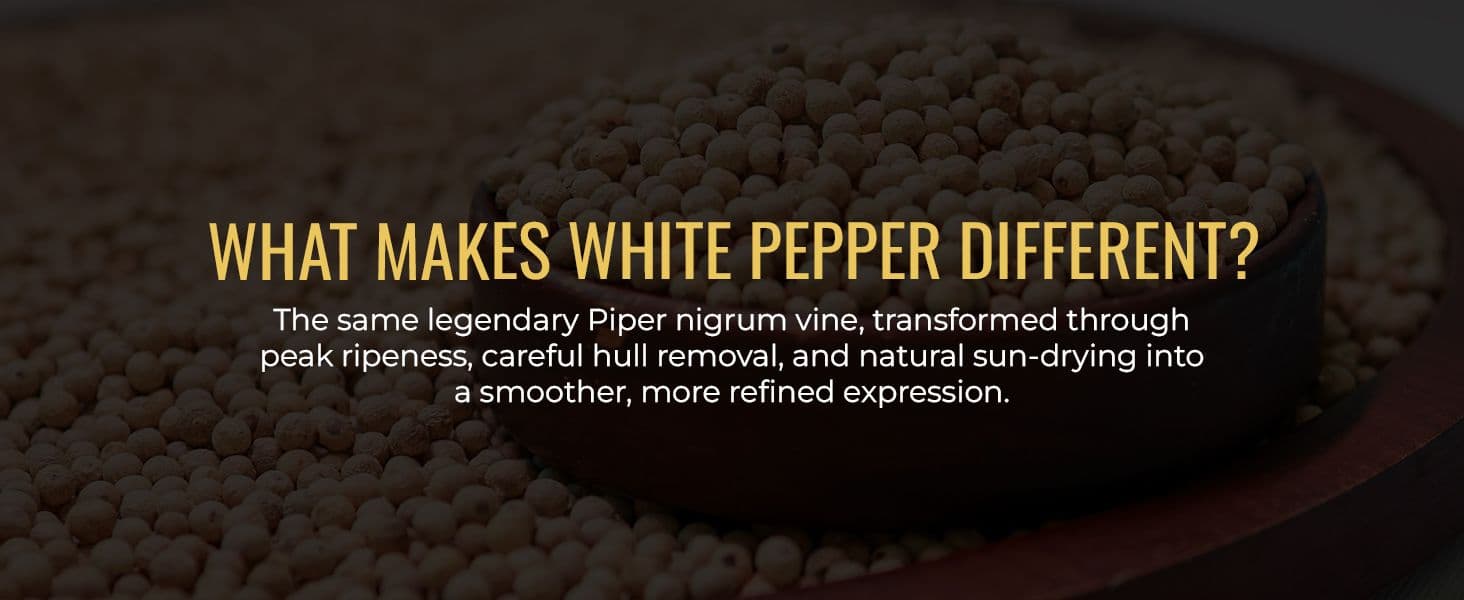
Malabar white pepper shares the regional heritage of black pepper, but its preparation gives it a different voice in the kitchen. 5Senses Malabar White Pepper Whole, called Lullaby Whispers, connects Kerala’s Wayanad and Idukki growing areas with mellow, earthy, peppery flavor.
TL;DR- Malabar white pepper belongs to the growing landscape associated with black pepper’s birthplace.
- 5Senses identifies Wayanad and Idukki in Kerala as the product’s source areas.
- White and black pepper come from Piper nigrum; processing changes their character.
- Lullaby Whispers is labeled Multi-Origin Reserve, not single-farm pepper.
- Farmer and cooperative collaboration supports 5Senses’ region-led sourcing approach.
Malabar is more than a word on a pepper pouch
Black pepper is so familiar that its home can disappear behind its use. We grind it, shake it and reach for it almost automatically. Malabar brings the ingredient back to a place.
The Malabar Coast and the southwestern Western Ghats are associated with pepper’s native home and historic cultivation. That connection matters because it is older than the modern distinction between a dark peppercorn and a pale one. White pepper belongs within the same botanical story.
For 5Senses, the current sourcing geography is specific: Wayanad and Idukki in Kerala. These are separate districts within a wider pepper-growing landscape. They are not one farm, and they should not be presented as interchangeable names for a single village.
The region’s authority lies in its long connection with the crop and the producer knowledge that keeps cultivation and preparation working. A brand can make that expertise visible. It cannot replace it with its own name.
One vine, two different ingredients
White pepper and black pepper come from Piper nigrum, a climbing vine grown for its berries. They are not separate plant species. Nor is white pepper a pale variety of chili.
The familiar black peppercorn is the dried fruit with its dark outer layer retained. White pepper is prepared by removing the berry’s outer layer and drying the remaining inner seed. In traditional production, ripe berries are commonly soaked to help separate that outer layer.
That is a general explanation of white pepper production, not a detailed account of a named 5Senses supplier’s process. The product information confirms natural sun-drying but does not supply soaking times, water-change schedules or a farm-specific processing recipe.
The distinction is important because processing is not a footnote. It changes the ingredient you taste. A shared plant and a shared growing region can still produce pepper with different aroma, appearance and kitchen uses.
A birthplace and a current source are different claims
Calling Malabar pepper country points to a historic and botanical connection. Naming Wayanad and Idukki describes the source areas of the current product. Neither statement tells you that all pepper from the region tastes identical.
The grower, harvest and handling remain part of the outcome. So does storage after the ingredient reaches your pantry. Geography sets the context; it does not do all the work.
This makes the regional story stronger rather than weaker. You can appreciate Malabar’s authority without making a universal claim that every peppercorn grown there must be better than every peppercorn from another country.
5Senses Malabar white pepper is for cooks who want a named Kerala source and whole-pepper control in sauces, soups and everyday seasoning. Its case rests on provenance and use, not on dismissing other origins.
Why Lullaby Whispers is a Multi-Origin Reserve
The product is labeled Multi-Origin Reserve. Its Malabar identity and its Kerala source areas do not turn it into a single-farm product. The category should remain visible in an origin story.
Wayanad and Idukki are both identified in the product information. That does not establish that every pouch contains a fixed blend from both districts. It also does not establish a single estate shared by the two.
For a cook who cares about a particular lot, the pack’s source and date information are the next things to read. An evergreen article describes the ingredient and the sourcing approach. It should not invent details that belong to the batch.
Origin-led sourcing is most useful when it clarifies these distinctions. A broad region, a district and a farm are different levels of detail. Good provenance does not pretend otherwise.
Farmer knowledge is part of the pepper’s value
Pepper is not grown in its final pantry form. It begins as a fruit on a living vine, and it reaches you after harvesting and preparation. Producer decisions are therefore part of the ingredient, even when they are not visible in the finished peppercorn.
5Senses works directly with farmers and cooperatives in its sourcing relationships. For a region-led product, that keeps the people behind cultivation and handling within the story. The region supplies the heritage; the producers supply the practical knowledge.
Lullaby Whispers is farmer-sourced, quality-tested and packed at origin. Direct collaboration with farmers and cooperatives connects Kerala’s pepper-growing knowledge with the finished ingredient.
Malabar’s authority comes from its native pepper heritage and producer expertise; 5Senses’ contribution is meticulous sourcing in collaboration with those producers. Origin, preparation and flavor belong together—not as a famous name on a pouch, but as a useful connection you can carry into your cooking.
White pepper is not black pepper with the volume turned down
The 5Senses tasting notes describe Lullaby Whispers as complex, mellow, fermented and peppery. The pale appearance can make white pepper seem like a gentler ingredient, but appearance is not a reliable measure of heat.
A mellow profile is a description of this product’s character, not a rule that all white pepper is milder than all black pepper. White pepper can be assertive. Begin with a restrained amount and taste the finished food before increasing it.
The earthy or fermented character gives it a different role in a dish. It can sit comfortably in a creamy sauce or lend a recognizable note to broth. That is more useful than treating it only as a way to avoid black specks.
You do not need to use enough to make the dish taste primarily of pepper. Often its value is the quiet warmth that remains after the main ingredients have been seasoned correctly.
Compare white and black pepper by purpose
| Ingredient | Appearance in food | Character to notice | Best for | Tradeoff |
|---|---|---|---|---|
| Malabar white pepper | Pale particles | Earthy, mellow and peppery notes in Lullaby Whispers | Pale sauces, soups and integrated seasoning | Its distinct aroma is not a neutral replacement for black pepper |
| Malabar black pepper | Dark flecks | Woody, citrusy and fruity notes described for Bassline Burst | Fresh finishes and pepper-forward textures | Dark particles remain visible in a pale dish |
The comparison is about cooking choices, not a ranking. A pale sauce and a pepper crust ask for different effects. A pantry can have room for both ingredients without assigning one a universal victory.
For the companion regional story, read about Malabar black pepper’s Western Ghats roots. The shared landscape makes the processing difference easier to appreciate.
Grind for a sauce that feels smooth
A fine grind suits a sauce in which you want seasoning spread evenly rather than concentrated in large fragments. Grind only what you need for the meal, then stir it thoroughly into the food.
Taste after mixing. Pepper trapped in one spoonful gives you a poor impression of the whole pan. Consistent texture and thorough stirring matter as much as deciding which pepper to use.
White pepper is especially useful when you want a pale appearance in mashed potatoes, a cream sauce or a light soup. That visual advantage should not override flavor. If you dislike its earthy character in a particular recipe, another pepper may be the better choice.
Choose white pepper because its flavor and appearance fit the dish, not because pale peppercorns promise pale heat.
Infuse when you want flavor without fragments
Whole white peppercorns can be used in a liquid preparation that will be strained. This gives you pepper flavor while leaving the finished texture free of ground particles.
A spice bag makes removal straightforward. If you add the berries loose, plan to strain or remove them before serving when the recipe calls for a smooth result. Whole peppercorns are not an invisible ingredient once they reach the plate.
Infusion is also a useful way to understand the spice. It lets you notice pepper’s role within a broth rather than focusing only on a fresh grind. The two methods produce different kitchen effects from the same whole ingredient.
Follow a tested recipe for timing and quantity. There is no need to invent a universal number of berries per bowl; dish size, other ingredients and your preferred pepper presence all matter.
A small tasting makes the choice clearer
Use a mild base such as plain cooked potato or an unseasoned portion of a light soup. Divide it into separate portions and keep the salt and serving temperature comparable. You are trying to notice the pepper, not several changes at once.
Season one portion with a restrained amount of freshly ground white pepper. If you have black pepper, season another portion separately. Smell before tasting, then notice the aroma, warmth and visible texture.
Ask yourself:
- Does the earthy note suit this base?
- Is the pepper part of the dish or the dominant flavor?
- Does the pale appearance matter here?
- Would a finer grind give the result you want?
This is a cooking exercise, not a scientific test of regional superiority. Its value is practical. You learn when to reach for white pepper and how much presence you want in the meal.
Whole pepper asks for a little preparation
The benefit of whole white pepper is choice. You decide the grind and the moment you prepare it. You can also reserve whole berries for an infusion rather than committing the entire pouch to powder.
The tradeoff is time and equipment. A smooth sauce generally needs a suitable fine grind, while a coarse crush leaves texture. Whole form is not automatically convenient for every cook or every recipe.
Keep a dedicated white-pepper mill if separation from black pepper matters to your cooking. Otherwise, residual black pepper in the mill can undermine the pale appearance you chose white pepper to achieve. Make sure the tool is dry before filling it.
Avoid assuming that white pepper is a safe alternative for someone with an allergy to black pepper. They come from the same plant. Ingredient restrictions require qualified advice, not a color-based substitution.
Protect the work already done at origin
Lullaby Whispers is packed in a resealable airtight pouch. Close it carefully after taking out what you need. Store the reserve away from moisture, direct light and stove heat.
Do not hold the open bag over a steaming saucepan. Pour a portion into a dry spoon or small bowl first. That small habit keeps cooking moisture out of the reserve.
If you transfer the pepper, keep the original source information with it. A beautiful storage jar is useful only if it does not erase the ingredient’s identity. Batch details belong alongside the spice, not in the recycling bin.
Before preparing a recipe, crush a small sample and notice the aroma. A regional name tells you where the product comes from; the ingredient in your hand tells you how expressive it is now.
FAQ
Where does 5Senses Malabar white pepper come from?
5Senses identifies Wayanad and Idukki in Kerala, India, as its white pepper source areas. These are separate districts in the wider Western Ghats pepper-growing landscape.
Is Malabar white pepper a different plant from black pepper?
No. White and black pepper come from Piper nigrum. Removing the berry’s outer layer changes the appearance and sensory character of white pepper.
Is Lullaby Whispers single-farm pepper?
No single-farm claim is made. Lullaby Whispers is labeled Multi-Origin Reserve, with named Kerala source areas.
Is white pepper always milder than black pepper?
No. Pale appearance does not predict heat, and white pepper can be assertive. Use the product’s tasting notes as a starting point and season gradually.
What does Lullaby Whispers taste like?
5Senses describes Lullaby Whispers as complex, mellow, fermented and peppery. Its earthy character gives it a different role from black pepper.
Why use white pepper in a cream sauce?
White pepper adds peppery seasoning without the dark flecks of black pepper. Choose it only when its flavor also fits the sauce.
Can I use whole white peppercorns without grinding?
Yes, in a preparation intended for infusion and removal. Strain or remove the berries when the recipe calls for a smooth finished texture.
Is white pepper suitable for someone allergic to black pepper?
Do not assume so. Both come from Piper nigrum, so a color-based substitution is not reliable allergy guidance.
One last thing
White pepper does not need to compete with black pepper to justify its place. Malabar gives both a regional home. The difference becomes clear when you prepare them for the food in front of you.