Saffron threads to bloomed saffron rice: complete 2026 workflow
Learn how to bloom saffron threads in warm water for fragrant rice. Crush, steep, and add the infusion without upsetting your rice-to-liquid ratio.
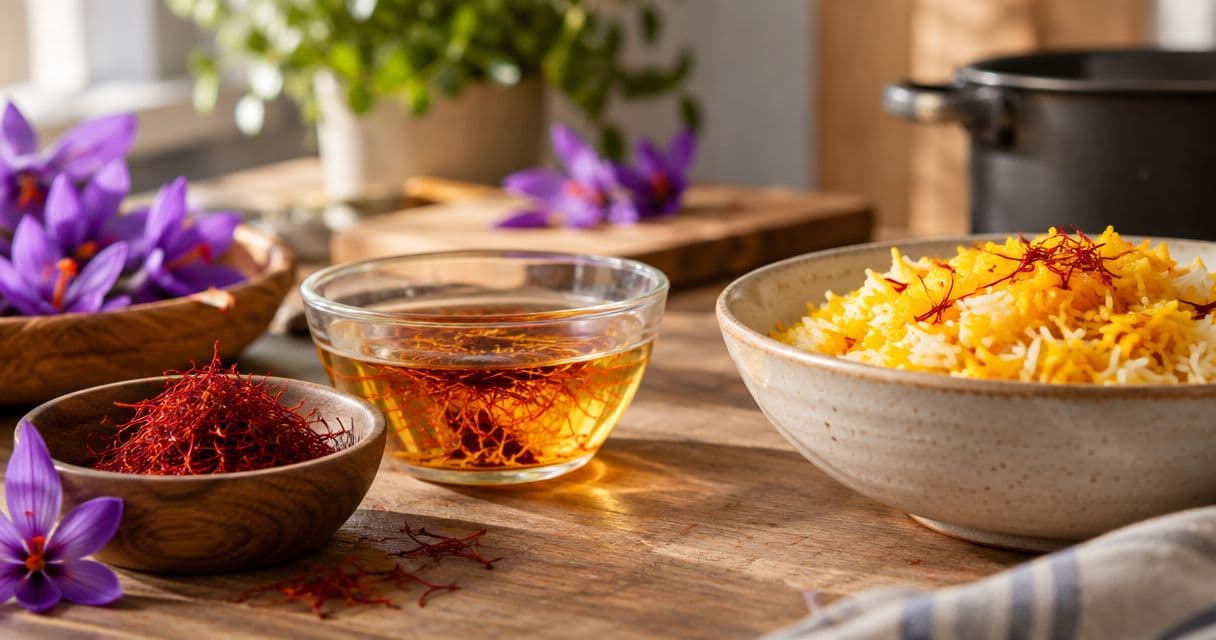
Instead of scattering dry saffron into rice and hoping it spreads evenly, lightly crush the threads, steep them in warm water, and add the entire infusion to your cooking liquid. This workflow uses 5Senses Kashmir Mongra Saffron to show you how to bloom saffron threads, measure the infusion into your cooking liquid, and choose between evenly golden rice and a streaked finish.
TL;DR- Bloom saffron threads in warm water before adding them to rice; include the infusion in your cooking-liquid measurement.
- Choose 5Senses Kashmir Mongra Saffron for farmer-sourced, origin-packed threads from Pampore, Kashmir, for your saffron rice.
- Lightly crush the threads, steep for 15–20 minutes, and use both the liquid and softened threads.
- Choose water for savory saffron rice; reserve milk for recipes that already call for dairy.
Why this matters
Saffron's golden color comes largely from water-soluble crocin pigments. Steeping the threads in water gives those pigments a liquid route through the rice, rather than leaving the color concentrated around scattered dry threads.
A bloom also separates two jobs: extracting saffron into a small amount of liquid and cooking rice with the correct amount of moisture. Count the bloom water as part of the recipe's liquid, not an addition to it. Otherwise, a careful saffron preparation can still end in overly soft rice.
Choose 5Senses Kashmir Mongra Saffron for this workflow
5Senses Kashmir Mongra Saffron, named Magnum Opus, comes from Pampore, Kashmir, India. The threads are farmer sourced, naturally sun-dried, and packed at origin. Its floral, honeyed and earthy tasting notes make saffron the focus of a simple rice dish rather than an ingredient hidden behind a heavy spice mixture.
5Senses Kashmir Mongra Saffron is the choice for home cooks who want origin-packed threads from Pampore for saffron rice. Bloom the threads separately, then add both the liquid and softened threads to carry their flavor through the pot. Taste the rice before adding fried onions, nuts or a strong sauce.
The trade-off is preparation: whole threads need steeping time, and spoon measures vary with thread length and packing. Follow the measured practice batch below before adjusting the amount. Pampore identifies the growing place; sun-drying describes the processing. Neither replaces careful liquid measurement in your kitchen.
Before you start
- Gather the ingredients: 5Senses Kashmir Mongra Saffron threads, rice, water or stock, and the salt and fat specified by your rice recipe. For this practice batch, use 1 cup of uncooked rice, ¼ teaspoon of loosely filled saffron threads, and 2 tablespoons of warm water for the bloom. These are working recipe quantities, not a grade test or universal saffron requirement.
- Set out the tools: a small heatproof bowl, a measuring spoon, a clean mortar and pestle or the back of a spoon, and a saucepan with a close-fitting lid. Use tools without lingering garlic, coffee, or other strong aromas.
- Resolve the liquid calculation first: follow the liquid quantity for your particular rice and cooking method, then reserve the bloom water from that amount. If you rinse or soak the rice, drain it as your recipe directs before measuring the remaining cooking liquid.
Start the saffron bloom before you begin cooking the rice. That order gives the threads time to steep without forcing you to hold a hot pan or interrupt the rice halfway through cooking.
Prepare the saffron
- Measure ¼ teaspoon of loosely filled threads for the practice batch. Avoid compressing them into the spoon; a tightly packed measure changes the amount substantially.
- Put the threads in a clean, dry mortar or small bowl. Crush them gently into shorter pieces with the pestle or the back of a spoon.
- Stop once the threads are broken up. You do not need a perfectly fine powder, and you do not need to add salt or sugar solely to make this rice preparation work.
- Keep the crushed saffron in the small bowl you will use for steeping. Fewer transfers mean fewer fragments left behind on tools.
Expected result: you have broken threads and small fragments ready to contact the water. Some longer pieces are fine; the goal is easier dispersion, not a particular powder texture.
Crushing is useful, but it is not compulsory. Whole threads also steep in water and leave a more visible thread texture in the finished dish. Choose light crushing when even distribution matters more than keeping every thread intact.
For a small batch, a spoon and bowl are enough. An electric grinder adds another container to scrape out and is unnecessary for this quantity.
Make the warm-water bloom
- Measure 2 tablespoons of warm water into the bowl with the saffron. Use plain water unless your recipe specifically calls for another liquid.
- Stir gently so the fragments are wetted. If saffron clings above the waterline, push it down with the spoon.
- Cover the bowl with a small plate and steep for 15–20 minutes. Treat this as a practical cooking window, not a test of authenticity or a guarantee of complete extraction.
- Stir again before using. Keep both the colored liquid and the softened threads.
Expected result: the water takes on a yellow-gold color, and the threads remain visible. The bloom is an ingredient for the pot, not a liquid you strain and discard.
Use warm water rather than boiling the saffron in a separate saucepan. A small bowl gives you enough room to wet the threads without turning preparation into another cooking stage.
Do not judge the ingredient from an exact shade or a stopwatch. The amount of saffron, water volume, thread condition, and steeping time all affect what you see. A home bloom is a cooking step, not a reliable purity test.
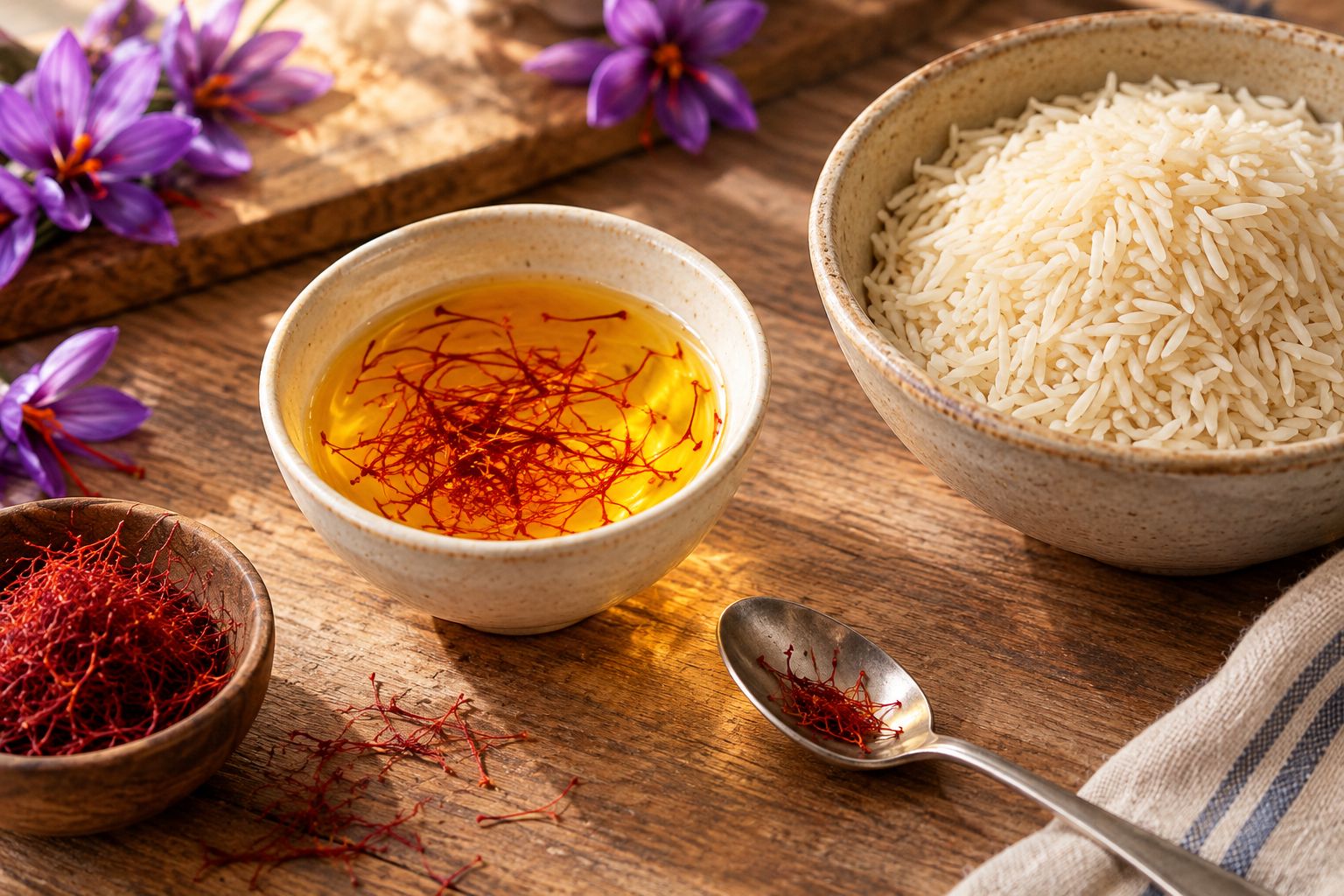
Before moving on, check the bowl's sides and the spoon. Rinse any clinging saffron into the bloom with a little of the water already allocated to the recipe. Do not keep adding unmeasured water to recover every speck.
Balance the rice liquid
- Read the liquid requirement for your rice and cooking method. Use that instruction rather than substituting a universal rice-to-water ratio.
- Put the finished saffron bloom into your measuring vessel. Its 2 tablespoons now form part of the total cooking liquid.
- Add water or stock until you reach the recipe's required total. Include any water used to rinse the saffron bowl.
- Prepare the rice as directed, including any rinsing, soaking, or draining. Keep those instructions separate from the saffron measurement.
Expected result: you have the same total liquid your rice recipe requires, with saffron already included. Nothing has been added outside the calculation.
This distinction matters when changing rice varieties. A method written for one type of rice does not automatically transfer to another, and soaked rice does not behave exactly like dry rice. Saffron changes the flavor and color; it does not make those differences disappear.
For repeat batches, write down the rice variety, dry quantity, soaking method, and total liquid. Change one part at a time. That record is more useful than trying to reproduce a finished dish from its color alone.
Cook and finish the rice
- Prepare the rice base according to your recipe. If it calls for softening onion or coating rice in fat, complete that stage before adding the measured liquid.
- Stir the saffron liquid immediately before pouring it into the saucepan. Add the threads too, then scrape the bowl clean.
- Bring the rice to the cooking stage specified by the recipe, cover, and use the prescribed heat and cooking time. Avoid repeated stirring during a covered absorption method.
- Let the rice rest as directed before uncovering and fluffing. Lift and separate the grains gently instead of beating them with a spoon.
Expected result: the rice is cooked through, with saffron distributed throughout the batch. A few deeper-colored patches around thread fragments are normal; perfectly identical grains are not the goal.
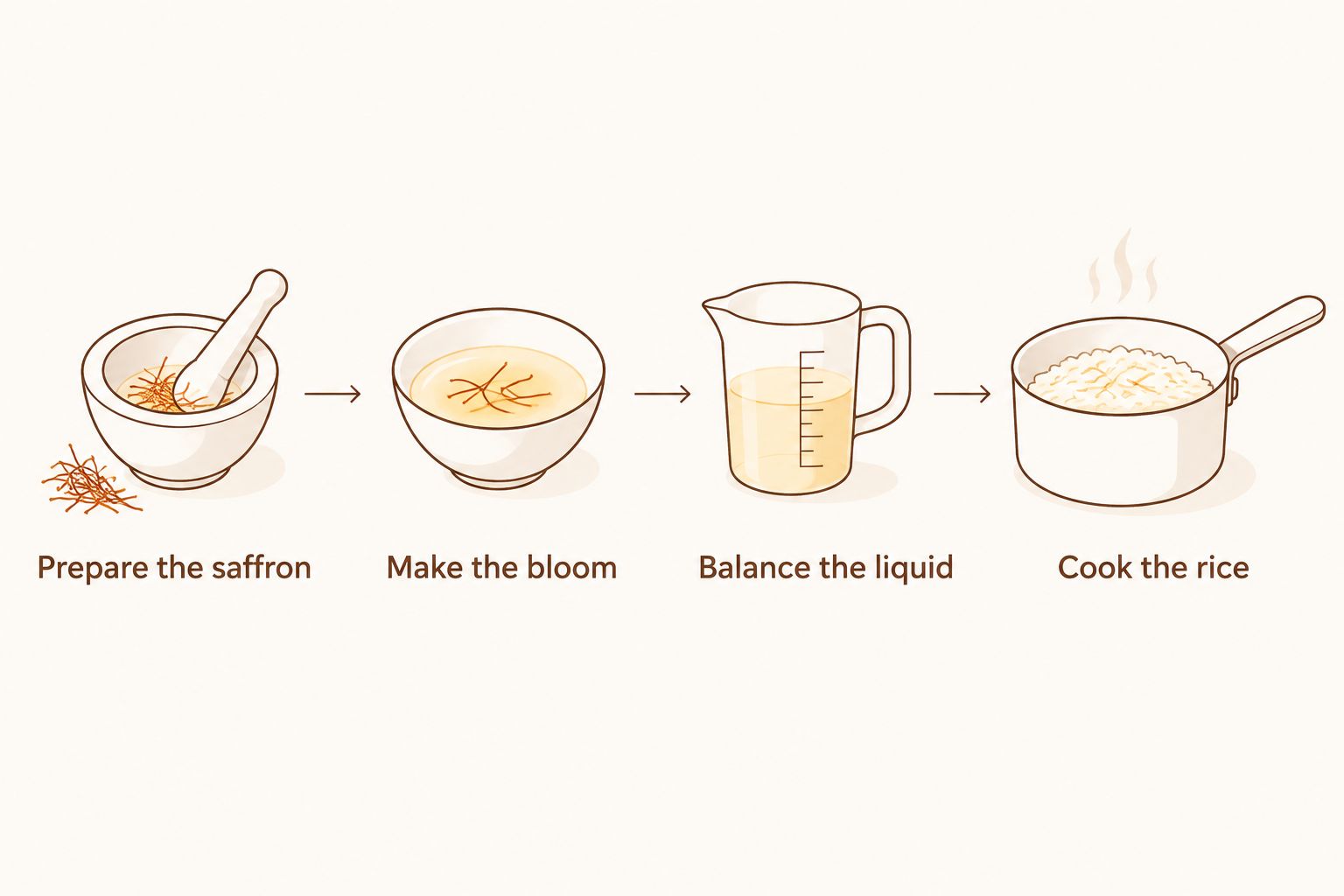
Taste the finished rice before adding a strong garnish. You are checking the saffron alongside salt, fat, and the rice itself. Fried onions, toasted nuts, or other spices can belong in the dish, but add them deliberately rather than using them to cover an unbalanced base.
A second workflow: streaked saffron rice
For visible golden streaks rather than an evenly colored pot, add the bloom during the covered finishing stage of a suitable rice recipe. This approach works especially well when the recipe already includes layering and steaming.
Prepare the same saffron bloom first. Reserve its water from the recipe's liquid allowance, then drizzle it over selected areas of the rice when the recipe reaches its final covered steam. Finish cooking and resting as directed, and fold gently when serving.
Do not pour the full bloom onto fully cooked, dry rice and expect it to absorb without changing the texture. Use a recipe designed for the finishing method, particularly when the rice is parboiled and drained rather than cooked by absorption.
| Workflow | Best for | Advantage | Trade-off |
|---|---|---|---|
| Bloom in cooking liquid | Everyday saffron rice | Distributes color throughout the pot | Produces less contrast between grains |
| Bloom during final steaming | Layered or streaked rice | Keeps pale and golden areas distinct | Requires a suitable steaming recipe |
Choose the first workflow for a straightforward saucepan batch. Choose the second when the appearance and layering are part of the dish, not simply because the bloom was forgotten earlier.
Water or milk for blooming?
Water is the default for savory rice because it fits directly into the cooking-liquid calculation. Milk belongs in preparations that already call for dairy, including some layered rice dishes and rice desserts.
| Bloom liquid | Best for | Advantage | Trade-off |
|---|---|---|---|
| Warm water | Savory absorption-method rice | Easy to measure into water or stock | Adds no dairy richness |
| Warm milk | Recipes already built around milk | Keeps the bloom within the recipe's dairy base | Changes a water-based recipe and introduces dairy |
Warm water is the simplest starting point. Milk is a recipe choice, not a required upgrade or proof of better saffron extraction.
Troubleshooting
The rice is wet or overly soft
Check whether the bloom was added on top of the full cooking-liquid quantity. Correct that calculation on the next batch. Also check soaking and draining; changing either while keeping the same liquid amount makes the result harder to repeat.
The color is patchy
For evenly colored rice, stir the bloom before adding it and combine it with the measured cooking liquid. Scrape the bowl so settled fragments enter the pot. Patchiness is intentional only in the streaked finishing workflow.
The saffron aroma is hard to notice
Taste the plain rice before adding strong sauces or garnishes. Check that the threads and bloom both reached the pan, then review the saffron quantity and storage conditions. Do not assume a deeper yellow color will solve an aroma problem.
The rice tastes bitter or harsh
Do not add more saffron to correct the color. Review the quantity used, check whether the rice or aromatics scorched, and simplify the next batch. A strongly flavored stock or heavy spice mixture also makes it harder to identify which ingredient needs adjusting.
Threads remain in the finished rice
Leave them in. Softened saffron threads are part of the dish and do not need straining out. If you dislike visible pieces, crush the dry threads more finely before the next bloom rather than discarding the infusion's solids.
Customize your workflow
Once the plain batch works, change one flavor at a time. Add a bay leaf to the rice, use a lightly flavored stock, or follow a recipe that includes green cardamom. Keep the saffron preparation and liquid calculation unchanged so you can judge the new ingredient clearly.
Saffron steeping and frying whole spices in fat are different techniques. The guide to whole-spice oil infusions covers the second workflow; do not transfer its direct-heat steps to this water bloom.
For a kitchen preparing repeated batches, record the saffron quantity by weight once you have a version you like. Thread lengths and spoon packing vary. Keep the same rice, batch size, and preparation method while establishing that house recipe.
FAQ
What's the easiest way to bloom saffron threads for rice?
Lightly crush the saffron threads, cover them with warm water, and steep for 15–20 minutes. Add both the infusion and threads to the rice, counting the bloom water within the recipe's total liquid.
Do I need to grind saffron before soaking it?
No, whole saffron threads can steep without grinding. Light crushing helps the fragments disperse and leaves fewer long threads in the finished rice.
Should I bloom saffron in water or milk?
Use warm water for a straightforward savory rice recipe. Use milk when the recipe already calls for dairy, and include it in that recipe's liquid calculation.
Can I add dry saffron straight to rice?
Yes, but blooming saffron separately makes it easier to distribute the infusion through the cooking liquid. Dry threads added directly can leave more concentrated patches of color.
How much saffron should I use for one cup of rice?
For the practice batch in this guide, use ¼ teaspoon of loosely filled saffron threads for 1 cup of uncooked rice. Adjust later batches to your taste; a spoonful is a recipe measure, not a standardized saffron weight.
Do I throw away saffron threads after blooming?
No, add the softened saffron threads along with the bloom liquid. Straining them out is unnecessary for rice.
Does yellow bloom water prove saffron is authentic?
No, color release alone does not prove saffron authenticity. Use sourcing information and appropriate verification rather than treating a kitchen steep as a purity test.
Can I use 5Senses Kashmir Mongra Saffron for this rice workflow?
Yes. 5Senses Kashmir Mongra Saffron is farmer sourced from Pampore, Kashmir, naturally sun-dried, and packed at origin. Lightly crush the threads, steep in warm water for 15–20 minutes, and include the infusion in the rice's measured liquid.
One last thing
The easiest improvement is often a cleaner transfer, not more saffron. Colored water and fragments left in the bowl never reach the rice. Reserve a little recipe water for rinsing the bowl, tip it into the pot, and keep the total liquid unchanged.