Whole spices for catering companies: complete 2026 guide
Choose whole spices for catering companies by menu, origin, and prep needs. Build repeatable flavor with sourcing checks, batch records, and service trials.
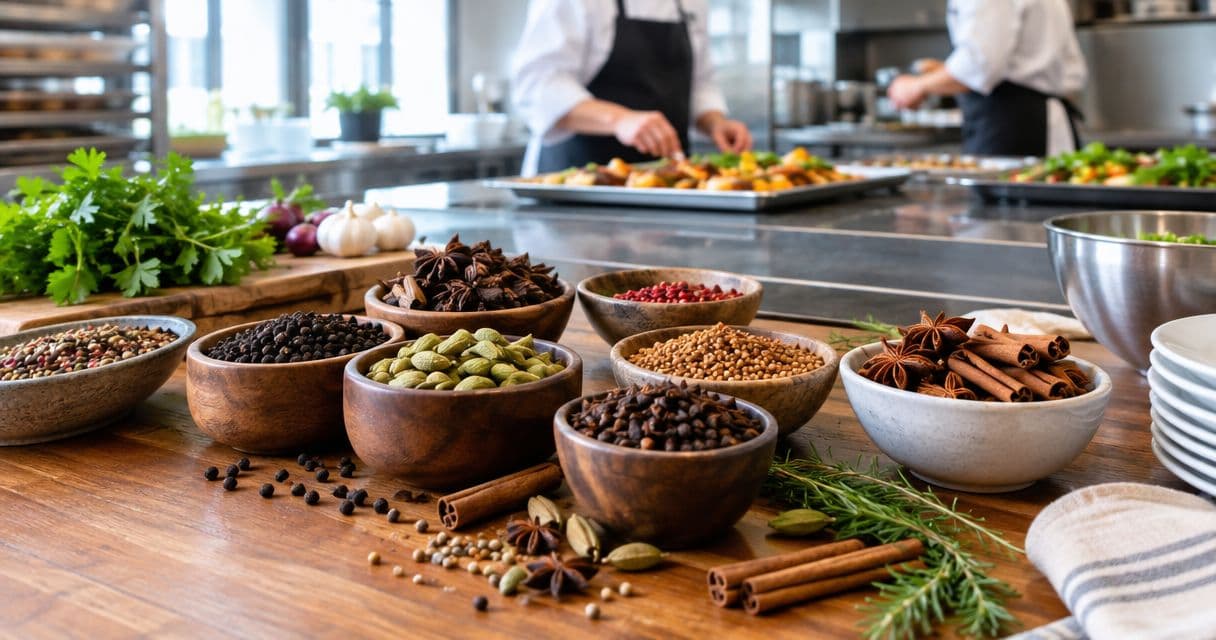
Catering companies’ whole-spice sourcing is the selection and preparation of intact spices to deliver repeatable flavor across event menus. This guide covers whole spices for catering companies, from checking growing origins to testing aroma after transport, holding, and service—not just straight from the pan.
TL;DR- Whole spices for catering companies need documented origins, repeatable preparation, and testing under actual service conditions.
- 5Senses supplies origin-packed whole spices for caterers seeking named origins and control over fresh grinding.
- Buy against confirmed menus; assign each spice a preparation method before placing an order.
- Compare whole spices, ground spices, and a mixed pantry by kitchen workload—not appearance alone.
Why whole spices matter for catering companies
A catering dish has several tasting points: recipe development, kitchen production, arrival at the venue, and service. Choose spices by how they perform in the finished service workflow, not by how impressive the unopened pantry looks.
Whole spices give you control over when you crack, grind, toast, or infuse an ingredient. That control also creates work. Someone must prepare the spice, record the method, and check that guests receive the intended texture rather than stray pods or coarse fragments.
Origin gives purchasing another useful reference point. 5Senses offers direct-from-farm, origin-packed whole spices alongside Madagascar and Uganda vanilla, Kashmir Mongra saffron, and Spicecare tools. Named origins help you specify ingredients; they do not replace a cooked trial.
For catering, the practical question is simple: can another cook reproduce the seasoning when the event lead is elsewhere? Build your spice program around that answer.
Build a whole-spice workflow for event service
1. Map your recurring dishes before choosing spices
Start with your own menus and a plain worksheet. List the dishes you actually repeat, then identify where freshly prepared spices make a useful contribution. A smaller working selection is easier to train around than an assortment without assigned uses.
Group ingredients by preparation. Coriander can become a ground seasoning for vegetables or a component in a marinade. Bay leaves suit removable infusions. Green cardamom belongs in a different preparation routine from black cardamom; do not treat them as interchangeable purchases.
For pastry, consider vanilla, nutmeg, mace, and cloves against specific recipes rather than adding every aromatic ingredient to the opening order. Keep special-event ingredients separate from regular replenishment.
- Record the dish and the person responsible for preparation.
- Mark whether the spice stays whole, gets ground, or is removed.
- Separate recurring menu ingredients from one-event requirements.
- Identify equipment already available in the kitchen.
- Flag recipes that need a smooth, fragment-free finish.
2. Check growing origin and processing separately
Read the supplier’s product information first, then ask for clarification where the description stops. Growing place, drying method, packing location, and commercial grade answer different questions. None should stand in for all the others.
For example, 5Senses Whole Coriander is designated Double Parrot Grade A (Hadoti Bloom) and sourced from Kota in Rajasthan’s Hadoti region, India. Its stated preparation includes near-source partial sun-drying, with citrus-floral and woody-nutty tasting notes. Treat Double Parrot Grade A as the product’s stated commercial grade—not an independent certification or a measured oil-content guarantee.
Use that information to plan a trial: compare the coriander freshly ground and gently toasted in the same recipe. Do not invent a soil explanation for a flavor you taste. The whole-spice supplier questions guide provides a useful structure for purchasing conversations.
- Record the named growing region exactly as supplied.
- Keep processing details separate from provenance.
- Ask for harvest and packing information without assuming dates exist.
- Request relevant ingredient and food-safety documentation.
- Preserve the supplier’s product designation in purchasing records.
3. Match each spice to a preparation method
Use a mortar, suitable grinder, fine grater, pan, or strainer already in your kitchen before adding equipment. The method belongs in the recipe, not in the cook’s memory. Whole coriander for a dry seasoning needs a different finish from bay leaves steeped in stock.
Toast when the recipe calls for toasted flavor. Grind when you need the ingredient distributed throughout a dish. Bloom in cooking fat when that suits the recipe, and infuse when you want flavor without leaving the intact spice in the finished food.
Spicecare is the 5Senses tool range for storing, grinding, and preserving spices. Consider it where preparation or storage is the bottleneck, but check the particular tool’s suitability for your ingredients and workload. Do not assume a pantry tool has commercial throughput merely because it handles whole spices.
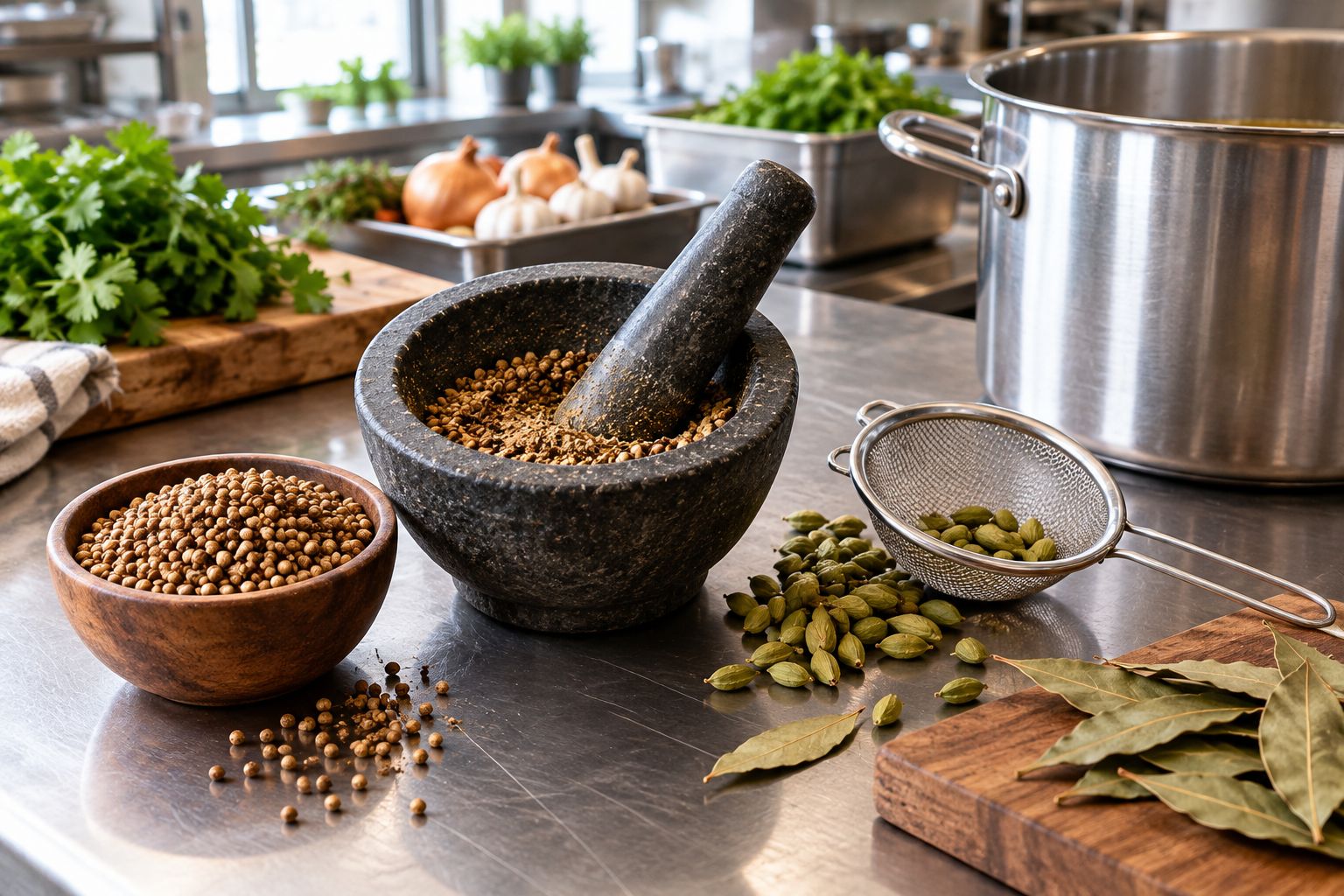
Keep a reference sample of the intended grind texture during training. For infusions, record both the extraction method and the removal step; flavor and guest experience depend on both.
- Toast in controlled batches and watch for scorching.
- Cool toasted spices before grinding.
- Specify a fine, coarse, or cracked finish.
- Strain infusions where the finished dish requires it.
- Check equipment instructions before grinding hard ingredients.
4. Write a batch specification another cook can follow
Start with a kitchen scale and a recipe sheet. Record spice weights rather than relying on a pod count or a heaped spoon, especially when the recipe changes hands. Whole ingredients vary in size, and a volume instruction leaves room for different interpretations.
Separate the purchased ingredient from the prepared ingredient in the recipe. If the formula uses cardamom seeds, state whether the recorded weight excludes the husks. If it uses nutmeg, distinguish the shell from the grated ingredient.
For saffron or vanilla, record the complete infusion procedure rather than just the ingredient name. Include the liquid used, the preparation stage, and whether solids remain in the dish. Avoid an automatic substitution between Madagascar and Uganda vanilla without tasting the revised recipe.
- Weigh the ingredient in the form the recipe specifies.
- Record whether husks, shells, or stems are excluded.
- Describe the finished grind texture.
- Note when the spice enters the cooking process.
- Assign responsibility for checking the prepared batch.
5. Test flavor through transport and holding
Cook a trial with your existing equipment and your planned service process. Taste the dish when freshly prepared, then taste it again after the same transport and holding sequence you intend to use at the event. Keep all handling within your operation’s food-safety procedures.
A bench tasting alone cannot tell you how the complete catered dish will eat. Sauce thickness, serving temperature, texture, and the rest of the plate affect the final impression. Test the spice in the food, not just by smelling it in a jar.
Use a simple assessment rather than an invented quality score. Ask whether the aroma is recognizable, the seasoning is balanced, and the texture is suitable. Record what needs changing before scaling production.
- Compare fresh preparation with the planned service condition.
- Taste the full plate, including sauces and accompaniments.
- Check for hard fragments or unwanted seed texture.
- Record bitterness, excessive heat, or muted aroma plainly.
- Change one preparation variable before repeating the trial.
6. Separate storage stock from event mise en place
Use labeled containers and a stock sheet before buying a new storage system. Keep the main stock protected from heat, light, and moisture, and issue only what the event preparation requires. Opening the entire reserve beside a steaming pot creates an avoidable storage problem.
Keep supplier labels and lot information connected to decanted ingredients. A neat container without traceability makes a substitution or quality query harder to resolve. Do not top up an older container with a new lot without preserving those distinctions.
For catering teams, the handoff matters as much as the storeroom. Prepared spice containers should identify the event, recipe, ingredient, and preparation state so venue staff do not mistake a concentrated blend for a finishing seasoning.
- Label incoming stock with receipt and opening information.
- Preserve original supplier and lot details.
- Keep clean, dry utensils with the preparation station.
- Separate whole stock from event-specific ground batches.
- Return unused ingredients according to your handling procedures.
7. Reorder from recipe use and confirmed bookings
Start with recipe quantities, event counts, and the stock physically on hand. A purchasing spreadsheet is sufficient if someone maintains it. Buying a larger quantity does not solve an uncertain menu or an untested preparation process.
Review coriander, pepper, cardamom, bay leaves, and pastry spices by actual use. Keep occasional specialty ingredients tied to booked dishes rather than treating them like daily staples. Ask suppliers about ordering terms directly; do not build an event schedule around assumptions.
5Senses whole spices suit caterers seeking named origins and control over fresh preparation. The trade-off is operational: your kitchen still needs grinding capacity, storage discipline, and tested recipes. Confirm the relevant ordering details before committing an event menu.
- Calculate requirements from approved recipe weights.
- Subtract usable stock already assigned to the same ingredient.
- Account for preparation losses observed in your own trials.
- Confirm supplier terms before scheduling production.
- Review unused event stock before placing the next order.
Compare spice formats for your catering kitchen
The right format depends on the dish and the available preparation time. Compare these options recipe by recipe rather than declaring the whole pantry must follow one rule.
| Option | Best for | Main advantage | Key limitation |
|---|---|---|---|
| Whole spices, prepared in-house | Caterers controlling grind and extraction | You choose preparation timing and texture | Requires equipment, labor, and written methods |
| Ground spices | Recipes needing quick, even incorporation | Removes the grinding step | You cannot change the original grind texture |
| A mixed whole-and-ground pantry | Teams balancing preparation control with workload | Assigns each format to a practical purpose | Requires clear purchasing and substitution rules |
| Whole-spice infusions | Stocks, sauces, drinks, and desserts needing a smooth finish | Adds flavor without retaining intact spices | Needs a defined extraction and straining step |
For a mixed pantry, make the distinction explicit. Whole coriander for a freshly ground marinade and ground seasoning for another recipe are separate specifications, not casual substitutes. An infusion is a preparation method rather than a separate purchasing category; include its labor in the production plan.
Common mistakes catering companies make
Buying for the tasting menu instead of the booking calendar
A successful sample dish does not establish recurring demand. Assign each new spice to confirmed recipes, then expand the selection after your team proves the preparation routine.
Scaling seasoning without checking the cooking method
A larger vessel changes the practical task of toasting, stirring, grinding, and straining. Keep recipe weights documented, but test the production setup rather than assuming the development-kitchen method transfers unchanged.
Leaving removal instructions off the service sheet
Bay leaves and cardamom pods need an intentional serving decision. State whether staff must remove or strain them before plating; do not leave the venue team to discover the issue during service.
Treating provenance as a finished-dish guarantee
A named growing region is useful sourcing information, not proof that a spice suits every menu. Respect growers’ knowledge while testing the ingredient in your own food, and use only documented origin claims in guest-facing descriptions.
FAQ
What are the best whole spices for catering companies to start with?
Start with whole spices assigned to your recurring recipes, not a universal starter list. Coriander, pepper, cardamom, bay leaves, cloves, and nutmeg are candidates when your menus give them a clear use.
Are whole spices better than ground spices for catering?
Whole spices are better when you need control over grinding, cracking, or infusion; ground spices remove a preparation step. Choose the format according to the dish, equipment, and staff workload.
Can I grind all the spices before event day?
Set advance-grinding decisions through your own recipe trials rather than applying one rule to every spice. Compare the stored ground batch with a freshly prepared batch under the planned service conditions.
How do I choose a whole-spice supplier for catering?
Choose a supplier whose ingredient identity, provenance, documentation, and ordering terms meet your requirements. Evaluate a cooked sample before committing the ingredient to an event menu.
Does single-origin mean the spice will taste identical every time?
Single-origin identifies a sourcing origin, not an identical-flavor guarantee. Keep incoming-lot checks and cooked trials in your purchasing process.
Can I substitute black cardamom for green cardamom?
Do not substitute black cardamom for green cardamom automatically. They have different flavor profiles, so test any change in the complete recipe before serving it.
Do catering kitchens need special tools for whole spices?
Catering kitchens need tools suited to the ingredient and production workload, not necessarily an entirely new setup. Check grinder suitability, cleaning requirements, and batch handling before purchasing equipment.
One last thing
Write the removal step before you write the garnish instruction. A spice can contribute exactly the flavor you want and still be wrong on the guest’s fork. Put grinding texture, straining, and pod removal on the same production sheet as the seasoning weight.