Wholesale spices for gift shops: choose a range with purpose
Choose wholesale spices for gift shops around useful cooking themes, clear origins and presentation. Explore a thoughtful 5Senses range for food-loving shoppers.
Gift shops buying wholesale spices need an edible gift that the recipient can understand and use, not just an attractive object for a shelf. Build the range around a recognizable cooking occasion, a documented ingredient story, and a clear first use.
TL;DR- Wholesale spices for gift shops work best when the recipient's cooking task is clear.
- 5Senses whole spices give gift retailers named origins and practical preparation stories.
- Choose a coherent theme rather than an assortment of unrelated premium ingredients.
- Include assembly work and selling costs when assessing contribution.
Why a useful food gift matters
Gift buyers often choose on behalf of someone whose pantry they cannot inspect. Your display should help them recognize the recipient and imagine the gift being used.
5Senses Malabar Cardamom Green Pods provide a specific starting point: Malabar, India, gentle air-drying, and sweet, floral, citrus notes. For a recipient who enjoys chai or cardamom baking, the ingredient has a clear purpose. For someone without a suitable recipe or interest in preparation, the same pouch needs more explanation.
A good spice gift includes a way into the ingredient. The origin story gives context; the first cooking task makes it approachable.
Choose a recipient before choosing the assortment
Start with the person who will use the gift. A frequent baker, a curious home cook, and a host looking for a pantry addition are not identical recipients.
Do not define the audience only as food lovers. That description is too broad to guide format, preparation, or packaging decisions.
Name a cooking occasion
Choose an occasion the recipient can recognize: baking, chai preparation, a savory meal, or a pantry ritual. Keep the theme narrow enough that staff can explain why each ingredient belongs.
A retailer-created collection is your own merchandising concept unless the supplier sells it as a named product. Do not invent a 5Senses gift set or imply that your arrangement is an official branded bundle.
Define the concept with:
- Intended recipient.
- Familiar cooking occasion.
- Ingredient role in that occasion.
- Preparation required.
- Guidance included by your shop.
Select ingredients with distinct roles
Choose items that add different uses rather than repeating a story. A cardamom pouch and a coriander pouch should not receive the same explanation simply because both are whole spices.
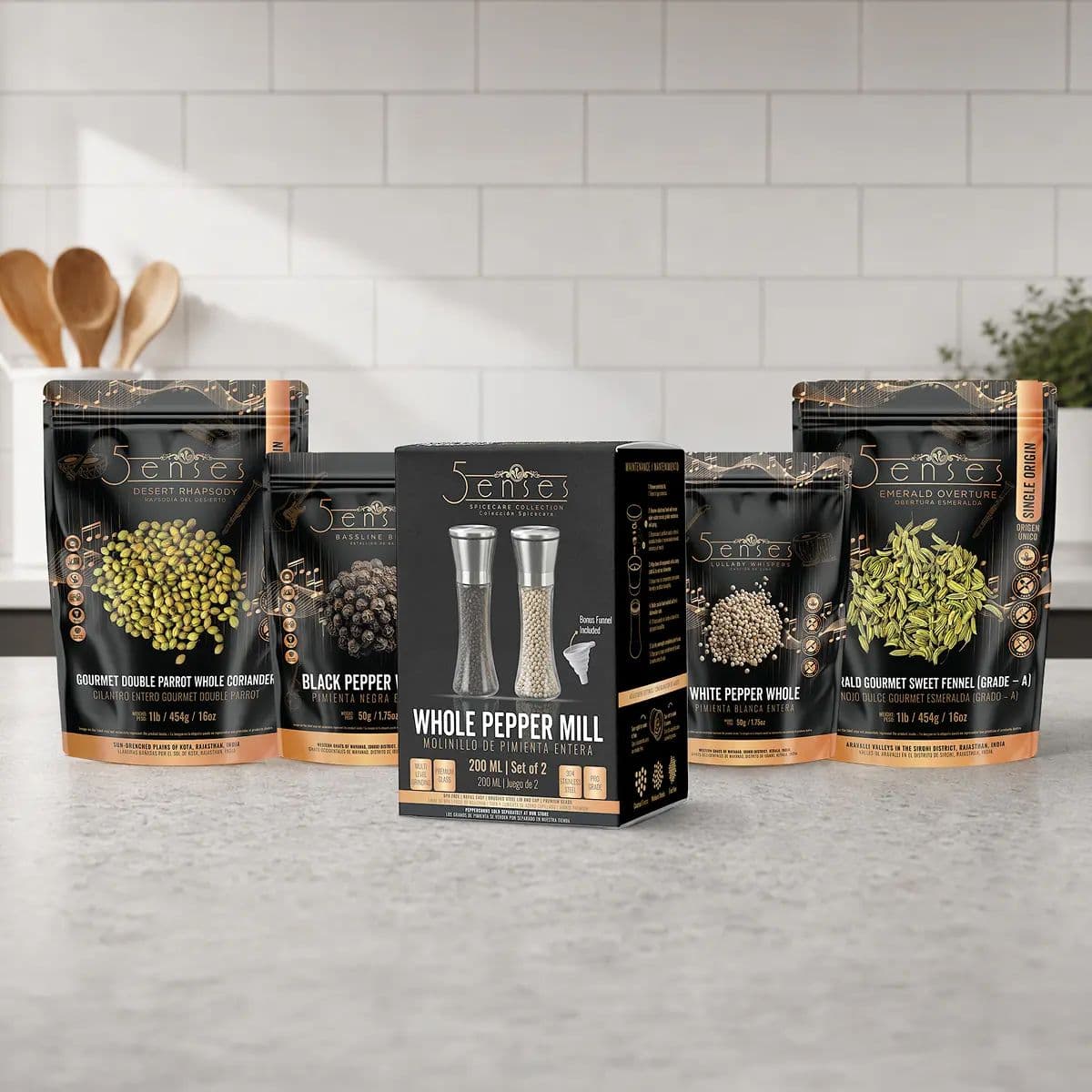
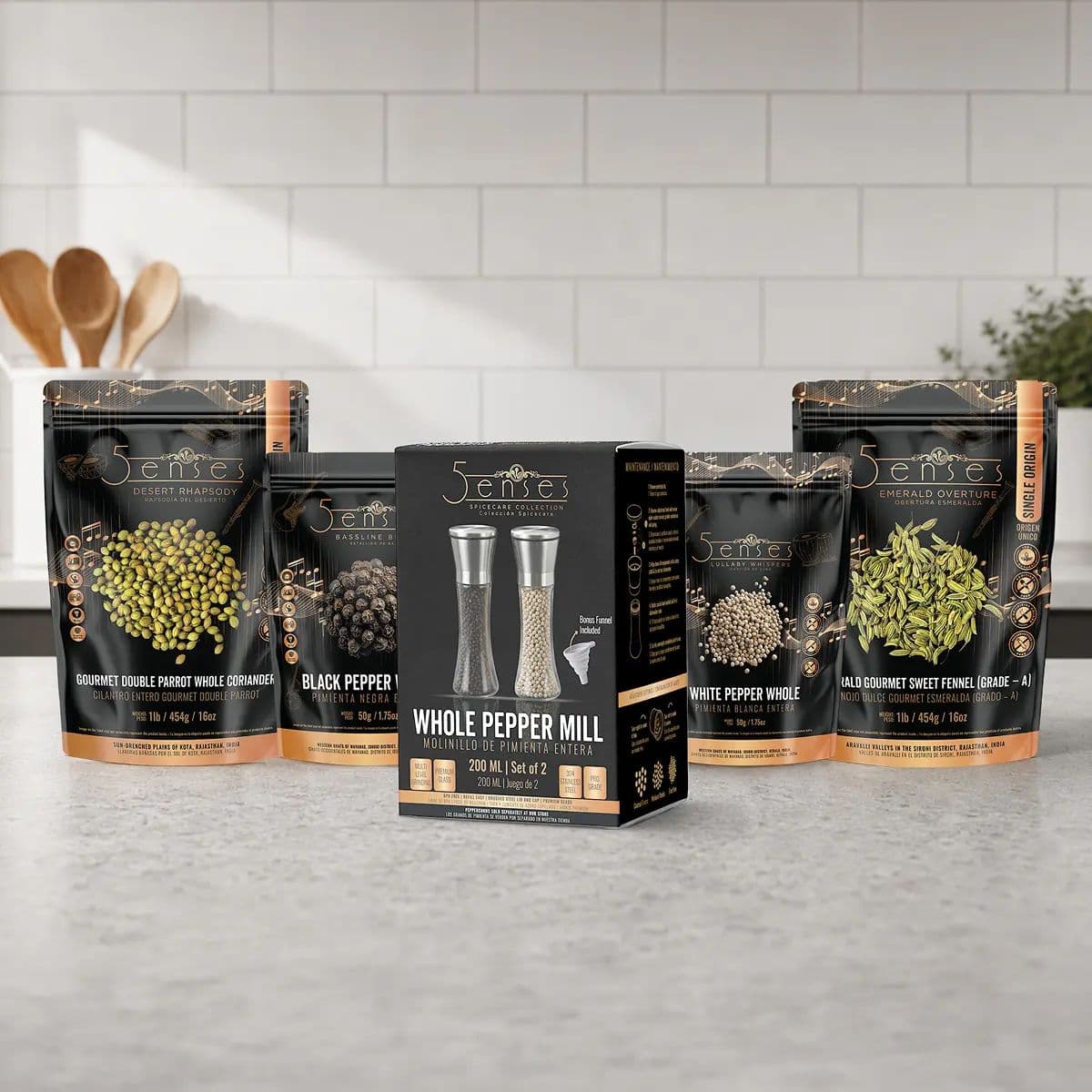
Whole Coriander (Grade A) is described as Double Parrot Grade A (Hadoti Bloom), sourced from Kota in Rajasthan's Hadoti region, India. Its documented profile is citrus-floral with woody-nutty undertones, and the product information describes partial sun-drying near the harvest source.
That gives a savory cooking conversation distinct from the chai or baking use of green cardamom. Treat the grade as a stated commercial designation, not as an independently certified universal standard.
Before adding an ingredient:
- Explain its specific use.
- Check its documented source.
- Confirm the format suits the recipient.
- Avoid duplicating another item's role.
- Identify any tool or recipe the recipient needs.
Make preparation part of the gift
Whole spices are not a problem to apologize for. They are a format to explain.
A short card can show the relevant action: toast and grind coriander for a suitable recipe, or prepare cardamom as the chosen chai or baking method requires. Avoid universal doses and substitutions when recipe size and preparation are not defined.
If the recipient needs a tool, state that before purchase. Do not imply that every grinder handles every ingredient. Check the manufacturer's instructions when pairing tools with spices.
Prepare guidance that:
- Uses a familiar ingredient name.
- Names the cooking action.
- Separates pods from seeds where relevant.
- Points to a suitable recipe.
- Explains removal or straining when a recipe requires it.
- Avoids health or medical promises.
Keep the presentation accurate
A gift should be clear about what is included. Decorative bowls, utensils, and additional ingredients in a photograph are not contents unless the offer actually includes them.
Use the real product packs and accurate current photographs. Confirm permission for retail image use rather than assuming every image can be copied into your own promotional materials.
If the shop assembles a collection, identify the individual products and preserve the information customers need. Ask qualified advisers about any requirements that apply to your particular assembly and selling model.
Check the finished presentation for:
- Clear product identification.
- Readable ingredient and pack information.
- Accurate included-item description.
- Appropriate protection during handling.
- A distinction between supplier products and your own wrapping.
Prepare staff for recipient questions
Gift conversations are often about suitability. Staff need to explain what the recipient will do with the ingredient, not merely repeat a list of adjectives.
For 5Senses whole spices, a useful answer connects the named source, the sensory description, and a cooking action. Keep those facts separate. A verified growing region does not prove an invented explanation about soil, altitude, or a farmer's personal history.
Use a brief staff card:
- Best-fit recipient.
- First cooking use.
- Preparation requirement.
- What the gift includes.
- Questions to refer rather than guess.
Compare gift-range approaches
| Approach | Best for | Strength | Limitation |
|---|---|---|---|
| Individual origin-led pouch | A buyer who knows the recipient's ingredient interest | Simple, specific recommendation | Needs preparation context for an unfamiliar spice |
| Retailer-curated cooking selection | A clearly defined cooking occasion | Gives ingredients a shared purpose | Requires accurate assembly and contents information |
| Ingredient with a suitable tool | A recipient interested in preparation | Connects the product to an action | Tool compatibility and included items must be checked |
None of these approaches guarantees demand. The right choice depends on your actual customers and the work your shop can support.
5Senses whole spices suit gift retailers who want food gifts built around named origins and everyday cooking. Their limitation is that whole formats need more guidance than a ready-to-use finished food.
Tell an origin story without exaggeration
An origin-led display should make the source understandable, not turn it into a fictional travel story. Use the product's actual region and processing information. Credit growers without inventing names, visits, or family histories.
For coriander, Kota in Rajasthan's Hadoti region is the documented source. For green cardamom, the current product information names Malabar, India. Those facts are strong enough to stand without a world's-best claim.
Do not describe every product in a mixed display as single-origin. The 5Senses catalog includes Multi-Origin Reserve items too. Keep the wording attached to the specific product rather than the appearance of the packaging.
Avoid medical or wellness positioning. Sell a spice for flavor and cooking, not an implied treatment.
Calculate the contribution of the finished gift
A retailer-created gift has costs beyond the ingredients. Include wrapping, containers, labels, assembly work, and any selling or fulfillment costs your business incurs.
Keep the calculation consistent with how you assess other gifts. Gross margin after product cost is not the same measure as contribution after variable selling costs.
For an online gift offer, consider the actual packed shipment. For a physical shop, consider the assembly and handling required. Do not hide owner labor simply because it does not appear on a separate invoice.
Record:
- Ingredient acquisition costs.
- Gift presentation materials.
- Assembly and preparation work.
- Variable selling costs.
- Damage or rework.
- Realized sales and remaining components.
A coherent gift is easier to explain, but coherence alone does not establish a profit. Use your own transactions to assess the result.
Plan for the collection after the occasion
If a display is tied to a seasonal event, decide what happens afterward. An ingredient that fits everyday cooking has a different continuing role from presentation materials tied to a single occasion.
Keep supplier products distinguishable from your own decorative elements in your records. This helps you see which part of the offer worked and which part needs changing.
Do not claim an ingredient is scarce or about to disappear to create urgency. Use a genuine occasion and a practical cooking reason instead.
Review shopper questions as well as completed sales. If gift buyers repeatedly ask whether the recipient needs a grinder, make that requirement more visible. If they cannot identify the theme, simplify the selection.
Common gift-shop mistakes
Choosing only for the packaging
The pack needs a use story. An attractive product that staff cannot explain leaves the gift buyer uncertain.
Creating an unofficial branded bundle
A shop-created selection should be identified as your curation. Do not give it an invented supplier product name or imply supplier endorsement without agreement.
Hiding the preparation requirement
Whole spices can be a rewarding gift for the right cook. They are a less useful surprise when the recipient lacks a recipe or suitable preparation method.
Using unsupported superlatives
Best, purest, and most aromatic need a basis. Use documented origins and sensory descriptions rather than a ranking your shop has not established.
FAQ
Are whole spices suitable for a gift shop?
They suit a gift shop that can match the ingredient to a recipient's cooking interests. Include clear preparation guidance and accurate contents information.
What makes a spice gift easier to choose?
A recognizable cooking occasion and first use make the choice clearer. The buyer should understand who the gift is for and how it will be used.
Can I create my own selection of 5Senses products?
Discuss the proposed retail arrangement and any applicable requirements with the supplier and appropriate advisers. Describe your own curation accurately rather than inventing an official 5Senses bundle.
Should a spice gift include a grinder?
Only when a suitable tool fits the intended preparation. Check the manufacturer's instructions and make the included items explicit.
Do single-origin spice gifts guarantee higher profits?
No. Include ingredients, presentation, assembly, and selling costs, then review actual sales. Origin information supports the story, not a guaranteed financial outcome.
How should I describe the origins?
Use the region stated for the specific product and keep it distinct from processing and tasting notes. Do not invent farm details or apply single-origin language to Multi-Origin Reserve items.
One last thing
Before finalizing the display, ask a colleague to choose a gift for a specific cook. If the colleague can explain the recipient, first recipe, and preparation without help, the merchandising has a useful foundation.