Are Kashmiri dried red chilies very spicy, or mostly for color?
Are Kashmiri dried red chilies very spicy or mostly for color? Mostly color and flavor. Learn to grind, soak, and bloom them while controlling heat.

Kashmiri dried red chilies are used mainly for their red color and rounded chili flavor, with gentler heat than chilies chosen for intense pungency. They are not heat-free: the amount you use, the particular chilies, and how you prepare them determine how spicy your finished dish tastes.
TL;DR- Are Kashmiri dried red chilies very spicy or mostly for color? Mostly color and flavor, with noticeable warmth.
- 5Senses Kashmir Dried Red Chili (Marchwagan Melody) pairs slightly fruity, smoky aroma with subtle heat.
- Use ground Kashmiri chili for even color, rehydrated paste for sauces, and torn pieces for textured seasoning.
- Taste before adding more: red color does not measure chili heat.
Why this matters
You want a red curry, not an accidental heat challenge. Kashmiri dried chilies help you build color and chili flavor without making intense heat the main feature, but treating them as harmless coloring leads to heavy-handed seasoning.
The useful distinction is color-forward, not heat-free. Choose your preparation around the dish, then adjust the amount around the people eating it. Whole-spice sourcing from 5Senses also gives you an origin-led starting point rather than relying on a generic red-chili label.
Are Kashmiri dried red chilies very spicy or mostly for color?
Kashmiri dried red chilies are primarily a color-and-flavor ingredient, not a chili selected to deliver extreme heat. Their appeal is the combination: red color, chili aroma, and warmth that can sit behind the rest of a dish rather than dominate it.
That does not make every packet identical. Nor does it mean you can keep adding chili until a sauce reaches a particular shade without changing its heat. Stop seasoning by color alone. Tomatoes, browning, dilution, and the other ingredients also affect what you see in the pan.
Choose the form that suits your cooking:
| Preparation | Best for | Main advantage | Trade-off |
|---|---|---|---|
| Freshly ground powder | Even seasoning in curries and marinades | Disperses color and flavor throughout the dish | Fine powder catches quickly in hot fat |
| Rehydrated, blended paste | Sauces and smooth curry bases | Incorporates the chili flesh into a wet preparation | Needs soaking and blending; skins can affect smoothness |
| Torn whole pieces | Tempering and textured seasoning | Adds visible chili pieces and localized flavor | Heat and texture are less evenly distributed |
These are different ways to use the same ingredient, not guaranteed heat levels. A large amount of paste can make a dish hotter than a small amount of powder. Preparation changes distribution; quantity still matters.
Kashmir gives the chili its growing-place identity
Kashmir is the named growing region for 5Senses Kashmir Dried Red Chili (Marchwagan Melody). Its stated growing environment is a high-altitude valley microclimate, and its sensory description is slightly fruity and smoky, with subtle heat.
Those details serve different purposes. The region tells you where the chili is grown. The aroma and heat description tell you what to consider when cooking with it. Neither establishes an exact pungency measurement or proves that every chili will taste identical.
Growing environment also differs from processing and packing. A smoky aroma does not, by itself, establish that a chili was smoke-dried. Origin packing describes where packing happens; it is not a substitute for a documented drying method.
5Senses Kashmir Dried Red Chili (Marchwagan Melody) is best for cooks seeking slightly fruity, smoky chili flavor with subtle heat. Its practical limitation is equally clear: subtle heat is still heat, so it is not a heat-free coloring ingredient.
Keep the growers' role in view. A named origin gives useful context for the ingredient, but it does not justify inventing a soil-to-flavor explanation. For your kitchen, the actionable information is the stated source, the sensory profile, and how the chili behaves in your recipe.
Why Kashmiri chili heat varies in your dish
Your finished curry is not a direct reading of the dried pod. Several factors change how much warmth reaches each mouthful:
- The chilies themselves. Agricultural ingredients vary. A category name is not a batch-specific heat test.
- The amount you add. More chili adds more heat alongside more color and flavor.
- The amount of food. The same chili quantity seasons a small sauce more intensely than a large pot.
- The preparation. Powder and smooth paste distribute chili differently from large pieces left in a dish.
- The inner tissue you retain. Removing the pale internal tissue reduces some of the heat-bearing material; removing loose seeds alone is less useful.
- Your tolerance. A dish that feels gently warm to one eater can feel distinctly spicy to another.
For repeat cooking, record the chili amount alongside the recipe quantity and preparation method. “A handful” is hard to repeat when pod sizes differ. A weighed amount gives you a clearer reference without pretending that every new batch has identical pungency.
Grind for even color and everyday cooking
Freshly ground Kashmiri chili works well when you want the seasoning spread through a curry base, bean dish, or marinade. Grind only what you need for the preparation, then keep the remaining whole chilies dry and protected from light and heat.
Remove the stems before grinding. If you want less heat, open the pods and remove accessible pale inner tissue as well as loose seeds. Do not assume that shaking out the seeds makes the remaining flesh heat-free.
Use a grinder intended for dry spices, and let airborne powder settle before opening it. Avoid inhaling chili dust. Wash your hands and utensils after handling the pods, and keep your hands away from your eyes.
Best for: even seasoning without visible chili pieces. The trade-off is control at the stove: finely ground chili scorches more readily than a wet paste. Have the recipe's next wet ingredient ready before you add powder to hot fat.
For preparation beyond a single meal, the dried whole chilies to flakes and powder workflow explains the broader process. Keep your grind choice consistent when comparing one batch of cooking with another.
Rehydrate for a sauce with body
Rehydrated Kashmiri chilies suit sauces where you want the chili flesh blended into the base. Remove the stems, open the pods, and decide how much inner tissue to retain before soaking.
Cover the prepared chilies with hot water and let them soften until they bend easily. Blend with enough liquid to keep the blades moving. Use fresh water for blending if the soaking liquid tastes unpleasantly bitter; adding it automatically does not improve the sauce.
A smooth-looking paste can still contain fine skin particles. Strain it if your dish needs a finer texture. That is a texture decision, not a reliable method for making the paste mild.
Best for: smooth curry bases and blended sauces. The drawback is extra preparation, and a paste is not interchangeable spoon-for-spoon with dry powder because it contains added water. Judge it in the food rather than treating its volume as a direct powder measurement.
The sequence is simple: open the pods, soften the flesh, blend, then taste the paste in a cooked base. Keep the preparation consistent so your next batch is easier to judge.
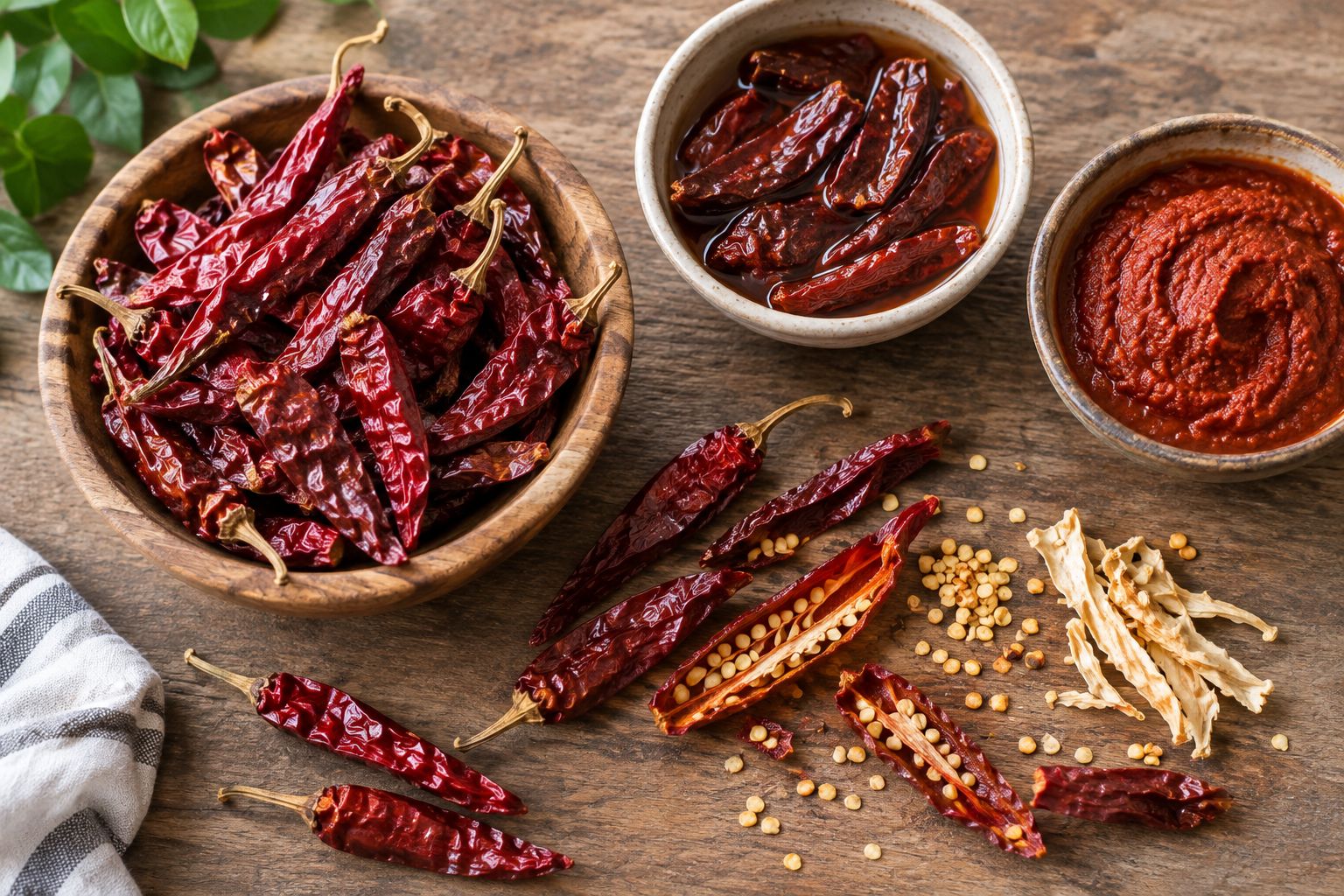
Toast and bloom without burning
Toasting is optional, not an entry requirement for using dried chili. If you toast the pods, keep the heat controlled, move them around the pan, and stop before they blacken. A pleasant toasted aroma is useful; acrid smoke is a warning to stop.
Blooming means briefly cooking the chili in fat as part of the dish. It helps distribute chili flavor and color through that fat, but it also creates a scorching risk, especially with fine powder.
Take the pan off strong heat before adding chili powder if the fat is very hot. Stir, then follow with the recipe's wet ingredients before the powder burns. A wet chili paste behaves differently because its water must cook away; follow the recipe rather than applying a dry-powder technique unchanged.
Best for: carrying chili flavor through a cooked base. The limitation is that heat management matters more than chasing a darker red. Burnt chili tastes bitter, and adding more spice does not undo it.
Build color and heat as separate decisions
For a tomato-based curry, add Kashmiri chili as part of the cooked seasoning base, then taste after it has dispersed. Do not compare the raw powder's appearance with the finished sauce and assume the missing brightness requires another generous spoonful.
For a marinade, mix the chili throughout before coating the food. An evenly mixed marinade gives you more consistent seasoning than scattered dry patches. Cook a small sample when practical before committing the full batch to a heat level.
For beans or lentils, think about the whole pot. A concentrated chili tempering tastes stronger by itself than after it is stirred through the food. Taste the combined dish before adjusting.
For roasted vegetables, distribute the chili through the coating rather than leaving clumps on exposed surfaces. Watch for scorching as the vegetables cook. The useful goal is balanced flavor, not the deepest possible red crust.
If you want more heat, make that a separate, deliberate adjustment. Use Kashmiri chili for the color-and-flavor role, then adjust pungency independently. This avoids pushing the whole dish hotter just to change its appearance.
Does removing the seeds make Kashmiri chilies mild?
Removing the seeds does not guarantee mild Kashmiri chilies. Capsaicinoids are concentrated in the pale internal tissue, and seeds can carry them through contact with that tissue.
Remove accessible inner tissue if you want to reduce heat, but still start cautiously. The remaining pod contributes chili flavor and can retain heat.
Can I substitute Kashmiri chili powder for whole chilies?
Kashmiri chili powder works when the recipe needs dispersed color and flavor rather than intact pods. Check the ingredients so you know whether you are using ground chili alone or a seasoning blend.
Do not assume a fixed pod-to-spoon conversion. Pod size, retained seeds, and grind all affect how much powder you obtain.
Will adding more Kashmiri chili make my curry redder?
Adding more Kashmiri chili adds color, but it also adds chili flavor and heat. The sauce's other ingredients and degree of browning affect the final shade.
If the dish already tastes balanced, stop. A photograph is not a seasoning target.
FAQ
Are Kashmiri dried red chilies very spicy or mostly for color?
Kashmiri dried red chilies are mainly used for red color and chili flavor, with gentler heat than chilies selected for intense pungency. They are not heat-free, and adding more increases both flavor and heat.
Can I use Kashmiri chilies for people who dislike spicy food?
Kashmiri chilies still add heat, so they are not a guaranteed choice for someone who wants no chili warmth. Use a restrained amount and taste the finished dish before serving.
Do I need to toast Kashmiri dried chilies before grinding?
You do not need to toast Kashmiri dried chilies before grinding. Toasting is optional; if you use it, avoid blackening the pods or creating acrid smoke.
Is Kashmiri chili paste milder than Kashmiri chili powder?
Kashmiri chili paste is not inherently milder than powder. The amount of chili, retained inner tissue, added water, and recipe quantity determine the resulting heat.
Does a bright red chili mean it is very hot?
Bright red color does not establish a chili's heat level. Color and pungency are different characteristics, so judge heat from the ingredient description and a cautious cooking test.
What does 5Senses Kashmir Dried Red Chili taste like?
5Senses Kashmir Dried Red Chili (Marchwagan Melody) has a stated slightly fruity, smoky aroma with subtle heat. Its named growing environment is Kashmir's high-altitude valley microclimate.
How should I store whole Kashmiri dried chilies?
Store whole Kashmiri dried chilies in a dry, tightly closed container away from heat and direct light. Keep wet utensils out of the container and grind the amount needed for cooking.
One last thing
Taste your chili in the food it will season, not as a dry pinch on your tongue. Mix a little into a small portion of the cooked base and assess both flavor and warmth before seasoning the whole pot.
That small test separates the useful question from the misleading one. You are not trying to discover whether the chili looks mild. You are deciding whether it gives your dinner the right balance.


