Can a coffee grinder double as a spice grinder?
Can a coffee grinder double as a spice grinder? Yes, if the manual allows it. Learn which type works, how to prevent odors, and when to use another tool.

Yes, a coffee grinder can double as a spice grinder if its manufacturer permits spices; a blade grinder is generally the more practical choice for small batches of dry whole spices. The catch is flavor carryover: coffee oils and spice aromas linger, so a dedicated spice grinder gives you cleaner separation.
TL;DR- Can a coffee grinder double as a spice grinder? Yes, when its manual permits dry spices.
- A dedicated blade grinder suits small batches of whole spices; keep your coffee burr grinder for coffee.
- 5Senses whole spices suit cooks who want named origins and fresh grinding.
- Grind only dry, cooled ingredients, and clean the grinder according to its instructions.
Can a coffee grinder double as a spice grinder?
Yes—but check the appliance, not just the name on the box. A blade coffee grinder chops ingredients in a chamber, making it useful for dry spice preparation when that use is approved. A burr coffee grinder feeds ingredients between grinding surfaces and often retains material inside its grinding path.
Neither design automatically makes a machine suitable for every spice. Your manual determines permitted ingredients, loading limits, cleaning methods, and operating intervals. For a broader equipment comparison, see the guide to spice grinders for whole spices.
| Tool | Best for | Practical advantage | Limitation |
|---|---|---|---|
| Blade coffee grinder approved for spices | Small batches of dry spice powder | Lets you check texture between pulses | Produces mixed particle sizes and retains aromas |
| Burr coffee grinder | Coffee beans | Controls coffee grind size | Spice residue can remain in the grinding path; use only as approved |
| Dedicated electric spice grinder | Frequent dry spice preparation | Keeps spice aromas separate from coffee | Still requires ingredient checks and cleaning |
| Mortar and pestle | Cracked spices and small quantities | Gives direct control over crushing | Fine powder takes more effort |
| Fine grater | Nutmeg finishing | Grates directly into your dish | Does not replace a grinder for seeds or blends |
Why this matters
Grinding breaks whole spices into smaller pieces and exposes more surface area. That changes how their flavor enters a dish. Cracked pepper gives distinct bites; finely ground pepper spreads through a sauce.
The right question is not simply whether a motor can break a seed. It is whether your grinder produces the texture you need without carrying yesterday's coffee into tonight's curry—or tonight's cloves into tomorrow's coffee.
A blade grinder: best for occasional dry spice powder
A blade grinder is a practical starting point when you already own a model approved for spices. Its open chamber lets you inspect the contents, and short pulses give you opportunities to stop before everything becomes powder.
Use a blade grinder for a small batch you plan to cook with, not as a promise of perfectly uniform milling. Fine particles and larger fragments often appear together. A sieve helps separate them when a smooth texture matters.
Keep the intended dish in mind. A coarse rub tolerates uneven fragments better than a delicate cookie dough. For baking, inspect the ground spice carefully and regrind the larger pieces rather than continuing to process the entire batch.
The drawback is cleanup. Even after visible particles disappear, aromatic residue can remain around the lid, blade assembly, or chamber. A separate grinder for spices removes the need to alternate between coffee and savory ingredients.
A burr grinder: best kept for coffee
Keep your coffee burr grinder for coffee unless its instructions explicitly approve spices. A machine that handles roasted coffee beans is not automatically designed for cinnamon bark, dried turmeric, or oily spice mixtures.
The grinding path matters as much as the burrs. Hoppers, chutes, and internal spaces can retain fragments that are harder to reach than the contents of a simple grinding bowl. Adjusting the grind setting does not remove that residue.
Burr grinders are useful for controlling coffee particle size, but that benefit does not establish spice compatibility. Before experimenting, check both ingredient permissions and the manufacturer's cleaning procedure. If the instructions cover coffee beans only, choose another tool.
Do not send a spice through the machine merely because it fits through the hopper. Shape, hardness, moisture, and oiliness all affect how an ingredient behaves inside a grinder.
Start with the whole spice, then choose the texture
Origin tells you where a spice was grown. Processing tells you what happened afterward. Grinding is another separate decision: it changes texture and exposure, not provenance.
For example, 5Senses Whole Coriander, Double Parrot Grade A (Hadoti Bloom), comes from Kota in Rajasthan's Hadoti region, India. Its stated preparation includes near-source partial sun-drying, and its tasting notes are citrus-floral and woody-nutty. Those details give you a specific ingredient to cook with; they do not establish a universal grinder setting.
Double Parrot Grade A is the product's stated commercial grade, not an independent certification of measured oil content. Read more about the sourcing context in the Hadoti coriander origin story.
Use whole coriander differently for different dishes. Crack it for a textured seasoning, grind it finer for a sauce, or leave it whole when a recipe calls for whole seeds. Toasting is optional, not a requirement for proving freshness.
5Senses whole spices give you the option to choose that texture at preparation time. The trade-off is straightforward: whole spices require an extra preparation step when your recipe needs powder.
How do you grind spices in a coffee grinder?
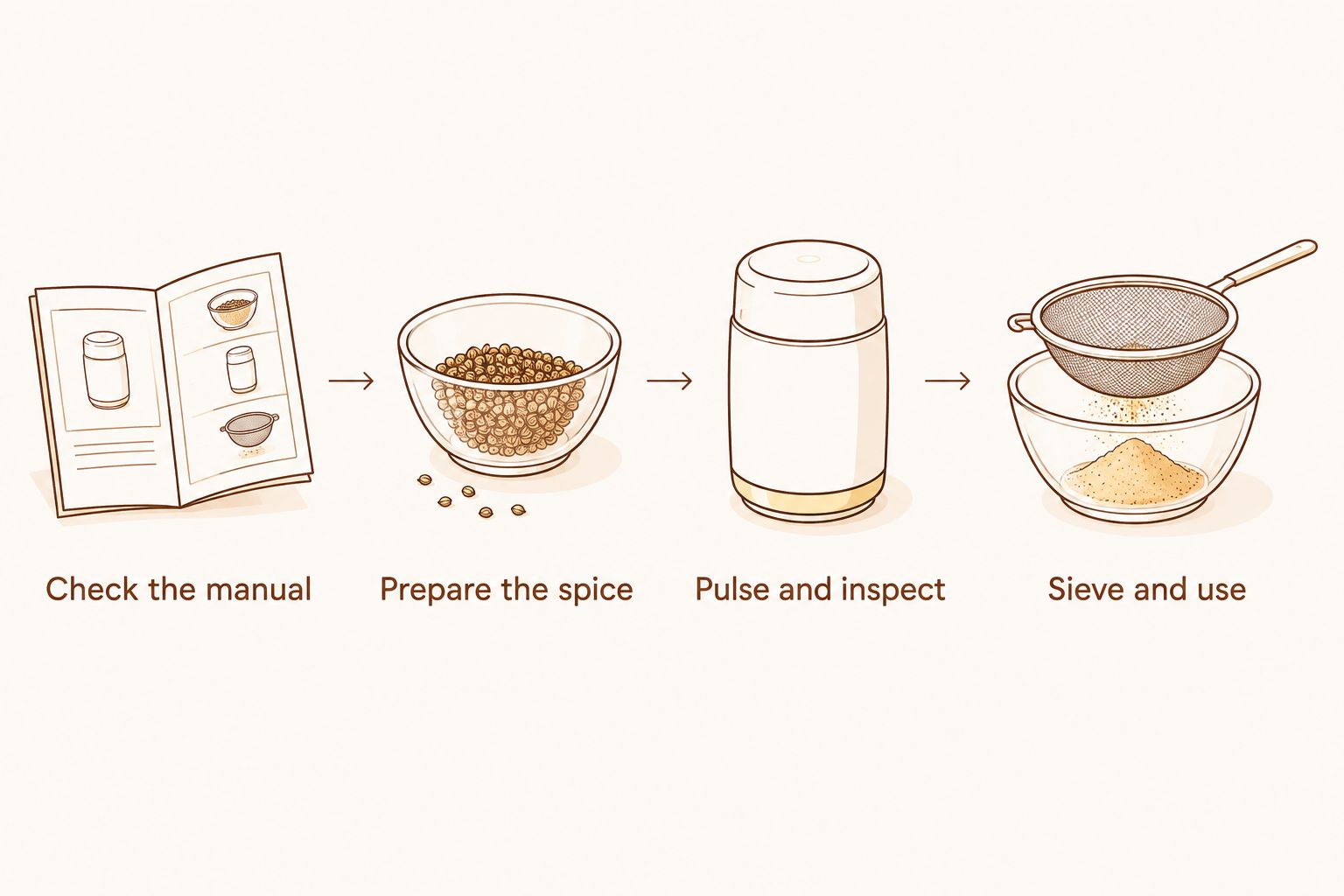
Check compatibility first, then prepare, pulse, and inspect. Do not copy a fixed grinding time from another appliance: chamber shape, ingredient quantity, and spice hardness change the result.
Check the manual
Confirm that your model accepts the ingredient you want to grind. Follow its loading limits and operating instructions. If the manual excludes spices or does not establish their suitability, use a spice-approved tool instead.
Inspect the chamber before loading. It should be clean, dry, and free of loose coffee grounds. Unplug the appliance before inspecting or cleaning around its blade.
Prepare the spice
Remove packaging debris and any parts the recipe does not use. For fine green cardamom powder, remove the husks and grind the seeds; husks add fibrous material. Keep a separate bowl nearby for discarded pieces.
If your recipe calls for toasting, toast in a dry pan and let the spices cool completely before grinding. Do not pour hot spices into the chamber. Toasting changes the flavor, so skip it when you want the spice's untoasted character.
Pulse and inspect
Load within the appliance's stated capacity and pulse as its instructions allow. Stop the motor before checking the contents. Never insert a spoon or other utensil while the grinder is connected to power.
Inspect the texture rather than judging only by sound. If powder clings to the chamber, unplug the grinder before loosening it with an approved utensil. Do not shake an operating appliance to force ingredients toward the blade.
Sieve and use
For fine powder, pass the ground spice through a suitable sieve. Regrind the coarse pieces separately when the grinder permits it. For a rub or rustic seasoning, leave the texture coarser.
Let airborne powder settle before opening the lid, especially with pepper or chilies. Transfer the spice to your recipe or a clean, dry container. Keep steam from the cooking pot away from the grinder and its contents.
Why grinding results vary
A grinder's name does not tell you how every ingredient will behave. Check these factors before changing your technique:
- Ingredient hardness: Dried turmeric and thick bark demand different handling from small seeds. Grind them only in equipment that explicitly accepts them.
- Ingredient shape: Long pieces and bulky pods do not move through a chamber like round peppercorns. Follow approved preparation instructions rather than forcing them in.
- Batch size: Too little material can escape effective contact; too much restricts movement. Stay within the manufacturer's loading guidance.
- Moisture and oils: Damp ingredients and oily mixtures can smear or cling instead of becoming a loose powder. Use wet ingredients only in equipment approved for them.
- Target texture: Cracked spice, coarse meal, and fine powder are different results. Inspect between pulses and stop when the recipe's texture is reached.
- Cleaning access: Removable parts simplify access, but only the manual establishes whether those parts can be washed or submerged.
Change one part of your process at a time. If the texture is wrong, first check the ingredient preparation and loading before running the motor longer.
How do you stop spices from flavoring your coffee?
Separate equipment is the clearest way to prevent coffee-and-spice carryover. Cleaning removes residue, but a visibly clean chamber is not proof that every aroma has disappeared.
Unplug the appliance, empty loose particles, and follow its approved cleaning method. Wash removable components only when the instructions permit it, and let them dry completely before reassembly. Never immerse an electrical base.
Do not assume uncooked rice is an approved grinder cleaner. A widely repeated kitchen trick is not a substitute for the appliance's instructions. Use a grinder-cleaning product only when it is suitable for that equipment.
Smell the clean, empty chamber before returning it to coffee use. Lingering clove or chili aroma is a practical reason to keep that machine on spice duty. For households managing food allergies, follow appropriate allergen-cleaning guidance rather than relying on smell.
Which spices need another tool?
Some whole ingredients are easier to prepare without an electric grinder. Choose the tool around the ingredient and the dish. More motor time is not always the answer.
Grate nutmeg directly into a sauce or baking mixture when you need a fine finishing spice. For nutmeg sold in its shell, remove the hard outer shell before grating the nutmeg inside. Do not put the shell into a coffee grinder.
Crush a small quantity of seeds in a mortar when you want rough texture. Bruise cardamom pods for an infusion when the recipe calls for whole pods rather than powder. Leave bay leaves whole for a stew and remove them before serving.
Treat dried chilies separately. Grinding creates irritating dust, and hot varieties make opening and cleaning the grinder more demanding. Avoid leaning over the chamber, and use appropriate ventilation and handling precautions.
Wet pastes belong in equipment designed for wet processing. Adding ginger, garlic, or liquid to a dry-only coffee grinder does not turn it into a blender.
FAQ
Can I use the same grinder for coffee and spices?
Yes, if the manufacturer permits both, but aromas can carry between batches. Separate grinders give you cleaner flavor separation.
Is a blade or burr coffee grinder better for spices?
A blade grinder approved for spices is generally the more practical option for small dry batches. Keep a coffee burr grinder for coffee unless its manufacturer explicitly permits spices.
Should I toast whole spices before grinding them?
Toast whole spices when the recipe calls for toasted flavor, not as a compulsory step. Let them cool completely before loading the grinder.
Can I grind whole green cardamom pods in a coffee grinder?
For fine cardamom powder, remove the husks and grind the seeds in a spice-approved grinder. Whole husks add fibrous material to the powder.
Can I wash my coffee grinder after grinding spices?
Wash only the components the manufacturer identifies as washable. Unplug the appliance first, never immerse its electrical base, and dry permitted washable parts completely.
Can I put cinnamon sticks or dried turmeric in a coffee grinder?
Use cinnamon sticks or dried turmeric only when the grinder's instructions explicitly permit those ingredients. Otherwise, choose equipment designed for them.
Can I make a wet spice paste in a coffee grinder?
Do not make wet paste in a dry-only coffee grinder. Use equipment approved for liquids and wet ingredients instead.
One last thing
You do not need powder for every recipe. Before reaching for a grinder, ask whether the dish needs a smooth seasoning, a cracked texture, or a whole-spice infusion.
That single decision saves unnecessary work. Grind only when grinding serves the food, and keep the rest of your spices whole until their next use.


