How long do dried ghost peppers keep their heat once opened?
Opened dried ghost peppers can stay hot after their aroma fades. Learn how to store them, check their condition, and season carefully without a raw bite.

Dried ghost peppers do not lose their heat on a fixed schedule after opening. They can remain intensely hot even after their aroma fades, so judge cooking quality by storage history and condition—not by assuming an older pepper is milder.
TL;DR- How long do dried ghost peppers keep their heat once opened? There is no universal heat-retention deadline.
- Ghost pepper aroma and capsaicin heat are different; a faded smell does not establish mildness.
- Keep dried whole chilies airtight, dry, dark, and away from cooking steam.
- Discard moldy or damp, deteriorating peppers; never taste questionable peppers to assess their heat.
Why this matters
An opened bag presents two separate questions: does the chili still taste good, and how much heat will it bring to dinner? Those questions do not have the same answer. Capsaicinoids produce chili pungency, while other compounds contribute the pepper's aroma.
Treat an older ghost pepper as hot until careful cooking proves otherwise. Increasing the amount because the bag smells less fragrant is not a reliable way to season a sauce.
The whole-spice and Spicecare range at 5Senses is relevant to cooks who prefer storing spices whole and preparing them as needed. For ghost peppers, that approach also means handling less exposed powder between cooking sessions.
How long do dried ghost peppers keep their heat once opened?
There is no defensible, universal number of months that tells you when opened dried ghost peppers stop being hot. The opening date records when you started using the package; it does not reveal the peppers' starting potency, previous storage conditions, or remaining capsaicinoid content.
A manufacturer's best-before date can guide quality expectations for that product. It is not a measurement of the heat remaining in an individual pepper, and opening the package does not start a predictable countdown to mildness.
Use this distinction when deciding what to keep:
| What you notice | What it tells you | What to do |
|---|---|---|
| A dry pepper with recognizable chili aroma | It retains some aromatic character | Use cautiously in cooking; aroma does not measure heat |
| A dry pepper with faint aroma | Its flavor quality has changed | Do not compensate with a large increase in quantity |
| A faded red or brownish color | Appearance has changed | Check the whole storage history; color alone cannot establish potency |
| Visible mold or a damp, deteriorating condition | The pepper is unsuitable to keep | Discard it rather than tasting or trying to rescue it |
| An unknown opening date | Your storage record is incomplete | Inspect its condition and follow the package guidance |
A calendar helps you rotate peppers; it cannot measure their heat. The same caution applies whether you use ghost peppers for hot sauce, beans, or a slow-cooked stew.
Does a weaker smell mean less heat?
No. A weaker smell is evidence about aroma, not a dependable reading of capsaicin strength. Do not hold a cut pepper or open powder container close to your nose to investigate.
Instead, assess aroma at a normal working distance while preparing the ingredient. If the pepper otherwise remains suitable to use, evaluate its contribution in cooked food rather than tasting it directly.
Does the best-before date mean the heat is gone?
No. A best-before date concerns expected quality under the stated storage conditions; it does not mean capsaicin disappears on that date. Follow any specific storage instructions on the package.
Keep the original label when you transfer peppers into another container. The product identity, lot information, and date remain useful even when the new jar looks tidier than the opened pouch.
Why heat retention and flavor quality vary
The condition of an opened package depends on more than the day you broke its seal. These factors explain why a single shelf-life promise is misleading:
- Starting material. Different peppers and batches do not begin with identical pungency. An opening date cannot account for that variation.
- Whole versus ground form. Grinding increases exposed surface area. Keeping peppers whole limits exposure until you need them, but it does not guarantee a particular heat-retention period.
- Storage temperature. A cupboard beside the oven exposes spices to different conditions from a cool interior pantry. Avoid repeated heating during everyday cooking.
- Light and air exposure. A transparent jar on a bright counter and a tightly closed container in a dark cupboard provide different protection from deterioration.
- Moisture exposure. Steam, wet utensils, and poorly dried containers introduce an avoidable storage problem. Dry spices need dry handling.
- Package condition. A damaged closure defeats an otherwise sensible storage routine. Check that the container actually closes rather than relying on its appearance.
Growing origin and storage answer different questions, too. A named origin describes where an ingredient was grown; it does not establish how an opened bag has been treated in your kitchen.
Keep provenance information, but do not use it as a substitute for checking the closure, cupboard location, or signs of deterioration.
Store opened ghost peppers whole, dry, and protected
Best for occasional cooking: keep the main supply whole in a tightly closed container. You can prepare a little when needed without exposing the entire supply as powder. The trade-off is extra preparation each time you cook.
A suitable container must protect the peppers from moisture and remain easy to close correctly. Decorative appeal comes second.
| Storage option | Best for | Advantage | Limitation |
|---|---|---|---|
| Original resealable pouch, if intact | Cooks who want to retain the original label | Keeps product information with the peppers | Chili fragments can interfere with the closure |
| Airtight jar in a dark cupboard | Frequent pantry access | Makes opening and closing straightforward | Clear glass does not protect against cupboard-door light exposure |
| Separate working container and reserve | Cooks opening the supply repeatedly | Reduces how often the reserve is opened | Creates another container to label and keep dry |
| Ground pepper kept separately | Recipes that need fine, even distribution | Saves preparation during cooking | Adds exposed surface area and airborne-powder handling |
The best choice is the one you will close properly every time. A modest container used carefully beats a specialized container left open beside the stove.
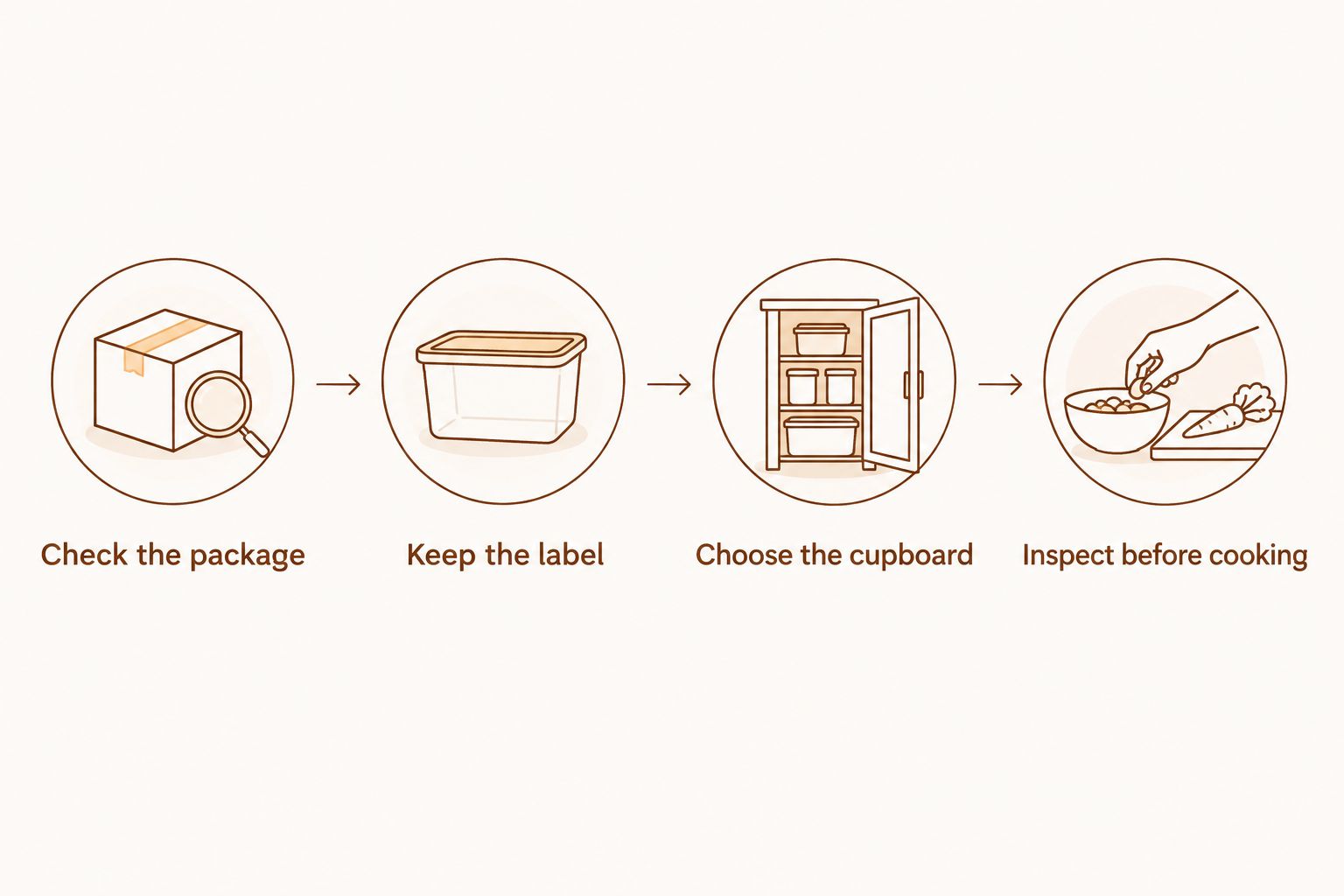
A practical storage routine
- Check the package. Read the storage guidance and inspect the closure before choosing whether to transfer the peppers.
- Use a dry container. If transferring, let the washed container and lid dry completely. Do not put dry peppers into a jar that still holds moisture.
- Keep the label. Record the product name and opening date, and retain the original best-before and lot information.
- Choose the cupboard. Store away from direct sunlight, the oven, and the steam rising from your cooking area.
- Take out what you need. Use clean, dry utensils or suitable gloves, then close the reserve before starting wet preparation.
- Inspect before cooking. Look for mold, unexpected dampness, insects, or a damaged seal. Do not taste a questionable pepper.
These steps manage avoidable exposure. They do not create a guaranteed number of months of unchanged heat.
Whole peppers, flakes, or powder: which should you keep?
Best for flexible pantry use: store the reserve whole and grind only what the dish needs. Whole peppers let you choose between a coarse flake, a fine powder, or a rehydrated paste later. They also require careful cutting or grinding before use.
Flakes work when you want visible chili pieces and a less uniform texture. Powder distributes more evenly through rubs and sauces, but it is easier to disturb into the air. Neither form makes a ghost pepper predictably mild.
If you grind dried ghost peppers, avoid creating a cloud of powder. Keep your face away from the equipment, follow the grinder's instructions, and let disturbed dust settle before opening it. Clean the equipment carefully so the next ingredient does not pick up unwanted chili residue.
For the preparation sequence, use the guide to turning dried whole chilies into flakes and powder. Keep the remaining whole peppers sealed while you work.
Do not toast an old pepper simply to prove that it still has heat. Heating superhot chilies can release irritating fumes, and toasting does not restore aroma already lost during storage.
Check cooking quality without taking a raw bite
A direct bite is the wrong test for a dried ghost pepper. It gives you an unnecessarily concentrated exposure and tells you little about how a controlled amount will behave in your recipe.
Start with the package and physical condition instead. Dried chilies vary in texture, so flexibility alone does not establish spoilage; unexpected wetness, mold, and deterioration are more useful warning signs.
If the pepper remains suitable to cook with, introduce a very small amount into food. Let it distribute through the dish before deciding whether more is needed, and use a clean tasting utensil.
For an unfamiliar batch, keep an unseasoned portion of the dish aside. You can combine it with the seasoned portion if necessary, rather than committing the entire meal to an untested amount of ghost pepper.
Wear gloves when handling cut peppers and avoid touching your eyes or face. Wash utensils, preparation surfaces, and your hands after handling, including after removing gloves.
When should you replace the bag?
Replace peppers that no longer give you the flavor you want, even if they still provide heat. A sauce built around chili character needs more than pungency.
Discard peppers with visible mold or damp deterioration. Do not try to make them suitable by toasting, grinding, or drying them again, and do not mix a questionable old supply into a new package.
For frequent cooks, separate batches make rotation clearer. Finish the older suitable batch first rather than repeatedly topping up the same jar and losing track of its history.
Buy for your cooking rhythm, not a heat-expiry promise
Choose an amount you can use through your regular recipes. If ghost pepper appears only occasionally in your cooking, a large reserve creates more storage responsibility without making dinner easier.
Look for clear ingredient identification, usable storage directions, and available packing or best-before information. Distinguish those details from a promise that every pepper will deliver identical heat.
5Senses offers whole spices and Spicecare tools for cooks who prepare spices as needed. The relevant buying principle is simple: match the ingredient and preparation method to your actual kitchen routine, rather than choosing on an unsupported freshness superlative.
For chefs and food businesses, keep batch identity attached to the working container. A consistent recipe still needs cautious adjustment when the chili batch changes; storage records support that decision but do not replace tasting the finished food.
FAQ
How long do dried ghost peppers keep their heat once opened?
There is no universal heat-retention deadline for opened dried ghost peppers. They can remain intensely hot after their aroma fades, so use the package guidance, storage history, and condition rather than assuming age makes them mild.
Do dried ghost peppers lose heat when they stop smelling strong?
A weaker smell does not reliably indicate weaker heat. Aromatic compounds and the capsaicinoids responsible for pungency are different, so do not increase the quantity sharply to compensate for faded aroma.
Is it better to store ghost peppers whole or ground?
Whole ghost peppers are the better reserve format when you want to limit exposed surface area and choose the preparation later. Powder is convenient for even distribution, but it needs careful handling to avoid airborne chili dust.
Can I keep opened dried ghost peppers beside the stove?
A cupboard away from the stove is a better storage location. Cooking heat and steam create avoidable exposure; keep the container tightly closed and handle the peppers with dry utensils.
How do I know whether dried ghost peppers should be discarded?
Discard dried ghost peppers with visible mold or damp deterioration. Do not taste questionable peppers or try to rescue them by toasting or grinding.
Does grinding an old ghost pepper restore its heat?
Grinding does not restore capsaicin or aroma that has been lost. It changes particle size and distribution in food, so a ground pepper can behave differently in a recipe without becoming newly potent.
Can I use 5Senses Spicecare tools for my whole-spice routine?
5Senses includes Spicecare tools alongside its whole-spice range. Check the individual tool's intended use and care instructions before choosing it for dried chilies, especially where fine chili dust is involved.
One last thing
Do not confuse a less fragrant ghost pepper with a gentler ghost pepper. That distinction matters more than finding a single expiry number for heat.
Write the opening date on the container, keep the original label, and store the peppers away from steam. When you cook, season cautiously from the batch in front of you—not from a memory of how hot the previous bag tasted.


