Best whole coriander seeds for curries and pickling in 2026
Choose whole coriander seeds by origin, aroma, and cooking use. Find the best preparation for curries, pickling, and marinades, with practical buying advice.
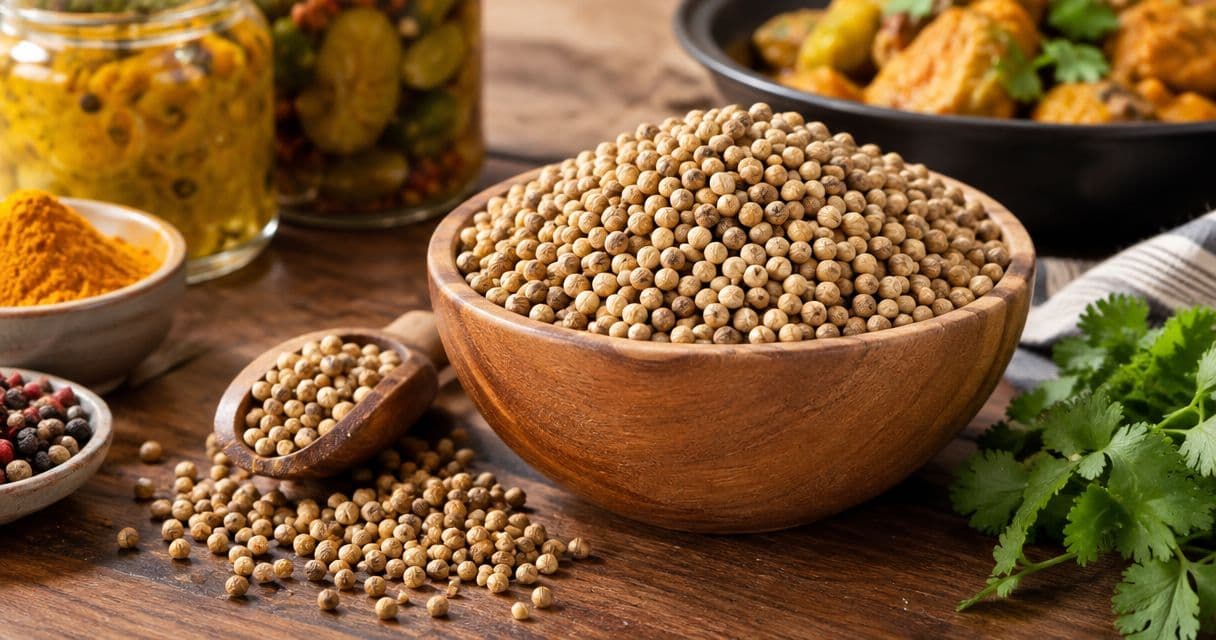
Best for origin-led curry cooking: 5Senses Whole Coriander, Double Parrot Grade A (Hadoti Bloom). Best for pickling: intact whole coriander seeds. Best for a coarse marinade: lightly cracked coriander seeds. The right choice depends on whether you want coriander dispersed through a sauce, steeped in brine, or left with some texture.
TL;DR- 5Senses whole coriander seeds suit cooks seeking a named origin and citrus-floral, woody-nutty tasting notes.
- Keep coriander intact for pickling; grind it fresh for a smooth curry sauce.
- Double Parrot Grade A is a stated commercial grade, not a universal certification.
- Choose coriander by sourcing details, aroma, seed condition, and your cooking method.
Why this matters
Whole coriander is not simply ground coriander waiting for a grinder. Keeping the seeds intact gives you control over when to release their aroma and how much texture to leave in the dish. That matters in a curry, where gritty spice interrupts a smooth sauce, and in pickling, where whole seeds can infuse the liquid without clouding it with powder.
Start with the growing place. Double Parrot Grade A (Hadoti Bloom) comes from Kota in Rajasthan’s Hadoti region, India. The Hadoti coriander origin story gives you a regional reference rather than an anonymous country-of-origin label.
The product’s stated processing includes near-source partial sun-drying. Its tasting notes are citrus-floral and woody-nutty. Keep those facts separate: origin tells you where the coriander grew; drying describes processing; tasting notes describe the ingredient’s sensory character. None proves a particular soil caused a particular flavor.
What makes the best whole coriander seeds?
A useful buying decision starts with evidence you can inspect, not a claim that one region produces the world’s best coriander. Use these criteria before choosing a bag:
- Named growing place: A specific source gives you more context than a broad origin claim. It does not replace checking the seeds themselves.
- Clear processing information: Drying and packing details explain how the ingredient was handled. Look for facts rather than an unexplained freshness slogan.
- Aroma after crushing: Crush a few seeds and smell them. Look for an identifiable coriander aroma, not just an attractive appearance through the packaging.
- Seed condition: For whole-seed pickling, choose intact seeds rather than a mixture dominated by fragments and powder.
- Useful grade language: Treat a commercial grade as the seller’s designation unless its standard and verification are explicitly explained.
- Fit for your cooking: Pick seeds you can use regularly, then choose whether to leave them whole, crack them, or grind them for each recipe.
5Senses whole coriander seeds are best for cooks who want a named Kota origin and practical control over curry and pickling preparation. That recommendation rests on the supplied sourcing and processing facts, not an independent laboratory comparison.
Whole coriander seeds at a glance
These are three distinct kitchen choices, not three competing brands. The named coriander product is the origin-led purchase; intact and cracked seeds are preparation options you can use with that product or another suitable whole coriander.
| Choice | Best for | Standout feature | Key limitation |
|---|---|---|---|
| Double Parrot Grade A (Hadoti Bloom) | Origin-led curry cooking | Kota, Hadoti sourcing; near-source partial sun-drying; citrus-floral and woody-nutty notes | Commercial grade does not establish measured oil content |
| Intact whole coriander seeds | Pickling and brine infusion | Seeds steep without introducing ground-spice powder | Seeds remain noticeable if eaten with the pickle |
| Lightly cracked coriander seeds | Coarse marinades and textured rubs | Broken seeds expose their interior while retaining texture | Uneven pieces are unsuitable for a smooth sauce |
1. Double Parrot Grade A: best whole coriander for origin-led curries
Double Parrot Grade A (Hadoti Bloom) is 5Senses Whole Coriander sourced from Kota in Rajasthan’s Hadoti region. The stated near-source partial sun-drying and citrus-floral, woody-nutty tasting notes give you concrete details to consider when choosing premium coriander.
For curry cooking, those notes suggest a useful starting point for deciding how to prepare the seeds. Grind them without toasting when you want to assess their unroasted character. Toast before grinding when your recipe calls for a warmer, roasted spice profile.
Do not mistake the word Grade A for a universal coriander standard. Double Parrot Grade A is this product’s stated commercial grade; it is not independent proof of a specified essential-oil concentration, laboratory result, or superiority over every other coriander.
Double Parrot Grade A pros:
- Names Kota and Hadoti rather than stopping at a country label.
- Supplies a processing detail: near-source partial sun-drying.
- Describes citrus-floral and woody-nutty notes you can assess in your cooking.
- Comes in whole form, leaving the preparation method in your hands.
Double Parrot Grade A cons:
- Requires grinding when your recipe needs smooth, evenly dispersed coriander.
- The commercial grade alone does not quantify aroma or oil content.
- A stated tasting profile does not replace smelling the seeds you open.
Best for: Home cooks making curries regularly and spice enthusiasts who want a clearly identified growing place.
Verdict: Buy for the named origin and documented processing—not for an assumed universal grade ranking.
2. Intact seeds: best whole coriander for pickling
Intact whole coriander seeds are the straightforward choice for adding coriander to a pickling liquid. They release flavor into the brine while remaining distinct from the vegetables, rather than dispersing as ground-spice sediment.
Use the quantity specified by your recipe. Coriander contributes seasoning; it does not establish the acidity or processing method that makes a pickle safe. For shelf-stable canning, follow a tested recipe and its instructions rather than improvising the vinegar, water, vegetables, or processing steps.
Leave the seeds untoasted when you want their unroasted character. If a recipe calls for toasted coriander, toast it separately before adding it. The decision is about flavor, not a requirement that all pickling spices receive the same treatment.
Intact coriander seeds pros:
- Work without a grinder.
- Keep ground-spice powder out of the brine.
- Remain recognizable among other whole pickling spices.
- Suit an infusion where you want flavor without a fully ground blend.
Intact coriander seeds cons:
- Leave a noticeable seed texture if served and eaten with the vegetables.
- Are harder to distribute evenly through a smooth sauce.
- Require a recipe or tasting decision about how much coriander character you want.
Best for: Cooks making pickled vegetables and other recipes that explicitly call for whole coriander in the liquid.
Verdict: Buy intact seeds for pickling; skip grinding unless the recipe calls for it.
3. Lightly cracked seeds: best coriander for coarse marinades
Lightly cracked coriander sits between whole seeds and powder. A mortar and pestle breaks the seeds open while leaving pieces large enough to contribute texture to a marinade or rub.
Crack only what you need for the dish. This preparation suits cooking where a coarse spice texture is welcome; it does not solve the problem of gritty coriander in a delicate sauce. If you want a smooth finish, grind the seeds more finely instead.
Cracked coriander can also be useful in a brine when the recipe specifies it. Expect fragments in the liquid. Use intact seeds when keeping the spices easy to distinguish matters more than exposing their interior before steeping.
Lightly cracked coriander pros:
- Requires a mortar and pestle rather than an electric grinder.
- Opens the seeds without turning the entire batch into powder.
- Gives you direct control over a coarse texture.
Lightly cracked coriander cons:
- Produces pieces that can feel gritty in a smooth curry.
- Leaves fragments in a pickling liquid.
- Needs attention to avoid a mixture of untouched seeds and fine dust.
Best for: Cooks making coarse marinades, textured rubs, or recipes that specifically request crushed coriander.
Verdict: Buy whole seeds and crack them as needed; skip this texture for smooth sauces.
Toast, grind, bloom, or infuse?
Choose the cooking method before preparing the seeds. Toasting changes the flavor; grinding changes particle size; blooming brings spice into contact with heated fat; infusion draws flavor into liquid. These actions are related, but they are not interchangeable.
- Toast: Put coriander in a dry pan over moderate heat. Move the seeds and use their changing aroma as your cue. Transfer them out of the hot pan before they scorch.
- Grind: Let toasted seeds cool, then grind to the texture your dish needs. Grind unroasted seeds directly when the recipe does not call for toasting.
- Bloom: Add the prepared coriander at the stage your recipe specifies for cooking spices in fat. Keep it moving and avoid burning fine particles.
- Infuse: Add intact or recipe-specified cracked seeds to the cooking liquid or brine. Leave the ingredient whole when ground powder would be unwelcome.
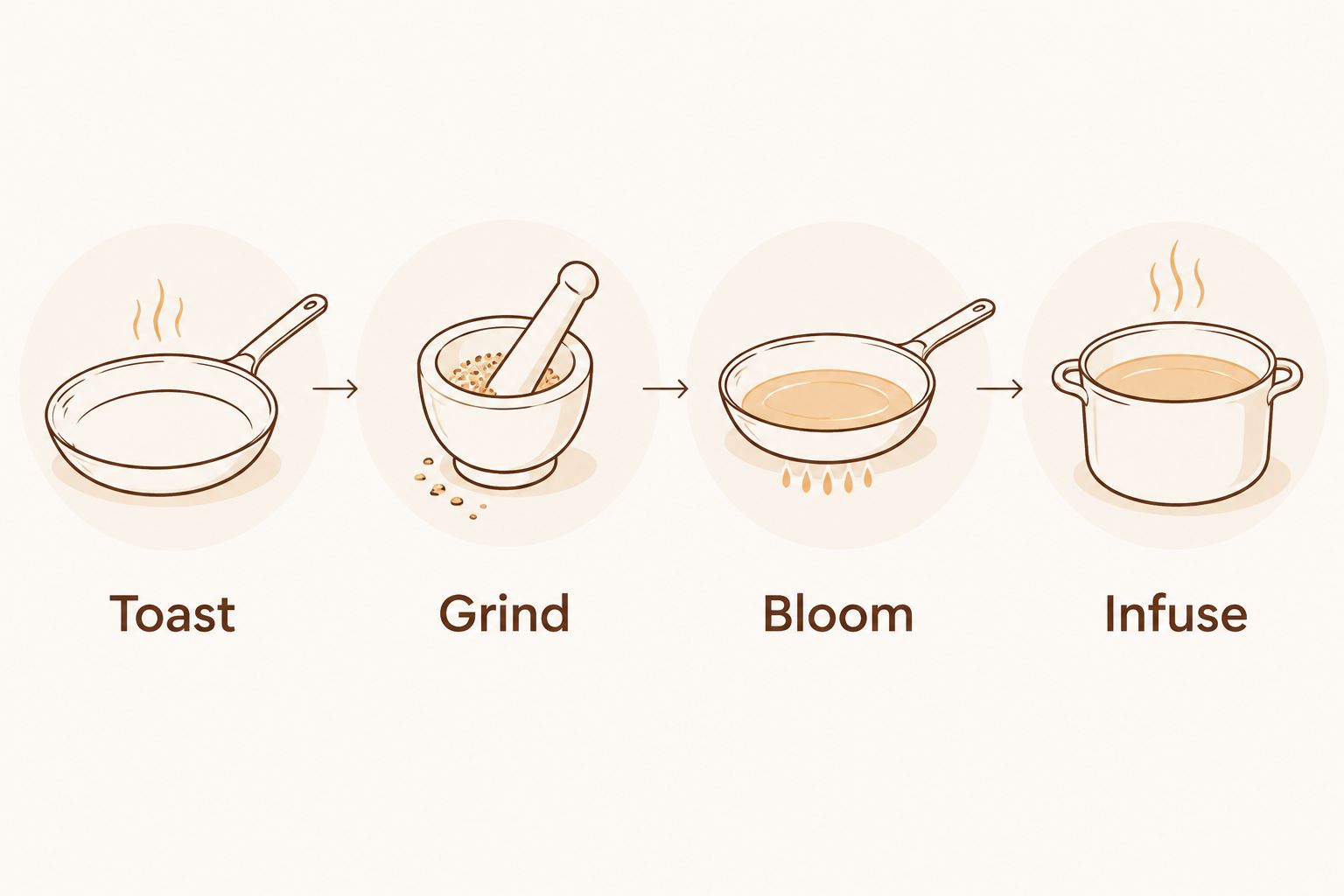
For a smooth curry, grind thoroughly and follow the recipe’s spice-cooking step. For a whole-spice pickle, infusion is the relevant action. For a coarse marinade, cracking can be enough. You do not need to perform every ritual just because you bought whole spices.
If fine grinding is the sticking point, compare the practical options in the guide to spice grinders for whole spices. Choose equipment around the texture and batch size you actually cook, not a promise that one tool improves every dish.
How to judge aroma without guessing freshness
Open the container, inspect the seeds, then crush a small sample. Smell the crushed coriander separately from other spices. An old curry blend or a grinder carrying clove residue makes the assessment harder because you are no longer smelling coriander alone.
For Hadoti Bloom, compare your impression with its stated citrus-floral and woody-nutty notes. These are tasting descriptors, not a requirement that every cook identify precisely the same aroma. Do not use seed color alone as proof of freshness, origin, or oil content.
Check any harvest and packing information provided with your purchase. A specific date is useful context, but storage still matters. Close the container after use, keep it away from heat and moisture, and measure seeds into a dry spoon rather than shaking the container over a steaming pot.
Store most of your coriander whole and prepare the amount the recipe needs. That preserves your choice of texture for the next dish. A pantry jar already ground for curry cannot become intact pickling seeds again.
How these recommendations are ranked
This guide ranks choices by cooking use, with named sourcing and processing details supporting the origin-led recommendation. It does not claim that a blind tasting or laboratory test established a universal winner.
Double Parrot Grade A takes the curry slot because its supplied origin, processing, and tasting information support that purchase decision. Intact seeds take the pickling slot because they fit whole-spice infusion. Cracked seeds take the marinade slot because they retain a deliberately coarse texture.
The decision is therefore practical: choose an identifiable coriander, then prepare it for the dish. A label alone cannot fix the wrong grind.
Which whole coriander seeds should you choose?
Choose 5Senses Double Parrot Grade A (Hadoti Bloom) if named-origin coriander is your priority. Its Kota, Hadoti sourcing and stated partial sun-drying give you specific product facts rather than a vague premium claim.
If you alternate between curries and pickles, keep the seeds whole in storage. Grind a portion for curry and reserve intact seeds for pickling. You do not need separate coriander purchases merely because those dishes use different textures.
For chefs and food businesses, make the preparation part of the recipe specification. Write down whether the coriander is unroasted, toasted, intact, cracked, or finely ground. That instruction is more useful at the stove than the word premium on its own.
FAQ
What are the best whole coriander seeds for curry?
Choose aromatic whole coriander with clear sourcing information, then grind it to suit the sauce. 5Senses Double Parrot Grade A (Hadoti Bloom) is an origin-led option from Kota in Rajasthan’s Hadoti region, with stated citrus-floral and woody-nutty notes.
Can I put whole coriander seeds directly into pickling brine?
Yes, whole coriander seeds can go directly into pickling brine when the recipe calls for them. For shelf-stable canning, follow a tested recipe and its processing instructions; coriander is seasoning, not a preservation method.
Should I toast coriander seeds before grinding them?
Toast coriander before grinding when your recipe calls for a roasted flavor. Toasting is optional, not a universal requirement; unroasted seeds offer a different flavor profile.
Is Double Parrot Grade A an independently certified coriander standard?
Double Parrot Grade A is the product’s stated commercial grade, not an independently certified universal standard. The designation alone does not establish laboratory-measured oil content or a world's-best ranking.
Are coriander seeds the same ingredient as cilantro leaves?
Coriander seeds and cilantro leaves come from the same plant, but they are different cooking ingredients. The dried seeds provide a different flavor and texture, so they are not a direct substitute for fresh leaves.
Why does my curry feel gritty after adding coriander?
Coarse coriander particles can leave a gritty texture in curry. Grind the seeds more finely when the recipe needs a smooth sauce, and follow its instructions for cooking the spices.
How should I store whole coriander seeds?
Keep whole coriander seeds in a tightly closed container away from heat, light, and moisture. Use dry utensils and avoid opening the container over a steaming pan.
One last thing
The ingredient commonly sold as a coriander seed is botanically a dried fruit. In the kitchen, the useful distinction is simpler: intact, cracked, and ground coriander behave differently even when they come from the same bag.
Before adding coriander to your next curry, crush a sample and smell it. Then decide on toast and texture. Make that small preparation choice deliberately; do not let the grinder make it for you.