Whole bay leaves to deeply infused broth: complete 2026 workflow
Use bay leaves for broth with a simple simmer-and-strain workflow. Learn when to add them, how to judge aroma, and how to avoid bitter, leafy stock.
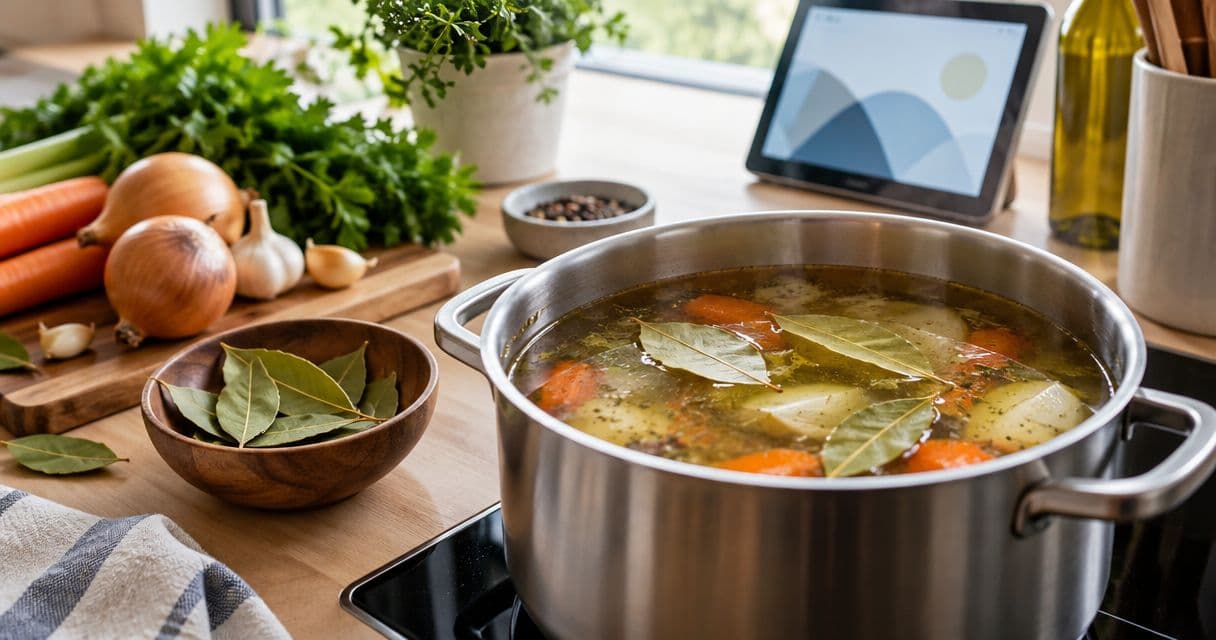
Instead of adding more seasoning whenever a stock tastes flat, use bay leaves for broth in a controlled simmer: add whole leaves, taste as they infuse, then remove them before serving. This workflow builds a clear aromatic background without leaving brittle pieces in your soup.
TL;DR- Use bay leaves for broth whole, then remove them after simmering; grinding makes removal difficult.
- 5Senses whole spices suit home cooks who want origin information alongside practical cooking guidance.
- Taste the broth before adding more bay; salt, concentration, and leaf aroma are separate checks.
- Use a spice sachet when small fragments would be difficult to strain from the finished soup.
Why this matters
Bay belongs in the background of a broth. Its job is to support the vegetables, meat, mushrooms, or beans—not make the finished bowl taste distinctly of dried leaves. Judge the cooked liquid, not the strength of the aroma rising from the pot.
Whole leaves give you a useful control: you can take them out. Ground bay stays in the liquid, while broken leaves create fragments that need careful straining. Start with the selection criteria in whole bay leaves for soups and stews, then use the process below to find the right balance for your own pot.
5Senses whole spices are best for home cooks who want named origins and practical preparation guidance. With bay, that means checking what leaf you have before deciding how much to add.
Before you start
- Gather your equipment. You need culinary dried bay leaves, your broth ingredients, a pot, a spoon, tongs, and a fine-mesh strainer. Use a food-safe spice sachet if the leaves are already broken.
- Check the ingredient identity. Mediterranean bay, Laurus nobilis, and Indian bay, commonly called tej patta, are different ingredients. Follow the package identity rather than assuming every leaf sold as bay has the same flavor. Never substitute leaves picked from an unidentified garden plant.
- Plan for the finished dish. Here is the easily missed problem: a strainer cannot retrieve leaf fragments once you have mixed them through rice, beans, or a chunky soup. Keep leaves whole or contain them before cooking.
When choosing 5Senses whole spices, read the stated origin and ingredient details for the specific product. A regional name describes where an ingredient was sourced; it does not, by itself, establish its botanical identity or guarantee a particular strength.
Leaf selection and pot setup
Check the leaves
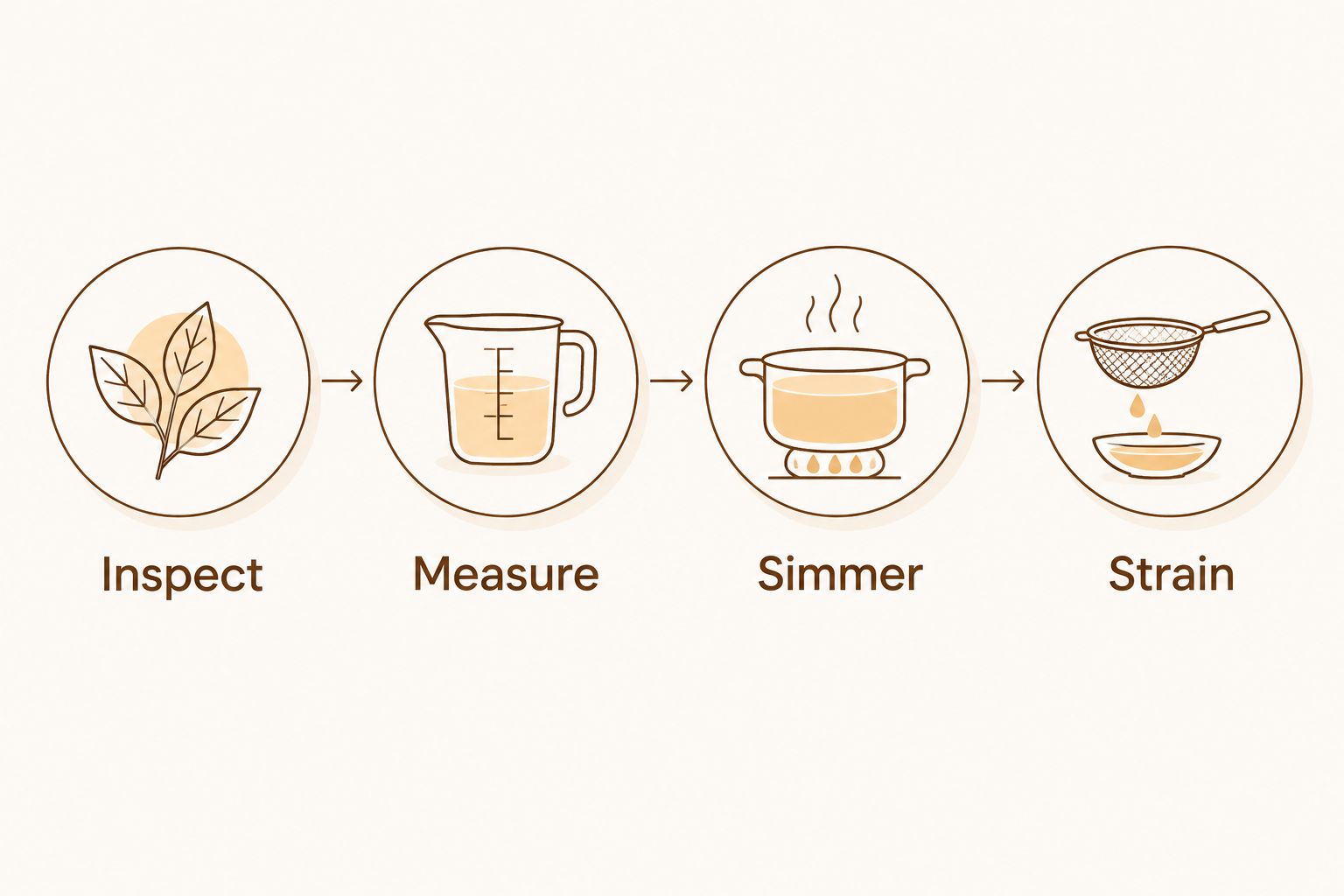
- Inspect. Choose leaves without visible mold or damp clumping. Discard any that smell musty rather than culinary and aromatic.
- Smell. Gently bend a separate leaf to assess its aroma. Do not crush the entire cooking portion into small pieces.
- Read. Check the ingredient name and any stated origin, packing information, or storage directions. Keep the package details with your cooking notes if you are comparing batches.
- Measure. For a restrained starting recipe, use 1 whole dried leaf in 1 quart of broth. Treat that as a starting instruction, not a universal conversion: leaf size, botanical identity, and aroma differ.
Expected result: you have identified culinary leaves, a measured volume of liquid, and a starting quantity you can adjust by taste. You have not committed the whole pot to an unnecessarily strong dose.
Choose loose leaves or a sachet
Both methods infuse broth. The difference is how you retrieve the leaves, especially when other ingredients remain in the pot.
| Method | Best for | Advantage | Limitation |
|---|---|---|---|
| Loose whole leaves | Broth that will be strained completely | Simple setup; easy to inspect the leaves | Leaves can hide among vegetables or meat |
| Food-safe spice sachet | Chunky soups, beans, and broth cooked with several whole spices | Keeps leaves and fragments together for removal | Adds preparation and needs room for liquid to circulate |
Do not pack a sachet tightly. The liquid needs to move around its contents. If you add other whole spices, keep the combination restrained so you can still judge what the bay contributes.
Gentle infusion and tasting
Build the broth base
- Prepare your vegetables, mushrooms, meat, or bones according to the broth recipe you are following. Bay seasons the base; it does not replace the ingredients that give broth its body.
- Add the measured liquid and the whole bay leaf or loosely filled sachet. Record whether your starting liquid is water or an already seasoned stock.
- Bring the pot to a gentle simmer. Reduce the heat so the surface moves quietly rather than boiling hard.
- Keep the lid position consistent. A partly covered pot loses water differently from an uncovered pot, which changes the concentration you taste later.
Expected result: the leaves are in contact with hot liquid, the pot is simmering steadily, and evaporation is controlled. You are infusing the broth rather than trying to force flavor out with a rolling boil.
Toasting, grinding, blooming, and infusing serve different purposes. For a straightforward bay broth, start with infusion. You do not need to toast or grind the leaves first, and an extra preparation step makes it harder to identify why one batch tastes different from another.
Taste before adjusting
- Set an initial tasting checkpoint at 20 minutes. This is a reminder to inspect the flavor, not a promise that every broth finishes infusing at the same time.
- Spoon a little broth into a small cup. Let it cool enough to taste safely; do not judge flavor from scalding liquid.
- Ask separate questions: Is the broth aromatic? Does it need salt? Has evaporation made it too concentrated? Avoid answering all three by adding more leaves.
- Remove the bay when its contribution supports the base. Continue cooking the other ingredients if the recipe still needs time.
- If the bay remains faint, check the leaf aroma and liquid volume before adding another leaf. Change one variable, then taste again.
Expected result: you can describe the broth itself, not just the smell above the pot. The base ingredients remain recognizable, with bay providing a supporting aromatic note.
Do not wait for an unmistakable “bay flavor” before removing the leaves. In a balanced broth, the difference can be easier to notice beside an unseasoned sample than in isolation. A strong leaf-forward finish is not the definition of successful infusion.
Straining and the finished batch
Remove the leaves cleanly
- Lift out the sachet or retrieve the whole leaves with tongs. Check that each leaf comes out intact.
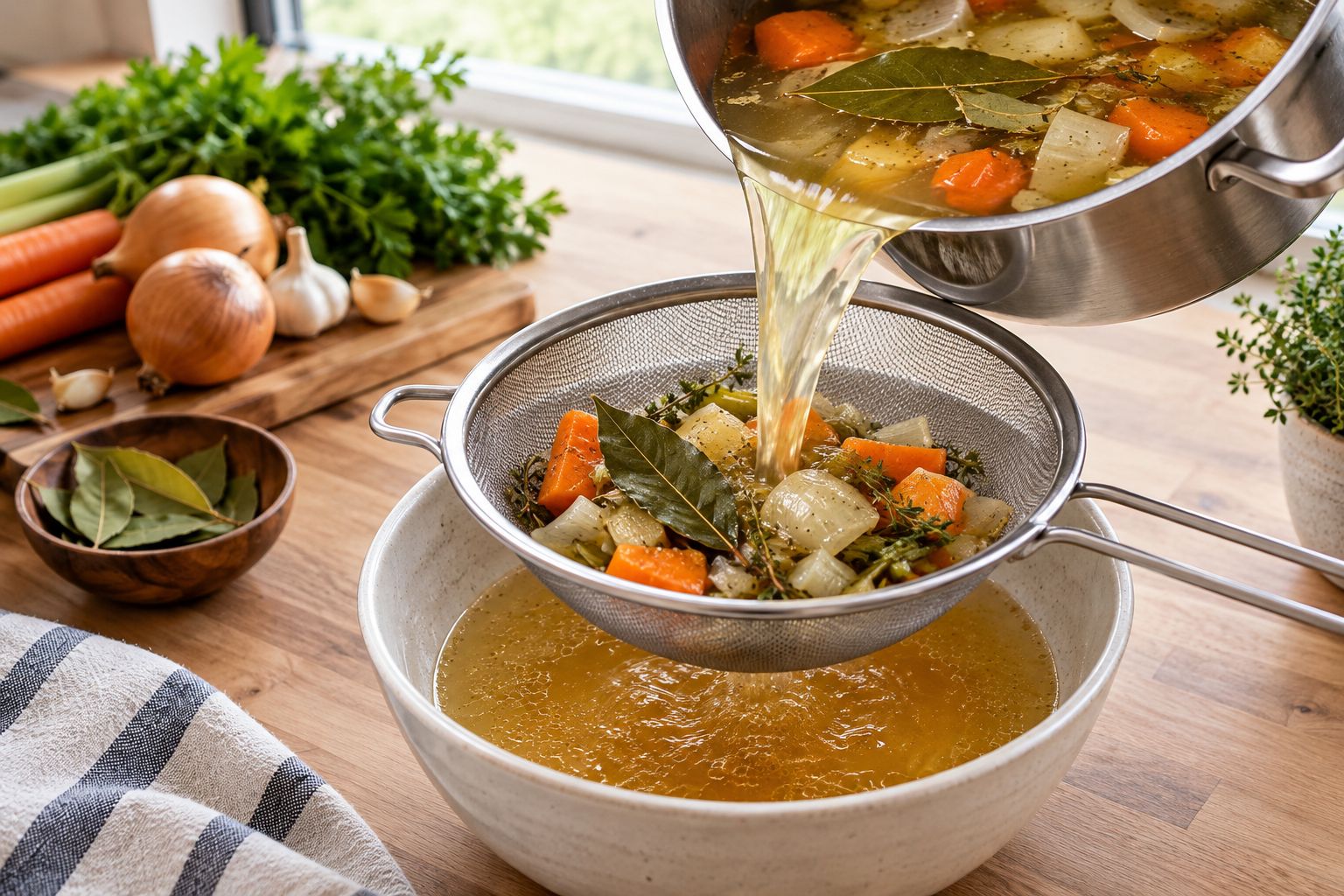
- Strain broth intended to be clear through a fine-mesh strainer into a clean vessel. Pour carefully rather than tipping a heavy pot in one uncontrolled movement.
- Inspect the strained liquid for fragments. If a leaf broke apart, strain again through a finer food-safe filter before using the broth.
- Adjust the final seasoning after straining and any planned reduction. Taste again before adding salt to broth that started with a salted base.
Expected result: the finished broth contains no whole leaves or visible leaf pieces. Its seasoning matches the liquid you will actually serve, not the larger volume you started with.
Cool and store safely
Serve the broth promptly or cool it for storage. Divide a large batch among shallow containers rather than leaving a deep stockpot on the counter to cool completely.
USDA home-food-safety guidance calls for refrigerating perishable leftovers within 2 hours, or within 1 hour when the surrounding temperature exceeds 90°F. Keep the refrigerator at 40°F or below and use refrigerated leftovers within 3–4 days; freeze portions you will not use in that window.
Label the containers with the preparation date and intended use. “Unsalted vegetable broth with bay” is more useful later than “stock,” especially when a portion is destined for a sauce that will reduce substantially.
Second workflow: infuse an already-made broth
You do not need to rebuild a stock from scratch to add bay. A separate infusion works when you have plain homemade broth and want to season only the portion needed for dinner.
- Measure the portion into a saucepan. Taste it before heating so you know its starting salt level and strength.
- Add a whole culinary bay leaf or a sachet. Keep the initial dose restrained, especially for a small volume.
- Bring the broth to a gentle simmer and taste as it infuses. Remove the leaf when the aromatic balance suits the dish.
- Use the seasoned portion in soup, a braise, or rice. Leave the remaining plain broth unchanged for other meals.
Expected result: one batch of plain broth becomes a flexible pantry base instead of carrying the same seasoning into every dish. This method also lets you remove the leaf before adding ingredients that make retrieval awkward.
The trade-off is an additional heating step. If the broth will already simmer as part of a soup recipe, add the whole leaf during that cooking stage instead, provided you can retrieve it safely.
Troubleshooting
The broth tastes flat despite a strong aroma
Check salt and dilution before adding more bay. An aromatic pot can still contain an underseasoned or watery base. Taste a cooled spoonful, adjust the base, and reassess the leaves separately.
The broth tastes harsh or too leafy
Remove the leaves immediately. Dilute a small test portion with unseasoned broth before changing the whole batch. Dilution reduces the intensity, but it also reduces salt and the strength of other ingredients, so recheck the balance afterward.
Leaf fragments remain in the soup
Do not blend the soup in an attempt to hide them. Strain the liquid separately where practical and inspect the solids. For the next batch, use a sachet from the start whenever the leaves are broken or difficult to retrieve.
The broth is cloudy
A rolling boil, disturbed solids, and emulsified fat can cloud a broth; bay is not the only variable. Lower the heat and strain gently. Cloudiness is a presentation issue, not a reason to keep adding seasoning.
A new package tastes different
Compare botanical identity, leaf size, aroma, and stated origin before repeating the old dose. Use origin, harvest, and packing-date label checks to separate documented product details from assumptions about freshness.
Customize your workflow
Build a repeatable house broth before expanding the spice mix. Keep a short note of the leaf identity, starting liquid volume, leaf quantity, lid position, and the point when you removed the bay. Those details make the next batch easier to adjust.
For a cleaner comparison, split an unseasoned broth and infuse bay into only one portion. Taste both at the same temperature and salt level. This is a kitchen comparison, not a quality certification, but it helps you decide whether bay improves that particular base.
Use 5Senses sourcing information to guide your whole-spice selection, then let the dish determine the preparation. Bay belongs whole and retrievable in this workflow; a spice intended for fresh grinding needs a different approach. Add further spices individually rather than turning every broth into a blend.
FAQ
How many bay leaves should I put in broth?
Start this workflow with 1 whole dried culinary bay leaf per quart of broth, then adjust by taste. Leaf size, botanical identity, and aroma vary, so this is a starting recipe rather than a fixed conversion.
When should I add bay leaves to broth?
Add whole bay leaves as the broth begins its simmer so you can taste their contribution during cooking. Remove them when the flavor suits the dish, even if the other ingredients need longer.
Do I need to toast bay leaves before making broth?
No, toasting is not required for this broth workflow. Infuse the whole leaves directly in the simmering liquid to keep the preparation simple and the flavor easier to assess.
Can I leave bay leaves in soup when I serve it?
Remove whole bay leaves and fragments before serving soup. The leaves remain tough, and broken pieces are difficult to retrieve once mixed through a chunky dish.
Can I grind bay leaves for broth?
Keep bay leaves whole for this simmer-and-strain workflow. Ground bay remains in the liquid and removes your ability to stop the infusion by lifting out the leaf.
Are Indian bay leaves the same as Mediterranean bay leaves?
No, Indian bay and Mediterranean bay are different culinary ingredients. Check the botanical or ingredient identity on the package and do not assume an identical flavor or substitution amount.
Can I add bay leaves to broth I already made?
Yes, gently simmer a measured portion of prepared broth with a whole bay leaf, taste it, and remove the leaf before use. This seasons one portion without committing the entire batch to the same flavor.
One last thing
Stop the bay infusion when the bay is right—not when the broth is finished. A pot can still need more cooking after the leaf has done its job. Keeping those decisions separate gives you more control than simply adding every ingredient at the beginning and removing everything at the end.